Car Battery Charger Cost: What to Pay for Each Type
For most drivers comparing Car Battery Charger Cost, the safest first buy is the NOCO Genius5 if you need one charger that can handle storage, low-voltage recovery, and multiple battery chemistries. If your car only sits for long stretches, a trickle charger or maintainer in the $20-$60 range is usually enough; if you need charging plus recovery, a standard charger in the $30-$100 range is the better spend. Buy for the job you actually have, because the wrong fit can leave a sitting car undercharged or shorten battery life.
Typical cost range
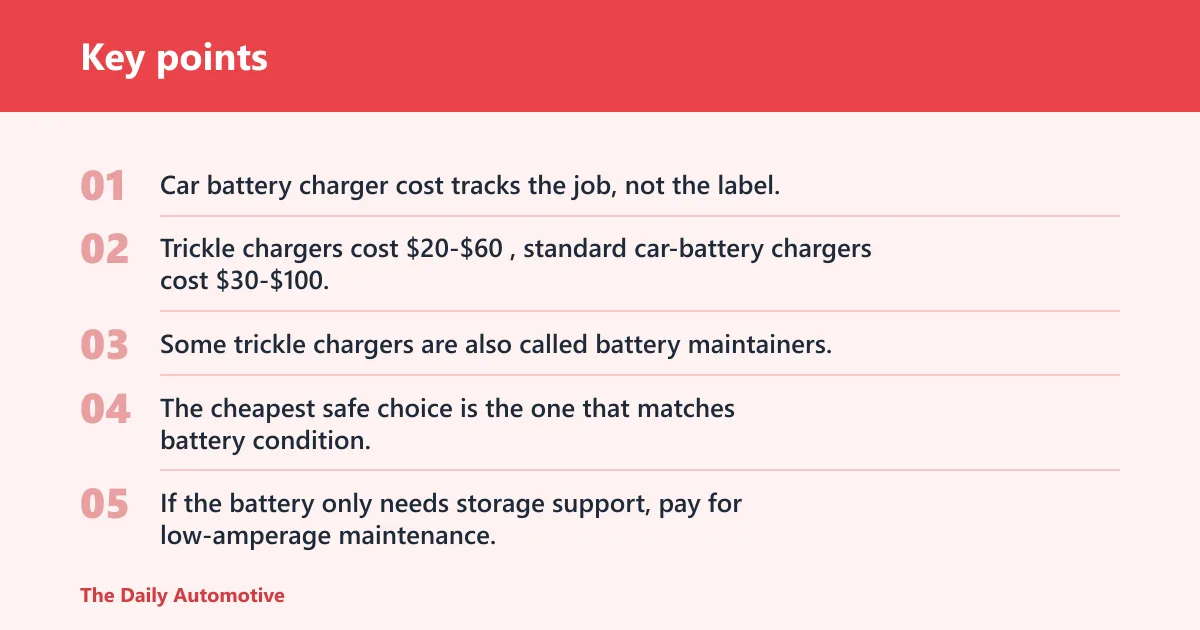


Car battery charger cost tracks the job, not the label. Trickle chargers cost $20-$60, standard car-battery chargers cost $30-$100, and wheeled battery chargers cost $80-$350+. Some trickle chargers are also called battery maintainers, which matters because maintenance and dead-battery recovery are not the same purchase.
The cheapest safe choice is the one that matches battery condition. If the battery only needs storage support, pay for low-amperage maintenance. If it is weak but still recoverable, pay for a smart charger with low-voltage support. If you need emergency starting, pay for the bigger wheeled unit only when you will actually use that function.
What each price tier usually buys
At the low end, you are usually paying for low-amperage output and simple maintenance. At the middle tier, you are paying for more charging modes, broader 6V/12V support, and better shutoff logic. At the high end, you are paying for shop-style hardware, higher output, and jump-start capability.
Example pricing makes the split clearer. A DieHard charger and tester costs $60-$70 and includes 30-amp rapid, 12-amp fast, and 2-amp maintenance modes. A Schumacher wheeled example costs $120-$200 and offers 2-amp trickle, 10-amp medium charge, 40-amp fast charge, and 200-amp emergency jump starting.
Which charger type fits your battery?
The right charger depends on whether the battery is being stored, slowly recovered, or asked to start a dead vehicle. A maintainer is for long-term connection. A charger is for recovery or routine charging. A jump-start unit is for emergency starting, which is a different job and a different price class.
Storage and maintenance use
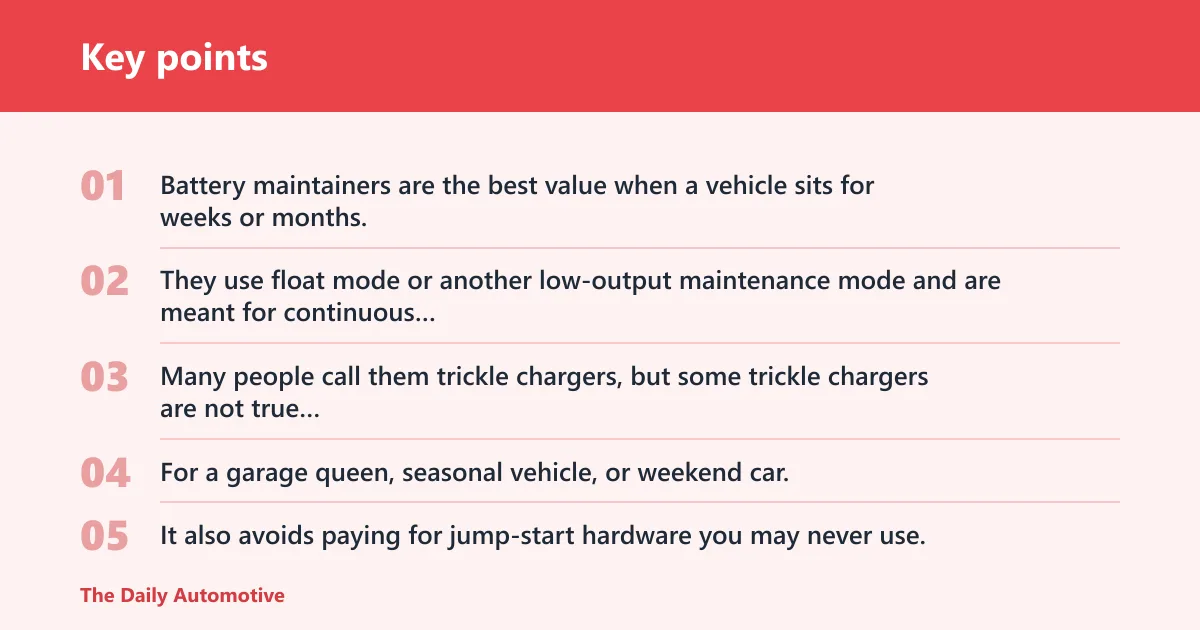
Battery maintainers are the best value when a vehicle sits for weeks or months. They use float mode or another low-output maintenance mode and are meant for continuous safe connection. Many people call them trickle chargers, but some trickle chargers are not true maintainers, so check whether the unit automatically shuts off or holds a maintenance voltage on its own.
For a garage queen, seasonal vehicle, or weekend car, a maintainer usually costs less than replacing batteries that die from neglect. It also avoids paying for jump-start hardware you may never use.
Dead-battery recovery
If the battery is already weak, choose a standard or smart charger with recovery logic. That is where charging modes matter. Standard chargers may have rapid, fast, and trickle modes, and fast charge is listed as 10-25 amps. Trickle or maintenance charge is listed as 1-2 amps, which is better for storage than for reviving a deeply discharged battery.
Smart chargers can add automatic charging logic, battery chemistry compatibility, repair or desulfation mode, and temperature sensing. The NOCO Genius5 works with 6- or 12-volt batteries, can safely charge gel, flooded, AGM, and lithium-ion batteries, and can charge batteries as low as one volt. (Thedrive)
Emergency start versus charging
A wheeled charger/starter is the right buy only when you want charging plus emergency starting in one shop-style unit. It costs more because it combines multiple charge modes with jump-start capability, reverse-polarity protection, and overheating protection. That price premium is wasted if you only need to maintain one commuter car.
Picture a truck that sits outside all winter. If the battery is simply low from storage, a maintainer is enough. If the vehicle needs to be started on site after a long neglect period, a wheeled unit may be the better one-time buy because it can cover both charging and emergency start duties.
Charging modes and features that change price
Modes matter more than marketing. Maintenance or float charging keeps a healthy battery topped off. Fast charging moves more current and costs more. Rapid charging and jump-start functions push the price higher still, because they require heavier components and stronger protection circuits.
Float, fast charge, rapid charge, and jump-start
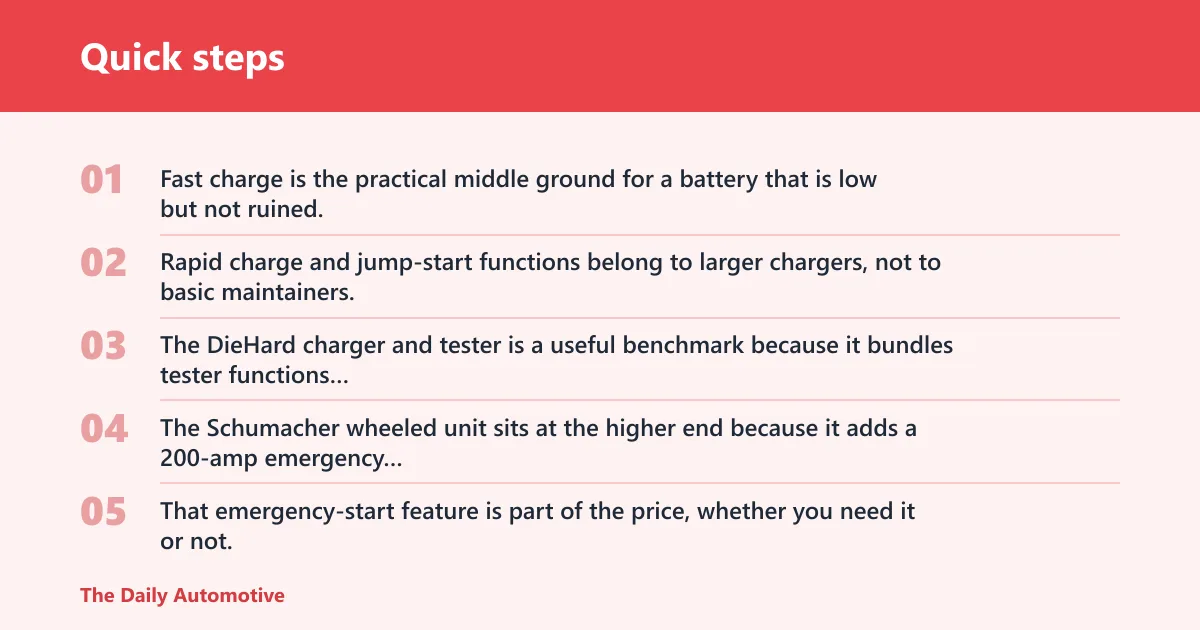
Float mode is the maintenance setting. It is the safest fit for long storage. Fast charge is the practical middle ground for a battery that is low but not ruined. Rapid charge and jump-start functions belong to larger chargers, not to basic maintainers.
The DieHard charger and tester is a useful benchmark because it bundles tester functions with multiple charging modes. The Schumacher wheeled unit sits at the higher end because it adds a 200-amp emergency jump starting function. That emergency-start feature is part of the price, whether you need it or not.
Automatic shutoff and repair modes
Automatic shutoff keeps the charger from running past the battery’s needs, which is why smart chargers often cost more. Repair or desulfation modes also move the price up, but they only matter if the charger can safely attempt recovery on the battery chemistry you own. Do not pay for repair mode if the battery is too far gone to justify the attempt.
Safety features that most affect price include reverse-polarity protection, short-circuit protection, overheat protection, timer or microprocessor shutoff, and safe manual use. Those features are worth paying for because they reduce the chance of a simple charging job becoming a replacement job.
Amps, tester functions, and portability
Amps are a buying variable, not a bragging number. Lower output is usually cheaper and better for maintenance. Higher output costs more and shortens waiting time, but only when the charger is built for that mode. Tester functions and portable, wheeled housings add cost because they add utility.
Battery Tender Junior comes with a five-year warranty, which is one reason shoppers compare warranty and feature set instead of price alone. A low-cost charger that fails early is not cheap for long.
How battery chemistry changes compatibility
Battery chemistry changes the buying decision because the wrong charging profile can do real damage. Flooded lead-acid batteries are the broadest fit. AGM and gel batteries need chargers that are labeled for those chemistries. Vehicle lithium batteries are usually the easiest to get wrong, so check the exact chemistry on the battery and charger label before you buy.
Flooded lead-acid, AGM, and gel
Flooded lead-acid batteries are the most forgiving for standard chargers, but they still benefit from automatic shutoff and correct voltage support. AGM and gel batteries can be more sensitive to charging profile, which is why smart charger compatibility matters more than bargain pricing.
If the charger manual does not state AGM or gel support, do not assume it is safe. That mistake can cost more than the charger saved.
Lithium battery support and limits
For vehicle lithium batteries, the practical label to look for is often LiFePO4 support rather than a vague “lithium” claim. The NOCO Genius5 is a clear example because it is listed for lithium-ion use along with flooded, AGM, and gel. If a charger does not explicitly list the chemistry, skip it.
That is especially true for low-voltage recovery claims. A charger that can wake a deeply discharged battery is not automatically right for every chemistry, and the manual should make that limit clear.
Why manual checks matter
Follow the vehicle and product manual before you connect anything. Chargers differ in clamp order, mode selection, and chemistry limits, and those details are not interchangeable. If the manual does not list your battery type, choose a different charger.
Car battery charger decision table
The cheapest safe buy depends on battery condition, chemistry, and whether the car needs maintenance, recovery, or starting support. Use this table to avoid paying for emergency-start hardware when a maintainer will do, and avoid buying a maintainer when the battery already needs recovery.
| Battery condition | Battery chemistry | Cheapest safe buying option | Expected price band | Buy charger vs replace battery | Hidden cost of wrong fit |
|---|---|---|---|---|---|
| Long-term storage, battery healthy | Flooded lead-acid or AGM | Battery maintainer / trickle charger with automatic shutoff | $20-$60 | Buy charger | Overpaying for fast-charge or jump-start hardware you will never use |
| Long-term storage, battery healthy | Gel or lithium with explicit support | Smart maintainer that lists the exact chemistry | $40-$100 | Buy charger | Wrong profile can shorten battery life or fail to charge at all |
| Weak battery, likely recoverable | Flooded lead-acid or AGM | Standard or smart charger with fast and maintenance modes | $30-$100 | Buy charger first | Buying only a maintainer can leave the battery too weak to recover |
| Deep discharge, low-voltage recovery needed | AGM or flooded lead-acid | Smart charger with low-voltage recovery and automatic logic | $60-$100 | Usually buy charger first | A plain maintainer may not wake the battery; replacement may follow anyway |
| Emergency start plus charging | Flooded lead-acid or AGM | Wheeled charger/starter with protection features | $80-$350+ | Buy charger if you need jump-start capability often | Paying for jump-start capacity raises cost when a separate starter would have been cheaper |
| Battery will not hold charge after recovery attempt | Any starter battery chemistry | Replace the battery | Varies by model | Replace battery | Repeated charging attempts waste time and may hide a failing battery |
Is it cheaper to charge or replace?
Charging is cheaper when the battery is healthy enough to hold a charge after recovery or storage maintenance. Replacement is cheaper when the battery will not stay charged, shows repeated failure, or is the wrong chemistry for the charger you own. The best spend is the one that fixes the real problem once.
When charging is the smarter spend
If the car sits idle and the battery is otherwise healthy, a maintainer is the least expensive safe solution. If the battery is low but recoverable, a smart charger with maintenance and fast-charge modes often costs less than a replacement battery plus a future charger purchase.
A common first-timer mistake is buying a jump-start unit for a car that only needs storage maintenance. That mistake adds weight, cost, and complexity without solving the real problem.
When replacement is the better answer
If a charged battery quickly goes flat again, replacement is usually the better spend. The charger may be fine. The battery may be failing. Charging a bad battery only delays the inevitable and can make diagnosis harder.
That is also true when the charger does not match the chemistry. A charger that cannot support AGM, gel, or the battery’s lithium type is the wrong tool, no matter how cheap it looks.
What to check before you buy
Start with voltage support, chemistry support, and the mode you actually need. Then check safety features, shutoff logic, and whether the unit is a maintainer, a charger, or a charger/starter. Those basics matter more than retail packaging or extra claims.
6V and 12V support
Most consumer car chargers are built around 12V use, but some standard chargers also support 6V. The NOCO Genius5 is a clear example of a charger that works with 6- or 12-volt batteries. If your vehicle or small battery uses a different voltage, confirm the charger label before buying.
Safety features to look
Look for reverse-polarity protection, short-circuit protection, overheat protection, and automatic shutoff. A timer or microprocessor shutoff is especially useful for unattended maintenance charging. Those features are worth the higher sticker price if the battery will sit connected for long periods.
Keep clamps connected only as the manual directs. Follow the vehicle and product manual, and keep the work area ventilated with no sparks near fuel or battery fumes.
Manuals, clamps, and connection basics
- Confirm battery chemistry and voltage in the vehicle manual.
- Check the charger manual for the same chemistry and voltage support.
- Choose maintenance mode for storage, charge mode for recovery, and jump-start mode only if you need emergency starting.
- Connect the clamps exactly as the manual directs.
- Watch for reverse-polarity and overheat warnings before leaving the charger unattended.
Frequently asked questions
How much does a battery charger cost?
The right spend depends on whether you need maintenance, recovery, or emergency starting. Pay for the mode you need, not the biggest box on the shelf.
How much is a car battery charger?
A car battery charger usually costs somewhere in the standard charger range unless you only need maintenance charging. If you need chemistry compatibility, automatic shutoff, or recovery modes, expect to move above the lowest price band. The cheapest safe option is the one that matches the battery’s actual condition.
How much does a car charger cost?
People often mean either a maintainer or a full charger when they ask this. A maintainer is cheaper and better for a parked vehicle, while a full charger costs more because it can recover a weak battery. If you also want jump-start capability, the price climbs again.
Cheap chargers vs battery chargers
The cheapest charger is not always the cheapest buy. A low-price maintainer can be perfect for storage, but it is the wrong tool for a dead or deeply discharged battery. Cheap becomes expensive when the charger cannot match AGM, gel, or lithium requirements and the battery still fails.
Charging car battery vs replacing?
Charge first if the battery is healthy enough to recover and hold a charge afterward. Replace it if it keeps going flat after charging, cannot support the vehicle, or the charger cannot safely match the chemistry. A charger is the smarter spend only when the battery still has life left.
Products related to this article
Sponsored / affiliate links. As an Amazon Associate I earn from qualifying purchases. I may earn additional commission from eligible campaigns.