Armor All for Cars: Multi-Purpose Cleaner, Detailer, Protectant
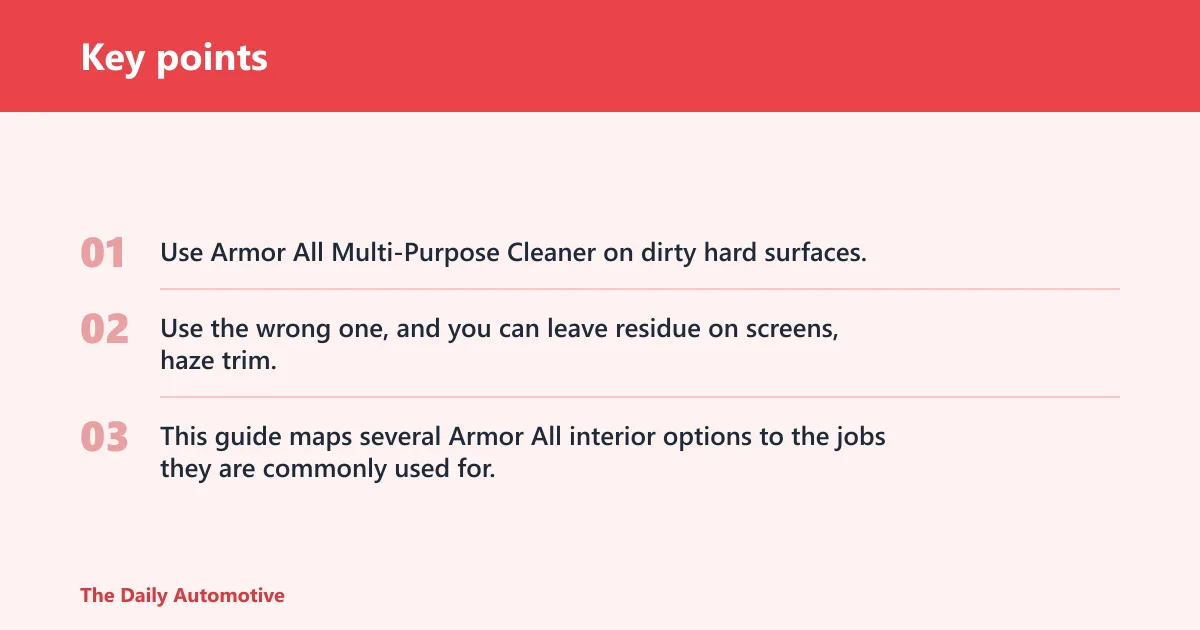
Use Armor All Multi-Purpose Cleaner on dirty hard surfaces, Armor All Interior Detailer for dust and a light finish, and Armor All Protectant on vinyl, plastic, and rubber that need UV protection. Use the wrong one, and you can leave residue on screens, haze trim, or miss the UV protection that helps interiors resist drying and cracking. This guide maps several Armor All interior options to the jobs they are commonly used for.
Armor All interior product decision table


| Common interior problem | Best Armor All product type | Surface compatibility | Finish level | Cleanup time | Failure risk | Choose this / avoid this |
|---|---|---|---|---|---|---|
| Dust film on dashboard and door trim | Armor All Interior Detailer | Finished interior trim; confirm label for your surface | Light shine, quick touch-up | Fast | Low if you use a small amount | Choose this for a quick reset. Avoid it when the surface has sticky grime that needs a true cleaner. |
| Built-up grime on hard interior surfaces | Armor All Multi-Purpose Cleaner | All auto surfaces listed on the bottle; Target lists the interior cleaner as 16 fl oz and non-abrasive | Low shine; cleaner first, finish second | Medium | Medium if oversprayed near gauges or screens | Choose this for dirty plastic, vinyl, and other hard surfaces. Avoid direct spray on displays, cluster lenses, or exposed electronics. |
| Dashboard fading concern and dry-looking trim | Armor All Original Protectant | Plastic, vinyl, and rubber | Protective sheen | Fast to medium | Medium if applied too heavily | Choose this for UV-prone trim. Avoid it on screens, gauge faces, and high-touch areas that need a dry finish. |
| Need more control than a spray bottle | Armor All Original Protectant Wipes | Plastic, vinyl, and rubber; check the package for the exact interior surfaces | Controlled protective sheen | Fast | Low to medium | Choose this when you want better targeting on trim edges. Avoid it for large, very dirty panels that need a cleaner first. |
| Quick clean plus a finished look in one pass | Armor All Total Interior Detailer & Protectant | Interior use; confirm the bottle before using on sensitive surfaces | Detailer plus UV protection | Fast | Medium if overapplied | Choose this when you want one product for light soil and protection. Avoid it when the cabin needs a deeper cleanup. |
| Heavier grime that standard cleaner does not remove easily | Armor All Heavy Duty Multi Purpose Cleaner | Interior product category; confirm the label for exact use cases | Cleaner first | Medium | Medium to high if used on delicate surfaces without checking compatibility | Choose this for deeper cleaning tasks. Avoid it on touchscreens, coated display panels, or any surface the label does not list. |
| Newer ceramic-enhanced cleaning line for interior use | Armor All Extreme Shield + Ceramic Multi-Purpose Cleaner | Interior category; verify the bottle for approved surfaces | Cleaner with ceramic-enhanced positioning | Medium | Medium if the surface is sensitive or glossy already | Choose this only when the label supports the task and surface. Avoid assuming it is a universal dashboard product. |
| Fast wipe-down of mixed interior and exterior touch points | Armor All Cleaning Wipes | Interior and exterior use, depending on the package directions | Light cleanup finish | Fastest | Low for simple wipe jobs | Choose this for quick, no-mess cleanup. Avoid it when you need stronger cleaning power or UV protection. |
Which Armor All product should you use first?
Start with the job, not the bottle label. If the surface is dusty, reach for a detailer or cleaning wipe. If it is actually dirty, use a cleaner. If the problem is sun exposure and dry-looking trim, finish with a protectant on plastic, vinyl, or rubber.
Cleaner for dirt and dust
Armor All Multi-Purpose Cleaner is the right first step when the cabin has grime, fingerprints, and dust stuck to hard surfaces. Armor All sells this as a spray, and Target lists the Armor All Multi Purpose Automative Interior Cleaner as 16 fl oz, unscented, and non-abrasive. That makes it a core cleanup product in the lineup rather than a finish product.
Use it where you need removal, not gloss. That means door panels, center-console plastics, and other interior surfaces the label approves. It is not the best first choice for display screens, because overspray can leave haze or residue around sensitive electronics.
Detailer for quick finishing
Armor All Interior Detailer is the touch-up product. It fits light dusting, quick shine, and the kind of maintenance pass that follows a deeper clean. If the surface only needs a refreshed look, this product belongs before protectant, not after a heavy cleaner.
A common first-timer mistake is using a detailer on a dirty panel and expecting it to clean like a true cleaner. That usually spreads the soil around and leaves the trim looking uneven. Use the cleaner first when the surface has visible buildup.
Protectant for UV-prone trim
Armor All Original Protectant is the UV-focused option for plastic, vinyl, and rubber. Armor All says it helps protect those surfaces and helps against damaging UV rays, which is why it belongs on dashboards and trim that spend time in sunlight. It is the product to use when the goal is protection, not just appearance.
If you want less spray control and less chance of overshooting onto adjacent surfaces, use Original Protectant Wipes. Wipes give you better control on dashboard edges, vent surrounds, and narrow trim pieces. They are a better fit for touch-up work than a full interior detail session.
Armor All cleaners and wipes
Armor All’s cleaning options split into three practical jobs. The Multi-Purpose Cleaner handles dirt on hard interior surfaces. Cleaning Wipes handle fast wipe-downs. Heavy Duty Multi Purpose Cleaner and Extreme Shield + Ceramic Multi-Purpose Cleaner sit higher on the cleaning side of the lineup, so they make sense only when the label matches the surface and the mess.
The right format matters as much as the formula. A spray is better when you need to cover a larger panel. A wipe is better when you need control and speed. For small, high-touch areas, the wipe format often cuts the chance of overapplication.
Multi-Purpose Cleaner
This is the straightforward interior cleaner in the lineup. Use it for dirty hard surfaces that need actual cleaning before any shine or protection. The non-abrasive formula matters because many interior plastics mark easily when the wrong cleaner is used.
Keep the spray away from screens, gauge clusters, and exposed switches. Spray onto a cloth when you are working near sensitive areas, then wipe the target surface with light pressure. That keeps liquid from pooling where it does not belong.
Cleaning Wipes
Armor All Cleaning Wipes are the quick-clean option when you want speed and less mess. They are useful for small spills, door handles, and mixed-use cleanup. Because they are wipes, they give you more control than a spray bottle on tight trim.
They are not the strongest choice for built-up soil, and they do not replace a protectant. Think of them as the grab-and-go option for fast cleanup, not the deep-clean answer.
When to skip direct spray
Direct spray is the wrong move near screens, instrument clusters, and other sensitive electronics. Even when a formula is interior-safe for listed surfaces, overspray can settle in seams and leave a smeared finish. Spray the cloth instead when the area has buttons, vents, or display edges nearby.
Suppose your center stack has a glossy screen with a plastic bezel. Spray the cleaner onto a microfiber cloth, wipe the bezel, and keep the display itself for a manufacturer-approved screen cleaner or a dry microfiber if that is what the vehicle maker calls for. That avoids coating haze and reduces streaking.
Armor All detailers and protectants
Detailer and protectant are not the same job. A detailer is for appearance and touch-up. A protectant is for surfaces that need UV defense and a finished layer. The Total Interior Detailer & Protectant sits between those jobs, while Original Protectant and its wipes are the clearer protection-first options.
Total interior Detailer & protectant
Armor All Total Interior Detailer & Protectant is the dual-purpose product in the lineup. It is built for interior cleaning plus protectant-style finishing, so it fits quick maintenance when you want one product to do two related jobs. That still does not make it a replacement for a stronger cleaner when the surface is heavily soiled.
Use it for light interior upkeep, not for neglected trim. If a dashboard only needs a fresh, clean look and a little UV defense, this is the middle-ground choice. If the surface is sticky or visibly dirty, start with Multi-Purpose Cleaner instead.
Interior Detailer
Armor All Interior Detailer is the finishing product in this group. It belongs on interior surfaces that already look reasonably clean and just need a light refresh. Its job is the final pass, not soil removal.
Use less product than you think you need. Too much detailer can leave the surface looking shiny in the wrong places, which is especially noticeable on matte trim and around climate vents.
Original Protectant and wipes
Original Protectant is the one to choose when the dash is the concern and UV protection matters. Armor All says it helps protect plastic, vinyl, and rubber, and that it helps against damaging UV rays. That puts it in the dashboard-care category, especially on surfaces that fade, dry, or crack from sun exposure.
The wipe version gives more control than a spray. That matters when the dashboard has stitched seams, narrow vent blades, or adjacent controls. Wipes also make it easier to stop before the finish turns too glossy.
What surfaces can you treat safely?
Armor All’s interior lineup is aimed mainly at dashboards, door panels, vents, plastic, vinyl, and rubber. That covers most hard surfaces inside the cabin. It does not mean every formula belongs on every material, and it does not mean you should treat displays, leather, or delicate coatings the same way.
Dashboards, door panels, and vents
These are the easiest interior surfaces to classify. Plastic dash panels, vinyl door trim, and rubber vent surrounds are the core use cases for Original Protectant and many cleaner products when the label allows it. Door panels and vents also benefit from wipe formats because they are easier to control in tight spaces.
Dashboard care is where UV protection matters most. The upper dash gets more sun than most other surfaces, so protectant belongs there when the goal is long-term appearance rather than a temporary shine.
Plastic, vinyl, and rubber
Armor All Original Protectant is built for these materials, and that makes it the clearest match for UV-focused trim care. Cleaners can help remove soil first, but they do not replace the protectant step when the surface is exposed to sunlight over time.
Do not assume every product in the lineup works the same way on these materials. Cleaner, detailer, and protectant have different jobs, and the finish level changes with them. That is why the label matters before the first spray.
Leather, screens, and high-touch areas
Leather needs caution. Not every Armor All interior product is meant for leather seats, and broad interior formulas should not be treated as universal leather care. Check the bottle, and use a leather-specific or manufacturer-approved product when the label does not clearly approve leather.
Touchscreens need even more caution. Avoid spraying any of these products directly onto a display unless the manufacturer specifically approves it. A dry microfiber or a screen-safe cleaner is the safer choice for most infotainment surfaces.
High-touch areas such as steering-wheel spokes, climate buttons, and shifter trim can also become slippery if you overapply protectant. Keep those areas dry enough for grip. That matters more than chasing extra shine.
How do you avoid streaks and greasy residue?
Streaks and greasy residue usually come from too much product, the wrong finish for the job, or spraying where the formula should not go. A protectant should leave the surface conditioned, not wet-looking. A detailer should freshen the finish, not turn trim slick. Control the amount, and the result improves immediately.
Use less product
Start with a light application. A thin coat is usually enough for interior trim. Heavy spraying creates more wipe-off work and raises the chance of residue in seams, vents, and button edges.
Armor All protectant products are designed to improve the look of plastic, vinyl, and rubber, but overapplication can make the finish look glossy in a way that does not suit every cabin. If the surface looks wet, there is too much on it.
Work in small sections
Small sections make cleanup easier and reduce streaking. Wipe one panel, check the finish, then move to the next. That approach matters most on dashboards and door trim where one pass can cover a large visible area.
Picture a sun-faded dashboard with three vent openings and a glossy center stack. Working in one small section at a time keeps protectant off the screen bezel and helps you stop before the finish becomes uneven.
Choose the right finish for the job
If the surface needs cleaning, use a cleaner. If it needs a quick cosmetic refresh, use a detailer. If it needs UV defense, use protectant. Mixing those jobs is what creates greasy-looking trim and dust-catching shine.
A shiny finish can work on some trim. It is a problem on others. Matte plastics, steering-wheel trim, and near-view surfaces usually look better with less gloss, while sun-exposed dash tops benefit more from protection than from visible shine.
- Pick the product based on the surface and the problem, not the finish you hope to see.
- Spray onto a cloth near electronics, screens, and tight trim.
- Use a separate cloth to buff off any excess.
- Stop if the surface looks wet or slippery.
- Use protectant only on approved plastic, vinyl, and rubber surfaces.
Armor All has over 50 years in the car care industry, and it partners with Oracle Red Bull Racing. That brand scale helps explain why the lineup is broad, but the useful question for owners is still simple: which bottle matches the surface and the job?
Frequently asked questions
What is Armor All multi-purpose cleaner used for in cars?
Armor All Multi-Purpose Cleaner is for dirty interior hard surfaces that need actual cleaning before any shine or protection. It fits dust, fingerprints, and grime on approved auto surfaces. Target lists the interior cleaner as 16 fl oz, non-abrasive, and unscented, which makes it the practical cleanup step in the lineup.
Is Armor All detailer safe on all interior surfaces?
No. Armor All Interior Detailer is for interior finishing, not for every surface in the cabin. It is a better fit for light dusting and touch-up shine on approved trim than for screens, leather, or heavily soiled panels. Always check the label before using it on a sensitive material.
How do you use Armor All protectant without leaving a greasy finish?
Use a light coat, work in small sections, and wipe off any excess before it settles. Armor All Original Protectant is for plastic, vinyl, and rubber, but too much product can make the surface look glossy or slippery. A wipe format gives more control than a spray bottle.
Can Armor All be used on vinyl, rubber, and plastic dashboards?
Yes, Original Protectant is the Armor All product aimed at plastic, vinyl, and rubber, and Armor All says it helps against damaging UV rays. That makes it the dashboard-care choice when the trim needs protection more than cleaning. Cleaner can come first if the dash is dirty.
Does Armor All make wipes as well as sprays?
Yes. Armor All offers Original Protectant Wipes and Cleaning Wipes, and the wipe format gives more control than a spray. Wipes are useful for small areas, tight trim, and quick touch-ups. They are also a good choice when you want to avoid overspray near controls.
Can Armor All products be used on leather seats?
Not automatically. The lineup is aimed mainly at plastic, vinyl, rubber, and other approved interior surfaces, but leather needs label-level confirmation before use. If the bottle does not clearly approve leather, use a leather-specific or manufacturer-approved cleaner instead of assuming a broad interior product will work.
Products related to this article
Sponsored / affiliate links. As an Amazon Associate I earn from qualifying purchases. I may earn additional commission from eligible campaigns.