5 Best Auto Mechanic Tools (2026): Based on Specs and Reviews
A starter tool set for auto mechanics commonly begins with about 20 to 30 essentials: ratchet and socket sets, combination wrenches, screwdrivers, pliers, a torque wrench, jack stands, and a scan tool. Skip the basics and you waste money on specialty tools while routine jobs stall. This guide ranks the first tools to buy by the repairs they handle, so you can build a starter kit in the right order.
Quick comparison
| Product | Badge | Best for | Price | ||
|---|---|---|---|---|---|
 |
DEWALT 192 Pcs. Mechanics Tool Set, 1/2, 1/4, 3/8 SocketDEWALT | Our pick | 192pc SAE/Metric · 1/4" · 1/2" · Hard Shell | $185.70
Price as of 14 Oct 2026
|
View |
 |
AstroAI Digital Multimeter, True RMS 6000 CountsAstroAI | Also great | True RMS · 6000 Counts · Automotive Grade | $34.99
Price as of 14 Oct 2026
|
View |
 |
AV Steel Low Profile Floor Jack 3 Ton (6600 lbs), HeavyAV Steel | Upgrade pick | 3 Ton Capacity · Low Profile · Dual Piston | $152.99
Price as of 14 Oct 2026
|
View |
 |
M-AUTO Foldable Z Creeper 2-in-1 Rolling Folding CarM-AUTO | Pair with it | 36" Adjustable · 2-in-1 · 330lbs Capacity | $38.75
Price as of 14 Oct 2026
|
View |
 |
JESIMAIK Cordless Impact Wrench, 1475Ft-lbs (2000N.m) 1/2"JESIMAIK | Also great | 1475 ft-lbs · 1/2" Drive · Brushless Motor | $149.98
Price as of 14 Oct 2026
|
View |
For a first setup, start with the tools that cover brakes, wheels, oil changes, and basic diagnostics. After that, add cordless power only if you are repeatedly removing stuck hardware or doing frequent wheel service.
How we chose
The list below follows repair flow, not brand hype. A tool made the cut if it solves common jobs early, avoids duplicate purchases, and fits typical passenger-car fasteners and access limits.
Drive size matters. So does coverage: metric first for most modern vehicles, SAE added for older domestic hardware and mixed fasteners.
Safety and compatibility also matter. Jack stands, torque control, battery-platform lock-in, and scan-tool coverage tiers all affect whether a tool helps or stalls a job.
Value matters for a first set. The goal is to buy tools that open the next five repairs, not a box full of specialty gear that sits untouched.
What should you buy first?
Start with a 1/4-inch socket set, a 3/8-inch ratchet, jack stands, and a 3/8-inch torque wrench. That combination covers the widest set of routine jobs: interior trim, battery work, brake hardware, wheel service, oil changes, and many small engine fasteners.
Start with a socket set
A socket set comes first because fasteners stop nearly every repair. Metric coverage is the priority on most modern cars, while SAE belongs in the kit if you work on older domestic vehicles or mixed-hardware projects.
Add a ratchet and breaker bar
A 3/8-inch ratchet handles most general under-hood fasteners. A breaker bar gives you the force for stuck lug nuts, suspension bolts, and rusted hardware that would punish a normal ratchet.
Buy jack stands before power tools
Jack stands matter more than a cordless impact wrench because they make the car accessible safely. Never rely on a floor jack alone; use stands in pairs on approved lift points before you get under the vehicle.
Add torque and diagnostics next
A 3/8-inch torque wrench and a basic OBD2 scan tool round out the first serious buy. Wheels, brakes, and many engine fasteners need correct torque, while code reading and live data keep you from guessing at electrical or drivability faults.
1/4-inch socket set: best for starter fasteners
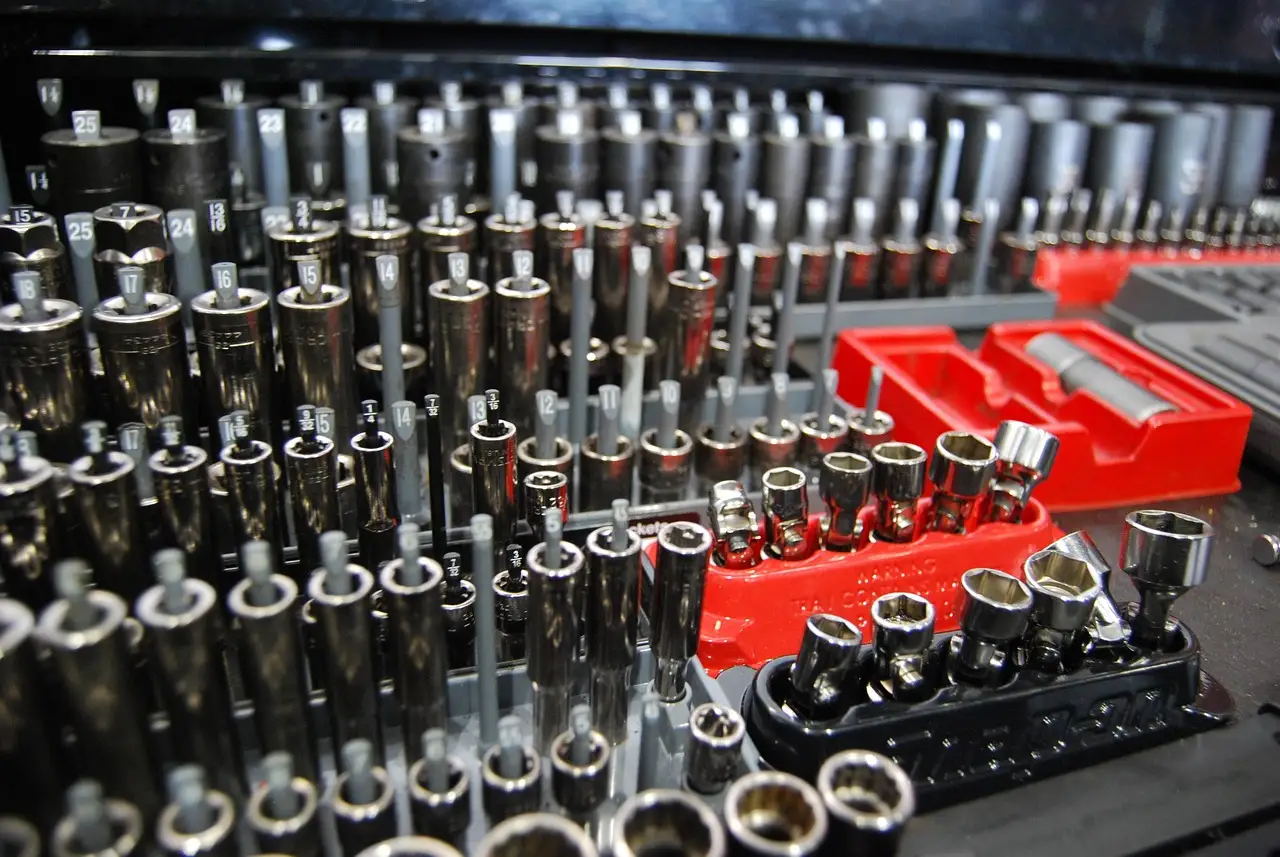
This is the set for a beginner who wants broad coverage in one box. The DEWALT 192-piece kit gives you 1/4-, 3/8-, and 1/2-inch drive pieces with SAE and metric sockets, so it can handle common fasteners across many cars without immediate duplication.
It stands out because the mix of shallow and deep sockets covers tight-access work, and the DirectTorque-style socket design is meant to reduce rounding on worn fasteners. That matters on battery terminals, engine covers, small brackets, interior trim hardware, and hose clamps where access is often awkward.
The drawback is size and overlap. A 192-piece kit is more than some beginners need, and the bigger box can tempt you to buy duplicates before you know which socket sizes you actually use most.
Metric and SAE coverage
Most modern vehicles lean metric. A first kit should still include SAE because older domestic cars, trailers, and accessory hardware can mix standards, especially in replacement parts and accessories.
Shallow versus deep sockets
Shallow sockets work best when fastener clearance is open. Deep sockets help on protruding studs, spark plug tube wells on some engines, and nut-and-bolt assemblies where threads extend beyond the nut face.
Why 6-point sockets matter
Six-point sockets are the safer default for rounded or corroded fasteners. They grip flats more fully than 12-point sockets, which helps on lug nuts, exhaust hardware, and any fastener that has already started to deform.
Common small fastener jobs
Use a 1/4-inch drive for intake covers, battery hold-downs, interior trim, airbox fasteners, sensor brackets, and many small engine-bay clips. It is also the better size for light-duty work where a larger drive would be awkward or too aggressive.
3/8-inch ratchet: best for general repairs
A 3/8-inch ratchet is the workhorse for most under-hood repairs. Look for a fine-tooth head, a reversible switch, and a comfort grip; that combination helps in tight spaces while giving you enough control for brackets, hose clamps, and accessory fasteners.
Fine-tooth head and reverse switch
A fine-tooth ratchet needs less swing room, which matters near firewall panels, intake runners, and frame rails. The reversible switch is a small feature that saves time when you are alternating between removal and installation.
Comfort grip and reach
A comfortable handle reduces hand fatigue during repeated work such as air-filter housing removal or brake hardware disassembly. If the handle is too bulky, it can also interfere with nearby components, so slim profile still matters.
Why it handles most under-hood work
Three-eighths-inch drive sits in the practical middle. It is strong enough for common general repair fasteners, yet compact enough for the majority of engine-bay tasks without jumping to a heavier half-inch setup.
Extensions, adapters, and when not to force it
Extensions are useful for serpentine covers, coil packs, and deep brackets. Adapters can expand your kit, but they also add flex; do not use a small ratchet to break loose seized hardware when a breaker bar is the correct tool.
What tools do auto mechanics actually use most?
The most-used tools are the ones that solve repeat jobs without drama: a torque wrench, breaker bar, pliers, cordless impact wrench, jack and jack stands, scan tool, work light, and pry bars. Those tools show up often because they solve the first layer of real-world repair problems.
3/8-inch torque wrench for wheel and brake work
A 3/8-inch torque wrench matters because wheels and brake hardware need correct clamping force. A click-type model is common and simple, while digital versions add readout and modes; either way, calibration should be checked periodically, especially if the wrench sees frequent use.
Breaker bar for seized lug nuts and suspension bolts
A breaker bar gives force without loading the ratchet mechanism. A common 1/2-inch drive size pairs well with wheel lugs and suspension bolts, especially when rust or high factory torque makes normal removal risky.
Pliers set for clamps, clips, and wire work
Needle-nose pliers help with clips and small connectors. Slip-joint pliers cover mixed sizes. Locking pliers grip damaged hardware. Add hose-clamp pliers or diagonal cutters if you expect coolant hoses, trim clips, or electrical trimming work.
Cordless impact wrench for high-volume removal
A 1/2-inch cordless impact wrench speeds up wheel removal, suspension work, and repeated disassembly. Battery platform compatibility matters because the tool is only as handy as the batteries you already own, and torque tiers vary widely by model class.
Jack and jack stands for safe access
Jack stands are not optional if you are lifting a car to work underneath it. Use them in pairs on approved lift points. A floor jack is for lifting, not for supporting the vehicle while you work.
Diagnostic scan tool for OBD2 codes and live data
A basic OBD2 scan tool reads and clears codes on most newer vehicles, while better units add live data and coverage for ABS or airbag systems. That extra coverage matters when a warning light is not a simple check-engine issue.
Work light for visibility
An LED work light with a magnetic base or hook saves time in cramped spaces. Rechargeable units are portable; corded lights avoid battery downtime. Brightness matters less than usable placement that keeps your hands free.
Pry bars for suspension and trim
Pry bars help with suspension positioning, exhaust alignment, and trim removal. A set with multiple lengths is better than one bar because short bars fit tight access while longer bars give more control and force.
Auto repair job-to-tool matrix
This matrix connects the first 12 common jobs to the minimum drive size and the tools that matter most. It separates essential tools from optional or job-specific ones so you do not buy extra gear before the basics are covered.
| Repair task | Exact tools needed | Minimum drive size | Priority |
|---|---|---|---|
| Brakes and wheel service | Socket set, ratchet, torque wrench, breaker bar, jack stands | 3/8-inch for calipers; 1/2-inch for lugs | Essential |
| Oil changes and filter swaps | Socket set, ratchet, drain-pan access tool, torque wrench | 3/8-inch | Essential |
| Battery and charging checks | Pliers, socket set, scan tool, work light, multimeter | 1/4-inch or 3/8-inch | Essential |
| Suspension and steering work | Breaker bar, sockets, ratchet, pry bar set, jack stands | 1/2-inch for larger bolts | Essential |
| Hose and clamp jobs | Pliers set, socket set, pry bars, work light | 1/4-inch or 3/8-inch | Essential |
| Electrical diagnostics | Scan tool, multimeter, pliers, work light | 1/4-inch for small panels | Essential |
| Interior trim and clips | 1/4-inch socket set, trim-friendly pry bars, pliers | 1/4-inch | Essential |
| Exhaust and rusted hardware | Breaker bar, 1/2-inch sockets, impact wrench, pry bars | 1/2-inch | Job-specific |
| Engine cover and intake work | 1/4-inch socket set, 3/8-inch ratchet, pliers | 1/4-inch | Essential |
| Tire rotation and lug service | Socket set, breaker bar, torque wrench, jack stands | 1/2-inch | Essential |
| Cooling system service | Pliers, socket set, pry bars, work light, scan tool | 1/4-inch or 3/8-inch | Essential |
| Small hardware removal | 1/4-inch socket set, ratchet, pliers, work light | 1/4-inch | Essential |
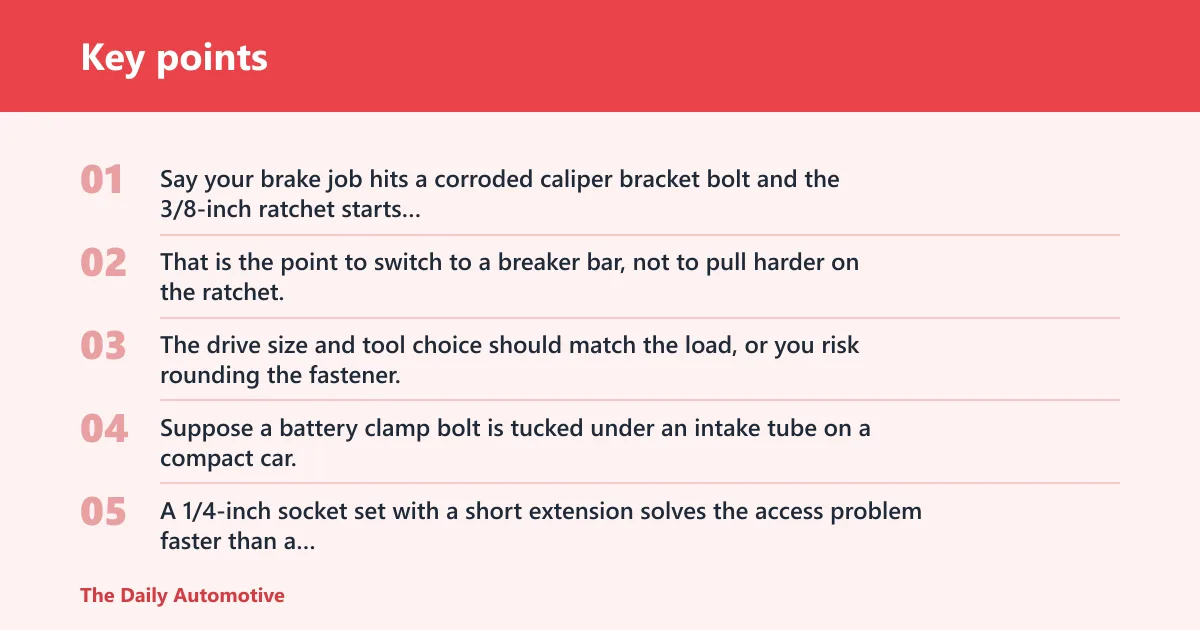
Say your brake job hits a corroded caliper bracket bolt and the 3/8-inch ratchet starts flexing. That is the point to switch to a breaker bar, not to pull harder on the ratchet. The drive size and tool choice should match the load, or you risk rounding the fastener.
Suppose a battery clamp bolt is tucked under an intake tube on a compact car. A 1/4-inch socket set with a short extension solves the access problem faster than a larger drive, and you avoid the overkill that slows down simple work.
Which one should you buy?
Start with the budget starter kit if you only plan to handle oil changes, battery swaps, trim, and basic code reading. Add the weekend DIY kit if you want brakes, wheel rotations, and occasional suspension work. Choose the apprentice kit if you expect repeated use and more frequent seized hardware.
Budget starter kit
Buy a metric 1/4-inch and 3/8-inch socket set, a 3/8-inch ratchet, pliers, jack stands, and a basic OBD2 scanner. That combination keeps you from spending on power tools before you know which jobs you actually do.
Weekend DIY kit
Add a 3/8-inch torque wrench, a breaker bar, a good work light, and trim-friendly pry bars. This kit covers brakes, wheel service, hoses, filters, and most interior or under-hood work without depending on a cordless impact wrench.
Apprentice mechanic kit
Go farther with a 1/2-inch breaker bar, a cordless impact wrench, and a better scan tool with live data and ABS or airbag coverage tiers. That is the point where repetitive removal and deeper diagnostics justify higher spend.
When to buy cordless next
Buy cordless after you know the battery platform you want to stay with. If wheel service, suspension jobs, or frequent teardown are on the schedule, a 1/2-inch impact wrench can save time. If not, hand tools still do the core work.
3/8-inch torque wrench: best for critical fasteners
This DEWALT set is more than sockets, but the reason to care here is coverage. For a beginner who wants a single purchase that can feed ratchets, extensions, and multiple drive sizes, the broad assortment cuts the chance of buying redundant pieces too early.
The main strength is versatility. It is a practical path for someone who needs metric and SAE sockets, shallow and deep options, and a hard shell case that keeps pieces together. The drawback is that you are paying for breadth, so if you only need a narrow starter range, the kit may feel bigger than necessary.
For torque work itself, remember that the wrench is the accuracy tool, not the socket box. Pairing a solid socket set with a 3/8-inch torque wrench is what matters for wheels, brakes, and engine hardware.
Breaker bar: best for seized hardware
This floor jack belongs in a starter safety setup, not in the tool box logic of removal work. The AV Steel 3-ton jack is a lifting tool for getting a vehicle onto stands, especially if you have a low-clearance car or want a fast lift from the dual-piston pump.
The strength is capacity and reach for lifting. A 3-ton rating gives room for many passenger vehicles, and the low-profile design helps with cars that sit close to the ground. The drawback is simple: a jack is not a substitute for stands, and it should not be the only support under the car.
For a first kit, this kind of jack supports the workflow. Lift, place stands, then work. That sequence matters more than any single lift feature.
Work light: best for visibility
This creeper is a comfort item, not a repair requirement. The M-AUTO 2-in-1 folding creeper and seat helps when you spend time under a car or along the side of a vehicle, but it does not replace the tools that actually remove fasteners.
The 330-pound capacity and swivel casters are the main convenience points, and the convertible seat mode can help on long jobs. The drawback is that it is optional at the start; if money is tight, buy jack stands, sockets, and a torque wrench before any rolling seat.
Use it only after the safety and repair tools are already covered.
Cordless impact wrench: best for speed
This JESIMAIK 1/2-inch impact wrench is for people who already know they are doing repeated wheel, suspension, or rusted-hardware work. The high torque rating, brushless motor, four modes, and included batteries make it attractive for fast removal jobs where a hand tool would be slow or tiring.
The obvious strength is speed. The drawback is fit and lock-in: you still need hand tools, you still need the right sockets, and the tool only stays handy if the battery platform fits the rest of your cordless plan. High torque also does not mean you should skip final torque with a torque wrench.
Based on the published specs and buyer feedback, this is best as a second-wave purchase, not the first one. It helps most when you are already doing frequent tire service or tackling stuck fasteners.
Best cordless tools for auto mechanics
The best cordless tools are the ones that remove repeated effort, not the ones with the biggest torque number. A 1/2-inch impact wrench, a work light, and a multimeter cover the most common productivity gains without replacing the hand tools you still need for access and final torque.
Impact wrench first, not everything cordless
For most DIY mechanics, a cordless impact wrench comes before cordless specialty tools. It helps with wheel removal, suspension teardown, and repeated bolt removal, but it should complement a socket set and breaker bar rather than replace them.
Battery compatibility matters
Choose a battery platform you can grow into. If you already own a compatible drill or light, staying in that system can save money. If not, the wrong platform creates duplicate chargers and spare batteries you do not need.
Scan tool and light still count as productivity tools
Power is not only about spinning fasteners. A scan tool saves diagnosis time, and a dependable work light saves the minutes lost to poor visibility. Those tools cut mistakes just as much as an impact wrench cuts effort.
What are the essential tools for auto repair?
The essential tools are the ones that let you remove, support, tighten, and diagnose without improvising. For most beginners, that means a metric socket set, 3/8-inch ratchet, breaker bar, pliers, torque wrench, jack stands, scan tool, and a work light.
Do not skip safety gear
A floor jack lifts the car. Jack stands support it. That distinction matters because the vehicle should not depend on hydraulic pressure while you are underneath it.
Do not skip diagnostics
A scan tool is not only for check-engine lights. Live data and system-specific coverage help when a fault sits in ABS, airbag, or charging-system logic rather than a simple stored code.
Do not skip access tools
Extensions, pry bars, and a breaker bar solve access and force problems that sockets alone cannot fix. If you buy sockets first but ignore those tools, you will hit avoidable dead ends on your first few jobs.
What are the best hand tools for auto mechanics?
The best hand tools are the ones you can use every week: sockets, ratchets, wrenches, pliers, breaker bars, torque wrenches, and pry bars. A 3/8-inch set handles most work, while 1/4-inch and 1/2-inch pieces fill the access and force gaps.
Wrenches still matter
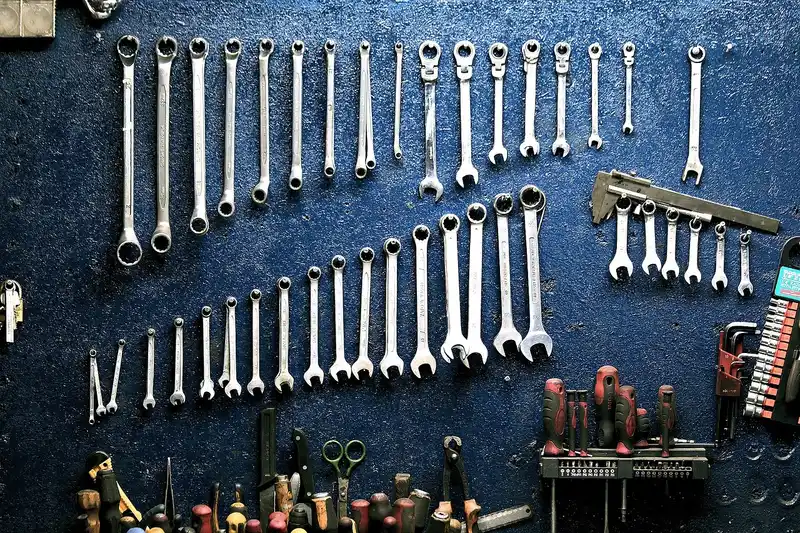
Combination wrenches help where sockets cannot fit, especially on hard-to-reach hose clamps, brackets, and sensor hardware. They are not flashy, but they are often the difference between a smooth job and a stripped fastener.
Pliers have multiple jobs
Needle-nose, slip-joint, locking, and cutters each solve different problems. One plier type cannot do all four well, and trying to force it only slows the repair.
How do I build an auto mechanic tool set on a budget?
Build the kit in repair order: sockets, ratchet, jack stands, torque wrench, pliers, breaker bar, then a scan tool. That sequence avoids duplicate buys and keeps you from paying for cordless power before you know which jobs you actually perform.
Budget starter kit
Buy metric first, then add SAE if you work on older domestic vehicles or mixed hardware. A basic socket set and 3/8-inch ratchet cover the most common fasteners without overspending.
Weekend DIY kit
Add a breaker bar, pry bars, work light, and a better torque wrench. Those pieces solve the failure cases that basic kits miss, especially seized bolts and tight-access fasteners.
Apprentice mechanic kit
Upgrade the scan tool and add a cordless impact wrench only after the hand tools are complete. That keeps your spending tied to actual repair flow rather than brand excitement.
Which brand tools are best for auto mechanics?
The best brand is the one whose tool line matches the jobs you plan to do and the platform you can keep buying into. DEWALT, AstroAI, and the cordless impact option here are all reasonable examples, but the buying decision should start with function, drive size, and compatibility.
Do not buy by logo alone
Brand reputation matters less than whether the tool fits the fasteners, the battery system, and the repair you are trying to finish. A well-chosen midrange tool is better than a premium tool you use wrong.
Match the brand to the category
Socket kits, torque tools, diagnostic tools, and cordless impacts do not need the same buying logic. Pick the right specification first, then compare brands inside that narrow field.
Frequently asked questions
What power tools do auto mechanics actually use most?
Mechanics use impact wrenches, lights, and scan tools most often because those tools reduce repeated effort or diagnosis time. High torque matters for rusted hardware, but hand tools still handle setup, final tightening, and the many places where precision matters more than speed.
What should a beginner auto mechanic buy first?
Start with a metric socket set, a 3/8-inch ratchet, jack stands, a torque wrench, and pliers. Add a breaker bar before you buy cordless power. That order covers common jobs first and prevents the common mistake of buying the flashy tool before the support tools.
Products related to this article
Sponsored / affiliate links. As an Amazon Associate I earn from qualifying purchases. I may earn additional commission from eligible campaigns.