What Car Accessories Work Best for Tires and Wheels?
The best tire and wheel accessories are the ones that fit the fault in front of you: a 12V tire inflator and gauge for low air, a plug kit for a small tubeless tread puncture, wheel adapters or center caps for fitment, and wheel covers or cap brushes for protection. Buy the wrong piece and you still have low tire pressure, roadside downtime, vibration, or wheel damage. This guide sorts the useful accessories by air, repair, fitment, and protection so you can buy the right tool first.

Must-have
Start here if you want the few accessories that solve the most common tire problems. A portable inflator covers pressure loss, a plug kit handles a puncture that stays in the tread, and spare valve caps help keep dirt and moisture out of the valve. For any plug repair, follow the tire maker’s repair limits and arrange a proper internal repair or replacement as soon as practical.
 As an Amazon Associate we earn from qualifying purchases. Prices and availability are accurate as of the date shown and are subject to change.

AstroAI AIRUN H portable tire inflator
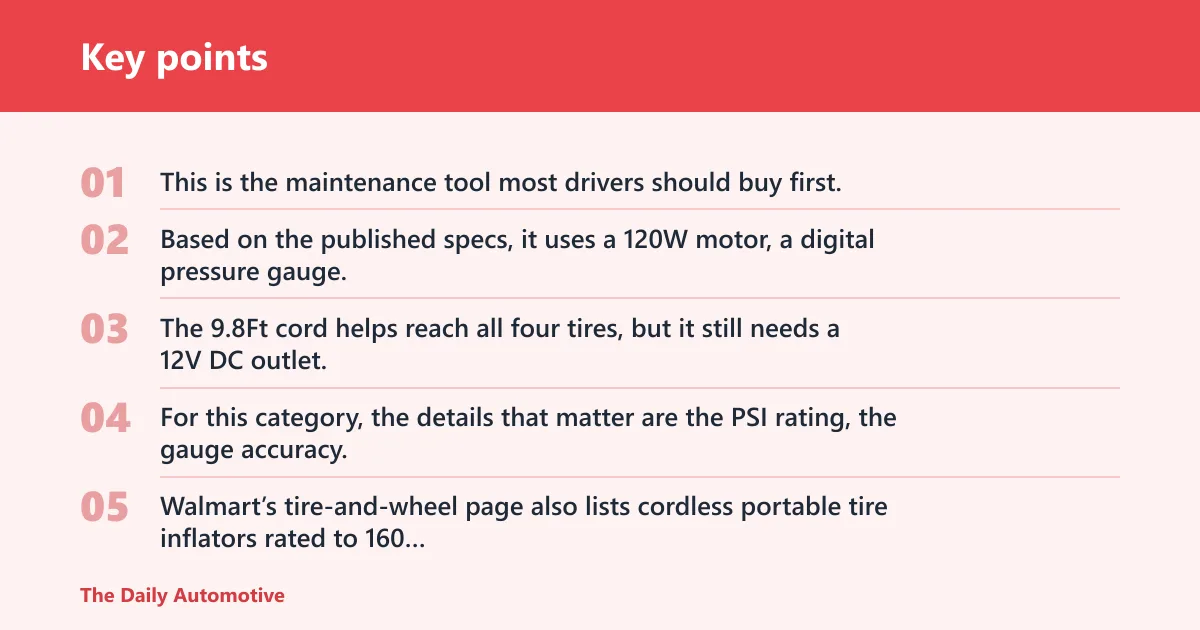
This is the maintenance tool most drivers should buy first. Based on the published specs, it uses a 120W motor, a digital pressure gauge, auto shut-off, and an LED light, which makes it suited to low pressure, roadside top-offs, and night use. The 9.8Ft cord helps reach all four tires, but it still needs a 12V DC outlet, so it is less flexible than a cordless inflator when the vehicle battery is weak or the outlet sits in an awkward spot.
For this category, the details that matter are the PSI rating, the gauge accuracy, and whether the tool stops at a preset pressure. Walmart’s tire-and-wheel page also lists cordless portable tire inflators rated to 160 PSI, which shows how much headroom these tools can offer. That does not mean every tire needs that much pressure; it means you should match the unit to the inflation job and choose a model with a clear digital readout instead of a guess-and-check pump.
As an Amazon Associate we earn from qualifying purchases. Prices and availability are accurate as of the date shown and are subject to change.

Rhino USA compact tire plug kit
This is the roadside emergency tool for a tubeless tire with a small tread puncture. The 14-piece case includes 9 plugs, a metal-handled reamer, an insertion tool, and a tire pressure gauge. That makes it more useful than a bare plug strip alone.
The drawback is just as important: it is not a repair for sidewall damage, rim damage, or a cut that will not hold a plug. It is temporary, not a finish-line fix, and tire makers and repair standards generally limit plugs to specific tread-area punctures. After a plug repair, you still need to inflate the tire to the correct pressure, inspect it again soon after, and arrange a proper internal repair or replacement.
Valve caps
Valve caps are simple, but they do a real job. They protect the valve core from dust and moisture, and they are a cheap replacement item when a cap goes missing. Walmart lists Slime black plastic replacement valve caps in a 4-piece pack, which is the right scale for a passenger vehicle.
The downside is obvious: caps do not seal a puncture and they do not fix a leaking valve stem. They are also easy to overbuy. If you only need a spare set, a 4-pack is enough unless you are stocking a trunk kit for multiple vehicles.
What accessory fixes which tire problem?
Match the accessory to the symptom, not to a generic “tire” label. Low pressure calls for inflation, a slow leak may need inflation plus diagnosis, a puncture in the tread can call for a temporary plug or sealant, and a winter trunk kit should cover air, visibility, and a basic repair attempt.
Low pressure
A portable inflator is the right first purchase when the tire simply sits below the recommended pressure. It is a maintenance tool, not a repair tool. If the tire keeps losing air, the inflator only buys time while you find the cause.
Say your sedan drops about 6 to 8 PSI over a week, but the tread looks normal. An inflator with a digital gauge can bring the tire back to spec and make it easier to spot whether the pressure loss returns, which points to a valve issue or a nail in the tread.
Slow leak
A slow leak needs a pressure check, then a repair path. A plug kit can help if the leak comes from a puncture in the tread and the tire is tubeless. If the leak comes from the valve stem or a bead problem, the plug kit will not solve it.
Puncture
For a tread puncture in a tubeless tire, a plug kit is the better emergency choice than sealant if the hole is clean and reachable. Sealant is more limited, especially when the puncture is larger, the sidewall is damaged, or the tire has TPMS concerns that make cleanup and sensor compatibility a concern.
Winter trunk kit
A winter trunk kit should include a portable inflator, a plug kit, a pair of gloves, a flashlight or LED light source, and spare valve caps. For drivers who go far from service, a jump starter with a compressor can replace two separate tools and save cargo space.
Tire repair matrix
This decision table is the quickest way to separate maintenance tools from emergency-only fixes. Use it before buying a kit that looks complete but does not match the tire problem you actually have.
| Problem | Best accessory type | What it solves | When it fails | Minimum compatibility checks |
|---|---|---|---|---|
| Low pressure | Portable tire inflator | Restores pressure at home or roadside | Does not stop a leak | 12V DC or cordless power source, PSI range, gauge, auto-shutoff |
| Slow leak | Inflator plus inspection; plug kit if tubeless tread puncture | Temporary refill and emergency closure of a tread puncture | Fails on sidewall damage, bead leaks, or larger cuts | Tubeless tire, visible puncture location, accessible hole |
| Puncture | Tire plug kit | Roadside emergency repair for a tubeless tire | Not for sidewalls or permanent repair on its own | Plug count, reamer and insertion tool, tubeless compatibility |
| Fitment swap | Lug nuts, wheel adapters, center caps | Matches wheel hardware to the vehicle and wheel | Fails if thread pitch, seat, bolt pattern, or hub bore is wrong | Thread pitch, seat type, bolt pattern, hub bore, stud size |
| Missing center cap | Wheel center cap | Replaces a missing cap for appearance and basic hub coverage | Does not fix a wheel-fitment problem | Wheel-series compatibility, finish, size, attachment style |
| Winter trunk kit | Inflator, plug kit, valve caps | Helps with cold-weather pressure drops and minor roadside issues | Does not replace a tow or a shop repair | Vehicle power access, storage space, tubeless tire support |
Should you buy a tire inflator or a jump starter with a compressor?
Buy a standalone inflator if you mostly want accurate top-offs, better gauge control, and a lighter tool to store. Buy a jump starter with an inflator if trunk space is tight and you want one device for a dead battery and low tire pressure. The combo unit is more convenient, but it is usually bulkier and more expensive.
Corded vs. cordless inflators
Corded inflators are often simpler because they pull power from the vehicle while you work. Cordless inflators avoid the 12V outlet and are easier to use away from the car, but battery capacity matters. If the battery is small, repeated use on multiple tires can become slow or inconvenient.
Peak amps and engine size
When you look at a jump starter with an inflator, the jump-start side matters as much as the pump side. The same source lists a jump starter and air compressor combo rated at 4000A. Peak amps should be matched to the engine size the unit is meant to support, because a compact car and a larger engine do not ask for the same starting reserve.
When the combo tool makes sense
A combo unit makes sense for commuters, parents, and road-trip drivers who want one cargo item instead of two. The tradeoff is that you should verify both functions, not just the compressor. If one part is underbuilt, the convenience disappears fast.
Picture a crossover that sits for two weeks in winter. A combo tool can start the engine and top off a tire before the driveway snow gets worse, but it still needs enough battery reserve and enough compressor output to do both jobs without dragging the other down.
Consumables and spares
These are the items that wear out, get lost, or get used up. Keep them in the vehicle only if you want a small, practical reserve. They are not cosmetic add-ons, and they are not a substitute for correct wheel fitment.
Tire repair sealant
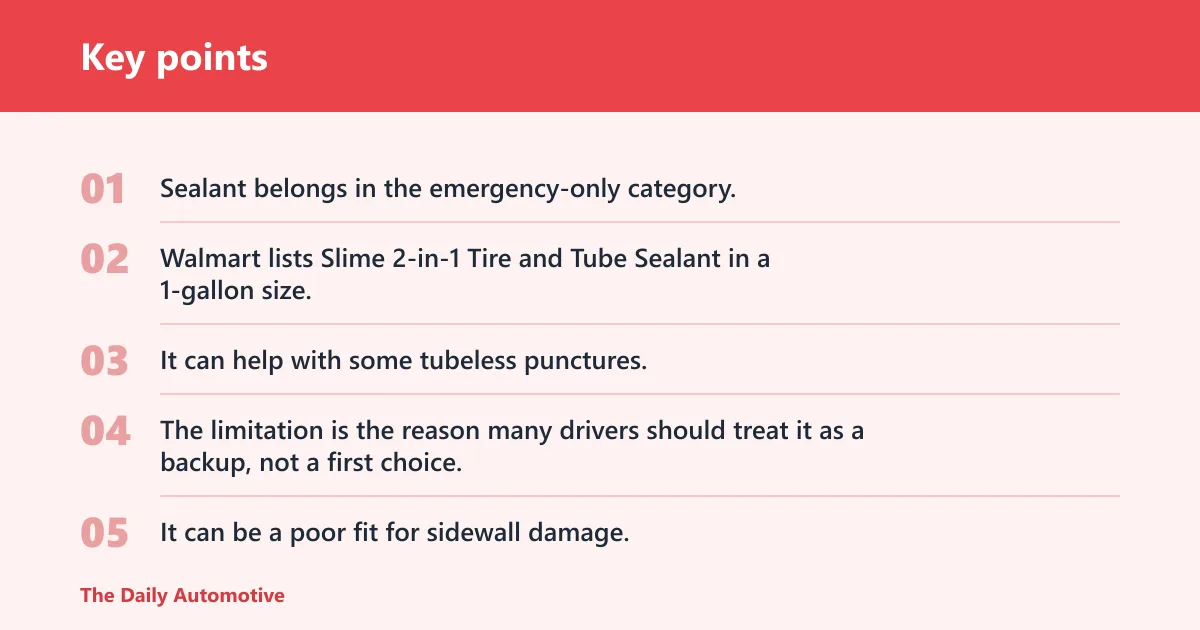
Sealant belongs in the emergency-only category. The same source lists Slime 2-in-1 Tire and Tube Sealant in a 1-gallon size, which shows that sealant is sold as a volume product for temporary use. It can help with some tubeless punctures, but it is not a cure-all and it should not be your only repair plan.
The limitation is the reason many drivers should treat it as a backup, not a first choice. It can be a poor fit for sidewall damage, and some TPMS-sensitive situations can make cleanup or follow-up more complicated. If you use sealant, you still need to check inflation again and plan for proper repair afterward.
Valve stems
Valve stems matter when the old stem is cracked, leaking, or aging out. The same source lists a 25-piece TR414 tire valve stem replacement set, and ASPSHOP lists a snap-in rubber tubeless tire valve with valve cap and valve core. Those listings point to the right use case: tubeless fitment, the correct rim hole size, and replacement rather than decoration.
The catch is compatibility. A snap-in rubber stem only works when the wheel’s rim hole size and the stem design match. If the hole is wrong, forcing the part is the wrong move.
Extra valve caps
Extra caps are simple insurance. The same source lists Slime black plastic replacement valve caps in a 4-piece pack, which is enough for a standard set of tires. Rubber or plastic both do the same basic job: keep dust and moisture away from the valve core.
The only real mistake is expecting them to fix a stem or core leak. They are a cheap spare, not a pressure-control device.
Nice-to-have

These parts matter, but they are not the first purchase if the tire problem is air or repair. Use them for appearance, replacement, or wheel matching. That is where hubcaps, center caps, and lug nuts belong.
Wheel covers and hubcaps
Wheel covers are mostly for looks and basic protection, not for making alloy wheels function better. In practice, that means they mainly hide and shield the wheel face from cosmetic scuffs and road grime, but they do not add meaningful mechanical performance. The same source shows a replacement 17-inch wheel cover set for Toyota RAV4 2013-2018 and a BDK four-pack of 16-inch OEM-style hubcaps. Those listings show the two fitment checks that matter most: wheel diameter and vehicle-specific style.
The drawback is that a cover is only useful if it fits. A snap-on cover that matches the wrong diameter or style can rattle, pop off, or simply look wrong. If you already have alloy wheels, you do not need a hubcap unless you are replacing a missing cover on a wheel designed for one.
Wheel center caps
Center caps replace a missing cap at the middle of the wheel and mostly help with appearance. ASPSHOP lists an ITP chrome cap for 4/136 wheels, which shows that bolt pattern compatibility and wheel-series compatibility matter here too. Finish is part of the decision, because a chrome cap on a black wheel can look mismatched if the wheel series was never meant for it.
The failure mode is simple: the cap fits the wrong wheel family or sits loose because the retention style does not match. Measure before buying.
Lug nuts
Lug nuts are fitment parts first and cosmetic parts second. The same source lists White Knight black chrome M12 x 1.50 spline lug nuts, 20 pack. The important checks are thread pitch, seat type, and whether the wheel calls for a spline or conical design.
If the thread pitch is wrong, the nut will not seat correctly. If the seat type is wrong, the wheel can loosen or clamp unevenly. Lug nuts are not a place to guess.
What wheel fitment parts do you need for aftermarket wheels?
Aftermarket wheels need exact fitment checks, not broad “universal” claims. Start with thread pitch and seat type for the lug nuts, then confirm bolt pattern, hub bore, and stud size if you are using adapters or spacers. One wrong dimension can turn a wheel swap into a vibration or safety problem.
Thread pitch and seat type
The lug nut must match the vehicle’s thread pitch and the wheel’s seat style. Conical and spline designs are common in aftermarket use, but they are not interchangeable with every wheel. If the wheel calls for one seat type and you buy another, the fit is wrong even if the nut threads on.
Wheel adapters
Wheel adapters convert one bolt pattern to another, but they are safety-sensitive parts. The vehicle bolt pattern, wheel bolt pattern, hub bore size, and stud size all need to line up. A hub-centric design is preferable when the setup calls for it, because the wheel should center correctly on the hub rather than on the studs alone.
Minimum checks before you buy
- Confirm the vehicle bolt pattern and the wheel bolt pattern.
- Check the hub bore size on the wheel and the vehicle hub.
- Verify stud size and thread pitch before ordering lug nuts or adapters.
- Match the lug seat type to the wheel design.
- Confirm whether the wheel needs a center cap or hub-centric support.
A common first-timer mistake is buying a wheel adapter because the bolt pattern sounds close. A 5×114.3 setup does not make every related wheel safe to mount. The hub bore and stud details still decide whether the wheel sits centered and clamps correctly.
Budget setups
These setups are grouped by job, not by brand hype. The first buy is still the inflator, because that is the fastest way to handle low pressure. After that, choose repair or fitment tools based on the wheel problem you actually have. Prices shown below are as listed in the table and can change over time.
| Setup | What to buy first | Why this order works | Price |
|---|---|---|---|
| Starter | AstroAI portable tire inflator, then valve caps | Covers low pressure and simple valve protection with one maintenance tool | $30.39 + basic spare caps |
| Mid | AstroAI portable tire inflator, Rhino USA compact tire plug kit, extra valve stems | Adds a roadside puncture option and a replacement part for stem leaks | $30.39 + $13.90 + spare stem set |
| Serious | Jump starter with air compressor, tire plug kit, valve caps, fitment-specific lug nuts or adapters | Combines battery backup, inflation, and wheel hardware for longer trips or modified wheels | Price varies by fitment parts |
Walmart’s broader Wheel Accessories in Auto & Tires category lists 1,000+ items, which is a reminder to filter by the problem you are solving instead of shopping the whole aisle. If your goal is a tire that stays inflated, the inflator comes first. If your goal is a wheel swap, the measurements come first.
Frequently asked questions
What car accessories actually help tires and wheels perform better?
The useful ones are the parts that solve a real tire or wheel problem: inflators for low pressure, plug kits for tread punctures, valve stems for leak repair, and correct lug nuts or adapters for wheel swaps. Wheel covers, caps, and brushes are mainly for protection and appearance, not performance.
Should I buy a tire inflator or a jump starter with an inflator?
Buy a standalone inflator if pressure checks and top-offs are the main task. Buy the combo if trunk space is limited and you want one emergency tool for both a dead battery and a low tire. The combo is convenient, but you should still check its compressor output and jump-start rating.
Do valve caps and valve stems really matter for tires?
Yes, but in different ways. Valve caps protect the valve from dirt and moisture, and a missing cap is easy to replace. Valve stems matter when the stem itself leaks or cracks. A cap does not fix a bad stem, and a stem has to match the rim hole and tubeless fitment.
Are hubcaps worth it for protection or just appearance?
Mostly appearance and basic protection. They can cover the wheel face and help keep road grime off the wheel, but they do not make an alloy wheel stronger or more functional. If you already have alloy wheels, you do not need hubcaps unless you are replacing a missing OEM-style cover.
Which tire repair kit is better: sealant, plug kit, or patch kit?
For roadside use, a plug kit is usually the better first choice for a tubeless tread puncture. Sealant can help in some emergency cases, but it is temporary and not ideal for every tire or TPMS situation. A patch alone is a shop repair tool, while a proper permanent repair is usually an internal patch-plug style repair.
What tire and wheel accessories should I keep in the trunk for emergencies?
Keep a portable inflator, a tubeless plug kit, spare valve caps, and a flashlight or LED light source. If you travel far from help, add a jump starter with a compressor. That mix covers pressure loss, a small puncture, and a dead battery without filling the trunk with duplicates.
Products related to this article
Sponsored / affiliate links. As an Amazon Associate I earn from qualifying purchases. I may earn additional commission from eligible campaigns.