What Does an Epicenter Do for Car Audio? How It Restores Bass
An Epicenter restores bass by reconstructing missing low-frequency harmonics. It works best when the system has midbass but starts to fall off below about 60–80 Hz. Set it wrong, and you get bloated, distorted bass that can overdrive the subwoofer or hide the system’s real limits. This guide explains how the Epicenter works, when it helps, when to skip it, and how to tune it safely with a subwoofer system.
Bass restoration via upper harmonics and hardware limits


An Epicenter is a bass restoration processor, not a subwoofer replacement. It analyzes the incoming signal, then uses the upper-frequency harmonics already present in music to recreate low notes that may be missing after compression, factory EQ, or source roll-off. That only helps when the system already has enough subwoofer hardware to play those restored notes.
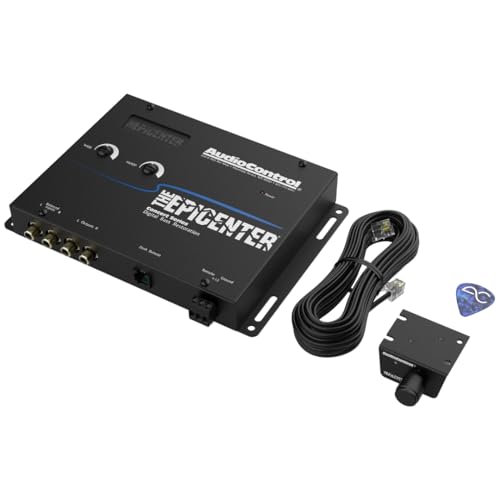
The original Epicenter uses the patented Bass Maximizer, has one 2-channel preamp input pair, accepts up to 15Vrms input, and can output up to 13.5Vrms. It also includes balanced inputs, a signal-to-noise ratio around 110 dB, and an ACR-1 dash-mount control. Those are integration tools, not proof that it will fix every thin system.
If the low end is absent because the subwoofer is too small, the enclosure is wrong, or the amp is underpowered, the Epicenter will not solve the real problem. It can only restore missing bass content that still exists in the source signal in harmonic form.
How bass restoration works
Bass restoration works by rebuilding missing fundamentals from harmonics that remain in the recording. When a kick drum or bass guitar note loses its lowest energy in a factory system or compressed file, the Epicenter pulls on the higher harmonics and shifts them down about an octave so the subwoofer can reproduce the missing note region.
This is why weak factory bass often responds well. Many OEM systems trim low-frequency content to protect small speakers or make the cabin sound cleaner at low volume. A bass restoration processor can restore some of that lost weight before the amplifier stage, but it cannot create bass that was never encoded in the source.
Picture a factory sedan with door speakers that still carry punch around 80 to 120 Hz, but the sound falls apart below that. The Epicenter can make the subwoofer section follow those missing lower notes more closely. If the source already has full-range bass, the effect may add more bloom than detail.
Is it the same as EQ or a subwoofer knob?
No. Bass restoration, equalization, and subwoofer level control do different jobs. EQ changes specific frequency bands directly. A subwoofer knob changes how loud the sub plays. An Epicenter rebuilds missing low-frequency content from the harmonics in the signal before amplification, so it works on the source, not just the output level.
That difference matters in installation terms. A bass knob usually trims overall sub level after the amp is already doing its job. An Epicenter changes what the sub amp receives. If you raise the Epicenter too far, you can create a thick, sloppy low end even when the sub gain is set correctly.
Where it belongs in the signal chain is before amplification. In a simple aftermarket system, that means source or factory audio feed, then the Epicenter, then the amplifier or DSP path that feeds the subwoofer amp. It is not a replacement for a proper line output converter, DSP setup, or amplifier gain setting.
Where does an Epicenter go in the signal chain?
Place it ahead of the subwoofer amplifier stage, not after it. In many installs that means between a factory radio or LOC and the sub amp. In a more complex system, it may sit before the DSP if the installer wants the DSP to process the restored bass content, though many integrations work better with the DSP correcting the signal first and the Epicenter feeding the sub amp path afterward. The exact order depends on how the rest of the system is built.
Balanced inputs on both Epicenter variants help reject hum and interference, which matters in factory integration and long signal runs. That does not erase poor grounding or bad routing, but it helps keep noise from getting into the bass signal.
Original Epicenter or Epicenter PRO?
Choose the original Epicenter if you want core bass restoration with straightforward remote control. Choose the Epicenter PRO if you need additional integration flexibility. The better choice depends on signal level, noise, and how the rest of the system is wired.
| Feature | Original Epicenter | Epicenter PRO | Best fit |
|---|---|---|---|
| Signal voltage | Accepts up to 15Vrms input; outputs up to 13.5Vrms | Selectable output voltage | Original for simple preamp-level integration; PRO for adjustable system matching |
| Remote | ACR-1 included | ACR-4 included | Both support dash-mounted bass adjustment |
| Line driver | No built-in line driver listed | Built-in line driver | PRO for longer runs or when you need stronger output control |
| Subsonic filter | PFM subsonic filter listed | Switchable PFM subsonic filter | PRO if you want easier filter control during setup |
| Inputs | Balanced inputs; 2-channel preamp inputs | Balanced inputs; 2-channel preamp topology | Either model for noise-sensitive installs |
The original model fits simpler systems that already have a clean signal path and only need bass restoration plus basic remote control. The PRO fits installations that need more output flexibility, cleaner long-run signal handling, or a built-in line driver for integration. That is especially useful in noisier factory systems or more layered aftermarket builds.
Bass restoration decision chart
This chart is the fastest way to pick the right unit and avoid buying features you will not use. It also helps you decide whether an Epicenter will help at all. If the system already has full-range bass or the problem is poor sub tuning, the answer may be no.
| Question | Original Epicenter | Epicenter PRO |
|---|---|---|
| Do you need bass restoration in a basic system? | Yes | Yes |
| Do you need a built-in line driver? | No | Yes |
| Do you want selectable output voltage? | No | Yes |
| Do you want the included dash remote? | ACR-1 | ACR-4 |
| Do you want switchable PFM subsonic filtering? | Listed PFM filter | Yes |
| Best-fit use case | Simple factory or aftermarket system that needs restored bass | More complex or noisy system that needs restoration plus output control |
How to wire and tune it safely
Safe tuning matters because the Epicenter can make a weak system sound fuller while also exposing weak links. If the amp is already near clipping, if the subwoofer box is too small, or if the gain structure is wrong, restored bass can become distortion fast. Use the remote sparingly and set the system for clean output first.
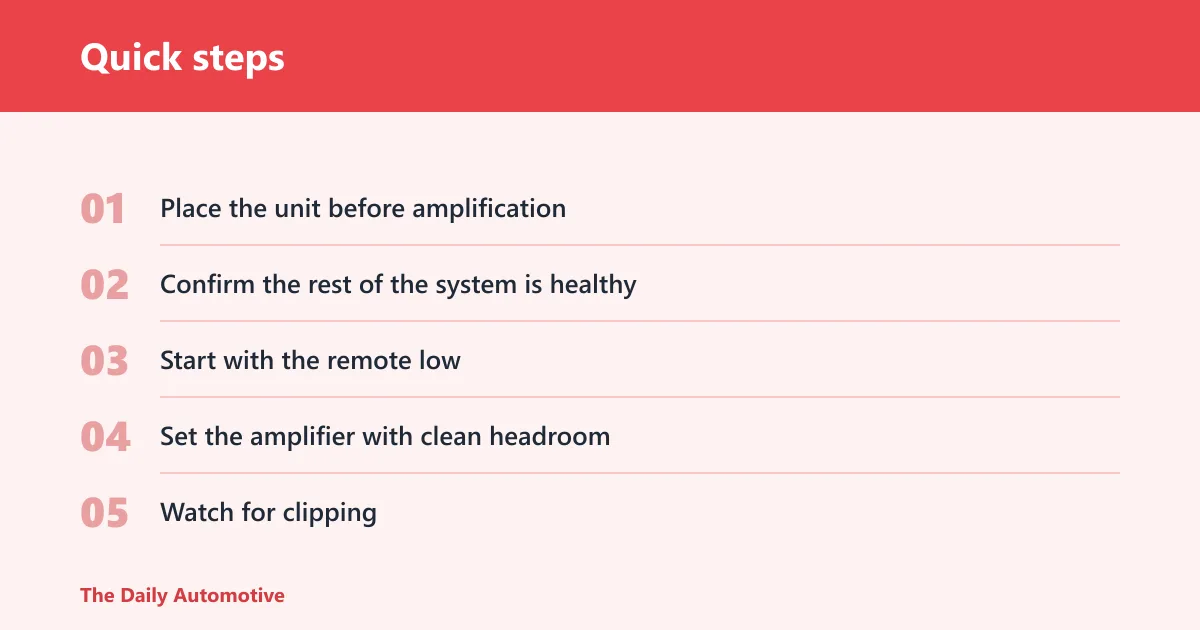
- Place the unit before amplification. Feed it from the source path that carries your full-range signal, then send its output to the sub amp path or to the next device in your signal chain.
- Confirm the rest of the system is healthy. Check subwoofer polarity, enclosure type, amplifier gain, and crossover settings before adding bass restoration.
- Start with the remote low. Use the ACR-1 or ACR-4 at minimum effect, then raise it only until the missing bass returns.
- Set the amplifier with clean headroom. Adjust the amp gain with the Epicenter near its normal listening position, not at a maximum setting.
- Watch for clipping. If bass turns hard, fuzzy, or compressed, reduce Epicenter effect or amp gain before anything else.
- Use the PFM subsonic filter when the system needs protection. This filter removes ultra-low frequencies that can waste cone travel and increase overexcursion risk, especially in vented subwoofer setups.
- Fine-tune for balance, not maximum effect. Stop when the system sounds full and controlled. If the cabin boom rises before the bass sounds clearer, back the control down.
A common first-timer mistake is turning the remote up because the low end sounds thin at idle volume. Suppose a compact sedan has a 10-inch sub in a vented box and the Epicenter is dialed high while the amp gain is already aggressive. At that point, one more step on the remote can push the woofer into audible strain before the music even gets louder.
Another common mistake is using the Epicenter to “fix” a system that already has strong low-end output. If a well-tuned aftermarket setup already plays down cleanly, the processor may add boom rather than depth. In that case, lower the effect or skip it entirely.
Frequently asked questions
What does an Epicenter do for car audio?
An Epicenter restores bass by rebuilding missing low-frequency content from harmonics in the signal. It helps most when a factory radio, compressed source, or system tuning has stripped away the low end below roughly 60–80 Hz. It is not a subwoofer substitute and cannot fix a weak enclosure or bad gain setup.
How does an Epicenter restore bass?
It listens for upper-frequency harmonics that belong to bass notes, then shifts that energy down about an octave so the subwoofer can reproduce the missing fundamentals. That process works only when the source signal still contains useful harmonic information. It does not create bass from silence.
Is an Epicenter the same as a subwoofer knob or EQ?
No. A subwoofer knob changes level, and EQ changes frequency response. An Epicenter reconstructs bass content before amplification, so it changes what the amplifier receives. That makes it useful for thin factory audio, but it also means an overdone setting can create boominess and distortion.
Will an Epicenter help factory speakers sound better?
It can help a factory system sound fuller only if the speakers and sub path are still passing some bass-related information. It will not make small door speakers play deep bass cleanly, and it will not cure a poor factory crossover or a subwoofer setup that is already tuned badly.
Can an Epicenter damage my subs if it is set too high?
Yes. Too much bass restoration can drive the sub amp harder, increase cone travel, and push the system into clipping or overexcursion. That risk rises when the enclosure is undersized, the amp gain is too high, or the PFM subsonic filter is not used where it should be.
What does the subsonic filter do on an Epicenter?
The PFM subsonic filter removes ultra-low frequencies that can waste power and overwork the subwoofer. On the PRO, it is switchable, which makes setup easier. Use it when the system needs protection from inaudible low-end content, especially with vented enclosures or any setup that reaches cone travel limits too easily.
Products related to this article
Sponsored / affiliate links. As an Amazon Associate I earn from qualifying purchases. I may earn additional commission from eligible campaigns.