Best Car Audio Systems for Bass Lovers (2026): we compared
For bass-focused setups, choose a sealed or ported sub setup matched to roughly the right RMS power for your trunk or cabin space; the enclosure and power matter more than peak wattage or brand. Pick the wrong enclosure, and the lows turn muddy, rattles show up, or the system runs out of breath before it hits hard. This guide compares the best bass-focused car audio setups by vehicle size, power needs, and the type of low-end punch you actually want.
This guide is part of our Car audio systems guide series.
Quick comparison
| Product | Badge | Best for | Price | ||
|---|---|---|---|---|---|
 |
Pioneer GM-D9701 2400W Max 1-Channel GM Digital ChampionPIONEER | Our pick | 2400W Max · Class-D Mono | $285.99
Price as of 25 Sep 2026
|
View |
 |
Rockford Fosgate Power T1000-1bdCP 1,000-Watt Mono AmplifierRockford Fosgate | Upgrade pick | 1,000-Watt Constant Power Mono | $659.99
Price as of 25 Sep 2026
|
View |
 |
Springfield Speaker 10" Subwoofer Foam Surround – 2 SpeakerSpringfield Speaker | Pair with it | 10" Foam Surround Repair Kit | $24.95
Price as of 25 Sep 2026
|
View |
The hardest bass usually comes from a ported 12-inch package in a trunk or cargo area with the electrical system to back it up. Sealed 12-inch systems give cleaner, tighter low end in smaller spaces, while under-seat powered subs are for compact bass, not trunk-rattling output.
How we chose
The comparison starts with enclosure type, because the box changes output more than brand badges do. Then came RMS power, amp class, fitment in real vehicles, and whether the electrical system can keep voltage stable under load.
We also looked at installation burden. A bass system that needs a better ground, a larger wiring kit, or alternator headroom can be the right buy, but only if the buyer plans for the full cost.
Finally, the choices had to map cleanly to common use cases: sedans, hatchbacks, trucks, and SUVs. A setup that sounds strong in a hatch can disappoint in a larger cabin if the enclosure and placement are wrong.
Ported 12-inch sub package: best for maximum bass
A ported 12-inch package is often a good call when the goal is strong low-end punch for the amount of cargo or trunk space available. It suits drivers who want bass that moves air, not just bass that fills the cabin quietly.
In the bass-first hierarchy, the ported box usually wins because the enclosure is tuned to output more efficiently at the low end. A loaded MDF enclosure matters here, because cabinet stiffness helps keep the bass from sounding loose or smeared.
A good example of the category is a dual 12-inch loaded enclosure paired with a monoblock amp. Motorist Care features an MTX Terminator dual 12-inch subwoofer package with a 1200W peak loaded enclosure, a Planet Audio 1500W monoblock amplifier, 5/8 MDF construction, and variable bass boost plus a low-pass filter. The useful lesson is not the badge; it is that the enclosure, amp, and controls are already matched.
The drawback is space. Ported boxes are usually larger than sealed boxes, and they are less forgiving when the trunk or cargo area is shallow. If the box is too small for the driver or the tune is off, the result can be weak bass below the tuning point and louder mechanical noise near it.
What to check before buying
Look at RMS power first. Peak numbers are marketing fuel, not the operating target. A monoblock Class D amp with a low-pass filter and bass boost control is the right match when the sub package is meant to play hard without wasting space or power.
Check the enclosure material too. MDF is preferred over thin board because it resists flex better, and flex is one of the fastest ways to lose bass impact. Also confirm that the loaded enclosure fits the trunk opening, not just the trunk volume on paper.
Sealed 12-inch sub package: best for smaller trunks
A sealed 12-inch package is the better choice when the vehicle has less room and the listener wants controlled bass instead of the largest possible output. It gives a tighter low end, works well in sedans and hatchbacks, and is usually easier to live with day to day.
Sealed boxes do not use the port’s extra acoustic gain, so they usually sound less forceful than a ported box at the same power. The tradeoff is cleaner transient behavior and a smaller cabinet, which matters when the trunk has to keep some cargo space.
Single versus dual configuration matters here. A single 12-inch sub can be enough for modest bass goals and lower amplifier demand, while dual 12-inch setups need more airspace, more power, and more attention to vibration control. The wrong box size can make a dual setup sound worse than a good single driver.
Where sealed boxes make sense
Sealed boxes fit neatly in tighter sedans, some hatchbacks, and smaller SUVs where a ported enclosure would eat too much cargo room. They also reduce the chance of boomy low-end output in cabins that already add cabin gain.
For listeners who want bass that blends with the front stage, a sealed 12-inch package is often the safer choice. It still needs real power, though. A weak amp can make a sealed sub sound polite and lifeless, which is the opposite of what bass buyers want.
Under-seat powered sub: best for compact bass
An under-seat powered sub is for drivers who want a clear bass upgrade without giving up trunk or cargo space. It can tighten up thin factory sound and add low-end fill, but it will not match a full-size trunk enclosure for output or depth.
The core advantage is packaging. The built-in amplifier keeps the footprint small, and the compact cabinet can work where a regular box simply will not fit. The real limit is thermal headroom and cone area, which cap how hard it can hit before strain shows up.
A recent example from the category is the Znclces under-seat subwoofer, which is rated at 1200 watts peak power, uses a built-in amplifier, and is designed with an aluminum shell for heat dissipation. Its remote allows adjustments for gain, bass boost, and crossover. That mix is useful for tuning, but it does not erase the physics of a small driver in a shallow space.
The drawback is simple: compact does not mean equivalent. Under-seat units can be plenty useful in a daily driver, but they are not a substitute for a properly powered 12-inch sealed or ported system when the goal is hard, room-filling bass.
Where it falls short
Heat dissipation matters more in this category than many buyers expect. When the amp and driver are packed into a small shell, sustained high-volume use can trigger compression or protection behavior sooner than a larger trunk system would.
Controls help, though. Bass boost and crossover settings let the installer trim the response to the cabin, which can make the sub feel stronger than its size suggests. Still, the ceiling is lower than a separate sub and amp package.
Springfield Speaker 10-inch foam surround repair kit: best for restoring an existing sub
This is not a bass upgrade in the usual sense. It is for fixing a damaged 10-inch subwoofer so the driver can work again instead of buzzing, rubbing, or leaking low-end output through a failed surround.
Its value is restoration, not more output. A repair kit can save money when the sub motor and cone are still healthy, but it will not turn a weak system into a hard-hitting one. The obvious drawback is that it solves a different problem than the one most bass shoppers are trying to buy.
What is the best car audio system for bass lovers?
The best bass system is usually a ported 12-inch sub package in a vehicle with room for it, fed by a properly matched monoblock amp and supported by good wiring. If space is limited, a sealed 12-inch package is the next-best full-size option. Under-seat powered subs are the right answer only when space matters more than output.
The enclosure should lead the decision, not the badge on the amp. A ported box is the strongest fit for drivers who want maximum low-end output in a sedan trunk, SUV cargo area, or truck cab with enough room. A sealed box is better when the sound needs to be tighter and the package smaller.
Power should be matched in RMS, not peak. In practice, bass systems in the 300–1,000 watts RMS range often make sense for daily drivers, while larger systems need more electrical support and more careful tuning.
Match the setup to the vehicle
Sedans usually benefit from sealed or compact ported enclosures that can work with trunk loading. Hatchbacks often tolerate slightly more box volume, but the cabin and cargo layout still dictate where the bass energy lands. Trucks need careful fitment because cabin space is limited and enclosure depth is often the bottleneck.
SUVs can handle larger enclosures better, which is why they are a natural home for dual 12-inch ported systems. Still, a bigger cargo area does not automatically make more bass. If the box is not tuned right, the extra space just makes the system easier to place, not stronger.
Choose the right amp and wiring kit
A monoblock amplifier with Class D design, a low-pass filter, and a bass boost control is the clean match for a dedicated sub stage. The low-pass filter keeps upper bass and midrange out of the sub, and the bass boost should be used lightly, if at all, because too much boost invites clipping.
Wiring matters more than many buyers think. A 4-gauge power wiring kit, fuse holder, and solid ground cable should be sized to the amp’s real power draw. If the wiring is too small, voltage drop and heat become the weak link long before the sub runs out of potential.
Bass-system decision table and failure cases
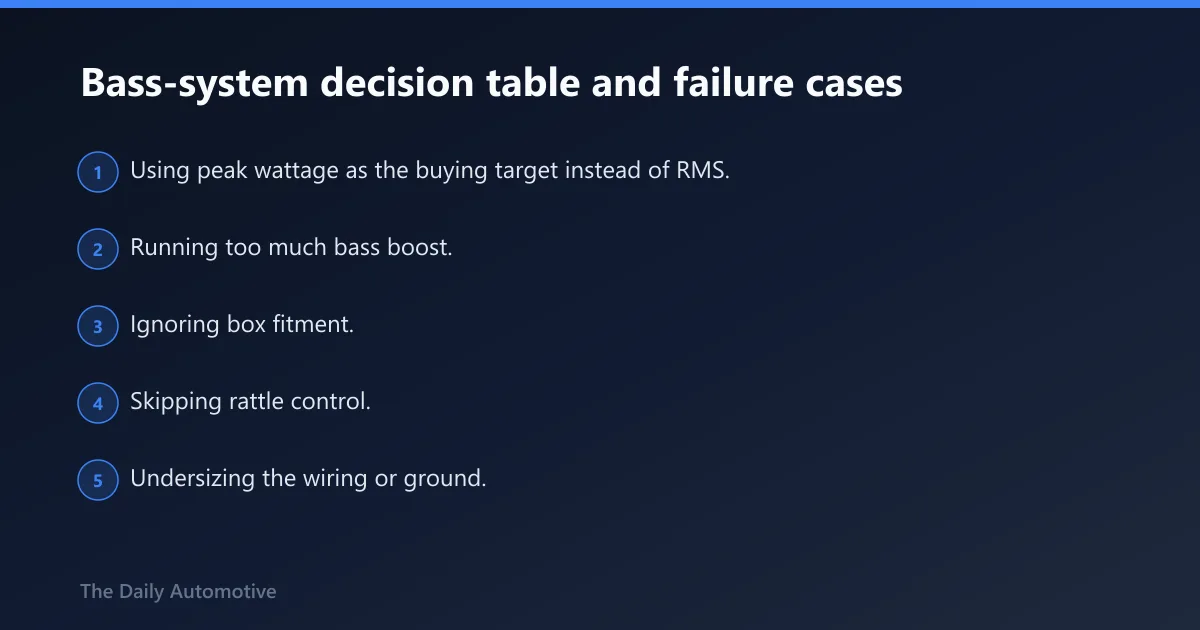
This is the part most product pages skip. Vehicle type, cargo room, and power support change the answer. A bass package that looks good on paper can fall flat in the wrong body style or with the wrong electrical setup.
| Vehicle type | Space limit | Listening goal | Best setup category | Why it fits |
|---|---|---|---|---|
| Sedan | Trunk opening and rear seat pass-through often limit box size | Deep bass with controlled cabin fill | Sealed 12-inch sub package | Smaller cabinet, better fitment, easier to tune for tight bass |
| Hatchback | More cargo flexibility than a sedan, but still limited depth | Strong daily bass without sacrificing cargo use | Sealed or compact ported 12-inch package | Good balance of output and usable space |
| Truck | Shallow cab space and seat clearance are the main limits | Clean bass upgrade without a large box | Under-seat powered sub or custom compact sealed box | Fitment matters more than raw cone area |
| SUV | More cargo room, usually enough for a larger enclosure | Hard-hitting bass for movies, rap, and loud playback | Ported dual 12-inch package | Extra volume and cabin gain favor bigger output |
Common mistakes: clipping, rattles, and electrical overload
- Using peak wattage as the buying target instead of RMS. That leads to amps that look big on paper but cannot deliver clean power.
- Running too much bass boost. This pushes the amp into clipping and makes the sub sound louder for a moment, then harsher and weaker.
- Ignoring box fitment. A box that is too large, too small, or not sealed well can erase the advantage of a good driver.
- Skipping rattle control. License plates, trim panels, and trunk lids can eat bass energy and make the system sound sloppy.
- Undersizing the wiring or ground. Heat, voltage drop, and poor performance show up fast when the amp is starved.
- Overloading the electrical system. If the alternator cannot keep up, voltage stability under load drops and the bass loses authority.
What the electrical system must be able to do
The car electrical system needs enough alternator headroom and battery capacity to hold voltage steady when the bass hits. If voltage sags, the amp clips earlier, output falls, and stress rises across the system.
Installation safety matters here as much as sound quality. Fuse placement, cable routing, and grounding are not cosmetic details. They are the difference between a proper bass build and a potential electrical problem.
When professional installation is the safer call
Professional installation is recommended when the amp draw is high, the vehicle needs trim removal or custom enclosure work, or the system will need electrical upgrades. It is also the safer route when the buyer wants the bass system tuned instead of merely connected.
A shop is often worth the labor cost when the plan includes a monoblock amp, 4-gauge wiring, trunk-based enclosure work, or a factory system integration. The extra labor can prevent clipped output, loose grounds, and the kind of rattles that make a strong setup sound cheap.
Which one should you buy
Buy the ported 12-inch setup if your first goal is maximum bass and you have the trunk or cargo room to support it. Buy the sealed 12-inch setup if you want strong bass with better fitment in a smaller space and cleaner daily-driver manners.
Buy the under-seat powered sub if space is the hard limit and you want a meaningful factory-sound upgrade without losing cargo room. It is also the best choice when the car is leased, the trunk must stay open, or the install has to stay simple.
For budget-minded buyers, a complete subwoofer package can be the smarter entry point because the enclosure and amp are already matched. For buyers who know their space, power needs, and tuning goals, separate components can deliver a better result, but only if the enclosure, amp, wiring, and electrical system are all chosen together.
Quick picks by need
- Most bass: Ported 12-inch package with a matched monoblock amp.
- Best for smaller trunks: Sealed 12-inch package.
- Smallest footprint: Under-seat powered sub.
- Fixing a damaged driver: Foam surround repair kit, not a new system.
How to choose
Start with the vehicle. Sedan, hatchback, truck, and SUV each change how much enclosure volume you can actually use.
Then match the enclosure to the listening goal. Ported for the most output. Sealed for tighter bass and less space use. Under-seat for convenience.
After that, match RMS power to the amp and confirm the wiring kit is sized for the load. Finish by checking alternator headroom, battery capacity, and whether the install needs professional help.
Frequently asked questions
Do I need a subwoofer for deep bass in my car?
Yes, if deep bass is the goal. Full-range speakers can play low notes, but they cannot move enough air to make bass feel physical. A subwoofer is the part of the system built for that job, and the enclosure determines how much of that bass you actually hear and feel.
What size subwoofer gives the most bass in a car?
Size helps, but the enclosure and power matter just as much. A well-designed dual 12-inch ported system will usually hit harder than a poorly matched larger setup. In a small car, a single 12-inch in the right box can outperform a bigger driver in the wrong enclosure.
Can a slim under-seat subwoofer still hit hard?
It can hit hard for its size, but it will not equal a trunk-mounted 12-inch system. Under-seat units are best for adding depth to factory audio and for drivers who need to save space. They are useful, just not physically capable of the same output as a full-size enclosure.
How much power does a bass car audio system need?
For many daily drivers, 300–1,000 watts RMS is a realistic target range. The exact number depends on the enclosure, sub size, cabin volume, and how loud the driver wants the system to play. Peak wattage is not the right number to build around.
Will my car electrical system handle a powerful subwoofer?
Only if the alternator and battery can keep voltage stable under load. A bigger amp may need stronger wiring, a better ground, or electrical upgrades. If the lights dim badly or the system clips early, the electrical side is probably falling behind the audio side.
Products related to this article
Sponsored / affiliate links. As an Amazon Associate I earn from qualifying purchases. I may earn additional commission from eligible campaigns.