What Happens If You Remove the Fuse Box in a Car
Many car owners wonder, What Happens If You Remove the Fuse Box in a Car?. It’s a common question, especially for those new to car mechanics or electrical systems. The fuse box is super important, but it can seem a bit tricky to understand.
Don’t worry! This guide will make it simple. We’ll go through everything you need to know, step by step, so you can feel confident.
Get ready to learn what happens and how it all works.
Understanding the Car Fuse Box
The fuse box is like the heart of your car’s electrical system. It holds many small fuses, and each one protects a different part of your car. Think of it like a guardian for your car’s electronics. If a part gets too much electricity, the fuse blows and stops the flow. This prevents damage to that part and the rest of your car. Removing it means these guardians are gone. This can stop many things from working, or worse, cause damage.
The Fuse Box’s Role
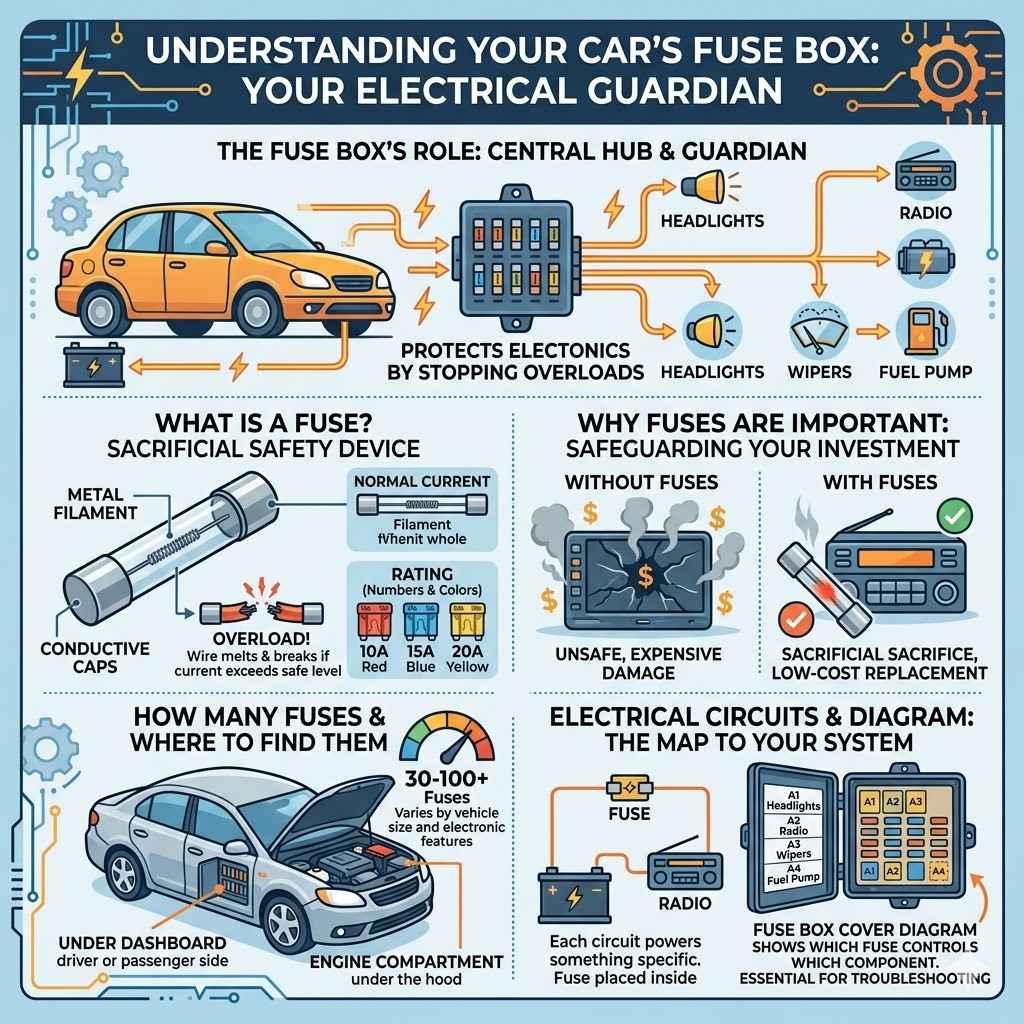
The fuse box is a central hub for electrical power distribution. It receives power from the battery and then directs it to various circuits throughout the vehicle. Each circuit is responsible for a specific function, such as powering the headlights, radio, windshield wipers, or fuel pump. Fuses are designed with a metal wire that melts and breaks if the current exceeds a safe level. This interruption is a safety feature.
What is a Fuse?
A fuse is a small electrical safety device. It contains a metal wire or filament. This wire is designed to melt and break when the electric current passing through it exceeds a safe level. This is called an overload. When the wire melts, it opens the circuit, stopping the flow of electricity. This protects the more expensive and sensitive components connected to that circuit from being damaged by too much power. Fuses are rated by the amount of current they can safely handle, indicated by a number and color.
How Many Fuses Are In A Car?
The number of fuses in a car can vary quite a bit. Most modern cars have between 30 to 50 fuses. Some larger vehicles or those with many electronic features might have even more, sometimes exceeding 100 fuses. These fuses are usually located in one or more fuse boxes. One common location is under the dashboard, often on the driver’s or passenger’s side. Another typical spot is in the engine compartment.
Why Fuses Are Important
Fuses are absolutely critical for your car’s safety and longevity. Without them, a sudden surge of electricity could fry delicate electronic components. Imagine a short circuit in your radio wiring. Without a fuse, that surge could easily damage the entire infotainment system, which can be very costly to replace. Fuses act as sacrificial lambs, protecting your investment. They are inexpensive to replace, unlike many of the parts they protect. This is why checking and replacing blown fuses is a common and vital car maintenance task.
Electrical Circuits Explained
An electrical circuit is a path for electricity to flow. It starts at the power source (like your car’s battery), goes through wires, components, and then back to the source. In a car, there are many separate circuits. Each circuit powers something specific, like your car’s starter motor or its interior lights. A fuse is placed within each of these circuits. This way, if the current gets too high in that one path, only that specific circuit is affected, and the rest of the car keeps working.
The Purpose of the Fuse Box Diagram
The fuse box diagram is your map to your car’s electrical system. It’s usually found inside the fuse box cover or in your car’s owner’s manual. This diagram shows you which fuse controls which component. Each fuse slot on the diagram will be labeled with the system it protects, like “Headlights,” “Radio,” or “Power Windows.” This is super helpful when a fuse blows. You can look at the diagram to find the correct fuse and
What Happens If You Remove the Fuse Box in a Car
Removing the entire fuse box from a car is a significant step and has widespread consequences. It’s not like pulling a single fuse; it’s like unplugging the main electrical control center. The immediate impact is that many, if not all, electrical systems will stop working. This is because the fuse box is the distribution point for power to all these systems. Without it, the electrical pathways are broken, and nothing can receive the necessary power to function.
Immediate Effects of Fuse Box Removal
When the fuse box is removed, the car’s electrical life support is cut off. The engine might crank if it’s purely mechanical, but it won’t start without the computer and fuel pump systems getting power. Lights, dashboard indicators, the radio, power windows, and door locks will all immediately cease to function. Even basic safety systems like airbags might be disabled because they rely on electrical power. The car effectively becomes a non-functional shell.
Loss of Engine Functionality
The engine control unit (ECU), often called the car’s computer, is vital for managing how the engine runs. It needs constant power to operate. If the fuse box is removed, the ECU loses its power source. This means it cannot communicate with other engine components like fuel injectors, spark plugs, and sensors. The fuel pump also needs power to deliver gasoline to the engine. Without power, it won’t run, and the engine will starve for fuel.
Disabling of Lights and Accessories
All the lights on your car, from headlights and taillights to turn signals and interior lights, are powered through fuses. Removing the fuse box means these circuits are disconnected. You will have no illumination, making driving impossible and unsafe. Accessories like the radio, air conditioning, power seats, and power windows also rely on fused circuits. They will all become inoperable.
System-Wide Electrical Failure
The fuse box is the central nervous system for your car’s electrical components. It ensures that each part receives the correct amount of power without overloading. Removing it means all these connections are severed. It’s like trying to run a house without its main electrical panel. Nothing will get power, and the entire network of electrical functions within the car collapses.
The Role of Relays
Relays are often found alongside fuses within the fuse box. They act as electrically operated switches. A small amount of current can be used to switch on a larger current. For example, your headlights draw a lot of power. A relay uses a low-power signal from a switch to control a high-power circuit for the lights. Removing the fuse box also removes these relays, further disrupting the flow of electricity to various systems.
Impact on Safety Systems
Modern cars have many safety features that are electronically controlled. These include anti-lock braking systems (ABS), traction control, electronic stability control (ESC), and airbags. These systems require a constant and reliable power supply, which they get from the fuse box. Removing the fuse box will disable these critical safety features. This makes the vehicle much less safe to operate, even if it could somehow be made to move.
Consequences and Risks of Fuse Box Removal
Removing a car’s fuse box is not a recommended procedure for any standard maintenance or repair. The consequences can be severe and far-reaching, leading to costly damage and safety hazards. It’s a situation that most car owners will never need to deal with, but understanding the risks is important. The primary risks revolve around irreversible damage to electrical components and the complete incapacitation of the vehicle.
Potential for Irreversible Electrical Damage
When the fuse box is removed, the protective layer that guards against power surges and short circuits is gone. If power were to be accidentally reconnected or if there was a fault elsewhere, components could be subjected to dangerously high voltages. This can burn out sensitive electronics like the car’s computer (ECU), various sensors, and control modules. Replacing these parts can be extremely expensive, often costing thousands of dollars.
Short Circuits and Fire Hazards
Without the fuses in place, any accidental short circuit becomes a significant fire hazard. A short circuit occurs when electricity takes an unintended path, often due to frayed wires touching. This creates a high current flow. Normally, a fuse would blow and stop this immediately. Without a fuse, the wires can overheat rapidly, melt their insulation, and ignite surrounding materials. This could lead to a serious car fire.
Damage to the Car’s Computer Systems
Modern cars rely heavily on a complex network of computers. The ECU, transmission control module (TCM), body control module (BCM), and many others manage nearly every aspect of the vehicle’s operation. These are highly sensitive and expensive components. Direct exposure to power fluctuations or faults without fuse protection can easily cause them to fail. Repairing or replacing these modules is a major undertaking.
Legal and Insurance Implications
Operating a vehicle without essential safety and functional components like those controlled by the fuse box is illegal. If an accident were to occur due to the vehicle’s inoperable state, there could be significant legal ramifications. Furthermore, insurance policies typically have clauses that exclude damage resulting from modifications or removal of safety-critical components. This means any repairs might not be covered, leaving the owner with the full financial burden.
Expert Intervention is Necessary
Dealing with automotive electrical systems, especially the fuse box, requires expertise. If there’s a problem with the fuse box or its components, it’s always best to consult a qualified mechanic or an auto electrician. They have the knowledge, tools, and diagnostic equipment to pinpoint the issue accurately and perform repairs safely. Attempting complex electrical repairs without proper training can lead to more problems than it solves.
Common Scenarios for Fuse Box Issues
While removing the fuse box is extreme, understanding why fuses blow is common. A blown fuse might be due to a faulty accessory, a worn-out component, or a short circuit. For example, if your cigarette lighter socket suddenly stops working, it’s likely a blown fuse. Another example is if your interior dome light stays on all the time, indicating a potential issue with its circuit that a fuse would normally manage. These are situations where a mechanic or owner might access the fuse box to diagnose and fix the problem by replacing a single fuse.
When and How to Access the Fuse Box Safely
Accessing the fuse box is a common task for car owners when dealing with minor electrical issues. It’s usually a straightforward process, but it’s important to do it correctly to avoid further problems. The key is to know where it is, how to open it, and how to identify the right fuses. Safety is paramount, so always disconnect the battery if you’re unsure or dealing with more than just a simple fuse swap.
Locating the Fuse Box
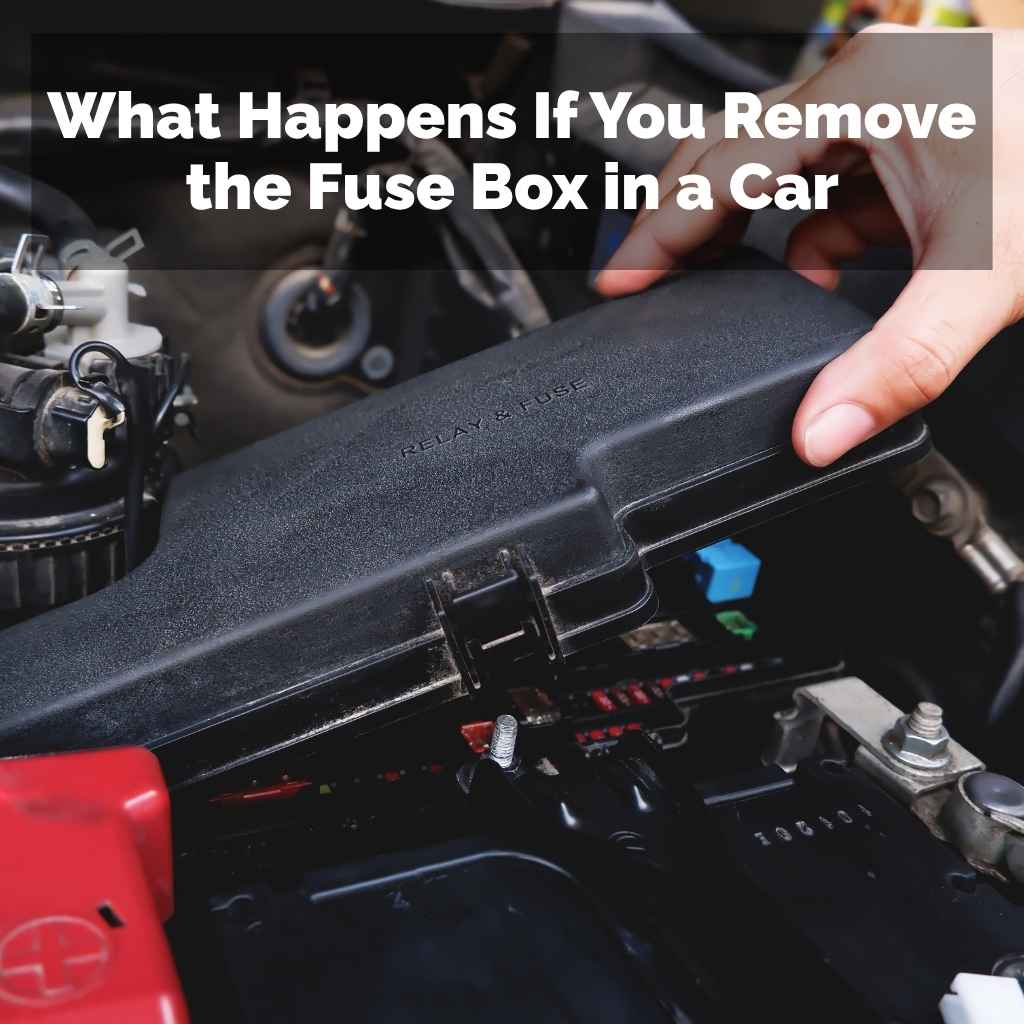
Most cars have at least two fuse boxes. One is typically located inside the passenger cabin, often under the dashboard on the driver’s or passenger’s side. It might be behind a small panel or door. The second fuse box is usually found in the engine compartment, under a cover, to protect it from the elements. Your car’s owner’s manual is the best resource for pinpointing the exact location for your specific make and model.
Identifying the Correct Fuse
Once you’ve opened the fuse box, you’ll see rows of fuses. Each fuse has a plastic casing and a metal prong. The amperage rating of the fuse is usually printed on its top. The fuse box cover often has a diagram or labels corresponding to the fuses. If not, your owner’s manual will provide a detailed diagram. This diagram is essential for identifying which fuse controls which part of your car.
Replacing a Blown Fuse
To
Safety Precautions When Working With Fuses
Safety is critical when working with any part of your car’s electrical system. Always ensure the engine is off and the ignition key is removed before you begin. If you’re unsure about what you’re doing, or if the issue seems more complex than a simple blown fuse, it’s best to seek professional help from a qualified mechanic. Working with electricity without proper knowledge can lead to serious injury or damage to the vehicle.
The Importance of the Correct Amperage
Using the correct amperage for
When to Call a Professional
If you’ve replaced a fuse and the problem persists, or if a new fuse blows immediately, there’s likely a more serious underlying electrical issue. This could be a short circuit, a faulty component, or a wiring problem. In such cases, it’s crucial to stop trying to fix it yourself and consult a professional auto mechanic or an auto electrician. They have the specialized tools and knowledge to diagnose and repair complex electrical problems safely and effectively.
Real-Life Scenarios and Examples
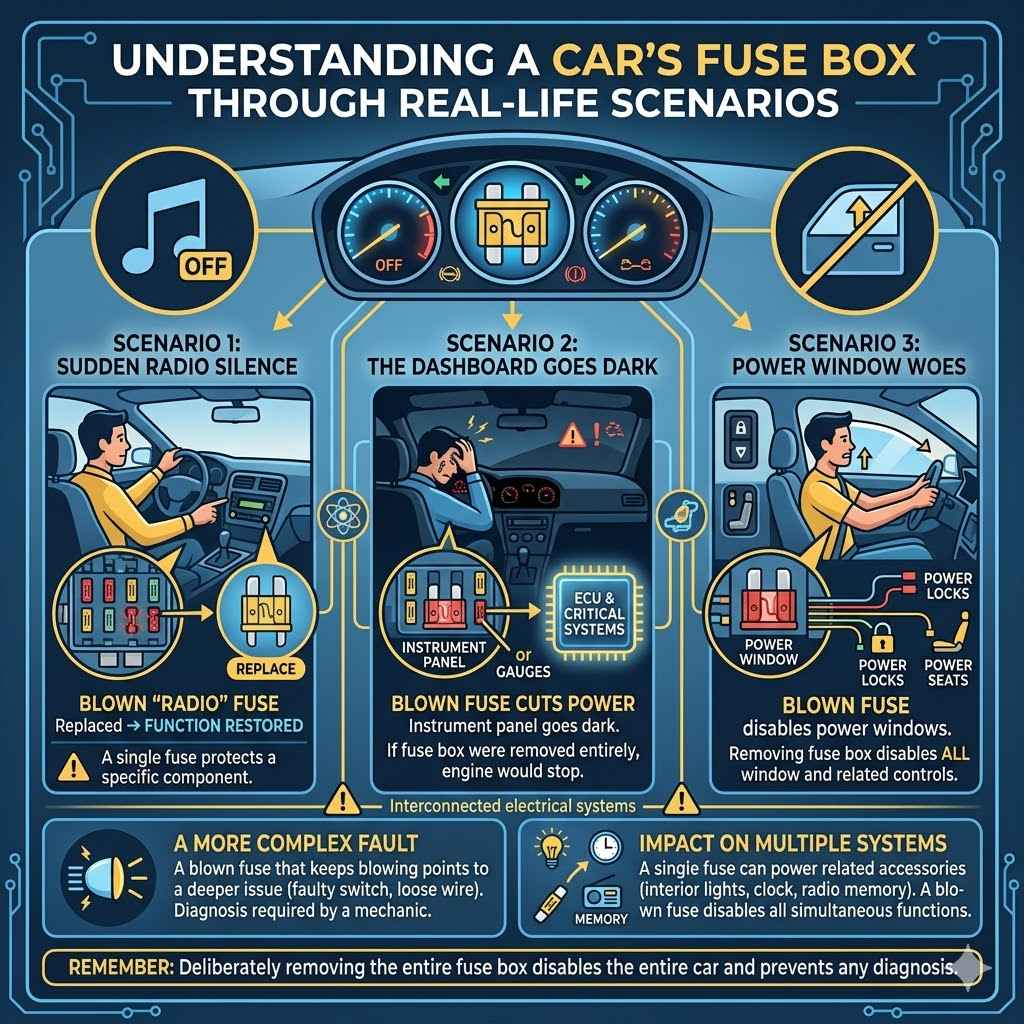
Understanding what happens if you remove the fuse box in a car can be clearer with real-life examples. While deliberately removing the entire fuse box is rare and highly inadvisable, electrical issues that mimic some of its effects are more common. These scenarios highlight the importance of the fuse box and its individual components in keeping a car operational.
Scenario 1 The Sudden Radio Silence
A driver might be enjoying their favorite music when suddenly the radio cuts out. They check the fuse box and find the fuse labeled “Radio” is blown. Replacing this single fuse with one of the same rating restores the radio’s function. This shows how a single fuse protects a specific component and how easy it is to fix. If they had tried to remove the entire fuse box, they would have lost power to many other systems, not just the radio, and created a much bigger problem.
Example of a Blown Fuse
Imagine a scenario where a driver plugs in a high-power phone charger into their car’s auxiliary power outlet (cigarette lighter). Suddenly, the outlet stops working, and so do any devices plugged into it. A quick check of the fuse box, guided by the owner’s manual, reveals that the fuse for the auxiliary power outlet has blown. Replacing this specific fuse restores power to the outlet, allowing the driver to charge their phone again. This is a common and easily resolved issue.
Scenario 2 The Dashboard Goes Dark
Another situation could be when a driver notices their dashboard lights, speedometer, and fuel gauge have all suddenly gone blank while driving. This is a more concerning issue. Upon inspection, they might discover that a fuse labeled “Instrument Panel” or “Gauges” has blown. Replacing this fuse might bring the dashboard back to life. If the fuse box were removed entirely, the engine would likely stop running too, as the ECU and other critical systems would lose power.
A More Complex Electrical Fault
Consider a car where the headlights intermittently fail. This could be due to a faulty headlight switch, a loose wire, or a failing relay within the fuse box. While a blown fuse might be involved, if it keeps blowing, it points to a deeper issue. A mechanic would inspect the wiring harness, the switch, and the associated relays and fuses to find the root cause. Removing the whole fuse box would shut off everything, preventing any diagnosis.
Scenario 3 The Power Window Woes
A common inconvenience is when one or more power windows stop working. Often, this is caused by a blown fuse dedicated to the power window system. Replacing this specific fuse is a simple fix. If the entire fuse box were removed, all the power windows, power door locks, and possibly even power seat adjustments would cease to function, creating a much more complex and widespread problem than a single faulty fuse.
Impact on Multiple Systems
In some cases, a single fuse can be responsible for powering multiple related accessories. For example, a fuse might protect the interior lights, the clock, and the radio memory. If this fuse blows, all these components would stop working. This illustrates how interconnected automotive electrical systems are and why the fuse box is so crucial. Removing it would disable all these functions simultaneously.
Frequently Asked Questions
Question: Can I drive my car if the fuse box is removed?
Answer: No, you cannot drive your car if the fuse box is removed. The fuse box is essential for powering critical engine components, lights, and the car’s computer system. Without it, the car will not start or operate.
Question: What happens if I try to start the car without a fuse in a specific slot?
Answer: If you try to start the car without a fuse in a slot that’s essential for starting (like for the ECU or fuel pump), the car will not start. Other accessories controlled by that slot will also not work.
Question: Is it dangerous to remove the fuse box?
Answer: Yes, it can be dangerous. Removing the fuse box leaves electrical components unprotected against surges and short circuits, which could lead to damage or even fire. It also disables all safety systems.
Question: How do I know which fuse to replace?
Answer: Your car’s owner’s manual will have a diagram showing which fuse controls which component. The fuse box cover itself may also have a diagram.
Question: Can I use a higher amperage fuse to fix a problem?
Answer: Never use a higher amperage fuse than what is specified. This can cause wires to overheat, damage electrical components, and create a fire hazard.
Wrap Up
Removing the fuse box in a car causes all electrical systems to fail. This includes essential functions like the engine, lights, and safety features. It is a critical component that protects your car’s electronics. Always ensure fuses are the correct rating when replacing them. If you face electrical issues, consult a professional.