Best Car Fire Extinguishers for Safety (2026): We Compared
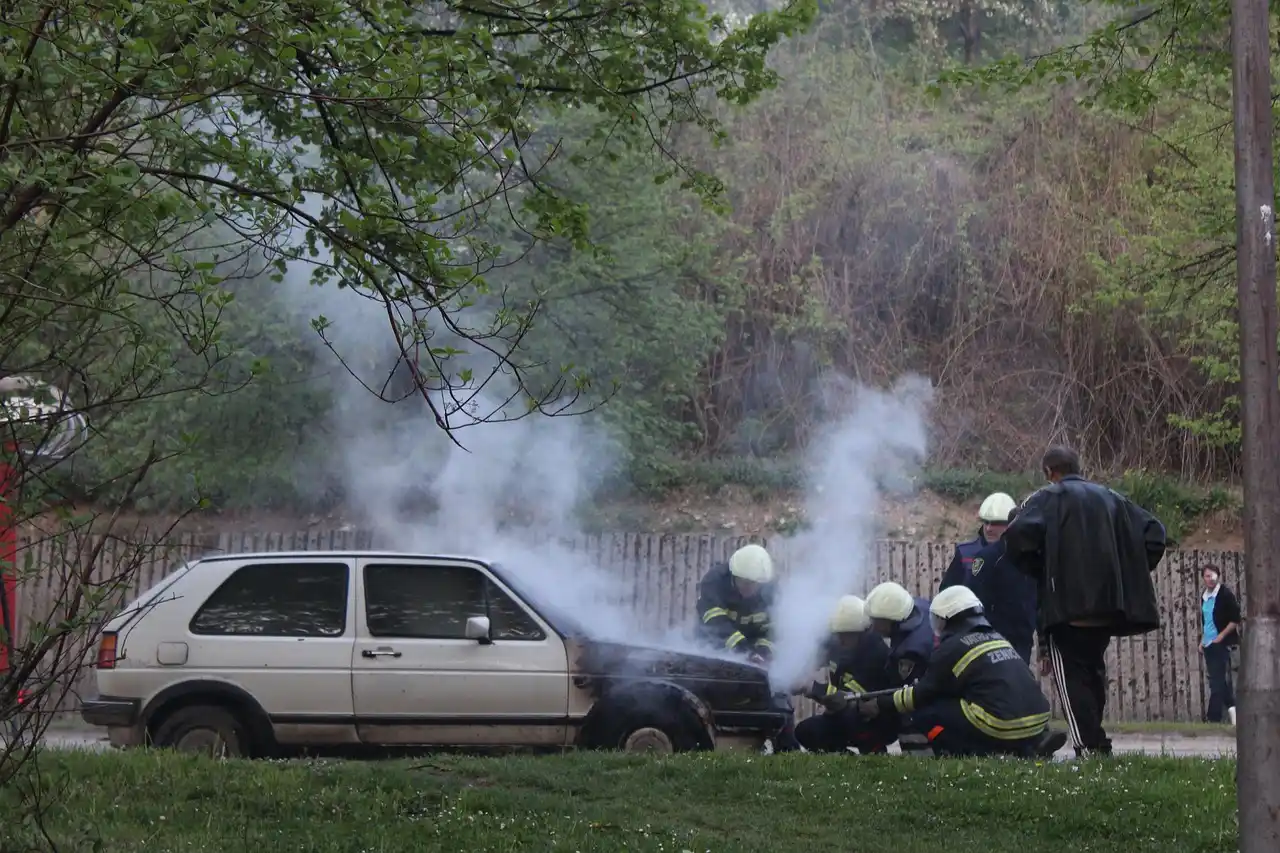
A compact car fire extinguisher is commonly a 2.5-pound ABC unit with a metal bracket, a gauge, and a quick-release mount. Fitment and usable mounting points vary widely by vehicle, so choose badly, and you burn time fumbling for it, spread residue across the cabin, or let a small under-hood fire turn into a total loss. This guide compares extinguisher types by fire rating, residue, mounting security, and how fast you can reach the handle.
Best overall car fire extinguisher: Kidde Pro Line 2.5 lb ABC Fire Extinguisher

This Kidde unit is presented as a strong all-around pick for many drivers because it combines a 2.5 lb ABC format with a metal vehicle bracket. In a passenger car, SUV, or pickup, that setup gives you wider coverage than a small auto-only bottle without moving into a bulky commercial-size unit.
It fits the usual advice for vehicle storage: enough agent to matter, but still small enough to mount where you can reach it fast. The tradeoff is mess. ABC dry chemical uses monoammonium phosphate in most ABC units, and it leaves residue, so it is a better suppression choice than a clean-agent unit when stopping the fire matters more than cleanup.
It is also the more practical choice for drivers who want one extinguisher that can handle cabin plastics, wiring, trim, and a small engine-bay fire. Based on the manufacturer’s specs and buyer feedback, that matters more than shaving off a small amount of size.
Why this unit leads the list
The main reason is balance. A 2.5 lb ABC extinguisher sits near the usual vehicle size target, and the included metal bracket helps keep it from becoming loose cargo in a crash. For a first-time buyer, that solves two problems at once: access and retention.
Who it fits best
Choose it if you drive a sedan, crossover, SUV, or light-duty truck and want one extinguisher that is easy to mount and broad enough for more than one fire source. It is also a sensible choice if you keep luggage, tools, or child gear in the cabin and need the extinguisher to stay in place.
One tradeoff to know
The dry chemical powder works well, but cleanup is the price. If the extinguisher goes off in a cabin or on electronics, expect residue on trim, upholstery, and switches. That is manageable, but it is not the low-mess choice.
Quick comparison
| Product | Badge | Best for | Price | ||
|---|---|---|---|---|---|
|
Pro Line 2.5 lb ABC Fire Extinguisher Metal Vehicle BracketKidde | Our pick | 2.5 lb · ABC · Metal Vehicle Bracket | $56.65
Price as of 17 Oct 2026
|
View |
 |
H3R Halon Fire Extinguisher for Car – HalGuard PRO CleanH3R Performance | Upgrade pick | 1.25 lb · Halguard PRO · Clean Agent | $330.00
Price as of 17 Oct 2026
|
View |
Use the table to compare rating, agent type, discharge style, and mounting needs before you buy. The best choice is not the highest number on the label; it is the unit you can reach, hold, and aim from a vehicle-safe location.
For most drivers, the key question is whether you want broader suppression with cleanup, or cleaner discharge with less runtime and less fire knockdown.
How we chose these extinguishers
We compared each option on four things that matter in a vehicle: UL rating, agent type, size, and how well the unit can be secured. That keeps the list focused on car use, not generic garage storage.
We also weighed access speed and inspection burden. A unit that is hard to reach, hard to secure, or hard to check is a weak choice even if its rating looks good on paper.
Finally, we gave extra weight to mounting security and maintenance. In a crash, an extinguisher that is not bracketed correctly can become a projectile. A unit with a gauge, service-life clarity, and durable hardware is easier to live with over time.
What size fire extinguisher should you keep in your car?
A 2 lb vehicle extinguisher is commonly a good fit for passenger cars because it is compact enough to store and heavy enough to matter on a small fire. If you want more coverage and do not mind the extra size, a 2.5 lb ABC unit is the next step up.
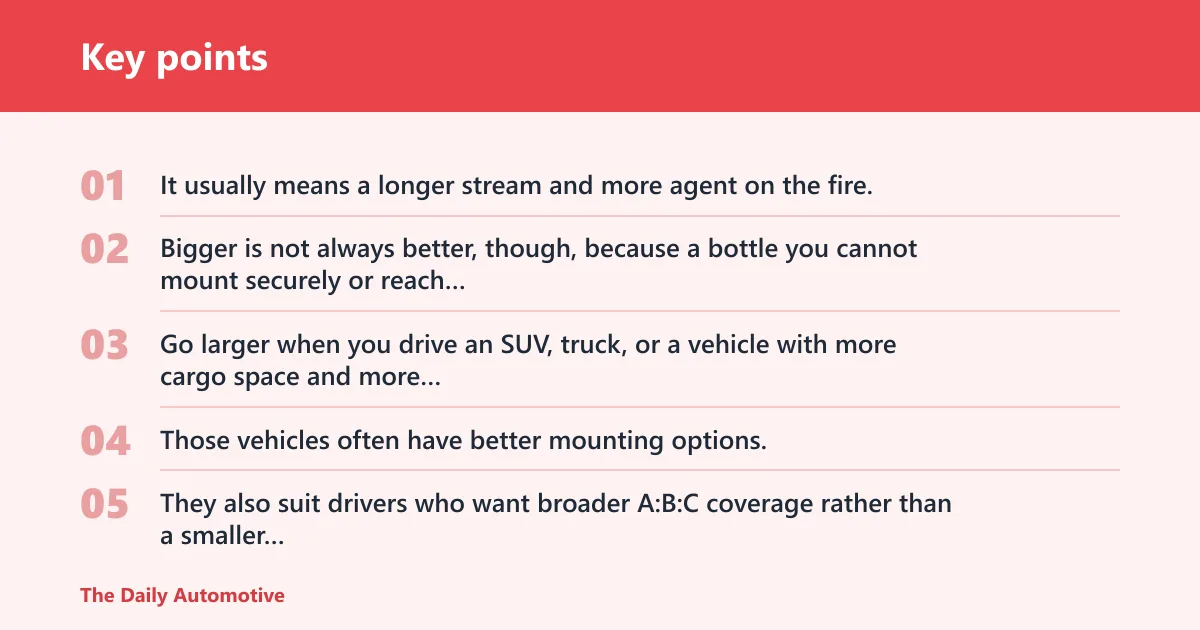
That extra half pound is not trivial. It usually means a longer stream and more agent on the fire, which helps when you are fighting heat from a wiring fault or fuel spill. Bigger is not always better, though, because a bottle you cannot mount securely or reach quickly is a poor trade.
When 2.5 lb ABC units make sense
Go larger when you drive an SUV, truck, or a vehicle with more cargo space and more electrical load. Those vehicles often have better mounting options, and the extra space makes a 2.5 lb ABC unit easier to secure without blocking passenger movement.
They also suit drivers who want broader A:B:C coverage rather than a smaller auto-specific bottle. If you may need to handle a seat, carpet, or cargo-area fire as well as a fuel or electrical one, broader coverage is worth the added size.
Why bigger is not always better
A larger extinguisher can be slower to grab, harder to mount, and more awkward to aim from a seated position. In a sedan, a unit that sits under a seat or beside a console may be more useful than a heavier bottle stored in the trunk.
Say your compact car has a small under-hood smoke event at a gas station. A 2 lb unit clipped near the driver seat is likely to be reachable in seconds; a larger bottle buried in cargo may not be.
Dry chemical vs clean agent
Dry chemical extinguishers use sodium bicarbonate in some classes and ABC powder in others, and they are common because they are affordable and effective on vehicle fires. Clean agent units use a different suppression approach and leave no residue, but in this article the H3R example is the one presented as a cleaner-discharge option.
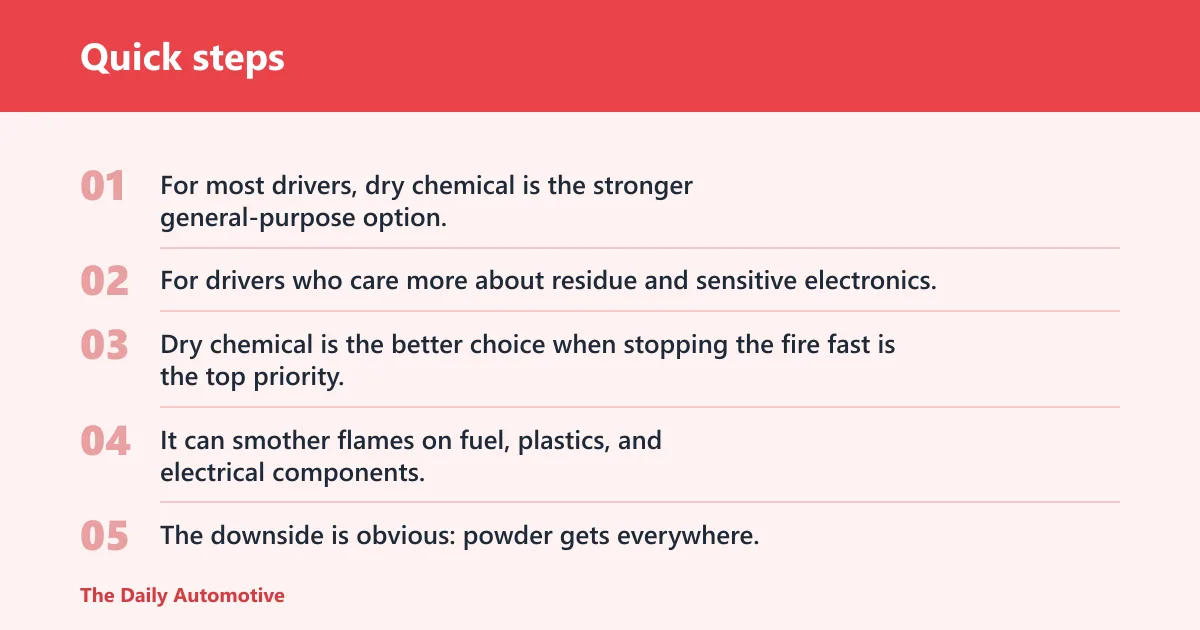
For most drivers, dry chemical is the stronger general-purpose option. For drivers who care more about residue and sensitive electronics, clean agent can be worth the tradeoff, but you should understand what you give up in suppression time.
Dry chemical: strong knockdown, messy cleanup
Dry chemical is the better choice when stopping the fire fast is the top priority. It can smother flames on fuel, plastics, and electrical components, which is why it dominates basic vehicle extinguishers. The downside is obvious: powder gets everywhere.
That mess matters more in a cabin than in a truck bed or engine bay. It can contaminate switches, vents, and upholstery, and it often takes more cleanup than drivers expect.
Clean agent: no residue, shorter discharge time
Clean agent units avoid the powder mess and are easier on cleanup-sensitive interiors. The tradeoff is that the H3R example here is presented with a smaller fire rating and a shorter discharge time than the dry chemical pick, which makes it less forgiving if you need repeated bursts or have to reach around hot components.
H3R MaxOut MX100 uses HFC-236fa clean agent and carries a 1-B:C rating. That is useful for low-residue use, but it is not the same as the broader ABC approach you get from a dry chemical bottle.
What changes for EV and hybrid owners
Hybrid and EV owners should think less about residue and more about access, thermal hazards, and escape time. A small extinguisher can help with trim, wiring, or an accessory fire, but it is not a cure for a battery event. The goal is to buy time and support evacuation, not to promise a total fix.
For those vehicles, storage location matters more than in many gas-only cars. Keep the unit within arm’s reach of the driver or front passenger, not under cargo or in a rear compartment that may be cut off by smoke or heat.
Do car fire extinguishers need a bracket?
Yes. A secure bracket is essential because loose extinguishers can become projectiles in a crash. It also keeps the handle pointed where you expect it, which matters when you are reaching for the unit under stress and visibility is poor.
Bracketed storage is not just about convenience. It prevents damage to the extinguisher body, protects the valve, and reduces the odds that the unit gets buried under cargo or slides out of reach.
Bracket included vs bracket sold separately
If the extinguisher includes a bracket, that is one less thing to source and one less compatibility question. First Alert AUTO5 includes a mounting bracket, and Kidde FA110 also includes a mounting bracket. That improves the odds that the unit is actually installed, not left loose in the car.
If the bracket is sold separately, confirm the fit before you buy. The bracket should hold the cylinder securely without rattling, and the latch should allow quick release with one hand.
Best mounting spots by vehicle type
In a sedan or compact car, the front seat base or a fixed point near the center console is usually the best compromise between access and security. In an SUV, a side cargo wall or seat-base mount can work if it does not block loading or rear-seat entry.
In a truck, many drivers place it behind the driver seat or along the lower center tunnel where it is easy to reach from the cab. For EVs and hybrids, keep it in the front cabin where you can grab it before smoke fills the rear.
Vehicle extinguisher decision table
| Use case | Minimum rating | Preferred agent | Ideal weight | Bracket requirement | Maintenance burden | Best storage location |
|---|---|---|---|---|---|---|
| Sedan or compact car | 5-B:C minimum; 1-A:10-B:C if you want broader coverage | Dry chemical | 2 lb to 2.5 lb | Required | Low to moderate; check gauge and service life | Under front seat or beside the center console |
| SUV | 5-B:C minimum; 1-A:10-B:C preferred | Dry chemical | 2.5 lb | Required | Low to moderate; inspect bracket and charge status | Front cabin or fixed cargo-wall mount |
| Truck | 1-A:10-B:C or higher | Dry chemical | 2.5 lb | Required | Low to moderate; watch for vibration damage | Behind driver seat or lower cab mount |
| Hybrid or EV | 5-B:C minimum; 1-A:10-B:C helpful for non-battery fires | Dry chemical for maximum suppression, clean agent if residue is the priority | 2 lb to 2.5 lb | Required | Moderate; keep inspection on a schedule | Front cabin within arm’s reach |
First Alert AUTO5: best for a simple vehicle backup
First Alert AUTO5 is the easier pick if you want a straightforward vehicle extinguisher with a documented 5-B:C UL rating and a mounting bracket. That rating clears the minimum benchmark many drivers use for car fires, and the bracket makes the unit easier to secure where it belongs.
This is a sensible option for drivers who want a compact backup for a sedan or small SUV and do not need the wider coverage of a larger ABC unit. The drawback is that 5-B:C is a minimum vehicle rating, not a full answer for every cabin or cargo-area scenario.
It fits drivers who want a dedicated car unit more than a general home-and-garage extinguisher. The downside is that it gives up some breadth compared with larger ABC models, so it is less flexible if you expect mixed fire types.
H3R Halon Fire Extinguisher for Car: best for less residue
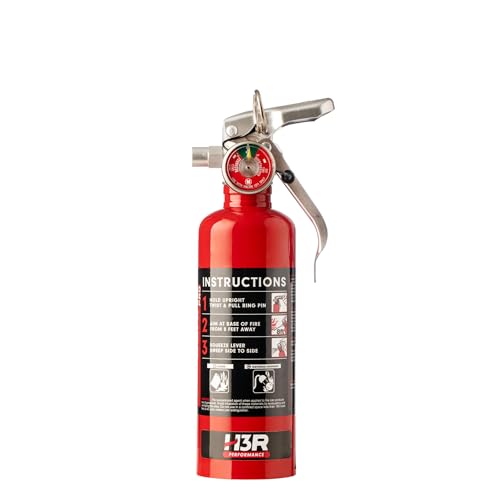
This H3R Performance unit is the best fit if cleanup is your top concern and you want a clean-agent format.
It is the better pick for buyers worried about powder contamination on electronics, upholstery, and tight interior spaces. The drawback is the smaller fire rating and shorter discharge time compared with a dry chemical ABC bottle, so it is not the strongest all-around suppression choice.
It makes the most sense for owners who value low residue above everything else, especially in a well-kept interior where a discharge event would be costly to clean. If you want the widest suppression margin, the dry chemical pick above is the stronger buy.
Which one should you buy?
Buy the Kidde 2.5 lb ABC unit if you want the best all-around choice for most cars, SUVs, and light trucks. It is the strongest balance of rating, size, and mounting security among the options here.
Choose the First Alert AUTO5 if you want a simpler, smaller backup and you are comfortable with the minimum 5-B:C vehicle benchmark. It is a practical fit for compact cars where bracketed storage and quick access matter more than broader coverage.
Choose the H3R clean-agent unit if your top concern is residue and you are willing to accept less discharge time and a lower B:C rating. That is a narrower use case, but it is a real one for drivers who want less cleanup around electronics and upholstery.
Suppose your crossover carries child seats, sports gear, and charging cables in the back. A 2.5 lb ABC extinguisher mounted in the front cabin is more useful than a smaller unit buried under cargo, because the first seconds matter more than total bottle weight.
One common first-timer mistake is leaving the extinguisher in the trunk because it feels “out of the way.” In a fire, out of the way usually means out of reach, and that is the wrong trade.
For trucks and larger SUVs, the 2.5 lb ABC format is the better default. For hybrids and EVs, keep the same size discipline, but pay even more attention to front-cabin storage, bracket security, and inspection cadence.
Frequently asked questions
What size fire extinguisher should I keep in my car?
A 2 lb extinguisher is the usual passenger-car fit, and a 2.5 lb ABC unit is the better choice if you want more agent without making the bottle too bulky. The key is whether you can mount it securely and reach it from the driver’s seat.
Is a 5-B:C extinguisher enough for a vehicle?
Yes, 5-B:C is a basic vehicle benchmark and can be enough for a small car fire if you react quickly. But if you want broader coverage for interior materials and wiring, a 1-A:10-B:C unit gives you more margin.
Should I choose dry chemical or clean agent for a car extinguisher?
Choose dry chemical if you want stronger general-purpose fire knockdown and are willing to clean up residue afterward. Choose clean agent if you want less mess and are mainly worried about the cabin, but accept shorter discharge time and lower B:C performance.
Do car fire extinguishers need a mounting bracket?
Yes. A bracket keeps the extinguisher from shifting, sliding, or becoming a projectile in a crash. It also makes the unit easier to grab quickly, which matters more than almost any label rating when seconds count.
How often should I check or replace a car fire extinguisher?
Check the pressure gauge monthly, look for damage to the cylinder and bracket, and confirm the service life or expiration date on the label. Replace or service the unit if the gauge is out of range, the mounting hardware is broken, or the unit shows corrosion or impact damage.
Will a clean-agent extinguisher damage car electronics?
Clean agent is generally the lower-residue choice, so it is less likely to leave conductive powder on electronics. That said, no extinguisher is harmless in every scenario, and the bigger issue is whether the fire is contained fast enough to protect the vehicle and get everyone out safely.
Products related to this article
Sponsored / affiliate links. As an Amazon Associate I earn from qualifying purchases. I may earn additional commission from eligible campaigns.