What Is Considered Open Carry in a Car? Explained Simply
Open carry in a car usually means the firearm is plainly visible and not hidden from ordinary sight; if it is covered, in a closed compartment, or under your body, some states may treat it as concealed. A mistake can lead to a weapons charge, a permit problem, or a traffic stop that turns into a criminal case. This guide explains the common vehicle locations that count as open carry or concealed carry, plus the state-law wrinkles that change the result.
Open carry in a car: the basic rule
What open carry means in plain terms
Open carry in a vehicle usually turns on visibility. If another person can see the firearm without opening a door, lifting a lid, or digging through storage, some states may treat it as open carry. If the gun is hidden from ordinary view, the analysis often shifts to concealed carry or transport rules.
Why visibility matters inside a vehicle
A car can change the carry analysis because the cabin has both exposed areas and enclosed storage. A firearm on a visible belt holster can stay in the open category in some states, while the same gun moved into a glove box, console, or under-seat space can become concealed. The exact result depends on state law, and sometimes on whether the gun is loaded.
How concealed carry differs at a glance
Concealed carry means the firearm is hidden from ordinary view. In many states, that can include a gun in a glove box, center console, under a seat, or inside a bag in the cabin. Many states also require a permit or license for concealed vehicle carry, though some allow permitless carry under defined conditions.
Where does a gun stop being open carry?
Glove box and center console
A gun in the glove box or center console is one of the most common trouble spots. Those spaces are enclosed compartments, so many states treat them as concealed carry rather than open carry. Access method can matter too: opening a lid to reach the firearm usually supports the concealed-carry view, not the open-carry view.
Under-seat storage and enclosed compartments
Putting a firearm under the seat usually moves it away from open carry and into concealed or transport-only territory. Even if part of the gun can be glimpsed, courts and police often look at whether it is hidden from ordinary view and whether the driver can access it without moving body parts or vehicle equipment.
What a mounted holster changes
A holster can support open display only when the firearm is actually visible and lawfully placed. A body-mounted holster on the driver’s belt is different from a holster clipped to the seat, dash, or console. Once the gun is tucked partly behind trim or covered by the seat edge, the open-carry argument gets weaker.
Is a holster enough in a car?
Body-mounted holsters versus cabin mounts
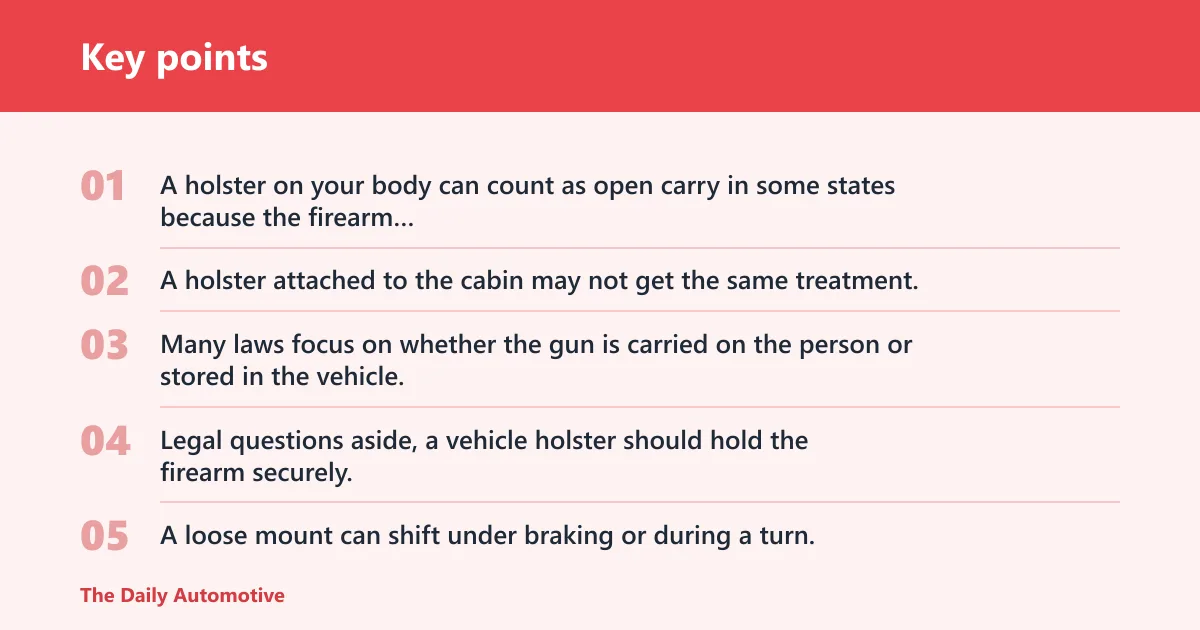
A holster on your body can count as open carry in some states because the firearm remains visible on the person. A holster attached to the cabin may not get the same treatment. Many laws focus on whether the gun is carried on the person or stored in the vehicle, and that distinction can change the legal category fast.
Retention, trigger coverage, and safe placement
Legal questions aside, a vehicle holster should hold the firearm securely, cover the trigger, and keep the muzzle pointed in a safe direction. A loose mount can shift under braking or during a turn. That is a safety issue even before state law enters the picture. A firearm that can slide free in a crash is a bad storage choice.
When a visible holster still may not solve the legal issue
Visibility does not create a universal right to carry in a car. Some states restrict loaded open carry in vehicles, some limit carry in certain cities or school zones, and some treat a vehicle differently from a sidewalk or parking lot. A visible holster may still fail if the state requires a permit for vehicle carry or bars carry on that roadway.
Loaded firearm rules in vehicles
Why loaded status can change the law
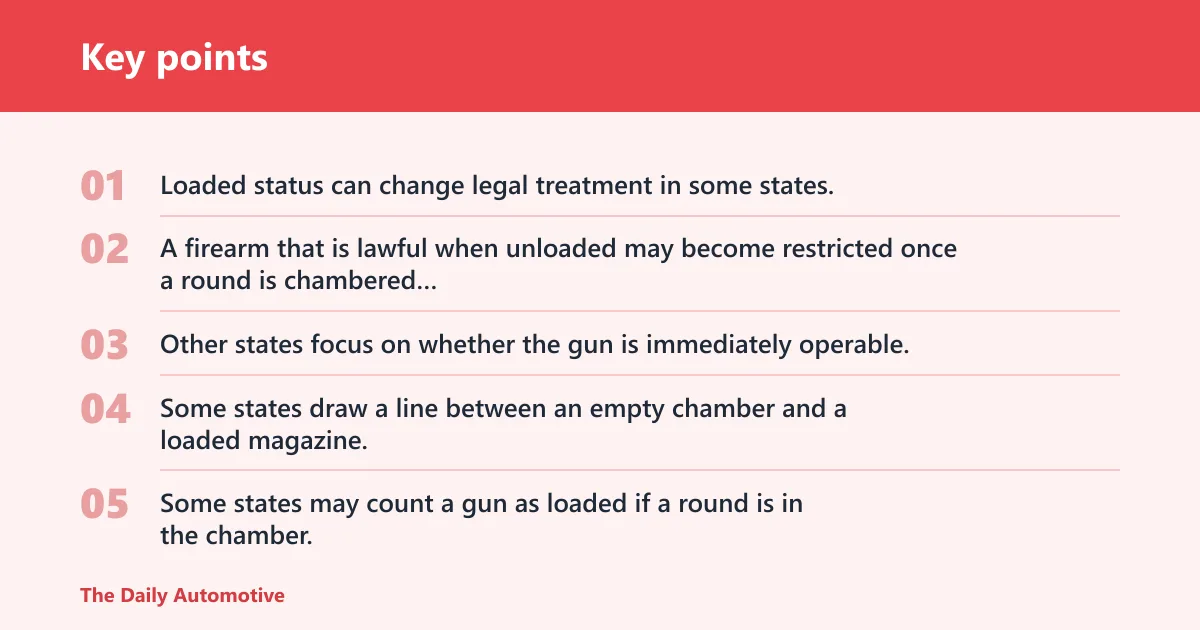
Loaded status can change legal treatment in some states. A firearm that is lawful when unloaded may become restricted once a round is chambered or a magazine is inserted. Other states focus on whether the gun is immediately operable, so the same setup can be treated differently depending on local law.
Magazine-in versus chamber-loaded distinctions
Some states draw a line between an empty chamber and a loaded magazine. Some states may count a gun as loaded if a round is in the chamber, if a magazine is inserted, or if ammunition is close at hand in the same compartment. That is why you should not assume a gun is “unloaded enough” for vehicle carry just because the chamber is clear.
Say your pistol is visible in a belt holster while you drive across town. If the state allows visible open carry in vehicles and does not restrict loaded carry there, that setup may be lawful. Move the same pistol into the center console, and the analysis can flip even though nothing else changed.
Why state rules vary so much here
Vehicle carry laws differ by state, and they may differ for drivers and passengers, loaded and unloaded firearms, highways, school zones, and private property. One state may allow visible loaded carry in a car without a permit. Another may require a license, or treat any accessible loaded firearm in the cabin as concealed carry.
Vehicle carry checklist
Use this as a decision path, not as legal advice. If any answer points to concealed carry, transport-only rules, or interstate travel, check the exact statute for that state and the specific roadway before driving.
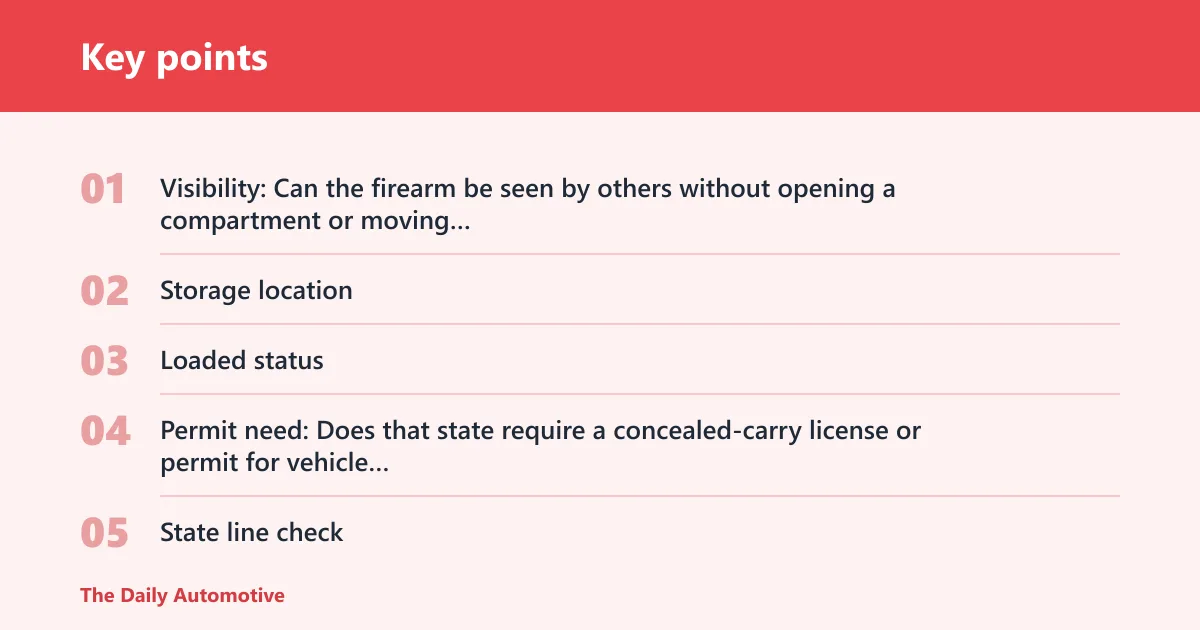
- Visibility: Can the firearm be seen by others without opening a compartment or moving the driver’s body?
- Storage location: Is it on the body in plain view, or inside a glove box, console, under-seat space, trunk, or locked case?
- Loaded status: Is the firearm loaded, with a chambered round or inserted magazine that may count as loaded in that state?
- Permit need: Does that state require a concealed-carry license or permit for vehicle carry, or does it allow permitless carry?
- State line check: Are you crossing into another state, entering a school zone, or driving onto private property with posted rules?
| Vehicle location | Typical legal treatment | Why it matters | Common caution |
|---|---|---|---|
| Glove box | Often concealed or transport-only | Enclosed compartment hidden from ordinary view | May require a permit or a specific transport rule |
| Center console | Often concealed or transport-only | Usually enclosed and closed to view | Access method can matter if the gun is loaded |
| Seat holster | Can be open carry or concealed, depending on placement | Visibility and attachment point control the analysis | Partly hidden mounts weaken the open-carry argument |
| Trunk | Common transport storage | Separated from the passenger cabin | Accessibility may affect whether it counts as carry or transport |
| Locked case | Often transport-focused | Signals restricted access and storage | Some states still regulate loaded contents or vehicle access |
A common first-timer mistake is assuming a locked case in the back seat is always the same as a trunk. It is not. In some places, the difference between a separated trunk and a case within arm’s reach can affect whether the firearm is treated as carry, transport, or concealed storage.
Can passengers open carry too?
Driver rules versus passenger rules
Passengers can face different rules from the driver. Some states allow a driver to keep a visible holstered firearm while limiting what a passenger can do in the same cabin. The same source states focus on who owns the firearm, who can access it, or whether the person has a permit. The same vehicle can therefore produce different legal outcomes for different people.
How passenger access changes the analysis
Passenger access matters because a shared cabin can create a hidden-carry issue even when the firearm is visible to one occupant. A gun in the rear seat may be visible to the driver but concealed from outside view. A passenger who can reach it without leaving the seat may also trigger separate possession or accessibility rules.
Why a shared cabin can create different legal outcomes
Shared access complicates classification. A firearm on the front passenger’s hip may be open carry for that person in one state, while the driver’s center-console storage may be concealed carry under the same law. That is why the driver, the passenger, and the storage location should each be checked separately.
Frequently asked questions
What is considered open carry in a car?
Open carry in a car usually means the firearm is visible to ordinary view and not tucked into a covered compartment. A belt holster or another plainly visible carry method may qualify in some states. Closed storage, under-seat placement, and hidden compartments usually push the firearm toward concealed carry instead.
Is a gun in the glove box considered open carry or concealed carry?
A gun in the glove box is often treated as concealed carry or transport, not open carry. The glove box is an enclosed compartment, and the firearm is hidden from ordinary view. Some states also require a permit for that kind of vehicle carry, so local law matters a great deal.
Do I need a permit to have a firearm in my car?
Maybe. Some states require a concealed-carry permit or license for a firearm stored or carried in a vehicle, while others allow permitless carry under specific rules. The answer can also change for residents versus nonresidents, and for loaded versus unloaded firearms. Check the state law and the route you are taking.
Can a loaded gun be in a car if it is visible?
Sometimes, but not always. A visible firearm is not automatically lawful just because it is in the open. Some states restrict loaded carry in vehicles, and some count a firearm as loaded when a magazine is inserted or ammunition is otherwise immediately available. State rules control the result.
Can I have a gun in a center console or under the seat?
Those locations usually create concealed-carry problems. A center console is typically enclosed, and under-seat storage is often hidden from ordinary view. In many states, those placements are treated as concealed carry or storage rather than open carry, and a permit or transport rule may be required.
Can passengers also open carry in a vehicle?
Sometimes, but passenger rules can differ from driver rules. A passenger may be allowed to carry a visible firearm in one state and barred from doing so in another, even inside the same vehicle. Access, visibility, and who controls the firearm can all affect the legal analysis.
Products related to this article
Sponsored / affiliate links. As an Amazon Associate I earn from qualifying purchases. I may earn additional commission from eligible campaigns.
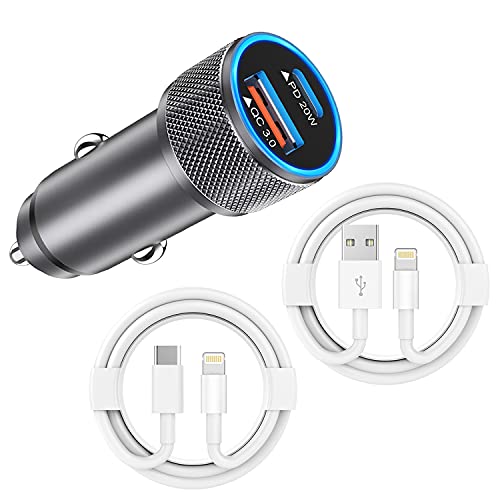 iPhone Car Charger,USB C Fast Car Charger[Apple MFi Certified] Apple Car Charging 38W Dual Port CarCharger Cigarette Lighter Adapter 2x3ft PD&QC 3.0 Lightning Cable for iPhone 14/13/12 Pro/11/Airpods
 Portable Car Heater Car Heater, Portable Electronic Auto Heater Fan Fast Heating Defrost 12V 120W Car Defrost Defogger, 2 in 1 Heating/Cooling Function 3-Outlet, Plug Adjustable