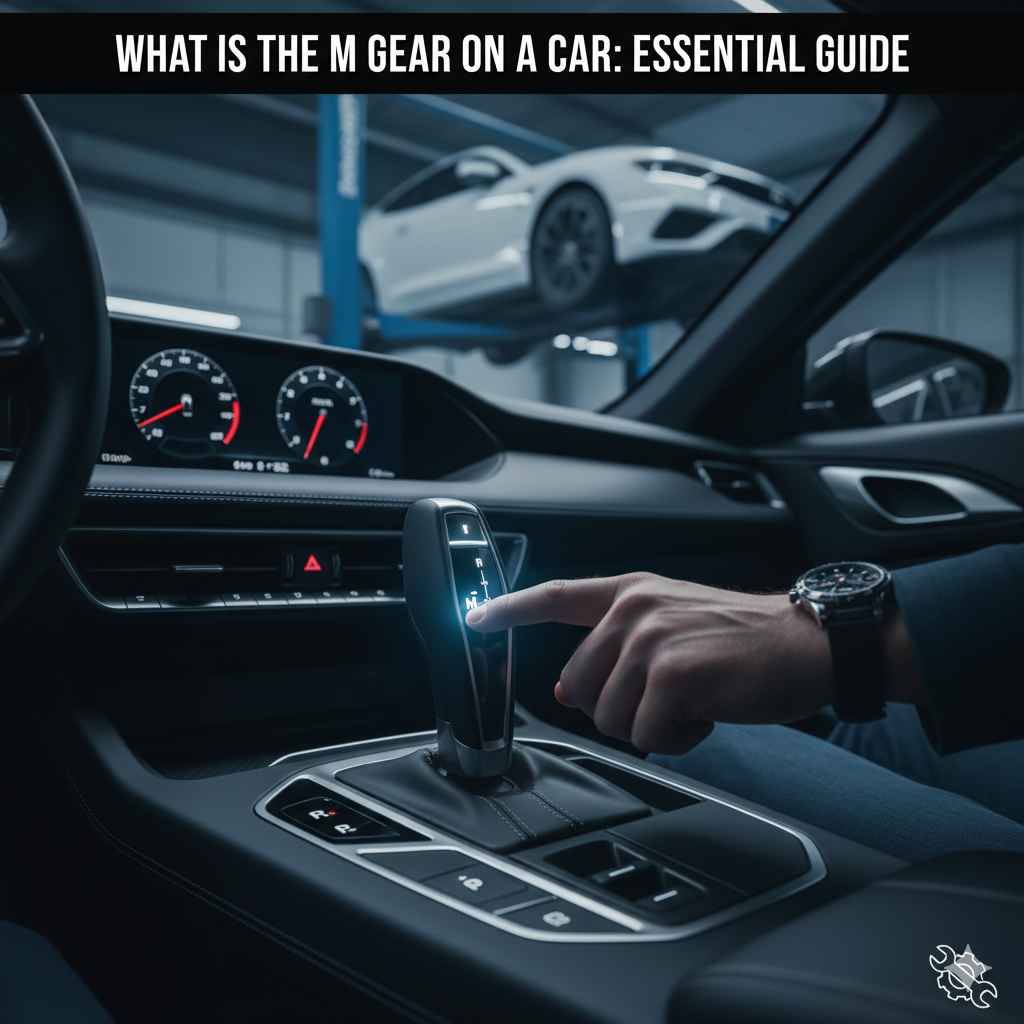
What Is The M Gear On A Car: Essential Guide
The “M” gear on an automatic car is a manual mode that lets you control gear shifts, offering more power for acceleration or engine braking for slowing down, enhancing driving engagement and performance without needing a clutch pedal.
It’s a mystery for many drivers – you’re cruising along, enjoying your automatic car, and then you notice a curious little “M” on your gear shifter. What exactly does it mean? Many car owners see this symbol and feel a bit confused, wondering if activating it is safe or even beneficial. Don’t worry, you’re not alone! Understanding the “M” gear can unlock a more responsive and enjoyable driving experience. This guide will break down what the “M” gear is, how it works, and when you can use it to your advantage, all in simple terms. Let’s demystify this feature and get you driving with more confidence!
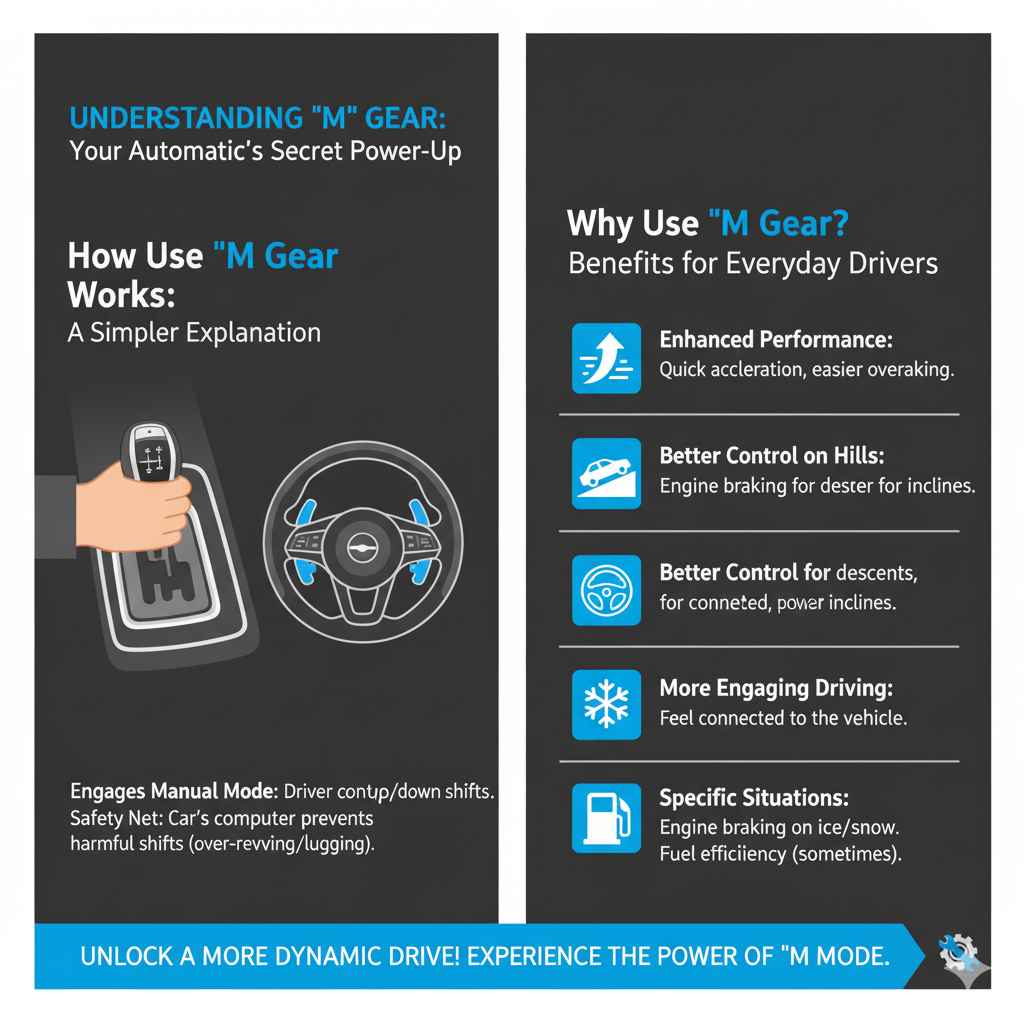
Understanding the “M” Gear: Your Automatic’s Secret Power-Up
So, what exactly is the “M” gear on a car? In most modern automatic transmissions, the “M” stands for Manual mode. It’s a fantastic feature that bridges the gap between a traditional automatic and a manual transmission. Think of it as giving you, the driver, the reins to control the gears yourself, without needing to operate a clutch pedal.
When you shift your automatic transmission into drive (“D”), the car’s computer decides when to shift gears based on speed, engine load, and other factors. It’s designed for maximum fuel efficiency and smooth comfort. However, sometimes you want a bit more control, perhaps for when you need a quick burst of acceleration or want to slow down more using the engine itself. That’s where the “M” gear comes in handy.
How the “M” Gear Works: A Simpler Explanation
In essence, engaging “M” tells the car’s transmission computer, “Okay, I’ll tell you when to change gears now.” Instead of automatically shifting up or down, the transmission waits for your input. Typically, you’ll see this initiated by moving the gear selector from “D” to “M.” Once in “M,” you’ll usually use either the gear shifter itself (often by nudging it forward or backward) or paddle shifters located on the steering wheel.
Upshifting: When you want to go to a higher gear (e.g., from 2nd to 3rd), you’ll nudge the shifter forward or press a specific paddle. The car will only shift up if your current speed and engine RPMs are appropriate for the next gear.
Downshifting: To drop to a lower gear (e.g., from 4th to 3rd), you’ll typically pull the shifter back or press a different paddle. This is useful for acceleration bursts or for engine braking.
The car’s computer still acts as a safety net. It won’t let you shift into a gear that would be too high for your current speed (over-revving the engine) or too low that it would cause the engine to lug uncomfortably. It manages these extremes, ensuring your engine stays within safe operating limits.
Why Use “M” Gear? Benefits for Everyday Drivers
You might be wondering why bother with “M” mode when your car shifts perfectly fine on its own. Here are some compelling reasons why this feature can be a game-changer for your driving:
Enhanced Performance and Responsiveness: When you need to accelerate quickly, like merging onto a highway or overtaking, shifting down manually can give you an immediate power boost. The car will be in a lower gear with higher RPMs, ready to unleash more power.
Better Control on Hills: Going uphill? Staying in a lower gear in “M” can maintain engine power better than the automatic might. Going downhill? Downshifting in “M” allows for engine braking, which helps control your speed without constantly relying on your brakes. This reduces brake wear and is safer, especially on long descents.
More Engaging Driving Experience: For those who enjoy a more connected feel to their vehicle, “M” mode offers a more interactive driving experience. It allows you to feel more in control and understand how your car’s gears affect its performance.
Improved Fuel Efficiency (Sometimes): While not its primary purpose, if you’re a smooth driver, you can sometimes improve fuel economy by carefully managing shifts. For instance, you might delay an upshift slightly on a flat road if you’re not accelerating hard. However, aggressive use of “M” mode for performance will generally use more fuel.
Engine Braking for Specific Situations: Beyond hills, engine braking can be very useful in slippery conditions. Gentle downshifting can help you decelerate smoothly without causing the wheels to lock up, which is a risk with sudden braking on ice or snow.
Types of “M” Gear Implementations
The “M” gear isn’t a one-size-fits-all feature. Manufacturers have developed different ways to implement this manual control. Understanding these variations can help you identify what’s in your car.
1. Shifter-Based Manual Mode
This is perhaps the most common type. You’ll find the “M” setting on your center console gear shifter.
How it looks: The gear selector typically has a sequence like P-R-N-D, and then a slot for “M” or “S” (Sport).
How to use it: Once you move the lever into the “M” position, you then use the shifter itself to change gears. This usually involves pushing the lever forward to upshift and pulling it back to downshift, or vice versa depending on the manufacturer.
2. Paddle Shifters
Many newer cars, especially those with a sporty feel, come equipped with paddle shifters mounted behind the steering wheel.
How it looks: You’ll see metal or plastic paddles, usually marked with a “+” for upshifting and a “-” for downshifting.
How to use it: These paddles are often connected to a specific “M” or “S” mode, or they can sometimes be engaged while in “D” mode to temporarily take over shifting. The electronic control unit (ECU) will usually revert back to automatic shifting after a few seconds if you stop using the paddles, or you can toggle them to stay in manual mode.
3. Dual-Clutch Transmissions (DCTs) and “M” Mode
Dual-clutch transmissions are a sophisticated type of automatic transmission that use two separate clutches. They are known for incredibly fast and smooth shifts, and their manual modes are often very responsive.
How they work: DCTs often have a dedicated “M” or “S” mode that works very similarly to the shifter or paddle systems described above. The underlying technology allows for rapid gear changes, giving a very direct and sporty feel when using manual control.
4. Continuously Variable Transmissions (CVTs) with “M” Mode
Some CVTs, which don’t have traditional fixed gears but rather a range of ratios they can continuously adjust, also offer a simulated “M” mode.
How it works: In these vehicles, “M” mode doesn’t actually change fixed gears. Instead, it locks the CVT into a set of predetermined, simulated gear ratios. This gives the driver the feel of shifting gears, offering more control over the engine’s RPM range without the true mechanical gear changes of a traditional automatic or manual transmission.
When to Use Your Car’s “M” Gear: Practical Scenarios
Knowing how to use “M” mode is one thing, but knowing when is crucial. Here are some everyday driving situations where your “M” gear can be your best friend:
1. Navigating Hills
Going Uphill: When climbing a steep incline, your car’s automatic transmission might struggle to decide the best gear. It might shift up and lose power, or continuously shift between two gears, which is inefficient and can strain the engine. By selecting “M” and shifting to a lower gear, you can keep the engine in its power band, making the climb smoother and less demanding for your vehicle.
Going Downhill: Long, steep descents are where “M” mode truly shines. Instead of riding your brakes the whole way down, which can cause them to overheat and fade, you can downshift into a lower gear (e.g., 2nd or 3rd) using “M” mode. This uses the engine’s resistance to control your speed. This is often referred to as engine braking. A good rule of thumb is to use the same gear you would use to comfortably drive up the hill.
2. Merging and Overtaking Safely
Merging onto a busy highway or needing to overtake a slower vehicle requires a swift and confident surge of power.
The Process: Before you need the power, nudge your shifter into “M” mode. Then, shift down one or two gears (e.g., from 6th to 5th or 4th). You’ll feel the engine rev up as it prepares for more action. When you need to accelerate, press the gas pedal firmly. The car will be in a lower gear, providing immediate torque and allowing you to merge or overtake more quickly and safely. You can then shift back up to higher gears as needed or let the car shift back to automatic if preferred.
3. Driving in Challenging Weather Conditions
While advanced traction control systems are excellent, understanding manual gear control can add another layer of safety.
Slippery Surfaces (Snow, Ice, Rain): On wet or icy roads, aggressive acceleration or braking can cause your tires to lose grip. By using “M” mode, you can achieve smoother acceleration by staying in a higher gear and gently applying the throttle. For slowing down, gentle downshifts can slow the car without the abruptness of braking, minimizing the risk of skidding. You can also use lower gears to increase engine braking, maintaining a controlled speed without heavy brake application.
4. Enjoying a Spirited Drive on Winding Roads
If you like to feel more connected to the road and enjoy the dynamics of your car, “M” mode is perfect.
The Experience: On a twisty road, you’ll want to keep the engine in a specific RPM range for optimal power and handling. “M” mode allows you to manually select the gear that keeps your engine in its sweet spot through corners and straightaways. You can downshift before a turn to maintain momentum and power out of it, leading to a more engaging and fun driving experience.
When NOT to Use “M” Gear (or use with caution)
While “M” mode is a fantastic tool, it’s not always necessary or beneficial.
Cruising on the Highway: For relaxed highway driving, leave your car in “D”. The automatic transmission is designed to find the most fuel-efficient gear for steady cruising. Constantly shifting manually on a flat highway will likely reduce your fuel economy.
Start-Stop Traffic: In slow-moving traffic, the convenience of an automatic is key. Constantly engaging and disengaging “M” mode or manually shifting in heavy traffic can be more of a distraction than a benefit.
When in Doubt: If you’re unsure about which gear to select or feel uncomfortable, it’s always best to let the automatic transmission do its job.
Over-Wounding the Engine: While the car’s computer has safeguards, it’s possible to force a downshift that might be too aggressive if you’re not careful, or to hold a gear too long and cause the engine to over-rev. Always listen to your engine and pay attention to the tachometer.
Comparing “M” Mode with Sport (“S”) Mode
You’ll often see “M” mode accompanied by or related to “S” mode (Sport mode). While they can overlap, they typically have distinct purposes.
| Feature | “M” (Manual) Mode | “S” (Sport) Mode |
|---|---|---|
| Primary Goal | Driver control over gear selection. | Enhanced performance and sportier driving feel. |
| Gear Shifts | Driver initiates each upshift and downshift. | Transmission shifts gears at higher RPMs and holds gears longer. |
| Throttle Response | Can be adjusted by the driver in conjunction with shifts. | Throttle response is often sharpened by the car’s computer. |
| Transmission Logic | Becomes a manual gearbox controlled by driver input. | The car’s computer dictates shifts with a sportier, more aggressive logic. |
| Driver Input | Essential for every gear change. | Mostly automatic, with driver potentially able to override with paddles. |
| Typical Use | Steep hills, overtaking, spirited driving, engine braking. | General spirited driving, quick acceleration, performance feel. |
In many cars, switching to “S” mode will alter the automatic transmission’s shift points, making it hold gears longer and shift at higher RPMs, thus providing more power. The steering might also feel sharper, and the throttle more responsive. “M” mode, on the other hand, gives you complete control over when those shifts happen. Some cars allow you to use paddle shifters in “M” mode after selecting “S” mode, offering a combination of both.
For instance, if you want to quickly overtake, you might simply put the car in “S” mode and floor it. The car will downshift automatically and accelerate eagerly. If you want precise control over exactly when and how much you downshift to set up for a corner or to hold a specific gear for engine braking, you’d use “M” mode (perhaps accessed after selecting “S” mode).
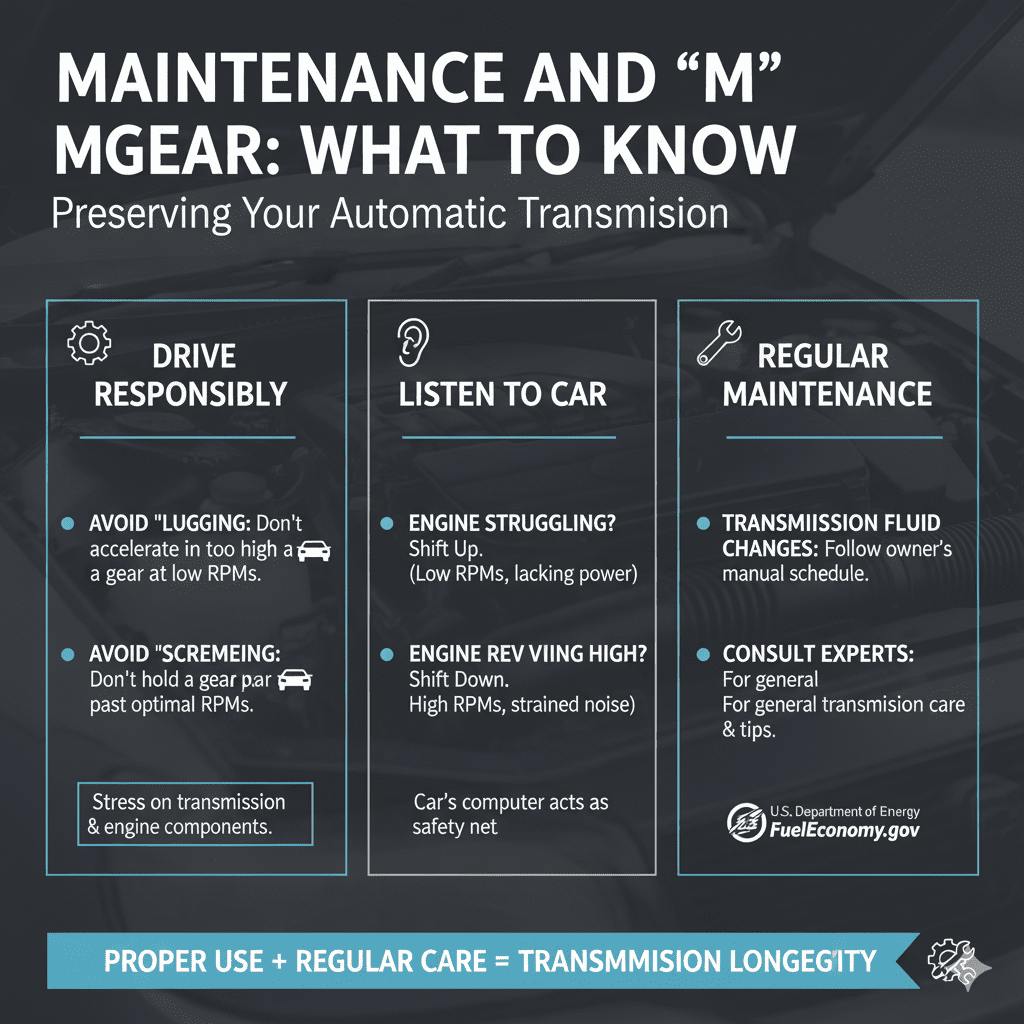
Maintenance and “M” Gear: What to Know
Does using “M” gear affect your car’s maintenance? Generally speaking, if you use “M” mode as intended (not aggressively driving the engine into its redline constantly), it won’t negatively impact your transmission or require different maintenance.
The key is to avoid “lugging” the engine (trying to accelerate in too high a gear at very low RPMs) or “screaming” the engine (holding a gear far past its optimal RPM range). These actions can put undue stress on the transmission and engine components.
Modern automatic transmissions are robust, and the car’s computer systems are there to protect them from common driver errors. When using “M” mode, listen to your car:
If the engine sounds like it’s struggling, shift up.
If the engine sounds like it’s revving too high or making a strained noise, shift down or let the automatic take over.
Regular transmission fluid changes, as recommended in your owner’s manual, are crucial for the longevity of any automatic transmission, regardless of how you drive it. You can find more information on general transmission care on sites like the U.S. Department of Energy’s Fuel Economy website, which offers tips on efficient driving that can indirectly benefit your transmission.
Troubleshooting Common “M” Gear Issues
While “M” gear is typically reliable, you might encounter a few quirks.
My “M” Gear Won’t Engage
This could be due to several reasons. The car might have safety protocols preventing engagement under certain conditions (e.g., engine too cold, parking brake engaged, or a significant safety fault detected). Check your owner’s manual. If the issue persists, it’s best to have it inspected by a qualified mechanic.
The Car Shifts Automatically Even When I’m in “M” Mode
This often happens in cars where paddle shifters are used for temporary manual control. After a period of inactivity or when certain conditions are met (like heavy acceleration or braking), the transmission might revert to automatic mode to ensure safety and efficiency. Some cars allow you to lock into manual mode through settings. Consult your owner’s manual for your specific car’s behavior.
“M” Mode Feels Sluggish or Jerky
If shifts are rough or delayed, it could indicate low transmission fluid, dirty fluid, or an issue with the transmission control module. Ensure your transmission fluid is at the correct level and condition. If problems persist, a professional diagnosis is recommended.
Conclusion: Mastering Your “M” Gear for a Better Drive
The “M” gear on your car isn’t just a fancy button; it’s a tool that puts you more in command of your driving experience. Whether you’re conquering a steep mountain pass, merging confidently onto a highway, or simply enjoying a more connected drive on a winding road, this manual control offers tangible benefits in performance, safety, and driver engagement.
By understanding how and when to use “M” mode, you can unlock a new level of driving proficiency. Remember to listen to your car, consult your owner’s manual for specifics on your vehicle, and practice in safe conditions. With a little exploration, you’ll find that the “M” gear transforms your daily commute into a more dynamic and enjoyable journey. Happy shifting!
Frequently Asked Questions (FAQs)
What does the “M” stand for on a car’s gear shifter?
The “M” on a car’s gear shifter typically stands for “Manual” mode. It allows the driver to manually select gears in an otherwise automatic transmission, offering more control over the vehicle’s performance.
Is it safe to use the “M” gear?
Yes, it is generally safe to use the “M” gear. Modern cars have built-in safeguards to prevent you from selecting a gear that the engine cannot handle, such as shifting into reverse while moving forward. However, it’s always good practice to use it thoughtfully and listen to your engine.
Can using “M” gear help save fuel?
Potentially, yes, but it depends on your driving style. If used for smooth, deliberate upshifts on flat roads and avoiding unnecessary acceleration, it can aid fuel efficiency. However, aggressive use for performance will consume more fuel than normal automatic driving. For most drivers, “D” mode is optimized for fuel economy in everyday situations.