What Is the Right Coolant to Water Mix for Winter?
A 50:50 mix of antifreeze and distilled water is commonly used as a safe winter default for many vehicles. Go a little stronger only if the owner’s manual allows it and you need extra freeze protection. Too much water can freeze or boil sooner, and too much coolant can cut heat transfer and corrosion protection. This guide explains when 50:50 is enough, when a stronger mix makes sense, and how to verify the ratio with a tester instead of guessing.
Why the coolant mix matters in winter
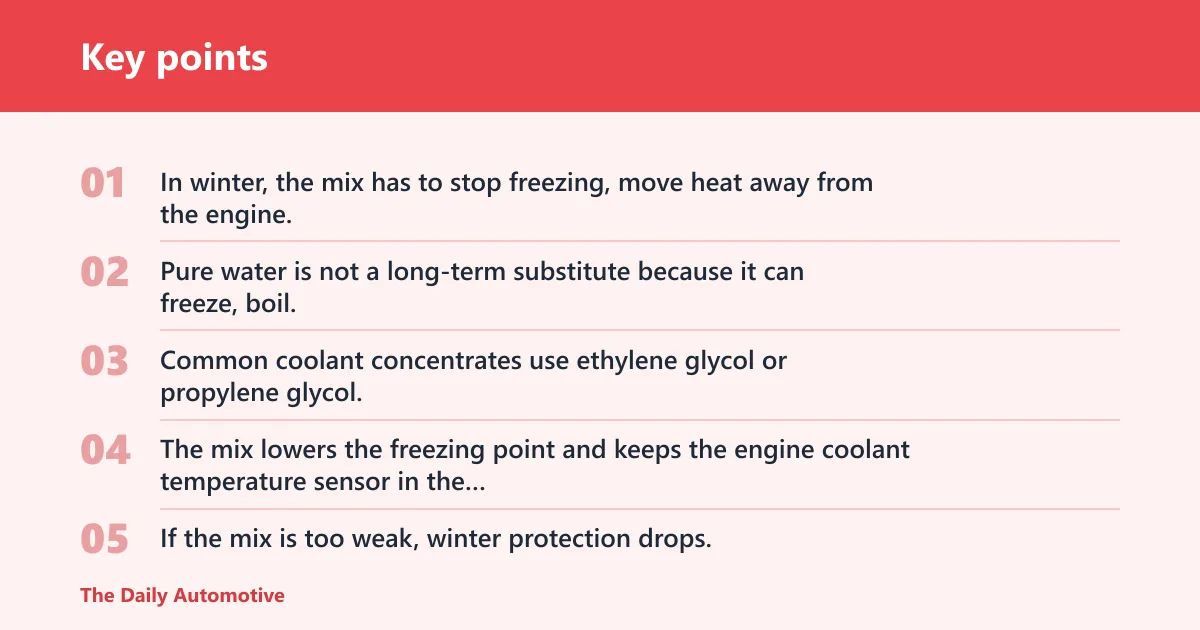


Coolant is a water plus antifreeze mixture. In winter, the mix has to stop freezing, move heat away from the engine, and let the cooling system’s pressure control work as designed. Pure water is not a long-term substitute because it can freeze, boil, and leave the system without the protection package coolant provides.
What coolant does in cold weather
Common coolant concentrates use ethylene glycol or propylene glycol, and they must be diluted before use unless the bottle is already premixed. The mix lowers the freezing point and keeps the engine coolant temperature sensor in the normal operating range instead of a cold-start spike or an overheating warning.
That balance matters. If the mix is too weak, winter protection drops. If it is too strong, heat transfer suffers. Corrosion inhibitors and additives also wear with age, so service history matters, not only the ratio.
Never open the cooling system cap when the engine is hot. Pressure can release scalding coolant fast.
What mix does your owner’s manual call for?
Your owner’s manual is the main source for approved coolant type, OEM approval, and any required mix ratio. A common vehicle coolant ratio is 50:50, but it varies by vehicle, and different coolants are not always compatible. The manual beats generic advice.
Find the approved coolant type and ratio
Look for the coolant family the vehicle accepts, such as IAT, OAT, or HOAT. Then check whether the manual calls for premix, concentrate, or a specific dilution. If the label and the manual disagree, follow the manual and the product label together, not one or the other on its own.
Check OEM approvals before you buy
Do not top up with an unfamiliar type because the bottle is the right color. Color is not a reliable standard. Use the approval list in the manual and on the container, especially if the system was filled with factory coolant and has not been converted.
Say your sedan calls for a specific OEM-approved OAT coolant and the reservoir is down a little before winter. The right move is not “any green antifreeze.” It is the exact approved type, mixed only if the product is concentrate and only to the ratio the manual allows.
50:50 or stronger for winter?
A 50:50 mix is the most common starting point, and it lowers the freezing point to around -37°C. That is enough for many drivers. In harsher cold, a slightly stronger mix can make sense if the manual allows it, but stronger is not automatically better because too much glycol can reduce heat transfer.
When a 50:50 mix is enough
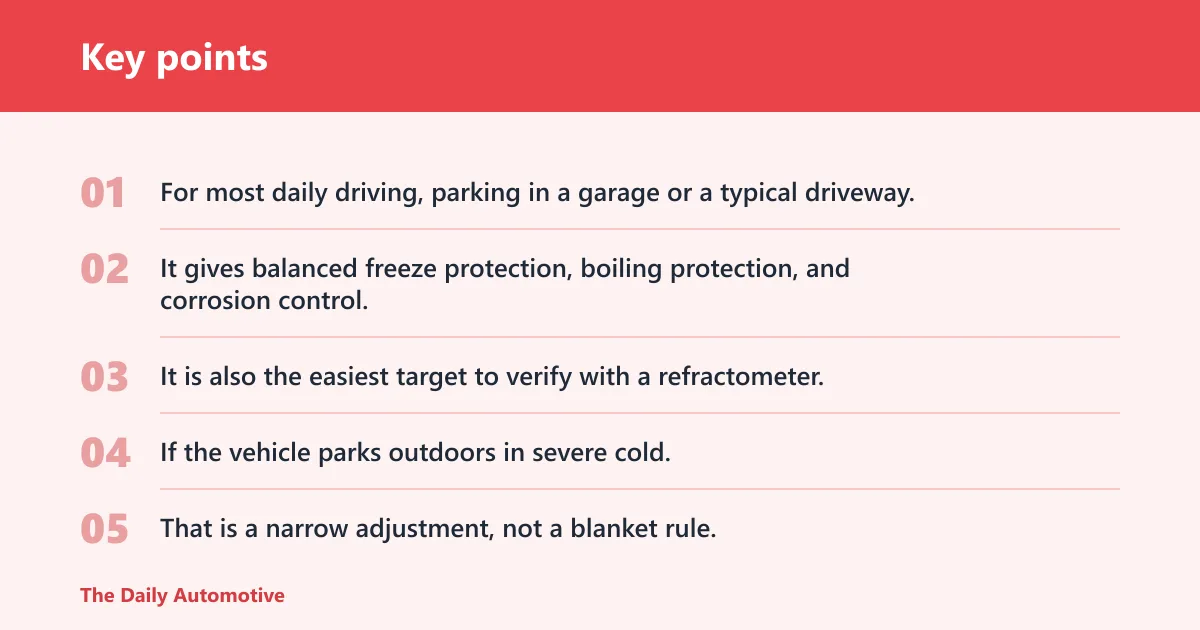
For most daily driving, parking in a garage or a typical driveway, and normal winter temperatures, 50:50 is the practical default. It gives balanced freeze protection, boiling protection, and corrosion control. It is also the easiest target to verify with a refractometer.
When a slightly stronger mix can make sense
If the vehicle parks outdoors in severe cold, a modest shift toward more antifreeze may be sensible, but only within the vehicle maker’s allowed range. That is a narrow adjustment, not a blanket rule. Too much glycol can leave the system less able to move heat away from the engine.
A common first-timer mistake is chasing the coldest forecast with extra concentrate. That can backfire in a truck idling in traffic after a frozen morning, because heat rejection matters after the engine warms up. Winter protection and cooling capacity have to stay in balance.
Coolant mix decision table
Use this table as a winter decision guide, not as a substitute for the owner’s manual. If your manual specifies something different, follow that first.
| Scenario | Recommended mix range | Premix or concentrate | Use distilled water? | Tester reading to confirm |
|---|---|---|---|---|
| Daily driving | 50:50, unless the manual gives another approved ratio | Premix is simplest; concentrate is fine if mixed correctly | Yes, for concentrate mixing | Freeze point around -37°C |
| Extreme cold parking outdoors | About 55:45 to 60:40, only if the manual allows a stronger mix | Concentrate plus measured water, or an approved premix at the needed ratio | Yes, preferably | Freeze point lower than a standard 50:50 reading, matched to your climate and manual |
| Top-off only | Match the system already in the car as closely as possible | Use the same approved product type; premix is safer if you need a small amount | Yes, if you are mixing concentrate for the top-off | Recheck the resulting freeze point after topping up |
Top-off only is different from a full fill. If the reservoir is low and the rest of the system still contains the correct mix, you are restoring the existing concentration. If the system has been diluted repeatedly, you may need more than a top-off.
Should you use distilled water?
Distilled water is commonly recommended for mixing concentrates because it reduces mineral deposits. That matters in winter, when scale and deposits can narrow passages and affect corrosion protection. Some sources are less strict, but distilled water is the safest default when you are mixing your own coolant.
Distilled water vs tap water
Tap water can bring minerals into the system, and hard water is the biggest concern. Softened water is better than hard tap water in some cases, but it still is not the same as distilled water. If local water quality is uncertain, distilled water is the cleaner choice.
Where softened water fits
Softened water may be acceptable as a practical compromise when distilled water is not available and you are in an emergency maintenance situation. That is a compromise, not a preferred standard. For a winter fill or a planned top-up, distilled water remains the better choice.
Can you mix water and coolant? Yes, if the product is a concentrate and the vehicle manual allows that ratio. Can you add water to coolant? Yes, but only enough to correct the concentration, and only if you then verify the result. Plain water alone is only a short-term emergency fill.
How to verify the freeze point
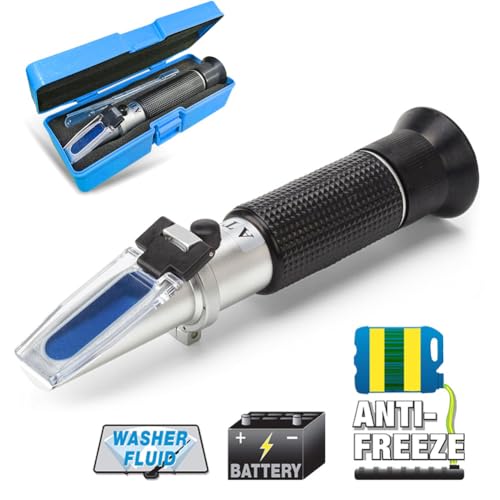
Do not rely on color or guesswork. A refractometer can be used to check freeze-point readings, and a hydrometer can also be used for checking antifreeze concentration. A 50/50 mix can be checked with a refractometer, which is the cleaner way to confirm winter protection before the first hard freeze.
Using a refractometer
Draw a small sample and check the instrument scale for antifreeze freeze point. If the reading does not match the target for your climate or the manual’s ratio, correct the mix before winter. This is the easiest way to confirm that the system still has enough glycol.
Using a hydrometer
A hydrometer measures fluid density and can show whether the mix is too weak or too strong. It is useful, but it is less direct than a refractometer for many drivers. Either tool is better than guessing from color alone.
Low glycol concentration means weak winter protection. If the reading is off, do not keep adding water. Correct the dilution with the proper coolant mixture, then recheck the freeze point.
Coolant top-off and refill basics
Check the coolant reservoir or expansion tank with the engine cool. The level should sit between the min and max marks. If it is below the mark, that can point to a leak or a past top-off mistake, and it deserves a closer look before the next cold snap.
What to do if the system is already diluted
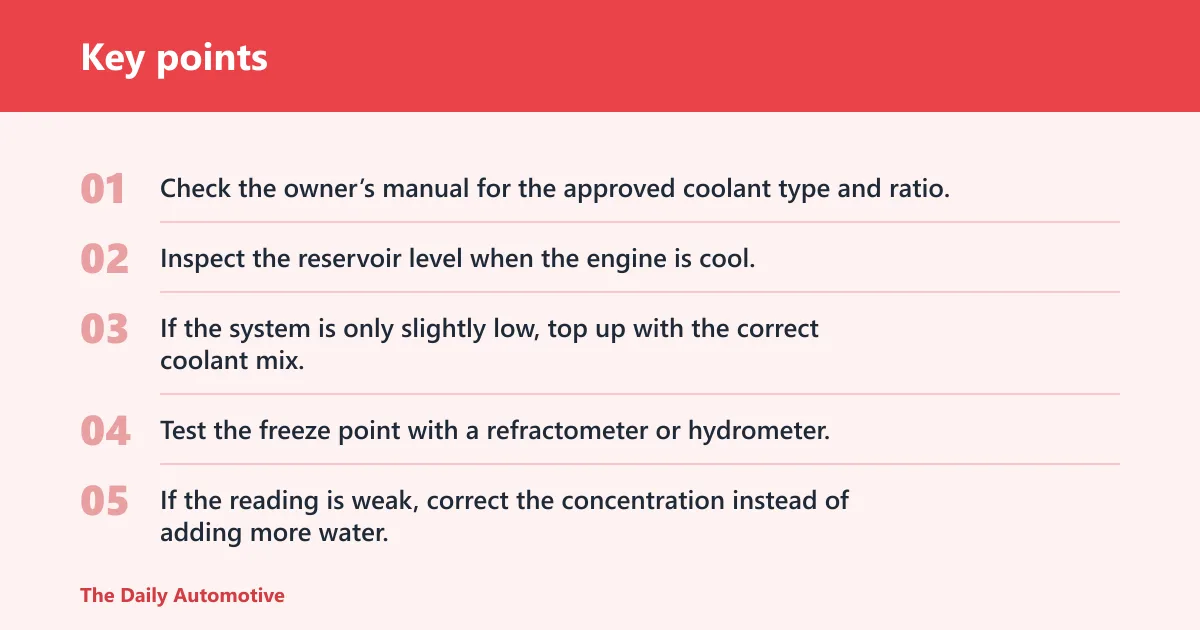
- Check the owner’s manual for the approved coolant type and ratio.
- Inspect the reservoir level when the engine is cool.
- If the system is only slightly low, top up with the correct coolant mix.
- Test the freeze point with a refractometer or hydrometer.
- If the reading is weak, correct the concentration instead of adding more water.
When contamination means a full service
If the coolant looks rusty, oily, sludgy, or mixed with the wrong product, a top-off is not enough. Low pH can mean the coolant should be changed. Low nitrites can indicate an incorrect coolant top up, and low carboxylates can indicate water-top-up dilution. Those are service clues, not signs to keep topping off and hoping for the best.
Picture an SUV that has been topped off with tap water twice during summer and now shows a low reservoir level before winter. The right fix is not another splash of water. It is to check the concentration, confirm the coolant type, and plan the corrective service the system actually needs.
Frequently asked questions
Can you mix water and coolant?
Yes, if you are diluting a compatible concentrate and staying within the vehicle maker’s approved ratio. Water and coolant are meant to work together in the correct mix. Do not use plain water as a long-term fill, and do not mix incompatible coolant types.
Can I use water for coolant?
Only as a temporary emergency move if the vehicle is low and you have no approved coolant on hand. Plain water alone is not a long-term substitute because it lacks proper freeze, boil, and corrosion protection. Fix the mix properly as soon as practical.
Can you add water to coolant?
Yes, but only when you are correcting a system that is short on fluid and you know the final concentration will still be right. If you keep adding water, you dilute winter protection. Recheck the level and the freeze point after the top-off.
Should I mix coolant with water?
Usually yes, if the bottle is concentrate and the manual allows that ratio. A 50:50 mix is the common winter default and gives about -37°C freeze protection. If the vehicle calls for something else, follow that instead and confirm it with a tester.
Can you put water in the coolant?
You can, but only to reach the proper dilution for the system and only with the right coolant already in the car. Water by itself is not enough for winter service. If the coolant is old, contaminated, or the mix is already weak, plan a more complete service.
Products related to this article
Sponsored / affiliate links. As an Amazon Associate I earn from qualifying purchases. I may earn additional commission from eligible campaigns.