Do You Need a Battery Blanket or Battery Warmer in Winter?
A battery blanket helps most below about 0°F, especially if the battery is older or the car sits outside. If your car already starts well above that, you usually do not need one. Skip the wrong accessory and you can still face slow cranking, a dead battery, or money spent where it will not fix the problem. This guide explains when a battery blanket makes sense, when a block heater is the better buy, and when neither is needed.
This guide is part of our Winter Car Care: The Complete Cold-Weather Guide series.
Winter battery decision table
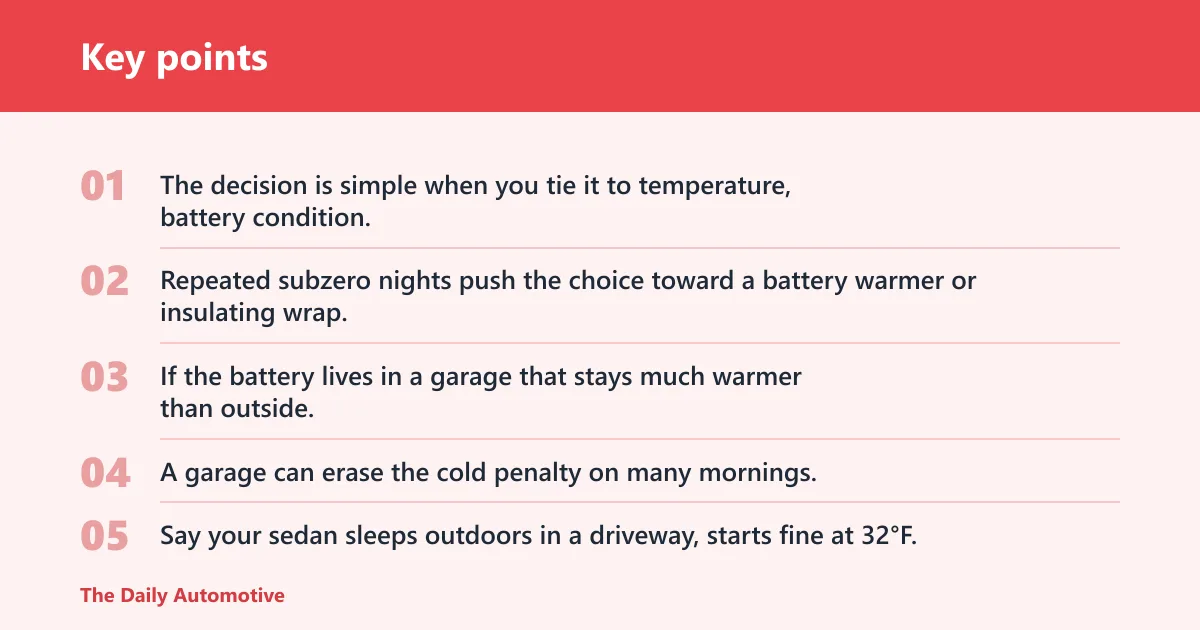
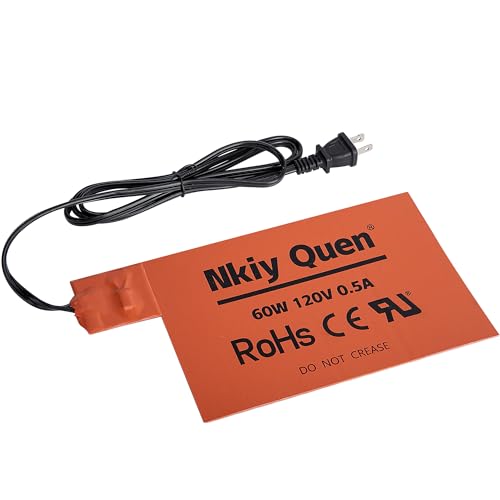

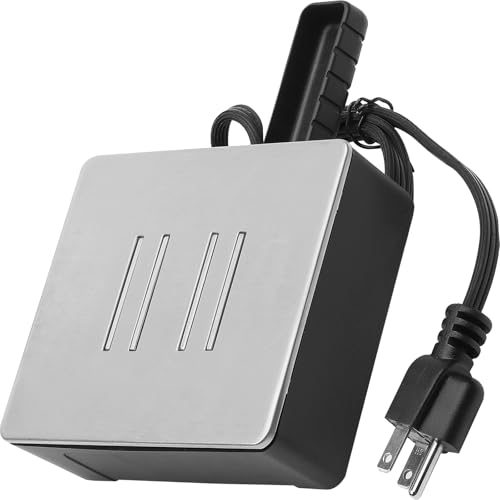
The decision is simple when you tie it to temperature, battery condition, and where the car sleeps. Mild cold often needs nothing. Repeated subzero nights push the choice toward a battery warmer or insulating wrap, while very severe cold often points to a block heater first, especially on diesel engines.
| Overnight low temperature | Battery age/condition | Best action |
|---|---|---|
| 32°F and above | Healthy battery, normal driving, garage or outdoor parking | Usually nothing |
| 32°F and above | Older battery, short trips, or noticeable slow cranking | Inspect the battery, charging system, and cable connections first; a warmer can help, but a weak battery may need replacement |
| 0°F to 32°F | Good battery, outdoor parking, repeated cold mornings | Consider a battery warmer or insulating battery wrap |
| 0°F to 32°F | Older battery or short-trip use | Battery warmer plus a charger plan if the battery is often undercharged |
| Below 0°F / -18°C | Healthy battery, outdoor parking | Battery warmer becomes much more useful; a block heater may be the better spend in very severe cold |
| Below -20°F | Diesel engine or a vehicle that struggles to start | Prioritize a block heater; add a battery warmer if the vehicle manual supports it and the battery still needs help |
| Any temperature | Battery already dead | Use a charger or replace the battery; a blanket will not revive it |
If the battery lives in a garage that stays much warmer than outside, the need often drops away. A garage can erase the cold penalty on many mornings, which is why a warmer is not an automatic buy for every winter driver.
Say your sedan sleeps outdoors in a driveway, starts fine at 32°F, and only begins to crank slowly after a cold snap near 0°F. That is the kind of pattern where a battery warmer starts to make sense. If the same car lives in a heated garage, the warmer may sit unused for most of the season.
Do you need a battery blanket in winter?
You need one only if cold weather is actually lowering starting performance where you park. A battery blanket helps most when overnight lows regularly move into subzero territory, the battery is not fresh, or the car sees short trips that never fully recharge it. Mild cold and a healthy battery usually do not justify the purchase.
What cold does to cranking amps
Cold weather slows lead-acid battery chemistry, and cranking amps drop as battery temperature falls. That matters because the starter still asks for the same burst of power on a frosty morning. When the battery is cold, it can deliver less of that burst, so the engine may crank slowly or fail to start.
That effect can be confused with other winter problems. Thick oil can also make the engine harder to spin, and a weak alternator or bad connections can leave the battery undercharged. A blanket helps the battery hold temperature; it does not fix thick oil, worn starter parts, or a charging problem.
When short trips raise the risk
Short daily trips under 10 minutes are a common use case where a warmer can help, because the alternator may not replace what the starter used. Repeated short-trip driving plus cold nights is a bad combination for an older lead-acid battery. The battery starts the next morning already behind.
Picture a compact SUV that gets a 6-minute school run and a 5-minute grocery run, then sits outside at 0°F. That pattern can leave the battery low even if the car ran yesterday. A warmer may reduce the cold-start penalty, but a charger or a battery test may still be needed if the battery is chronically undercharged.
When garage parking makes it unnecessary
Garage parking often cuts the need for a battery blanket sharply. If the battery spends the night in a space that stays well above outdoor lows, the chemistry penalty shrinks. In that situation, a warmer can be redundant unless the battery is old, the vehicle is driven in extreme cold, or the garage is still near freezing.
Battery blanket vs block heater
A battery blanket heats or insulates the battery itself. A block heater warms the engine coolant or oil, which helps engine startup in a different way. In very severe cold, both can be useful together, but many drivers should buy only one. The right choice depends on whether the main problem is the battery or the engine.
What each one heats
A battery blanket targets the 12V lead-acid battery so it can preserve cranking performance in cold weather. A block heater targets the engine side, not the battery. MotorBiscuit notes that block heaters warm the engine oil and help startup, which is why they matter more when thick oil is part of the problem.
When the block heater is the better buy
Below -20°F, the block heater often becomes the better spend, especially for diesel engines. Diesels usually benefit from warmer oil and easier combustion conditions, so a battery blanket alone may not solve the hardest starts. In deep cold, the battery may still need help, but the engine itself is often the bigger barrier.
If the vehicle has a garage and still struggles only on the coldest mornings, that again points you toward the engine side of the problem. A warmer battery does little if the oil is thick enough to slow cranking badly. In that case, the block heater earns priority.
Why diesel drivers often start there
Diesel drivers often start with a block heater because cold oil and combustion conditions can make startup much harder than on a gasoline vehicle. A battery warmer can still help the battery supply strong cranking amps, but it is usually the complement, not the first fix, in very severe cold.
What a battery warmer is and how it works
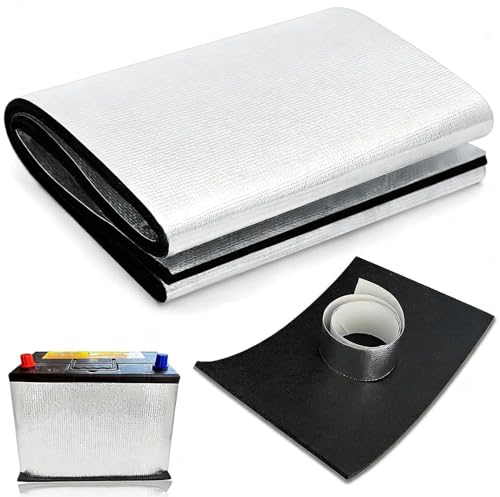
A battery warmer is another name for a battery blanket or battery wrap. It may be a passive insulating battery wrap or a powered unit that plugs into a standard 120V outlet. Its job is to keep the battery warmer overnight or before startup so the battery can deliver better cranking performance.
Powered and unpowered versions
MotorBiscuit distinguishes plug-in units from basic insulators. The powered version adds heat and typically plugs into a 120V outlet, while the unpowered version mainly slows heat loss. The passive wrap is cheaper and has no power draw, so it can be a year-round option for drivers who want simple insulation.
BatterySkills lists 80-watt battery blanket heater warmer product examples, and also names 36-inch battery wrap products. Those figures are useful for sizing discussions, because the blanket has to fit the battery case without forcing the terminals into a cramped or exposed position.
Overnight use and pre-start timing
The same source says plug-in battery warmers can be left on all night. That makes them practical for winter parking, as long as the product is designed for that use and the vehicle manual does not say otherwise. For many drivers, plugging in before bedtime is the simplest routine.
A common first-timer mistake is treating a warmer like a rescue tool after the car will not start. It is not. The better use is preventive: warm the battery before the cold morning arrives, then start the car with less strain on the battery.
Will it help a dead battery?
No. A battery blanket is not a charger, and it will not revive a dead battery. It can help a weak battery keep more usable temperature, but a battery that is discharged too far or has failed internally needs charging, testing, or replacement. The warmer is a prevention tool, not a repair.
Weak battery versus dead battery
A weak battery may still start the car, but slowly, especially in the cold. A dead battery gives little or no cranking response. That difference matters because a warmer can improve the weak-battery case, while a dead battery needs a charger or a replacement battery before the vehicle can start reliably.
Signs the charging system is the real issue
If the battery keeps going flat after normal use, the charging system may be the problem instead of winter temperature. Repeated jump starts, warning lights, or a battery that loses charge after a drive point away from the blanket and toward testing. A warmer cannot correct a bad alternator or loose connection.
Suppose the engine starts after a jump, then the battery is flat again two days later despite a 30-minute drive. That is not a blanket problem. That pattern calls for battery and charging-system diagnosis first, because the cold may only be exposing a deeper fault.
Fit, safety, and compatibility checks
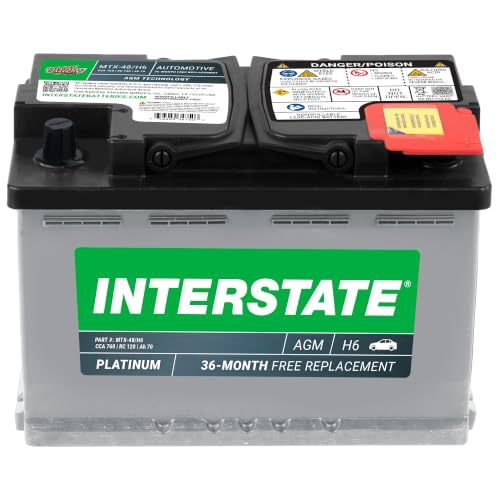
Battery warmers are generally intended for lead-acid car batteries, including many AGM batteries used in modern cars. They are not for EV lithium-ion traction packs, which SlashGear says are not the target use case. Check the vehicle manual and the product manual before you buy or plug in anything.
Lead-acid, AGM, hybrid, and start-stop batteries
Most 12V automotive battery warmers are aimed at lead-acid batteries, including AGM units found in many hybrid and start-stop vehicles. The key question is whether the product fits the battery tray and allows safe terminal clearance. If the car uses a 12V auxiliary battery, that is the part the warmer may help.
Do not assume every hybrid or start-stop vehicle wants the same setup. Some use compact 12V batteries in tight spaces, so fit and cable routing matter more than the label on the package. Follow the vehicle manual for access and electrical work.
Why EV traction packs are different
EV traction packs are not the same product category as a 12V lead-acid battery. SlashGear says battery warmers are not for EV lithium-ion battery packs. That means you should not buy a battery blanket expecting it to warm the drive battery in an EV or treat it as a generic winter fix for high-voltage battery systems.
Cord routing and manual checks
Gadgetsfeed says battery blankets plug into a standard 120V outlet. Route the cord where it will not touch hot or moving parts, and make sure the blanket does not cover the terminals too tightly. Follow the product and vehicle manual for installation and disconnect order when working around the battery.
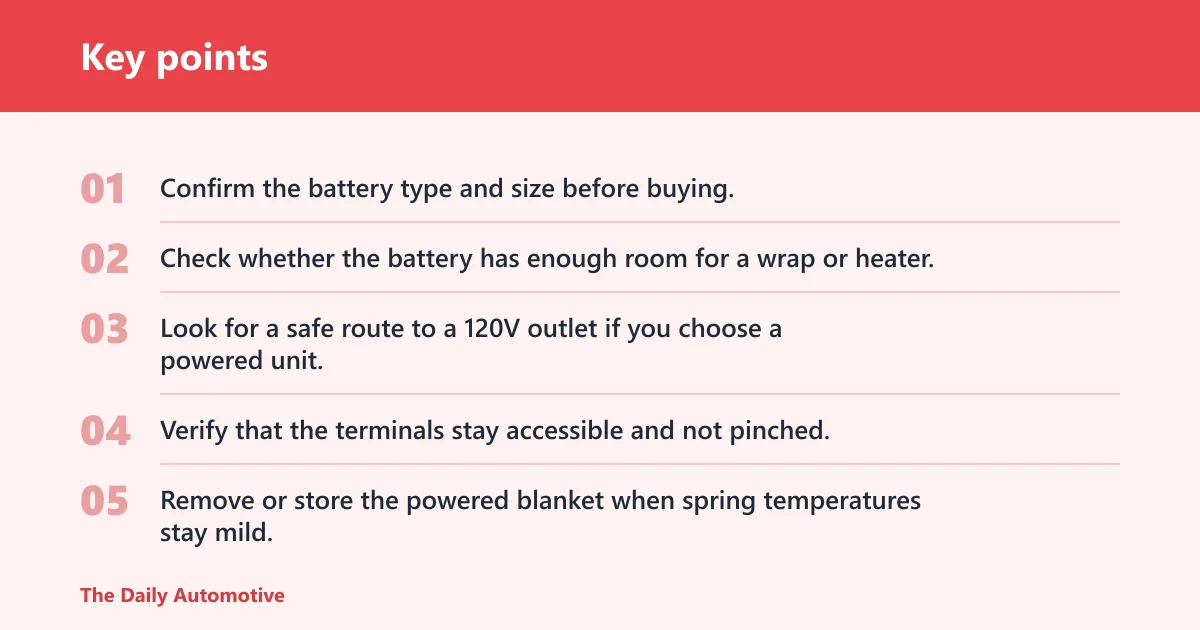
- Confirm the battery type and size before buying.
- Check whether the battery has enough room for a wrap or heater.
- Look for a safe route to a 120V outlet if you choose a powered unit.
- Verify that the terminals stay accessible and not pinched.
- Remove or store the powered blanket when spring temperatures stay mild.
Frequently asked questions
What temperature is cold enough to use a battery warmer?
The same source says battery warmers are most useful below 32 degrees Fahrenheit, and Gadgetsfeed says they are most effective when temperatures regularly drop below 0°F. That means the real buying threshold depends on how often you see subzero nights, not just one chilly morning.
Will a battery blanket help if my battery is already dead?
No. A battery blanket does not charge a dead battery or bring it back from failure. If the battery will not hold charge, use a charger if appropriate, or replace the battery after testing. The blanket only helps preserve temperature for a battery that still has usable charge.
Can I leave a battery warmer on overnight?
The same source says plug-in battery warmers can be left on all night, which fits the usual pre-start use case. Use only a product designed for that duty, and follow the manual. If the car will sit in warmer weather for weeks, remove the powered unit or stop using it.
What is the difference between a battery blanket and a block heater?
A battery blanket warms or insulates the battery. A block heater warms engine coolant or oil, and MotorBiscuit notes that it helps engine startup. Use the blanket when cold battery performance is the problem. Use the block heater when thick oil or very severe cold is the bigger issue.
Do battery blankets work on EV batteries?
No, not on the traction pack. The same source says battery warmers are not for EV lithium-ion battery packs. They are aimed at 12V lead-acid automotive batteries, including many conventional cars, some hybrids, and some start-stop setups with accessible auxiliary batteries.
Should I choose an insulating wrap or a powered battery warmer?
Choose an insulating battery wrap if you want lower cost, no power draw, and only moderate winter help. Choose a powered battery warmer if you routinely see repeated subzero nights and can plug into a 120V outlet. If the battery is old or the starts are already weak, also test the charging system.
Products related to this article
Sponsored / affiliate links. As an Amazon Associate I earn from qualifying purchases. I may earn additional commission from eligible campaigns.