Is Owning an Auto Repair Shop Worth It? The Math Explained
Owning an auto repair shop is worth it only if you can buy or build toward roughly seven figures in annual labor and parts sales, keep gross profit near 50%, and still clear owner pay after rent, payroll, and debt. Miss those targets and the shop can drain cash fast. This guide breaks down the math, startup costs, and a yes-or-no decision framework for mechanics, managers, and investors.
What owning an auto repair shop actually means
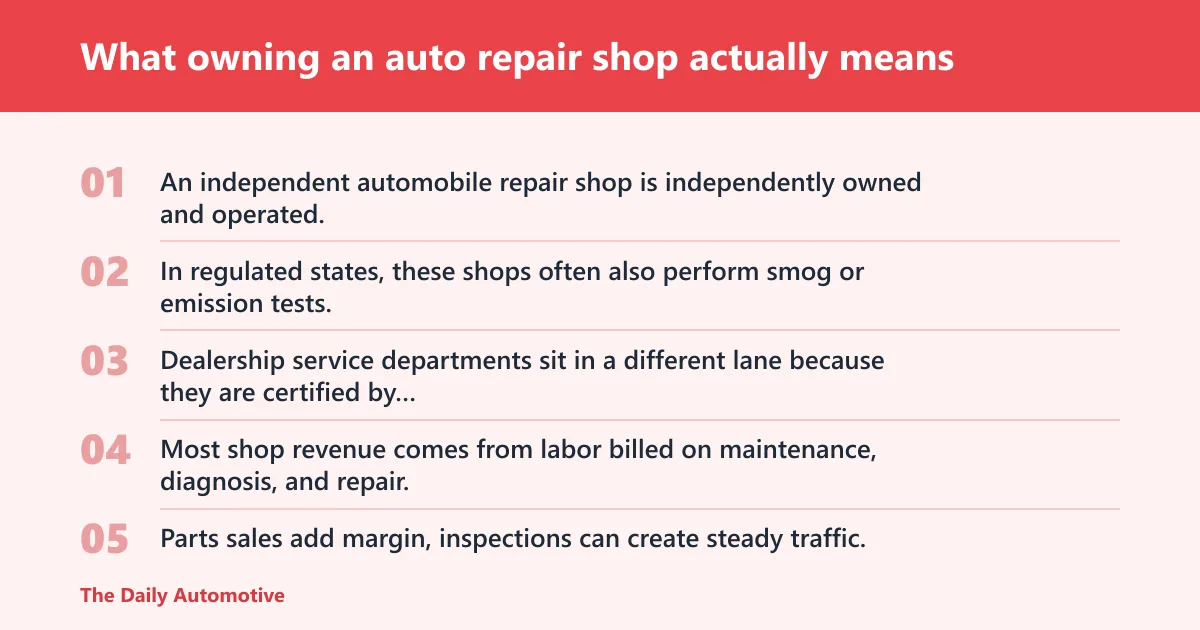
An independent automobile repair shop is independently owned and operated, and it can earn money from repair and maintenance work, parts sales, vehicle inspections, diagnostics, and specialty services such as detailing or customization. In regulated states, these shops often also perform smog or emission tests. Dealership service departments sit in a different lane because they are certified by their OEM to perform warranty and recall repairs.
Independent shop revenue streams
Most shop revenue comes from labor billed on maintenance, diagnosis, and repair. Parts sales add margin, inspections can create steady traffic, and specialty work can lift average repair orders if the shop has the right tools and staffing. Diagnostic work matters because modern vehicles often need scan-tool time before a repair path is clear.
How this model differs from dealership, chain, tire, and quick-lube formats
Dealerships can win warranty and recall work through OEM certification. Chains often compete on national branding and promotion. Tire stores lean on tire and alignment volume. Quick-lube shops move cars fast and live on repeat service. An independent shop has more freedom in service mix, but it also has to build trust and process from scratch.
Where OEM certification and emissions work fit
OEM certification can widen the menu of repairs a shop may perform and can help with certain makes, but it usually means added training, equipment, and process discipline. Smog and emission testing can be a useful traffic source where the law allows it, yet it rarely supports a business by itself.
📊 A larger shop can earn $100,000+ a year. Source: Is Owning an Auto Repair Shop Worth It?.
Is owning a mechanic shop worth it for you?
It is worth it for a technician-owner, manager-owner, or investor-owner only when the person’s skills match the business model. Strong wrench skills help, but the shop still needs sales discipline, pricing control, staffing, and cash management. Success depends on business management ability, not just mechanical skill.
When it fits a technician-owner
A technician-owner can make this work if they can delegate enough to keep production moving while pricing jobs correctly and tracking gross profit. That path fits someone who can lead the front end, read a P&L, and resist the urge to do every repair personally.
When it fits a manager-owner
A manager-owner often has the best shot at scaling because they can manage service writers, labor efficiency, and customer retention without being trapped on the hoist. This path fits a person who can recruit techs, train a service advisor, and keep cars moving through the bay.
When it fits an investor-owner
An investor-backed operator needs enough capital to survive a slow ramp and enough operating discipline to hold margins. This path works best with a proven manager in place, because the money alone does not fix poor workflow, bad pricing, or weak customer follow-up.

How much does it cost to start an auto repair shop?
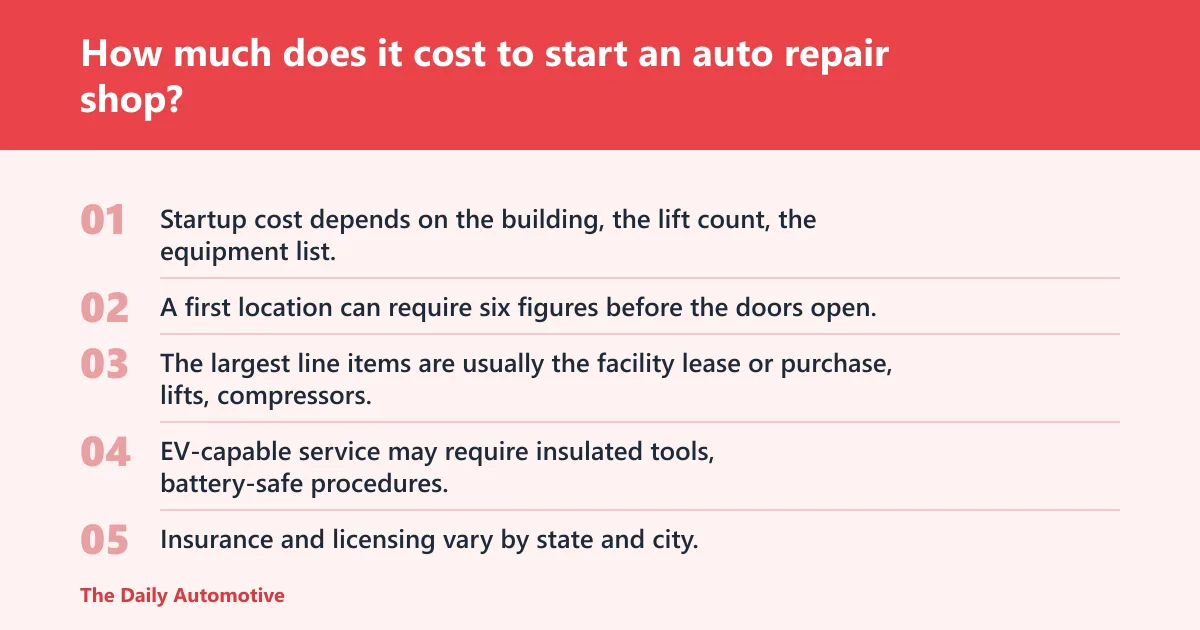
Startup cost depends on the building, the lift count, the equipment list, and how much cash you need before the shop breaks even. A first location can require six figures before the doors open, then more working capital to cover payroll, rent, insurance, inventory, and slow months.
Facility, tools, and equipment
The largest line items are usually the facility lease or purchase, lifts, compressors, tire and alignment equipment, scan tools, hand tools, diagnostic gear, and bay setup. EV-capable service may require insulated tools, battery-safe procedures, and higher-end diagnostics, which adds cost fast.
Insurance, licenses, inventory, and setup costs
Insurance and licensing vary by state and city, but the owner still needs to budget for general liability, garagekeepers coverage, workers’ comp where required, business registration, sales tax setup, and any inspection or emissions licenses. Parts stocking and initial consumables can eat cash early.
Working capital before break-even
Working capital is the buffer that keeps the lights on before the customer base fills in. A shop that opens with only enough money for tools and rent can run out of cash long before it reaches stable volume. That is why the first-year runway matters as much as the launch budget.
| Sample startup cost bucket | Illustrative amount |
|---|---|
| Leasehold improvements and sign-out | $25,000 |
| Lifts, compressor, basic shop equipment | $85,000 |
| Scan tools, diagnostics, specialty tools | $35,000 |
| Insurance, permits, legal, accounting setup | $12,000 |
| Initial parts and consumables | $18,000 |
| Working capital reserve | $75,000 |
| Total illustrative startup need | $250,000 |
What are the biggest expenses in an auto repair shop?
The biggest expenses are labor, rent or mortgage, utilities, equipment maintenance, marketing, and parts procurement. Operating costs include labor costs, inventory and parts procurement, and rent and utilities. If those stay out of line, even strong sales can fail to produce owner income.
Labor and payroll
Payroll usually includes technicians, a service advisor or service writer, and sometimes a parts runner or detail help. The service advisor is the customer interface, traditionally called a service writer. That role matters because estimates, communication, upsells, and workflow control all affect retention and car count.
Rent or mortgage, utilities, and upkeep
Real estate can be a quiet killer. A cheap building with poor access may hurt volume, while a prime site can carry a heavy fixed cost. Utilities rise with compressors, lifts, heat, AC, and equipment use. Upkeep also matters because broken lifts and worn diagnostics stop revenue.
Marketing, parts control, and shop overhead
Marketing is not optional, especially at launch. Local SEO, reviews, fleet accounts, and referrals are often more valuable than broad ads. Parts control also affects margin: poor purchasing, returns, and inventory shrink can quietly erase gross profit.
How profitable is an auto repair shop?

Profit depends on labor rate, parts margin, car count, and overhead control. A larger shop can earn $100,000+ a year, but that does not mean every location will. A shop with enough labor hours sold, a sane cost structure, and steady customer flow can produce real income.
Gross margin and labor rate basics
Many owners track gross profit before they worry about net income. A shop near 50% gross profit has room to pay techs, advisors, rent, and overhead while still leaving something for the owner. If labor rate lags the market, the rest of the model gets harder fast.
Monthly car count and average repair order
Car count and average repair order drive sales volume. If a shop sees too few cars, even a healthy ticket average will not cover fixed costs. If tickets are too low, the bays stay busy but the dollars do not.
A sample first-year break-even model
Say your shop runs two service bays and one part-time admin role. If fixed monthly costs are in the high tens of thousands and gross profit holds near 50%, the shop would need roughly the mid–six figures in monthly sales to break even. At an average repair order around that level, the shop would need roughly a few hundred repair orders a month, or around several per business day in a typical 20-workday month.
| Sample monthly model | Value |
|---|---|
| Fixed monthly costs | $38,500 |
| Gross profit target | 50% |
| Break-even sales | $77,000 |
| Average repair order | $425 |
| Monthly car count needed | 181 |
| Approximate car count per workday | 9 |
Owner-readiness scorecard and break-even model
A shop is more likely to work when the owner can score well on capital, operations, and sales discipline. Technical skill alone is not enough. If several scorecard items are weak, the business will likely need more cash, a stronger manager, or a different format.
Ten-point readiness checklist
- Enough cash for startup plus at least six months of runway.
- A clear local market with steady demand.
- Ability to price labor at market level.
- Comfort reading financial statements.
- A plan for hiring and keeping technicians.
- A service advisor process for estimates and follow-up.
- Access to parts sources and inventory control.
- A realistic marketing plan for local search and reviews.
- Compliance plan for zoning, insurance, and permits.
- Capacity to adapt for hybrid and EV service needs.
What the score tells you about risk
If the owner scores high on cash, management, and customer acquisition, the business case improves. If the score is weak on staffing or working capital, the odds of a cash squeeze rise sharply. That is especially true for a first-time owner who is learning the front office while trying to run production.
Picture a two-bay shop in a commuter strip with plenty of traffic but weak pricing. If the bays average only six cars a day and the average ticket stays low, the owner may stay busy and still miss payroll. Busy is not the same as profitable.
What can make or break the location and customer base?
Location matters because it affects visibility, access, and the kind of customers the shop can reach. Market demand, competition, pricing power, and service mix decide whether traffic turns into profitable work. A good site with weak demand can still fail.
Traffic, demographics, and local demand
A shop near commuters, apartment clusters, fleet routes, or older vehicle stock can have an easier path to steady volume. The key question is not whether cars pass by. It is whether enough of the right customers need the services the shop sells.
Competition, pricing power, and service mix
Independent shops compete with dealerships, chains, tire stores, quick-lube operations, fleet-focused shops, and specialty shops. The best position is usually a clear one: European cars, fleet maintenance, diagnostics, emissions work, or a trusted general-repair model with strong retention.
Local SEO, reviews, fleet work, and referrals
Customer acquisition usually comes from repeat business, trust, reputation, local search, reviews, fleet accounts, and referrals. A loyal customer base can create repeat business, especially when the shop follows up on declined work and service reminders. Good service and a strong reputation matter for long-term success because they lower the cost of each new appointment and keep bays fuller without constant ad spending.
What are the risks of owning an independent auto repair shop?
The main risks are thin margins, staffing gaps, compliance mistakes, and a slow ramp to enough cars per day. Independent shops are businesses that are independently owned and operated, so the owner carries the full burden of payroll, rent, equipment debt, and customer acquisition.
Failure case: skilled, but undercapitalized
A common first-timer mistake is assuming that technical skill will cover weak business structure. Suppose a top technician opens a small shop, brings in a few loyal clients, and then faces a slow month when payroll, parts bills, and rent hit at once. Without enough car count or margin, the shop can fail while the work quality stays high.
EV and hybrid service changes the cost equation
Hybrid and EV work can be profitable, but it changes the equipment and training bill. Shops need scan tools, diagnostic subscriptions, insulated safety gear, and technician retraining. That cost makes sense only if the local market has enough EV and hybrid volume to support the investment.
Licensing, zoning, insurance, and compliance checklist
Requirements vary by state, county, and country, so every owner should verify the local rule set before signing a lease or buying a building. A basic checklist includes zoning approval, business registration, sales tax setup, emissions or smog licenses where required, garage liability, garagekeepers coverage, workers’ comp, environmental handling rules, and waste disposal compliance.
Frequently asked questions
is owning a auto repair shop profitable
It can be profitable, but only when sales volume, labor efficiency, and overhead line up. A shop with disciplined pricing and repeat customers can produce solid income. A shop with low car count, bad staffing, or weak controls may stay busy and still lose money.
how much can an auto repair shop make a year
Results vary widely by size and execution. A larger shop can earn $100,000+ a year, but a small or poorly run location may earn far less or lose money. Annual profit depends on sales, gross margin, staffing, and fixed costs.
what licenses do you need to open an auto repair shop
That depends on where the shop is located. Owners usually need business registration, zoning approval, tax setup, insurance, and any state or local permits tied to emissions, inspections, or environmental compliance. The exact list should be confirmed with local authorities before launch.
Products related to this article
Sponsored / affiliate links. As an Amazon Associate I earn from qualifying purchases. I may earn additional commission from eligible campaigns.