What to Do If You Cant Afford Your Car
If you can’t afford your car, act before the next missed payment: call the lender, ask for a hardship option or extension if the shortfall is temporary, and if the payment will stay unaffordable, sell the car or surrender it voluntarily before repossession starts. Waiting can add late fees, hit your credit, and leave you owing money after the lender sells the car. This guide shows how to tell a cash-flow problem from a permanent affordability failure and choose the least damaging exit.
What to do first
Call the auto lender or loan servicer before you miss the payment. Ask for hardship help, a due date change, a deferral, or a catch-up plan, and ask whether any agreement will be sent in writing. Get the loan contract, payment history, and a real transportation budget in front of you first.
Start with the servicer, not silence
Experian says to contact your lender and request a deferral, and it lists seven steps for struggling borrowers. That is the right starting point because the servicer can tell you what options exist on your specific contract. Some lenders allow a short pause in payments, but availability varies.
Ask for the exact status of the account: current, late, delinquent, or in default. Those labels matter. A late account may still be fixed with a due date change or catch-up plan, while a defaulted account can move toward repossession faster under the contract and state law.
What to ask on the call
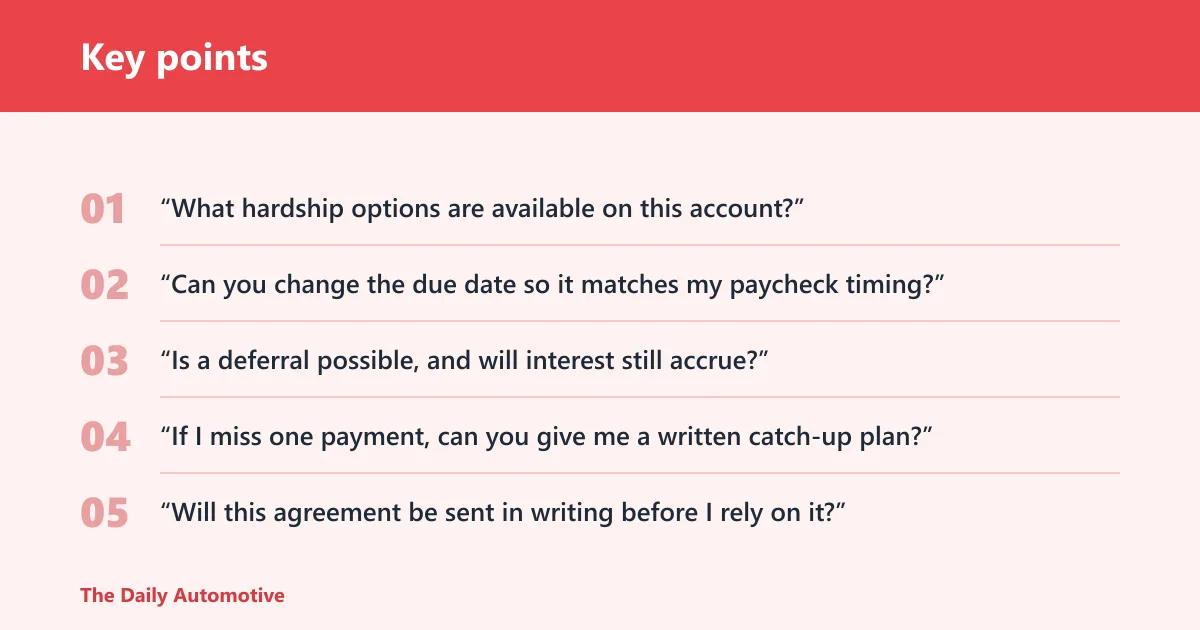
- “What hardship options are available on this account?”
- “Can you change the due date so it matches my paycheck timing?”
- “Is a deferral possible, and will interest still accrue?”
- “If I miss one payment, can you give me a written catch-up plan?”
- “Will this agreement be sent in writing before I rely on it?”
- “What happens to my account status if I use this option?”
What to gather before you decide
- Loan contract and payment schedule
- Most recent statement and payment history
- Take-home pay dates for the next two months
- Insurance premium, fuel estimate, and maintenance needs
- Current mileage and approximate vehicle value
- Any quotes for replacement transportation
Can you still keep the car?
You may be able to keep the car if the problem is temporary and the total transportation budget still works. If the payment is the only strain, a due date change, a short deferral, or a catch-up plan may buy time. If insurance, fuel, and repairs also strain the budget, the car may be unaffordable even before the loan payment is due.
Look beyond the monthly note
Crediful says insurance and maintenance belong in the transportation budget. That matters because a payment that looks manageable on paper can fail once you add premium increases, tires, oil changes, fuel, parking, and the cost of getting around while the car is in the shop. If the backup transportation cost is high, the car may not fit the budget.
Say your payment is due on Friday, but your paycheck clears next Wednesday. A due date change may solve that problem with less damage than skipping the payment, especially if you can cover the account before late fees build. That is a cash-flow problem, not necessarily a permanent affordability failure.
Separate delay from structure
A temporary gap means the income is likely to recover soon. A structural problem means the payment will keep colliding with your budget every month. If the gap keeps repeating, a deferral may only move the stress forward, not fix it. That is where a sale, refinance, or surrender becomes the less harmful option.

When a short-term fix makes sense
A short-term fix makes sense only when the cash shortfall is temporary and the car remains affordable once the gap closes. During a payment deferral, interest may keep accruing, and the skipped payments may be added to the end of the loan. A loan modification may lower the payment or extend the term, but approval is not automatic.
Deferral
The same source says to request a deferral, and InCharge says lenders may pause payments for a short time without penalty. That can help if you expect income to resume soon. It does not erase the debt. Ask whether interest keeps accruing and whether the skipped amount moves to the end of the loan.
Loan modification
A loan modification changes the existing loan terms. It may lower the rate or extend the term, and that can reduce the monthly payment. Approval requirements vary by lender. Extending the term can reduce the monthly bill while increasing total interest, so compare the relief against the added cost.
Suppose a two-paycheck household loses one shift-based income stream for six weeks but expects it to return. A short deferral or due date change may be the least damaging fix. If the lower income is permanent, that same deferral simply delays the harder decision.
Can refinancing lower the payment?
Refinancing can lower the payment if you qualify, but it replaces the current loan and is not a cure for every budget problem. It depends on credit, income, vehicle age and mileage, and equity. If the vehicle is older, has high mileage, or is worth less than the loan balance, refinance options narrow quickly.
Check the math before applying
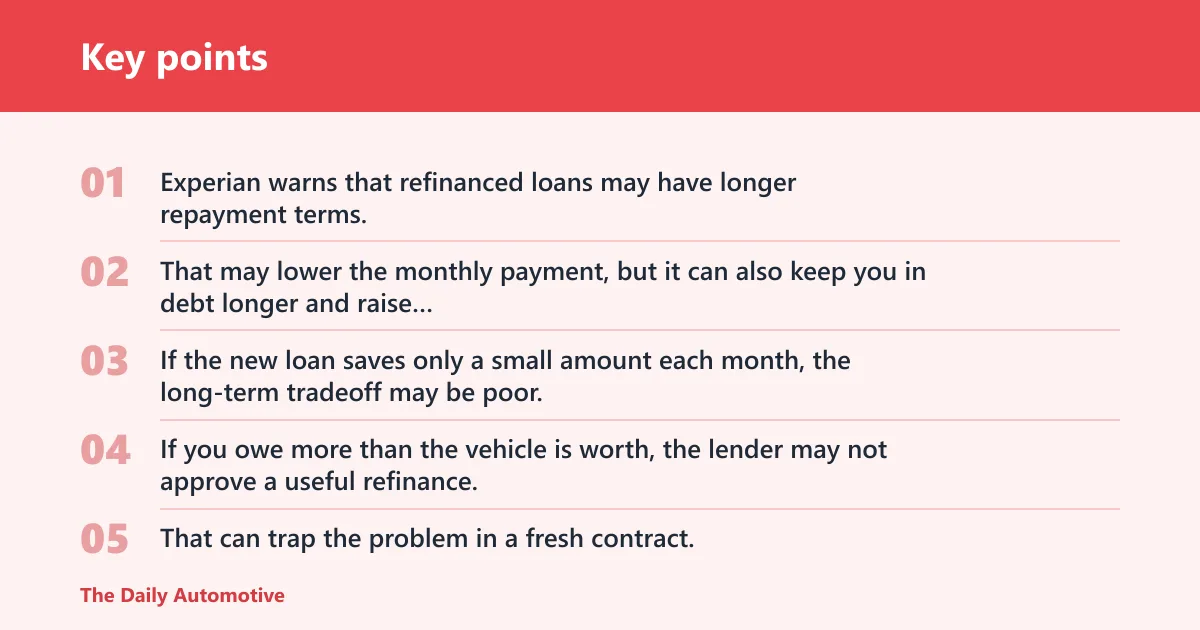
Experian warns that refinanced loans may have longer repayment terms. That may lower the monthly payment, but it can also keep you in debt longer and raise the total interest cost. If the new loan saves only a small amount each month, the long-term tradeoff may be poor.
Negative equity matters here. If you owe more than the vehicle is worth, the lender may not approve a useful refinance, or you may get approved only by rolling too much debt into a new loan. That can trap the problem in a fresh contract.
| Scenario | Exact next move | What to ask the lender | Does refinancing make sense? | Is selling or trading realistic? | Likely credit or repo risk |
|---|---|---|---|---|---|
| Paycheck timing problem | Ask for a due date change or brief deferral before the due date arrives. | “Can you move the due date to match my paycheck, or pause one payment without penalty?” | Usually no. The issue is timing, not loan structure. | Usually unnecessary if you can cover the account next pay cycle. | Main risk is a late fee or a reported late payment if you miss the date. |
| Temporary income gap | Request hardship help and a written catch-up plan. | “What deferral or catch-up plan can bridge the gap, and what happens to interest?” | Maybe, but only if income is stable again and the new loan truly lowers payment. | Possible if equity is positive and you can replace the car affordably. | Credit damage grows if payments are missed; default risk rises if the gap lasts. |
| Persistent unaffordability | Ask what exit options the lender will document in writing. | “What are my documented options if this payment will stay beyond my budget?” | Often no. Refinancing rarely fixes a payment that is structurally too high. | Maybe, if the sale covers the payoff or you can bridge the shortfall. | Default and repossession risk rise fast once missed payments repeat. |
| Underwater loan | Ask for the payoff amount, deficiency risk, and whether a sale or surrender is allowed. | “If I sell or surrender, what balance could remain after the vehicle is sold?” | Limited. Negative equity often blocks a useful refinance. | Sometimes, but selling or trading may leave a balance you still owe. | Credit damage can follow either a missed payment or a poor exit that leaves a deficiency. |
| Already-delinquent account | Ask whether the account is in default and whether repossession has started. | “Is this account in default, and has repossession begun under the contract?” | Often unavailable once default has started. | Harder, and it may need lender cooperation. | Late reporting, default status, and repo risk may already be active. |
What if you need to give the car back?
If the payment will stay unaffordable, giving the car back may be less damaging than waiting for repossession, but it is not a clean exit. Voluntary surrender can still leave a deficiency balance if the sale of the vehicle does not cover the loan, and it can still harm credit. Repossession can also trigger fees and faster collection pressure.
Selling, trading, or surrendering
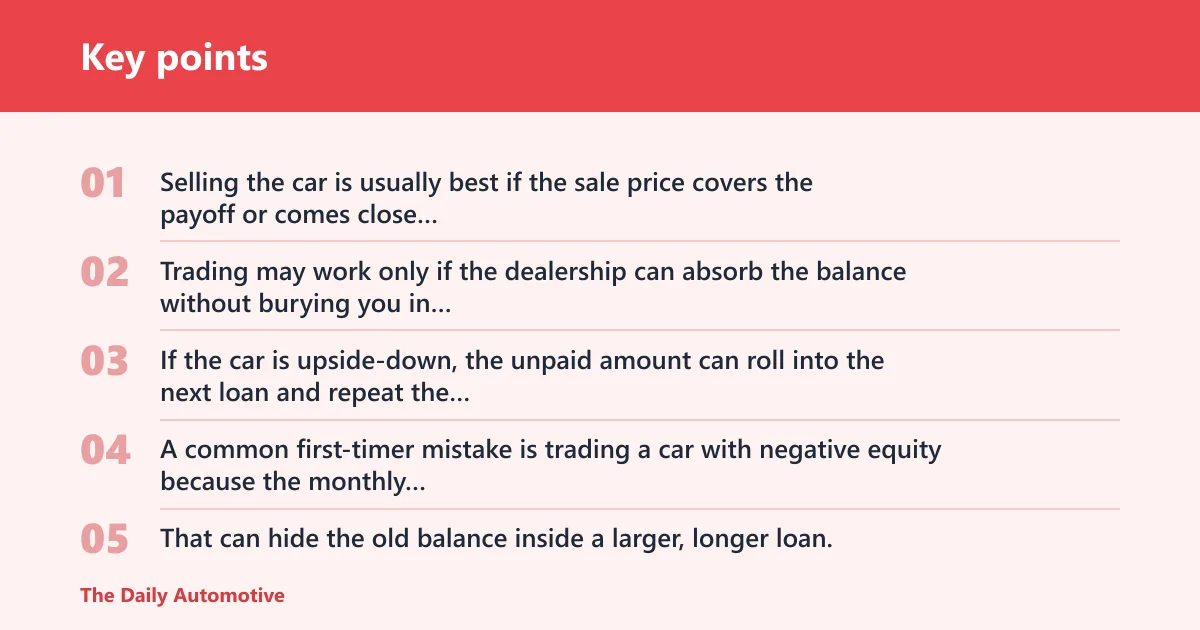
Selling the car is usually best if the sale price covers the payoff or comes close enough to manage the remainder. Trading may work only if the dealership can absorb the balance without burying you in the next loan. If the car is upside-down, the unpaid amount can roll into the next loan and repeat the problem.
A common first-timer mistake is trading a car with negative equity because the monthly payment on the new vehicle looks lower. That can hide the old balance inside a larger, longer loan. The monthly bill may fall while the total debt grows.
Repossession and personal property
The same source notes that some states allow repossession after a single missed payment. InCharge says default is typically around 90 days without a payment, and a default can lead to repossession. Contract terms and state law control the details. If the vehicle is taken, ask how to retrieve personal property left inside.
Credit report timing
The same source says a missed payment may appear on a credit report after 30 days. Hardship agreements may still be reported in a way that shows the account was modified or assisted, while missed payments, surrender, and repossession all damage credit. The earlier you act, the more likely you are to avoid the worst reporting.
What if insurance, fuel, or repairs are the real problem?
If you can afford the loan payment but not insurance, fuel, or repairs, the vehicle may still be unaffordable. That changes the decision. A cheaper car with lower insurance and repair costs may be the better long-term move. If the current car needs an expensive repair, compare that bill with the cost of replacing the vehicle and the financing it would require.
Separate car costs from loan costs
What to do if you can’t afford your car insurance depends on whether the issue is a late premium, a policy increase, or a car that no longer fits the budget. If you cannot keep insurance active, do not assume the loan payment still matters most. Many states and lenders require coverage, so let the insurance problem and the loan problem inform each other.
What to do if you can’t afford car repair starts with the repair estimate and the car’s actual value. If one major repair is larger than the vehicle’s worth, keeping the car may not make financial sense. What to do if you can’t afford your car finance is a different question from what to do if the car itself keeps draining cash after the payment clears.
Frequently asked questions
What to do if you can’t afford your car payment anymore
Call the lender before the next due date and ask for a deferral, due date change, or hardship plan in writing. If the payment will stay too high, compare a refinance, a sale, or a voluntary surrender before default. The least damaging option depends on whether the problem is temporary or permanent.
What happens if you can’t pay your car finance
Late fees, delinquency, and credit damage may start first, and default and repossession may follow under the contract and state law. Some lenders may offer a short pause, but approval is not guaranteed. If the account becomes overdue, ask immediately whether there is a catch-up plan or a documented hardship option.
If I can’t afford my car can I give it back
Yes, voluntary surrender is possible with many lenders, but it is usually a last resort. The lender can still sell the car, and you can still owe a deficiency balance if the sale does not cover the loan. Your credit will still take damage, so ask for the surrender terms in writing first.
What to do if you can’t afford your car insurance
Contact the insurer before coverage lapses and ask whether a payment plan, due date change, or policy adjustment is available. Then check whether the car remains affordable once insurance is included. If you cannot keep insurance active, the vehicle may not be usable, even if the loan payment itself seems manageable.
What to do if you can’t afford car repair
Get the repair estimate, compare it with the vehicle’s value, and weigh that against your transportation budget. If the repair is large and the car is already expensive to run, selling may be the better move. Do not let one repair bill hide a larger affordability problem.
What happens if you can’t pay your car
If you cannot pay the car loan, contact the lender right away and explain whether the problem is temporary or ongoing. Missing payments can trigger late fees, reporting to the credit bureaus, default, and repossession. The sooner you ask for a written option, the more choices you may still have.
Products related to this article
Sponsored / affiliate links. As an Amazon Associate I earn from qualifying purchases. I may earn additional commission from eligible campaigns.
 Car A/C Repair Kit, 270PCS Rubber O-Ring Seal Kit + 40PCS Car Air Conditioner Valve Core Kit for R12 R134a A/C with Remover & Install Tool+10pcs R134a AC Valve Caps, Fix Refrigeration System
![iPhone Car Charger,USB C Fast Car Charger[Apple MFi Certified] Apple Car Charging 38W Dual Port CarCharger Cigarette Lighter Adapter 2x3ft PD&QC 3.0 Lightning Cable for iPhone 14/13/12 Pro/11/Airpods](https://m.media-amazon.com/images/I/41XizrssoiL._SL500_.jpg) iPhone Car Charger,USB C Fast Car Charger[Apple MFi Certified] Apple Car Charging 38W Dual Port CarCharger Cigarette Lighter Adapter 2x3ft PD&QC 3.0 Lightning Cable for iPhone 14/13/12 Pro/11/Airpods
iPhone Car Charger,USB C Fast Car Charger[Apple MFi Certified] Apple Car Charging 38W Dual Port CarCharger Cigarette Lighter Adapter 2x3ft PD&QC 3.0 Lightning Cable for iPhone 14/13/12 Pro/11/Airpods