How to Calculate Paying Off a Car Loan Early & Save More
To calculate an early car-loan payoff, start with your current principal balance, add interest through your planned payoff date, and subtract any fees or rebates your lender says apply. Skip that math, and you can end up short or overpaying by hundreds. This guide shows the hand calculation, then how to check it against a lender payoff quote.
Car loan payoff math

Amortization is the payment split that sends part of each installment to interest and part to principal. Early in the loan, more of the monthly payment goes to interest because the balance is higher. As principal falls, the interest charge falls too, which is why extra principal payments can shorten the term.
APR drives that interest cost. It is the annual rate used to derive the monthly rate for the payoff math, and that monthly rate determines how much of each payment is consumed by interest before the balance drops.
The inputs you need before you start
Before you calculate anything, gather the remaining loan balance, APR, remaining term, required monthly payment, and any extra payment you plan to send. The Car Payoff Early Calculator includes a “Remaining Term (Months)” input and an “Additional Monthly Payment” input, and its output includes “Total Savings from Early Payoff.”
You also need to check whether the lender applies payments to principal first, whether it uses daily interest accrual, and whether a prepayment penalty appears in the loan terms. Those details can change the final payoff quote.
How do you calculate an early payoff?
Start with the current balance, convert APR to a monthly rate, and apply the scheduled payment against that balance month by month. Then add your extra monthly payment or lump sum to principal and recalculate until the balance reaches zero. That gives you a payoff month and a savings estimate.
Convert APR to a monthly rate
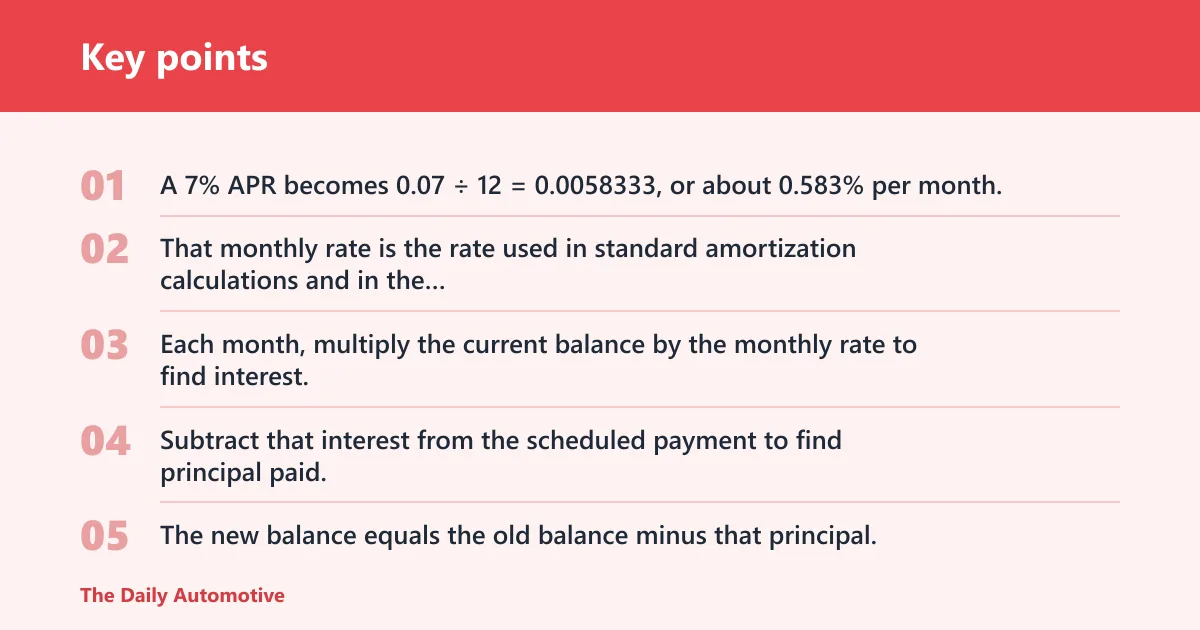
Use this formula: monthly rate = APR ÷ 12. A 7% APR becomes 0.07 ÷ 12 = 0.0058333, or about 0.583% per month. That monthly rate is the rate used in standard amortization calculations and in the EMI-style formula shown on many loan calculators.
Estimate the remaining balance after each payment
Each month, multiply the current balance by the monthly rate to find interest. Subtract that interest from the scheduled payment to find principal paid. The new balance equals the old balance minus that principal. Early payments reduce principal faster only if they are actually applied to principal, not held in suspense.
Add an extra payment and recalculate the payoff month
Add the extra amount to the scheduled payment, then repeat the interest-and-principal split each month. The extra amount attacks principal directly, so next month’s interest charge drops sooner. Experian says paying off a car loan early can cut interest costs, but the result depends on fees and payment posting rules.
Payoff worksheet
Use this text-only worksheet to verify the math by hand. It uses the same basic setup as the example on the calculator page: a $30,000 loan at 7% with an extra $250 per month. That example claims a new payoff time of about 44 months and about $3,000 in interest saved.
| Step | Input or calculation | Result |
|---|---|---|
| 1. Original balance | $30,000 principal remaining | $30,000 |
| 2. Monthly rate | 7% ÷ 12 | 0.0058333 |
| 3. Scheduled payment | Standard monthly installment on the loan | Use the lender’s amortized payment |
| 4. Extra payment | Add principal-only payment each month | $250 extra |
| 5. Payoff month and savings | Repeat the split until balance reaches zero | About 44 months; about $3,000 interest saved |
Suppose your payment is due on the first of each month and you send the extra $250 with a principal-only instruction. If the lender posts it to principal right away, the payoff date should move forward. If it sits as a future payment or is applied next month, the savings will be smaller than your worksheet shows.
How much interest can I save by paying off my car loan early?
Your savings equal the interest you would have paid under the original schedule minus the interest you actually pay after the extra principal hits the balance. In the example above, the calculator page says the savings are about $3,000. That number can drop if the lender charges a fee or uses a different payoff date.
Interest savings are largest when the loan has a higher APR, a longer remaining term, and a larger balance. Lower-rate loans usually save less, so they may not be the best first target if you also carry higher-interest debt.
Is it better to make extra monthly payments or one lump sum?
Both methods cut interest because both reduce principal early. Extra monthly payments work better when you want a steady budget hit and faster amortization. A lump-sum payment works better when you have a windfall, tax refund, bonus, or savings bucket ready to apply now.
To compare them, hold the same balance and APR constant. Then test one version with monthly overpayments and another with a one-time principal reduction. The earlier the principal drops, the more interest you avoid.
Compare both using the same balance and APR
Use the same remaining balance, same monthly rate, and same loan terms in both calculations. If the lump sum is larger than one month of extra payments, it may save more interest because it cuts the balance immediately. If the lender applies monthly extras slowly, the lump sum can win by a wider margin.
A common first-timer mistake is sending a lump sum without checking whether the lender needs a payoff statement first. That can create a small leftover balance because daily interest keeps running until the payment posts.
How do I figure out my new payoff date after extra payments?
Count month by month after you add the extra principal. Each round, subtract that month’s interest from the payment, then subtract the remaining amount from principal. When the balance reaches zero, that is your new payoff date. The more you send each month, the fewer periods remain.
If you want a quick estimate, divide the remaining balance by the combined monthly payment after interest is approximated, then refine the result with a lender payoff quote. The quote should confirm the actual payoff date because daily interest accrual changes the final number.
Lender payoff quote
A lender payoff quote can differ from your estimate because it includes the exact payoff date, daily interest accrual, and any unpaid fees. It also shows whether the lender will apply money to principal only or hold it as an advance payment. That is why the quote matters even after you do the math by hand.
What to ask before sending extra principal
- Ask for a current payoff quote good through a specific date.
- Ask whether extra payments are applied to principal only.
- Ask how to label the payment so it is not treated as the next scheduled installment.
- Ask whether the loan has a prepayment penalty or early repayment charge.
- Ask whether daily interest accrues until the payment posts.
Sainsbury’s Bank says early repayment charges may apply if you pay a loan off early. That is why the payoff quote, not just the remaining balance, should guide the final payment amount.
How do prepayment penalties affect car loan payoff savings?
A prepayment penalty reduces net savings because the fee comes out of the interest you expected to avoid. If the fee is large enough, it can erase the benefit of paying early. Experian warns that a prepayment penalty can reduce or erase savings, so compare gross savings and fee side by side.
| Item | Amount |
|---|---|
| Gross interest saved | $3,000 |
| Prepayment penalty | $450 |
| Net savings | $2,550 |
| Breakeven month | When cumulative interest saved exceeds $450 |
If the fee is paid up front, you have to recover it through interest savings before the payoff plan is actually worth it. In that case, the breakeven month is the month when your saved interest crosses the penalty amount. If it never does, early payoff is the wrong move for that loan.
When is it not smart to pay off a car loan early?
It is often a poor choice when the loan rate is low, when you carry higher-interest debt, or when sending extra cash would drain your emergency fund. Early payoff also makes less sense if the lender charges a meaningful fee or if your lender applies extra payments slowly instead of to principal right away.
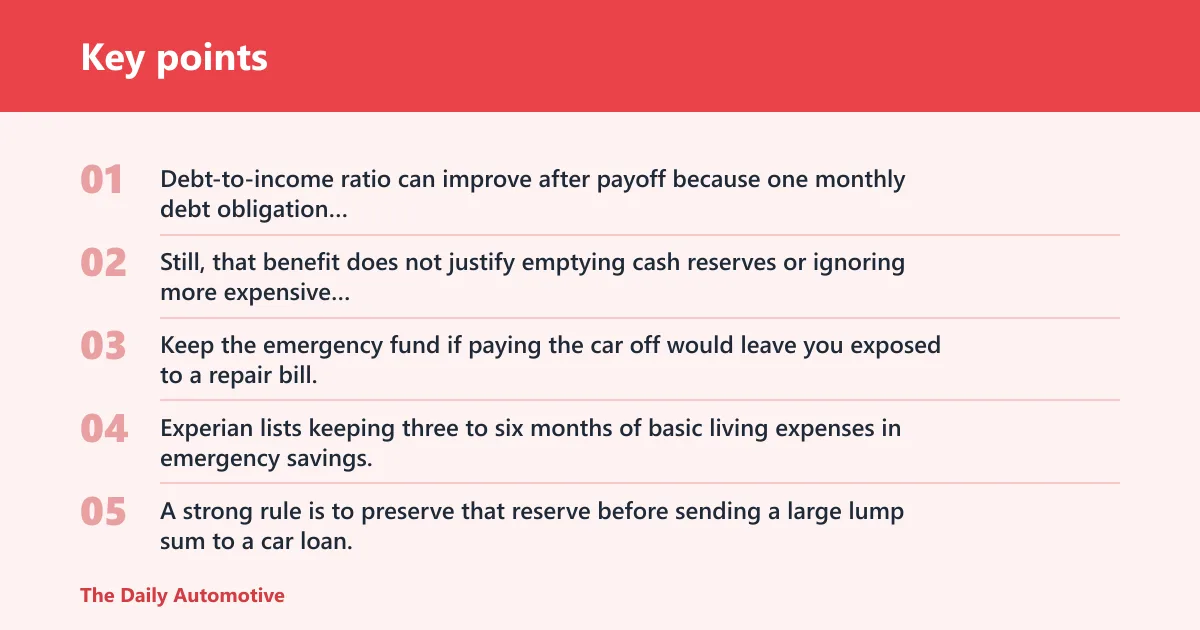
Debt-to-income ratio can improve after payoff because one monthly debt obligation disappears, which may help future credit applications. Still, that benefit does not justify emptying cash reserves or ignoring more expensive debt.
Should I pay off my car loan early or keep my emergency fund?
Keep the emergency fund if paying the car off would leave you exposed to a repair bill, medical cost, or job loss. The same source lists keeping three to six months of basic living expenses in emergency savings. A strong rule is to preserve that reserve before sending a large lump sum to a car loan.
If you have multiple debts, compare the car loan rate with your other balances first. A low-rate auto loan can stay in place while you direct extra money to higher-interest debt and still keep a cash cushion intact.
How do I check if my lender allows extra principal payments?
Read the loan agreement for principal-only payment language, early repayment charges, and any posting rules. Then call the servicer and ask whether online payments can be marked as principal only, whether extra money is held for future installments, and whether a separate payoff quote is required before you send a lump sum.
Always label the payment clearly if the lender allows it. If the servicer offers a note field, specify “apply to principal only” and confirm that the extra amount will not be treated as an advance monthly payment. That step helps prevent allocation errors.
Frequently asked questions
How do I calculate paying off a car loan early?
Start with the remaining balance, convert APR to a monthly rate, and calculate the month-by-month split between interest and principal. Add any extra monthly payment or lump sum to principal, then repeat until the balance reaches zero. Verify the result with a lender payoff quote because timing and fees can change the final amount.
What formula is used for an auto loan payoff calculation?
Many calculators use the standard EMI-style amortization formula that combines principal, monthly rate, and term into a fixed payment. The practical payoff version then subtracts monthly interest from each payment and applies the rest to principal. That loop continues until the balance reaches zero.
Does paying off a car loan early hurt my credit score?
It usually does not cause major harm, but the effect can vary because installment accounts have different roles in a credit file. The bigger change is that your debt-to-income ratio may improve for future borrowing. Do not expect a payoff to create a quick score jump on its own.
Products related to this article
Sponsored / affiliate links. As an Amazon Associate I earn from qualifying purchases. I may earn additional commission from eligible campaigns.