Which Battery Terminal to Connect First? Install vs Jump-Start
When you install a car battery, connect the positive (+) cable first and the negative (-) cable last; to take a battery out, reverse that and disconnect the negative (-) cable first. Jump-starting is a third, different sequence, and its final clamp goes on bare metal away from the battery. This guide sets out what DEKA, Interstate, Ford, Kia, Mazda, Optima, NOCO and Tesla publish for each job and where they differ.
Connection Order
Best Memory Saver Pick
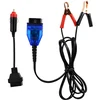 |
allsun OBD2 Memory Saver for Car
|
As an Amazon Associate we earn from qualifying purchases. Spec-based pick from the listing, not a hands-on test.
For installing a battery, the order is positive (+) on first, negative (-) on last. DEKA’s battery care guide says to connect the positive cable first and the ground cable last, and prints in capitals: always disconnect the grounded cable first and connect it last to prevent dangerous sparks. Kia gives the same answer for a replacement battery, and Interstate says reconnecting follows the removal steps with the red positive clamp going on first.
Removal is the mirror image. Ford’s owner’s manual for non-hybrid models says to apply the parking brake, switch the ignition and electrical equipment off, wait a minimum of two minutes, disconnect the negative battery cable terminal, then the positive, then remove the battery. It says to install by reversing that procedure, which puts the positive cable on first. For removal alone, see our guide on which terminal you disconnect first.
Reasons For Connection Order
The logic comes down to what is grounded. Interstate says the negative terminal connects to the vehicle’s frame, so with the negative cable attached, the metal around the battery is wired to the battery. A wrench bridging the positive post and any bare metal then completes a circuit. With the grounded cable off, that slip has nothing to complete. DEKA states the purpose directly: take the ground cable off first to avoid any sparking around the battery, and put it on last.
NOCO explains the same idea for jumper clamps: a loose negative clamp usually touches only ground, whereas connecting the negative first and then the positive creates a potential short. For a shorter answer, see our quick answer on which battery terminal to connect first.
Ford says a negative cable disconnected on its own must be isolated or placed away from the battery terminal to avoid arcing. Interstate says to wrap the loose red positive terminal in a cloth, or cover it with a plastic cup, so it cannot touch metal.

Step-by-step Guide
This sequence follows Ford’s owner’s manual for removal, DEKA’s installation steps and Interstate’s safety advice. Interstate strongly recommends a repair shop before disconnecting a battery. For hybrid or electric cars, use the manual instead.
- Read the manual. Find the battery location and any model-specific steps. Ford warns that removing the cables from only one battery does not disconnect the electrical system on a vehicle with more than one.
- Protect yourself. Interstate says to wear safety glasses and gloves and take off jewelry. Ignition off, parking brake on, electrical equipment off, per Ford.
- Add backup power if you can. Interstate says to connect backup power before disconnecting, and DEKA recommends a computer memory saver.
- Wait two minutes, then mark the cables. Ford says the engine management system needs the time to store its data. DEKA says to mark both cables.
- Loosen the negative (-) clamp first and lift it away. Interstate says never to let the wrench touch the other terminal.
- Loosen the positive (+) clamp, wrap it in a rag and lift it clear of the battery and any metal.
- Remove the hold-down and lift the battery out without tipping it. Interstate warns that batteries can weigh 40 pounds or more. If there is a vent tube, Ford says to reconnect it afterward so harmful gases cannot enter the cabin.
- Clean the tray and clamps with a wire brush and baking soda and water, per Ford. Clamps corroded beyond cleaning? See the best battery terminal connectors.
- Install the new battery in the same position and tighten the hold-down, per DEKA. Ford says an Auto-Start-Stop vehicle needs exactly the same specification.
- Connect the positive (+) cable first, then the negative (-). Ford says the ignition stays off and the cables must be fully tightened. DEKA says never to hammer clamps on.
- Reset what the car forgot: window bounce-back, clock and radio presets, per Ford.

Replacing a Battery vs Jump-Starting: Who Says What
The common mix-up is treating every battery job as one sequence. Interstate notes that jumper cables start with the positive cable while disconnecting a battery starts with the negative one. The table keeps each job separate and names the source.
| Job | Order | Detail | Who says so |
|---|---|---|---|
| Remove a battery | Negative (-) off first, then positive (+) | Wait two minutes; isolate the loose negative cable; cover the positive terminal | Ford owner manual (non-hybrid), DEKA, Interstate, Kia |
| Install a battery | Positive (+) on first, negative (-) last | Ignition off; fully tighten; do not hammer clamps on | DEKA, Interstate, Kia, Ford (“reverse the removal procedure”) |
| Jump-start with cables | Red to dead battery (+), red to booster (+), black to booster (-), last black clamp to bare metal away from the battery | Never to the dead battery negative post; keep cables off moving parts | Mazda 2024 CX-5 manual, Kia 2025 manual, Optima, DEKA, Interstate, NOCO; all say to remove the cables in reverse order |
| Battery charger | Charger off before clamps go on or come off | Optima: positive clamp on positive terminal, negative clamp to metal ground on the car or the negative post | DEKA, Optima |
| Lithium jump starter | Follow the device manual | Tesla Model 3 manual: red to the red positive jump post, black to the bolt by the brake fluid reservoir; negative off first | NOCO, Tesla Model 3 owner manual |
Where the sources differ, they differ on the details. For the last black jumper clamp, Optima says a shiny, unpainted metal bolt attached to the engine, Interstate a metal component like a bracket, DEKA the engine block, Kia a solid stationary metallic point away from the battery, and Mazda a location shown in its figure. NOCO adds that chassis ground gives the current a more direct return path than the dead battery’s negative post. The takeaway: follow the diagram in your owner’s manual.
Safety Precautions
Every manual read for this guide treats a battery as a hazard in two ways: gas and acid. Ford says batteries normally produce explosive gases, so keep flames, sparks and lighted substances away and shield your eyes. Mazda and Kia say hydrogen produced during normal operation could ignite and cause the battery to explode. DEKA says all batteries generate explosive hydrogen gas.
- Acid: Ford and Mazda say battery fluid contains sulfuric acid; flush eyes with water for at least 15 minutes and get medical attention.
- Metal and jewelry: Mazda says not to let metal tools touch either terminal or the positive terminal touch the vehicle body. Interstate says to remove jewelry.
- Frozen or low-fluid batteries: Mazda and Kia say not to jump-start one, because it may rupture or explode.
- Damaged batteries: Interstate lists corrosion, heat damage, bulging, cracks or a rotten egg smell as reasons to get a professional.
- Workplaces: OSHA 1926.441 requires ventilation that prevents an explosive gas mixture around batteries, and OSHA’s forklift battery guidance says to shut the charger off when connecting or disconnecting, and to use non-sparking tools.
Jump Starters, Chargers and Special Cases
For jumper cables, Kia’s 2025 manual says not to lean over the battery while connecting, and warns that joining the booster’s negative cable to the discharged battery’s negative terminal can make it overheat and crack, releasing acid. Mazda gives the reason: a spark could ignite gas around the battery. Mazda says to use only a 12 V booster, since 24 V can damage the starter and electrical parts. Our guide to jump-starting a car with a dead battery covers the full process.
NOCO says its lithium jump starters include reverse polarity and short circuit protection, but the device manual still governs. For charging, DEKA says gel and AGM batteries need a voltage-limited charger; see how to connect a trickle charger.
Start-stop cars add rules. Ford says an Auto-Start-Stop vehicle needs a replacement battery of exactly the same specification, describes a battery sensor reset after a new battery goes in, and says the battery management system needs eight hours of vehicle sleep time to relearn the state of charge. Ford also says not to connect an electrical device’s ground directly to the battery negative post. If your car has a battery sensor on the negative terminal or any other special procedure, follow the owner’s manual. For battery choices, see the best car battery for stop-start vehicles.
Troubleshooting Tips
- Small spark on the last jumper clamp: Optima says there may be a small spark, which is why that clamp goes as far from the battery as possible.
- No start after a jump: Interstate lists the starter, ignition switch, alternator and a fuse as other causes.
- Rough idle or odd shifting after reconnecting: Interstate says a battery disconnected without backup power can cause uneven idle, rough shifting and warning lights until the car relearns. Ford says an automatic transmission may shift firmly at first.
What You Lose When the Battery Is Disconnected
Interstate says disconnecting without backup power erases data in the car’s modules, and that shops commonly plug a backup battery into the OBD II port. DEKA recommends a computer memory saver while a battery is disconnected. See whether disconnecting the battery resets the car computer for more.
Interstate lists adaptive fuel calculations, diagnostic tracking, sound system settings and idle-air-control settings as the data at risk, and Ford lists window bounce-back, the clock and radio presets.
Frequently Asked Questions
Which Terminal Should Be Connected First On A Car Battery?
When installing a battery, connect the positive (+) terminal first and the negative (-) terminal last, as DEKA, Interstate and Kia state. When removing a battery the order flips: negative (-) off first, then positive (+). Jump-starting is a third sequence, shown in the table above.
Why Connect The Positive Terminal First?
The negative cable is the grounded one, so leaving it for last keeps the metal around the battery from being wired to the battery while you work on the positive post. DEKA says the grounded cable should come off first and go on last to prevent dangerous sparks.
What Happens If You Connect The Negative Terminal First?
The sources warn about sparks and short circuits rather than one fixed outcome. With the grounded cable already on, a wrench touching the positive post and bare metal can complete a circuit, which DEKA’s order is meant to prevent. If anything looks damaged afterward, have a shop inspect the car.
How To Safely Disconnect A Car Battery?
Ford’s owner’s manual for non-hybrid models says to apply the parking brake, switch the ignition and all electrical equipment off, wait at least two minutes, then disconnect the negative cable, then the positive. Interstate adds eye protection, gloves, no jewelry, and covering the loose positive terminal.
Which Battery Terminal Do You Connect First When Jump-Starting?
Red (+) clamp on the dead battery’s positive terminal, other red clamp on the booster’s positive terminal, black (-) clamp on the booster’s negative terminal. The last black clamp goes on solid bare metal away from the dead battery, not on its negative post, per Mazda, Kia, Optima and Interstate.
Which Terminal Do You Connect First On A Battery Charger?
DEKA says to turn the charger off before connecting. Optima’s charger instructions put the positive (red) clamp on the positive terminal and the negative (black) clamp on a metal ground on the car or on the negative post. Follow the instructions for your charger model, because designs differ.
Do Hybrid, Start-Stop Or Electric Cars Use The Same Order?
Not always. Ford describes a battery sensor reset after a new battery goes in, and Tesla’s Model 3 manual shows its own external power connection points. For any vehicle with a battery sensor or special procedure, follow the owner’s manual.
Conclusion
For a replacement, the order is negative off first, positive off second, then positive on first and negative on last. For jumper cables, it is positive on both batteries, the booster’s negative, then bare metal away from the dead battery. Chargers, start-stop cars and electric vehicles can differ, so the owner’s manual wins.
This guide does not cover hybrid or electric high-voltage systems, battery sizing or battery prices; ask a dealer or qualified shop for those.
Products related to this article
Sponsored / affiliate links. As an Amazon Associate I earn from qualifying purchases. I may earn additional commission from eligible campaigns.