What Was the First Supercar? Miura vs. 300SL: The Real Debate
Most automotive historians credit the 1966 Lamborghini Miura as the first supercar — its transverse mid-engine V12 layout and roughly 174 mph top speed set the template every modern supercar still follows. But the title is genuinely contested: the 1954 Mercedes-Benz 300SL Gullwing and the supercharged 1935 Duesenberg SJ both have real claims, decades earlier. This guide compares all three contenders, traces where the word “supercar” itself came from, and explains why no single answer satisfies every historian.
Insert your Affiliate Disclosure reusable block here.
Quick Answer
There’s no single agreed “first supercar.” Most historians point to the 1966 Lamborghini Miura for pioneering the mid-engine road-car layout, but the 1954 Mercedes-Benz 300SL Gullwing (first production car with fuel injection) and the supercharged 1935 Duesenberg SJ are genuine contenders too. Even the word “supercar” itself predates all three, first appearing in print in 1920.
Why “First Supercar” Doesn’t Have One Correct Answer
The confusion starts because “first supercar” can mean three different things: the first car to use the actual word, the first car with the technical layout we now associate with supercars, or the first car that simply felt like one to the people who drove it. Different historians pick different criteria, and each criterion points to a different car.
Enthusiast sources like Lamborghini’s own company history and outlets such as Jalopnik and Motorious disagree on which car deserves the title for exactly this reason — they’re not arguing about the facts, they’re using different definitions of “supercar” to begin with. This same kind of “which one counts as first” debate shows up across automotive history — the question of when the first car was ever made has a similarly contested answer, since “first” can mean the first working prototype, the first patented design, or the first car sold to the public.
What Actually Defines a Supercar?
A supercar is a high-performance road car that combines extreme speed, advanced engineering, and exclusivity — typically built around a powerful mid- or rear-engine layout, a top speed well beyond ordinary sports cars of its era, and low enough production numbers to stay genuinely rare. No single spec sheet number qualifies a car; it’s the combination that counts.
- Speed: A top speed that stood out sharply from other production cars when it launched.
- Engineering: A layout or technology genuinely new for its time — a mid-engine chassis, a supercharger, or fuel injection.
- Exclusivity: Low production numbers, often in the dozens or low hundreds rather than mass-market scale.
- Design: A body shape built around performance first, styled to look as fast as it drives.
The 3 Leading Candidates for “First Supercar”
Lined up chronologically, three cars keep coming up whenever historians debate this question — each pioneering a different piece of what a supercar would eventually become.
| Model | Year | Engine | Power | Top Speed | Why It’s a Contender |
|---|---|---|---|---|---|
| Duesenberg SJ / SSJ | 1935 | Supercharged inline-8 | 320–400 hp | ~140 mph | First production-based car to pair a supercharger with genuinely exotic performance |
| Mercedes-Benz 300SL Gullwing | 1954 | 3.0L inline-6, direct fuel injection | 215 hp | 155–163 mph | First production passenger car with direct fuel injection; fastest production car of its day |
| Lamborghini Miura | 1966 | 3.9L V12, transverse mid-engine | 350 hp | ~174 mph | First road car with a transverse mid-engine layout — the template nearly every supercar since has followed |
Best Miura Collectible Pick
Matchbox 1966 Lamborghini Miura P400 Diecast (1:64)
An affordable, accurately liveried replica of the car most historians call the first true supercar.
- Best for: Fans who want the exact 1966 P400 on a shelf without a premium price tag.
- Why we picked it: Correct 1966 bodywork at a genuinely low entry cost, matching the car this article centers on.
- Main drawback: 1:64 scale is small — detail is limited compared to 1:24 kits.
Compare more first-supercar collectibles
 Option 1 cvking Drift Tire RC Tyres Compatible with Arrma for Infraction for Limitless for HPI WR8 for HSP fo
|
 Option 2 Mercedes-Benz 300SL 1/24 Diecast
|
 Option 3 Hasegawa 1:24 Miura P400 SV Model Kit
|
As an Amazon Associate we earn from qualifying purchases.
Lamborghini Miura (1966): The Mid-Engine Pioneer
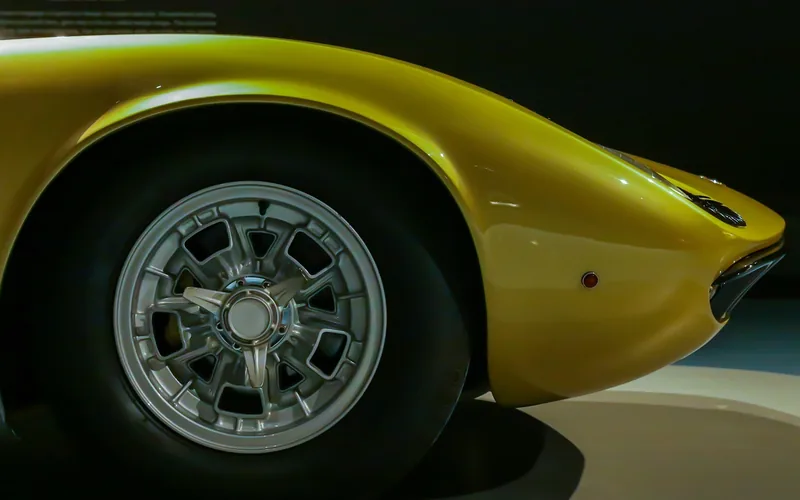
The Miura debuted March 10, 1966 at the Geneva Motor Show. Designer Marcello Gandini, working at Carrozzeria Bertone, wrapped a 3.9-liter V12 around a chassis that put the engine transversely behind the driver rather than up front — a configuration no production road car had used before. The first version, the P400, made 350 hp and reached roughly 174 mph, making it the fastest production car in the world at launch.
That mid-engine layout is the specific reason most historians hand the Miura the “first supercar” title over its rivals — it’s the architectural template that the Ferrari 308, Lotus Esprit, Ferrari F40, McLaren F1, and virtually every supercar since have followed.
Mercedes-Benz 300SL Gullwing (1954): The Post-War Contender
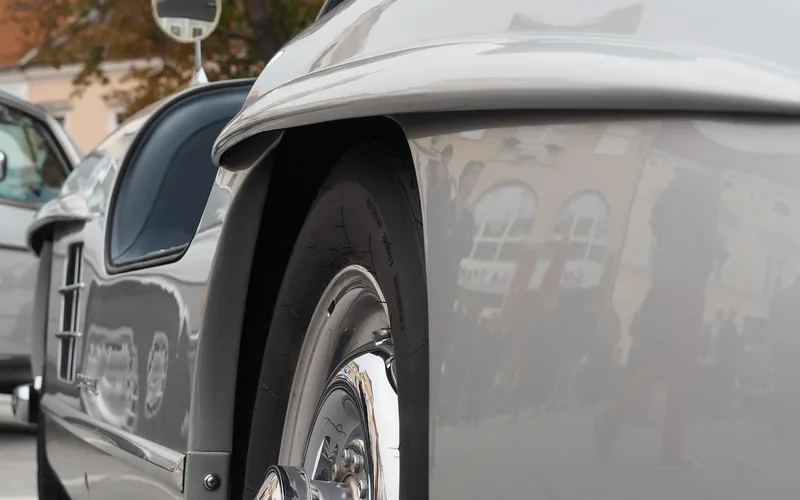
Unveiled February 6, 1954, the 300SL Gullwing paired a 3.0-liter inline-six making 215 hp with the world’s first direct fuel injection system fitted to a production passenger car — technology borrowed from wartime aircraft engines. Depending on the final-drive gearing fitted, it reached 155–163 mph, making it the fastest production car of the early 1950s, twelve years before the Miura existed.
Publications including Motorious and Heacock Classic have argued the 300SL, not the Miura, deserves the “first supercar” title because it combined genuine speed with cutting-edge technology and true exclusivity years earlier — the Miura’s advantage is the mid-engine layout, not being first to combine speed, tech, and rarity.
Duesenberg SJ / SSJ (1935): The Supercharged Original
Three decades before either European rival, Duesenberg fitted a centrifugal supercharger to its Model J chassis to create the SJ, and later the ultra-rare SSJ — only two of which were ever built. The supercharged inline-8 produced 320 hp in the SJ and up to 400 hp in the SSJ, enough for a 0–60 mph run in around 8 seconds and a top speed near 140 mph, figures that embarrassed most cars on the road a decade later, let alone in 1935.
The Duesenberg predates the word “supercar” being applied to any road car by decades, and it’s rarely the historians’ top pick — but it’s the earliest car that genuinely matches the modern definition: shockingly fast, mechanically exotic for its era, and built in numbers small enough to stay rare.
Ferrari 250 GTO (1962): A Racing Icon, Not Usually Called “First”
The 250 GTO is often mentioned in the same breath as the Miura and 300SL, but most historians treat it differently — it’s a homologation racer built to qualify for GT racing, not a road-going performance flagship designed to be the fastest car money could buy. Ferrari built 36 examples between 1962 and 1964 (sometimes counted as 39 alongside three related 330 GTO variants), and its rarity now drives extraordinary auction prices: a 1962 250 GTO/330 LM sold for $51.7 million at RM Sotheby’s in New York on November 13, 2023, a public auction record for any Ferrari.
Where Did the Word “Supercar” Actually Come From?
The word predates all three contenders above. It first appeared in print in 1920, in a British newspaper advertisement for the Ensign 6 — a car with roughly 39 hp, a figure that sounds unremarkable today but was genuinely potent for 1920. The term didn’t catch on in its modern sense until the mid-1960s, when motoring journalist L. J. K. Setright used it in CAR magazine to describe the newly launched Lamborghini Miura, which is part of why the Miura and the word “supercar” are so closely linked in most people’s minds.
📊 The word “supercar” first appeared in print in 1920 — describing the Ensign 6, a car with roughly 39 hp. — Source: Jalopnik, “The Term ‘Supercar’ Existed Long Before The Miura”
What Do Automotive Historians Actually Say?
Ask three historians which car was first, and you’ll often get three different answers depending on what they weigh most heavily — mid-engine architecture, raw speed, or how early the car predates every rival.
“Lamborghini Miura: The first Supercar in history” — the Miura “gave birth to the modern mid-engine super sports car.”
That’s Lamborghini’s own claim, and it’s the most commonly repeated version of the story — but it’s worth remembering that Lamborghini has an obvious interest in being remembered as the inventor of the category. Independent voices are less unanimous: Motorious has argued the 300SL “is definitively the world’s first supercar” on the basis of its technology and timing, while most mainstream automotive historians split the difference by crediting the Miura specifically with the mid-engine template while acknowledging the 300SL and Duesenberg SJ as legitimate earlier claimants under a broader definition.
How Supercars Evolved After the Miura
Whichever car gets the credit, the Miura’s mid-engine formula is what stuck. The Ferrari 308, Ferrari F40, and McLaren F1 all followed the same basic layout through the 1970s, ’80s, and ’90s, each pushing top speed and technology further — the F40 reached 201 mph in 1987, and the Porsche 959 hit 197 mph in 1986, both nearly 30 mph faster than the Miura two decades earlier.
Modern hybrid and electric hypercars like the McLaren P1 and Ferrari LaFerrari now reach 0–60 mph in around 2.5 seconds, a benchmark the Miura’s era couldn’t approach, while fully electric supercars are emerging as the next chapter — trading engine noise for instant torque but keeping the same core idea the Miura introduced: a rare, purpose-built car engineered purely to be the fastest thing on the road.
Frequently Asked Questions
What Defines a Supercar?
A supercar is defined by extreme performance, advanced or unusual engineering for its era, and genuine exclusivity — typically a powerful mid- or rear-engine layout, a top speed well above ordinary sports cars, and low enough production numbers to stay rare. No single spec makes a car a supercar; it’s the combination that matters.
Which Car Is Usually Credited as the First Supercar?
The 1966 Lamborghini Miura is the most commonly cited answer, largely because Lamborghini itself promotes this claim and the Miura’s mid-engine V12 layout became the template for nearly every supercar afterward. But the 1954 Mercedes-Benz 300SL Gullwing and the 1935 Duesenberg SJ both have genuine, independently argued claims to the title.
What Features Make a Car a Supercar?
Supercars are characterized by high horsepower relative to their era, lightweight construction, and engineering that was advanced for its time — historically a mid- or rear-engine layout, and today often carbon fiber bodywork, active aerodynamics, and hybrid powertrains. Low production numbers and a price that puts the car out of reach for most buyers round out the definition.
How Fast Was the First Supercar?
It depends which “first” you mean. The Lamborghini Miura reached about 174 mph in 1966. The Mercedes-Benz 300SL Gullwing hit 155–163 mph in 1954, twelve years earlier. The Duesenberg SJ topped out near 140 mph back in 1935 — each was the fastest production car of its own era.
Where Did the Word “Supercar” Come From?
The word “supercar” first appeared in print in 1920, in a British newspaper advertisement for the Ensign 6. It didn’t gain its modern meaning until the mid-1960s, when a CAR magazine journalist used it to describe the newly launched Lamborghini Miura — which is why the word and the Miura are so closely associated today.
Is the Ferrari 250 GTO a Supercar?
Most historians classify the 250 GTO as a racing-derived GT car rather than a supercar, since Ferrari built it specifically to qualify for GT racing rather than to be the fastest road car available. It’s still frequently mentioned in “first supercar” debates for its performance and engineering, and it now holds a $51.7 million public auction record.
Conclusion
There’s no single verdict on the first supercar, and treating it as settled fact misses the real story. The Lamborghini Miura gets the credit most often because its mid-engine layout became the standard every supercar since has copied — but the Mercedes-Benz 300SL Gullwing beat it to genuine speed and cutting-edge technology by twelve years, and the Duesenberg SJ was embarrassing ordinary cars on 1935 roads three decades before either one existed. The honest answer is that “first supercar” depends on which definition you’re using — and all three cars earned their place in that argument.
Products related to this article
Sponsored / affiliate links. As an Amazon Associate I earn from qualifying purchases. I may earn additional commission from eligible campaigns.