When Was the First Automatic Car Made: Essential Facts
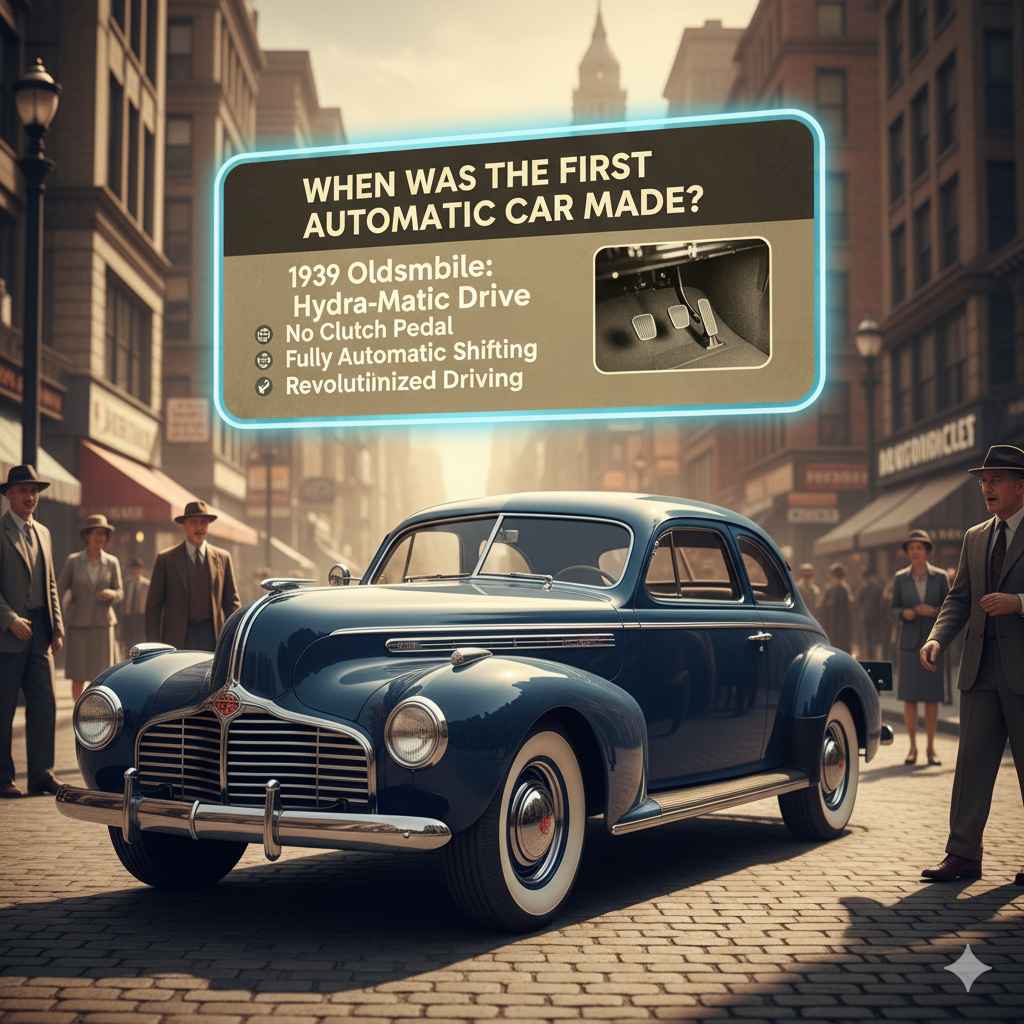
The first truly automatic transmission, freeing drivers from manual gear shifting, debuted in the 1930s with early prototypes and saw wider commercial release in the 1940s. While earlier forms existed, the 1939 Oldsmobile with its “Hydra-Matic” transmission is widely recognized as a landmark in automotive history, making driving significantly easier.
Ever wondered how cars got so easy to drive? For many of us, shifting gears feels like second nature, or not even a consideration if we’re lucky enough to drive a modern automatic. But it wasn’t always this way! The idea of a car that could change gears all by itself was once a dream, a complex challenge for engineers. If you’ve ever felt that slight hesitation when clutching and shifting, or simply marveled at how smooth some cars are, you’re probably curious about when this marvel of engineering first appeared.
Let’s dive into the fascinating story of the first automatic car, tracing its journey from a clever concept to a reality that changed driving forever. We’ll explore the key moments and inventions that led to the automatic transmission we know and rely on today, making your next drive feel like a glimpse into automotive history.
The Dawn of Effortless Driving: When Was the First Automatic Car Made?
Pinpointing the exact “first” automatic car can be a little tricky because the technology evolved over time. Think of it like building something amazing – there are early sketches, rough prototypes, and then the finished, perfected version. However, when most people ask “when was the first automatic car made,” they are usually referring to the first car that offered a mass-produced, truly automatic transmission that significantly simplified the driving experience for the average person.
The true game-changer, widely recognized as the first mass-produced automatic transmission, arrived in the late 1930s. This innovation was a huge leap forward, offering a smoother, less labor-intensive way to drive. Before this, driving a car meant constantly coordinating your hands and feet to manage the clutch and gear shifter. It required skill and practice, making driving less accessible to many.
Early Concepts and Prototypes: The Seeds of Automation
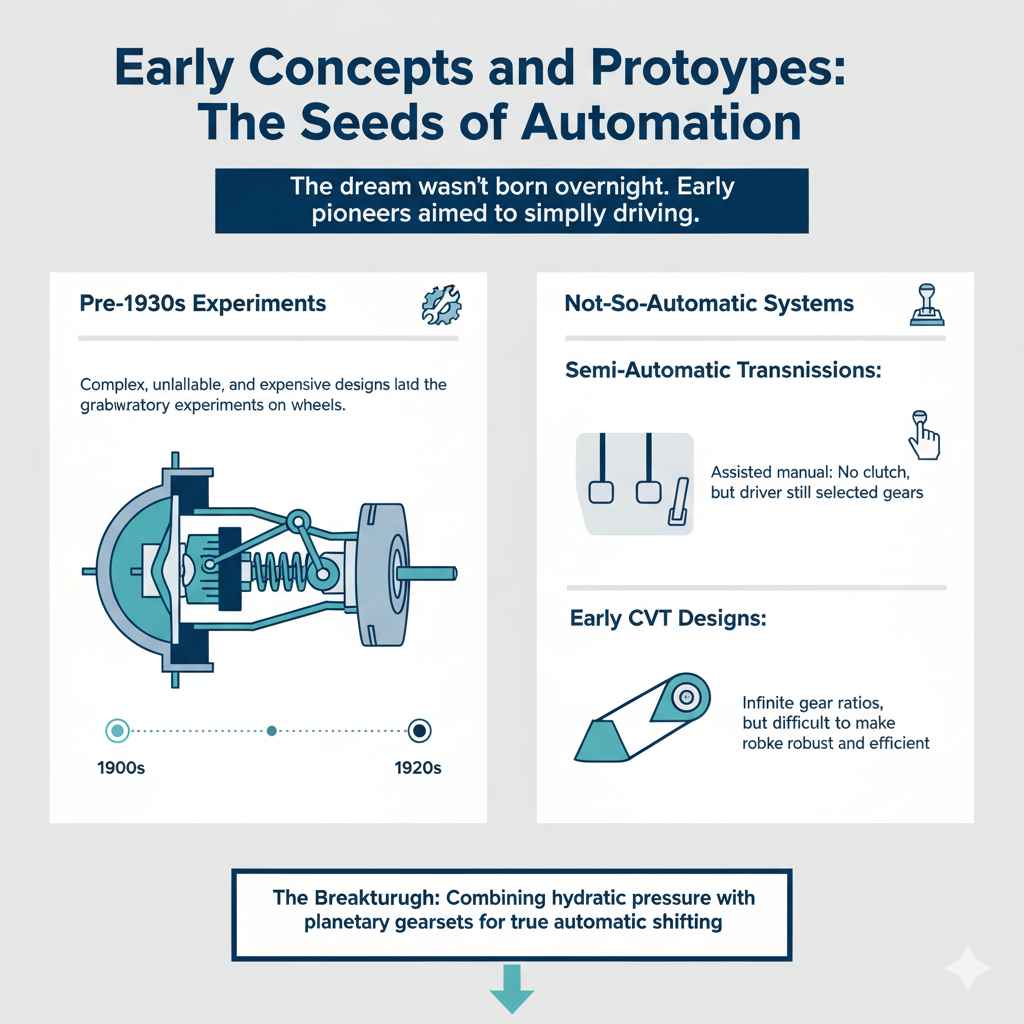
The dream of an automatic transmission wasn’t born overnight in the 1930s. Engineers and inventors had been tinkering with the idea for decades. Imagine a time when the very act of driving involved a complex dance of clutch, accelerator, and gear stick. It was a skilled task! These early pioneers recognized that simplifying this process would make cars more appealing and easier for everyone to use.
Some of the earliest patents and experimental designs for automatic transmissions date back to the turn of the 20th century. These were often complex, unreliable, and prohibitively expensive to produce. They laid the groundwork, though, demonstrating that the concept was possible. These weren’t cars you’d see at your local dealership; they were more like laboratory experiments on wheels. The core idea was to have the car detect the speed and load, and then select the appropriate gear without the driver needing to do anything but steer and use the accelerator and brakes.
The “Automatic” Gearbox vs. True Automatic Transmissions
It’s important to distinguish between early “automatic” systems and what we consider a modern automatic transmission today. Before the true automatics, there were systems that offered some level of assistance but still required driver intervention.
- Semi-Automatic Transmissions: These systems offered convenience by often eliminating the need for a clutch pedal, or by making gear changes smoother. However, the driver still had to manually select the gear. Think of them as an assisted manual transmission.
- Constant Velocity (CV) Transmissions: Some early designs aimed for a continuously variable ratio, meaning there were theoretically an infinite number of gear ratios. While revolutionary in concept, they were incredibly difficult to make robust and efficient enough for everyday use back then.
The breakthrough came when engineers figured out how to combine hydraulic pressure (fluid power) with planetary gearsets to create a system that could automatically select and shift gears based on vehicle speed and engine load. No clutch pedal, no manual shifting – just smooth, automatic operation.
The 1939 Oldsmobile: A Milestone in Automotive History
When we talk about the first truly automatic car made, the 1939 Oldsmobile Rocket 88 is often the name that comes up. This car featured the groundbreaking “Hydra-Matic” transmission, developed by General Motors (GM). This was not just a minor update; it was a revolution in personal transportation. The Hydra-Matic was America’s first mass-produced fully automatic transmission, and it was a revelation!
GM had been working on this technology for years, and its introduction was a massive deal. It meant drivers could simply put the car in “Drive” and go. No more fumbling with a clutch pedal and gear stick, especially in slow-moving traffic. This made driving significantly less tiring and much more accessible to a wider range of people, including those who found manual transmissions challenging.
How the Hydra-Matic Worked (Simplified)
The Hydra-Matic transmission used a torque converter instead of a traditional clutch to connect the engine to the transmission. A torque converter is essentially a fluid coupling that allows the engine to keep running even when the car is stopped. It also multiplies torque at low speeds, giving the car a strong initial acceleration off the line. Inside, a series of planetary gearsets, controlled by hydraulic pressure and a governor (which sensed vehicle speed), would automatically shift between different gear ranges.
This system provided four forward gears and one reverse gear. The “Hydra-Matic” name itself highlighted the use of hydraulics and the automatic nature of the transmission. It was initially offered as an option, but its popularity quickly grew, demonstrating the strong consumer demand for this more convenient way to drive.
The Evolution and Adoption of Automatic Transmissions
The success of the Oldsmobile Hydra-Matic paved the way for other manufacturers. While Oldsmobile and GM were pioneers, other companies soon developed their own versions of automatic transmissions. The technology continued to evolve rapidly throughout the 1940s and 1950s. Each new generation brought improvements in efficiency, smoothness, reliability, and cost.
In 1940, GM’s Hydra-Matic was also made available on other GM brands like Pontiac and Cadillac. By 1948, Chrysler introduced its “Fluid Drive” which was a simpler fluid coupling combined with a semi-automatic transmission, and later their fully automatic “PowerFlite” in 1953. Ford followed suit with its “Ford-O-Matic” in 1951 and the “Cruise-O-Matic” in 1958.
The post-World War II economic boom in the United States saw a massive increase in car ownership. The convenience of automatic transmissions played a significant role in this growth. Driving quickly transitioned from a skill to an everyday activity, and the automatic transmission was at the heart of this transformation. By the late 1950s and early 1960s, automatic transmissions were becoming standard equipment on many new cars, especially in America.
Key Innovations in Automatic Transmission Technology: A Timeline
The journey to today’s sophisticated automatic transmissions involved continuous innovation. Here’s a brief look at some pivotal moments in the development:
| Year | Innovation/Event | Significance |
|---|---|---|
| 1890s-1900s | Early conceptual designs and patents for automatic shifting mechanisms. | Pioneering ideas, but largely experimental and impractical for mass production. |
| 1921 | Garrett Morgan files patent for a three-speed automatic transmission. | An early, significant patent, though not widely adopted. Morgan was also an inventor of the traffic signal. |
| 1930s | Development of hydraulic systems and planetary gearsets for transmissions. | The technological foundation for modern automatic transmissions was being laid. |
| 1939 | Oldsmobile introduces the Hydra-Matic transmission. | The first mass-produced, fully automatic transmission, revolutionizing driving ease. Widely considered the benchmark for “the first automatic car.” |
| 1940 | Hydra-Matic becomes available on other GM brands (Pontiac, Cadillac). | Wider availability of GM’s groundbreaking technology. |
| 1948 | Chrysler introduces Fluid Drive (semi-automatic) and later PowerFlite (fully automatic in 1953). | Competitor innovation, demonstrating the growing trend towards automatic shifting. |
| 1950s – 1960s | Widespread adoption and refinement of automatic transmissions. | Became a common feature, with continuous improvements in efficiency and performance. |
| Late 20th Century – Present | Development of Electronic Control Units (ECUs), more gears (5, 6, 8, 10-speed automatics), Continuously Variable Transmissions (CVTs), and Dual-Clutch Transmissions (DCTs). | Increased fuel efficiency, smoother shifts, better performance, and more sophisticated control. (Learn more about how modern transmissions work from the National Highway Traffic Safety Administration (NHTSA)). |
The journey from those early, clunky prototypes to the silky-smooth, computer-controlled transmissions in cars today is a testament to human ingenuity. Each step was about making cars more accessible, more comfortable, and frankly, more fun to drive.
The Impact of the Automatic Transmission on Driving
The introduction of the automatic transmission didn’t just change how cars were built; it fundamentally changed how people interacted with their vehicles and the world around them. It was a pivotal moment that made driving less of a chore and more of a pleasure.
Increased Accessibility and Ease of Use
Before automatic transmissions, driving demanded a certain level of physical dexterity and coordination. Operating the clutch, selecting gears with a manual shifter, and managing the accelerator pedal simultaneously required practice. For many, including women, older drivers, and those with physical limitations, this could be a significant barrier to driving. The automatic transmission removed this barrier. Suddenly, driving became accessible to a much broader population. The simple act of putting the car in “Drive” and using only the accelerator and brake pedals made car ownership and operation incredibly straightforward.
Smoother Rides and Reduced Driver Fatigue
Imagine driving in heavy, stop-and-go city traffic with a manual transmission. Constantly engaging and disengaging the clutch and shifting gears can be exhausting. The automatic transmission provided a significantly smoother ride. The torque converter absorbed much of the jerkiness associated with gear changes, and the car would glide seamlessly from one gear to another. This reduction in driver effort led to less fatigue on long journeys and a more comfortable daily commute. It transformed the driving experience from a demanding task into a more relaxed activity.
Shaping Car Design and Urban Development
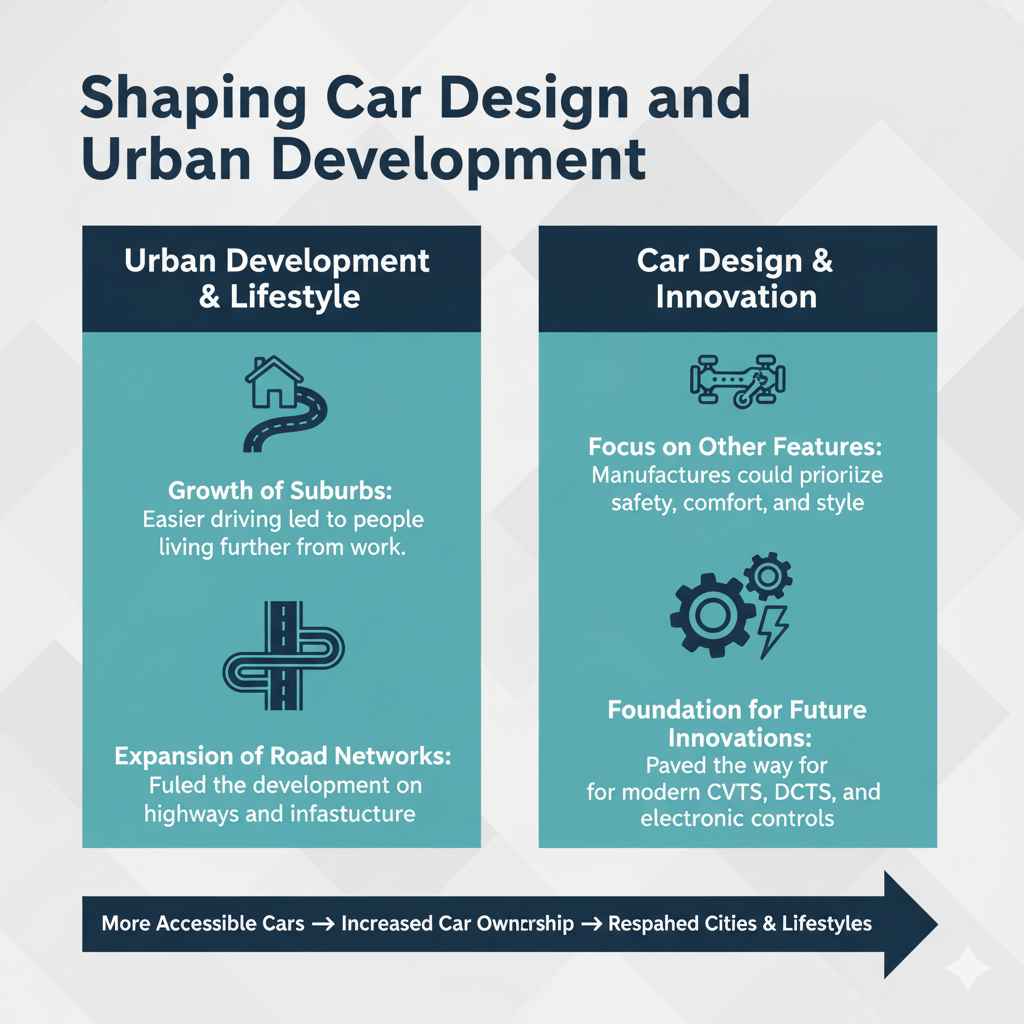
The proliferation of automatic transmissions had ripple effects beyond just the driver’s seat. As cars became easier to drive, more people bought them. This fueled the growth of suburbs and the development of extensive road networks, including highways. The convenience factor allowed individuals to live further from work and travel more freely, playing a role in reshaping cities and lifestyles. Furthermore, car manufacturers could focus on other aspects of vehicle design and performance, knowing that the transmission was handled automatically.
A Foundation for Future Innovations
The core principles established with early automatic transmissions – using fluid power and sophisticated gearsets – laid the foundation for all subsequent advancements in automatic transmissions. The introduction of electronic controls, more gear ratios, and entirely new types of automatics like CVTs and dual-clutch transmissions (DCTs) all build upon the revolutionary concept introduced in the late 1930s and 1940s. The quest for better fuel economy, smoother shifts, and enhanced performance continues, but the initial leap towards an automatic drive was the critical first step.
When Was the First Automatic Car Made: FAQ
Here are some common questions beginners have about the early days of automatic cars:
Q1: So, when exactly was the first automatic car made available to the public?
A1: The first mass-produced automatic transmission, the GM Hydra-Matic, was introduced in the 1939 Oldsmobile. This made it available to the public in the model year 1940. While there were earlier experimental systems, 1939/1940 is the generally accepted answer for the first truly automatic car.
Q2: Was the 1939 Oldsmobile the very first car to have any kind of self-shifting feature?
A2: Not exactly. Earlier cars had “semi-automatic” transmissions or fluid couplings that made shifting easier or sometimes automatic in certain conditions. However, the Hydra-Matic was the first system that was fully automatic in all driving conditions without requiring the driver to operate a clutch pedal or manually select gears for every change.
Q3: Did all cars immediately switch to automatic transmissions after 1939?
A3: No, it took quite some time for automatic transmissions to become common. They were initially expensive options. It wasn’t until the 1950s and 1960s that automatics started to outsell manual transmissions in many markets, especially in the USA.
Q4: What made the Hydra-Matic so special compared to earlier systems?
A4: The Hydra-Matic used a combination of hydraulic pressure and planetary gearsets to automatically shift through four forward gears. This was far more sophisticated and reliable than previous attempts. It truly eliminated the need for the driver to manage the clutch and gear lever for normal driving.
Q5: Were early automatic transmissions reliable?
A5: Early automatics, including the Hydra-Matic, could be complex and sometimes required specialized maintenance. They were a significant technological leap, and like all new technologies, there were learning curves for both manufacturers and mechanics. Reliability improved with each successive generation.
Q6: Why are manual transmissions still around if automatics are so much easier?
A6: Manual transmissions are often favored by driving enthusiasts for the direct control they offer. They can also be more fuel-efficient (though modern automatics are very competitive) and are typically less expensive to purchase and maintain. Some drivers simply prefer the engagement of a manual gearbox.
Q7: What’s the difference between a modern automatic transmission and the first ones?
A7: Modern automatic transmissions are vastly more complex and efficient. They often have many more gears (6, 8, 10 speeds or even continuously variable options), are controlled by sophisticated electronic computers (ECUs), and offer much better fuel economy and performance than the early fluid-and-gear-based systems. The fundamental principle of automatic shifting remains, but the execution is light-years ahead.
Conclusion: A Smoother Road Ahead
The question of “when was the first automatic car made” leads us on a fascinating journey through automotive innovation. While the concept simmered for years, it was the 1939 Oldsmobile with its revolutionary Hydra-Matic transmission that truly brought the dream of effortless driving to reality for the masses. This wasn’t just a minor convenience; it was a fundamental shift in personal mobility, making cars accessible and enjoyable for a whole new generation of drivers.
From these pioneering steps, the automatic transmission has evolved dramatically. Today, with advanced electronic controls, multiple gears, and incredible efficiency, it’s a ubiquitous feature that defines modern driving. Yet, it all began with that groundbreaking achievement over eighty years ago. So, the next time you glide through traffic or simply set your car to “Drive” without a second thought, take a moment to appreciate the brilliant engineers and bold visionaries who paved the way, creating a smoother, simpler road for all of us. The legacy of that first automatic car continues to shape our driving experience every single day.