When Was The First Car Invented
Ask five people when the first car was invented and you’ll get five different dates. Some say 1769, pointing at a steam-powered artillery tractor that crashed into a wall. Others insist it’s 1886, the year Karl Benz filed a patent for a three-wheeled, gasoline-powered machine. A few will argue it was 1908, because the Model T is the car that actually put the world on wheels.
Here’s the thing: they’re all sort of right. The word “car” covers a lot of ground, and the machine changed identity several times before it became the thing you drive today. This article walks through the whole messy evolution—steam monsters, internal combustion breakthroughs, the first true automobile, and the production-line revolution—so you can answer the question with confidence instead of guessing.

Cable Matters
Cable Matters 5-Pack 1/4 to 1/8 Headphone…
- Durable 3.5mm to 1/4 Adapter: Re-engineered 1/4 inch to 3.5mm adapter made of solid copper for durability and long life. This reli…
- 5-Pack Stereo Audio Adapters: A convenient set of 1/4 to 1/8 audio adapters (also known as 1/4 to 3.5mm adapter) lets a 6.35mm (1/…
- Universal Headphone Compatibility: This headphone jack adapter connects wired headphones or earbuds to audio devices such as ampli…
You’ll also pick up a few details most histories skip, like why Bertha Benz’s unauthorized road trip forced a brake design change, and why Europe beat America to the punch by two decades.
If you’re plugging wired headphones into a stereo system that only has a 6.35mm jack, the Cable Matters headphone adapter set solves that instantly. It’s a 5-pack of 1/4-inch to 3.5mm adapters with gold-plated connectors, so you can keep one at home, one in your audio bag, and one in the car without hunting for it.
The Question Everyone Asks: When Was the First Car “Invented”?
The honest answer is that there isn’t a single moment. The automobile didn’t appear fully formed like Athena from Zeus’s head. It evolved through several distinct stages, and each stage has a legitimate claim to the title.
Why the Answer Depends on Your Definition
Consider what you mean by “car.” Do you mean the first self-propelled road vehicle? That’s Cugnot’s steam tractor from 1769. Do you mean the first vehicle powered by an internal combustion engine? That’s Étienne Lenoir’s 1860 Hippomobile. Do you mean the first purpose-built automobile with a gasoline engine, patented as a standalone invention? That’s Karl Benz in 1886. Do you mean the first car affordable enough for ordinary people? That’s the Ford Model T in 1908.
Each answer is correct within its own frame. The useful approach is to stop hunting for one magic date and instead understand the chain of innovations that made the modern car possible. Once you see that chain, you’ll know exactly which date matters for which context.
Before Cars: Steam, Wind, and Horsepower Experiments
Long before gasoline, inventors tried to replace horses with steam. The results were heavy, slow, clumsy—and absolutely essential. These machines proved that a vehicle could move under its own power, even if the technology wasn’t ready for daily use.
Nicolas-Joseph Cugnot’s Fatal Fender-Bender
In 1769, French engineer Nicolas-Joseph Cugnot built a steam-powered tricycle intended to haul artillery for the French army. It moved at walking pace, about 2.5 mph, and had to stop every 15 minutes to build up steam pressure again. The steering was a hand-operated lever connected to the front wheel, and the boiler hung over the front axle, making the machine nose-heavy.
Legend says Cugnot crashed it into a brick wall during a demonstration—the first recorded automobile accident. The French army lost interest, the project was abandoned, and the machine now sits in the Musée des Arts et Métiers in Paris. But for all its impracticality, it was the first vehicle that moved under its own power without rails or tracks.
Richard Trevithick and the London Steam Carriage
Jump ahead to 1801. British inventor Richard Trevithick, better known for his work on high-pressure steam engines, built the Puffing Devil—a steam carriage that could carry several passengers. Three years later, he demonstrated the London Steam Carriage, which hit 8 to 9 mph on the streets of London. That sounds slow until you remember that walkers and horse carts shared those streets.
Trevithick’s machine was genuinely capable, but it had a fatal flaw: the roads. Steam carriages were heavy, and most roads of the era were unpaved dirt tracks. They rutted and broke under the weight. Worse, the British Parliament passed the Red Flag Act in 1865, requiring a person to walk ahead of any self-propelled vehicle waving a red flag. That killed British steam carriage development for decades.
The Internal Combustion Breakthrough: Lenoir and Otto
Steam had a ceiling. Boilers took time to heat, carried constant explosion risk, and needed constant water. The internal combustion engine solved all of that by burning fuel inside the cylinder instead of outside in a boiler.
Belgian engineer Étienne Lenoir built the first practical internal combustion engine in 1860, running on coal gas. In 1863, he mounted a version on a three-wheeled wagon and drove it from Paris to Joinville-le-Pont—a distance of about 11 miles. The Hippomobile, as he called it, was technically a functioning automobile, but the engine was inefficient and the fuel was lighting gas, not gasoline.
The real breakthrough came from Nicolaus Otto. In 1876, Otto built the first four-stroke internal combustion engine—intake, compression, power, exhaust. His design was efficient enough to be commercially viable, and it became the template for almost every gasoline engine since. Otto’s patent was so sweeping that it briefly choked the entire German auto industry. The four-stroke cycle is still called the Otto cycle today.
1886: Karl Benz and the Patent-Motorwagen
Karl Benz had a problem. He believed in the internal combustion engine, but he knew Otto’s patents would crush him if he copied the design. So he built his own engine, using an electric ignition instead of Otto’s flame ignition, and designed a complete vehicle around it from the ground up.
The Three-Wheeled Machine That Changed Everything
In 1885, Benz completed his first Motorwagen in Mannheim, Germany. It had three wire-spoked wheels—two in the back, one in the front—a tubular steel frame, and a 0.75-horsepower, single-cylinder four-stroke engine. Top speed was about 10 mph. It steered with a tiller, not a steering wheel.
On January 29, 1886, Benz filed patent number 37435 with the German Imperial Patent Office, titled “Vehicle with gas engine operation.” That patent is why 1886 is the most common answer to “when was the first car invented.” It wasn’t just another engine bolted onto a wagon; it was a purpose-built automobile, designed as a complete system. The Patent-Motorwagen is widely recognized as the first true automobile.
Bertha Benz’s Publicity Ride and Its Hidden Engineering Impact
Karl Benz was a brilliant engineer but a timid promoter. His invention was received with skepticism, and he hesitated to push it publicly. His wife, Bertha, decided to fix that herself.
In August 1888, Bertha took the Model III Motorwagen—without telling Karl—and drove from Mannheim to Pforzheim, a distance of about 66 miles each way, with her two sons. She bought ligroin (a petroleum solvent) at a pharmacy along the way, which effectively made it the first gas station purchase. She cleaned a clogged fuel line with her hat pin. When a leather brake shoe wore out, she asked a local cobbler to nail leather pads onto the brake blocks—inventing brake lining in the process.
That unplanned road trip proved the car wasn’t a toy. It also demonstrated the brake-pad fix so convincingly that Karl incorporated it into the design. So when someone says a woman’s touch made the car practical, they’re not being cute—it actually happened.
Daimler, Maybach, and the Four-Wheeled Race
Karl Benz wasn’t working in a vacuum. About 60 miles away in Bad Cannstatt, Gottlieb Daimler and his partner Wilhelm Maybach were building their own engines with the goal of powering a four-wheeled carriage.
While Benz focused on a purpose-built lightweight vehicle, Daimler and Maybach took a bigger, more powerful approach. In 1886, they installed a 1.1-horsepower engine on a converted horse carriage—a design they called the Motorkutsche. It had four wheels, which made it look more like a traditional carriage, and it was faster and more powerful than Benz’s car. By 1889, they had moved on to a purpose-built steel-wheeled car, dropping the carriage conversion approach entirely.
The rivalry mattered. Benz and Daimler never met, and their companies merged in 1926 to form Daimler-Benz, maker of Mercedes-Benz. But in the 1880s, their competition pushed both designs forward quickly. Daimler’s four-wheeled layout eventually became the standard, while Benz’s early lead in purpose-built design showed the way.
What Was the First Car Company?
If “first car” is contested, “first car company” is less so. Benz & Cie., founded by Karl Benz in 1883, is generally recognized as the first automobile manufacturing company. It began producing the Patent-Motorwagen for sale in 1888, making it the first commercially available automobile.
Daimler’s company, Daimler-Motoren-Gesellschaft, was founded later in 1890 and actually didn’t sell its first car until 1892. But the race to sell cars commercially was genuinely open for a few years. Panhard et Levassor in France began licensing Daimler engines and building cars in 1890, and they were the first to use a front-mounted engine with a gearbox and chain drive—a layout that shaped the modern car.
The French connection explains a lot. France embraced the automobile faster than any other country, thanks to decent roads and a culture that didn’t treat the car as a threat to horse-related industries. By the early 1900s, France was the world’s leading car producer. The United States didn’t catch up until Henry Ford’s assembly line made production dramatically cheaper.
From Luxury Toy to Mass Mobility: Olds, Ford, and the Assembly Line
The early automobile was a rich man’s toy. It cost thousands of dollars, required a chauffeur-engineer to keep it running, and was unreliable on unpaved roads. Making the car genuinely useful required a production breakthrough.
Ransom Olds: The Forgotten Production Pioneer
Ransom E. Olds rarely gets the credit he deserves. In 1901, his Olds Motor Works introduced the Curved Dash Oldsmobile, the first mass-produced automobile in the United States. While other manufacturers built each car one at a time, Olds put his on a stationary assembly line, using interchangeable parts and moving teams of workers from car to car. He produced about 425 units in 1901 and over 4,000 by 1903.
That number matters. It proved there was a market beyond wealthy enthusiasts. The Curved Dash Oldsmobile was small, simple, and relatively affordable—about $650, which was a fraction of the cost of European luxury cars. Olds showed that the assembly method could work, even if his approach was still a far cry from Ford’s moving line.
Why the Model T Was Not the First—But the Most Important
Henry Ford didn’t invent the car, the assembly line, or even mass production. But he perfected the combination. In 1908, Ford introduced the Model T, a car designed for ordinary people. It was rugged, simple to drive, and could handle rough roads. Then, in 1913, Ford’s Highland Park plant introduced the moving assembly line, cutting assembly time for a Model T from over 12 hours to about 93 minutes.
The effect was staggering. Production volume exploded, and the price dropped from $850 in 1908 to about $260 by the mid-1920s. At that price, the Model T wasn’t a luxury—it was a tool. It transformed American life, created the demand for paved highways, and made the automobile an everyday possession rather than a status symbol.
So if someone asks “when was the first car invented,” the Model T answer is technically wrong but culturally meaningful. It’s the car that made cars for everyone.
How the First Cars Shaped Modern Driving
The earliest cars looked more like carriages than anything you’d recognize today. The controls were alien, the infrastructure was nonexistent, and driving required a mechanic’s knowledge. The transition from those early machines to the modern car didn’t happen overnight—it required several distinct innovations.
From Tiller to Steering Wheel: Controls Evolve
Every early car, including the Benz Patent-Motorwagen, steered with a tiller—a lever that you pushed left or right to turn a single front wheel or axle. Tillers work fine at walking speed, but they become dangerous at higher speeds because they’re twitchy and don’t give enough leverage.
The steering wheel wasn’t adopted until around 1900. Panhard et Levassor introduced it on their 1894 model, and it slowly caught on. Around the same time, the crank starter was a curse. You had to manually spin the engine to life, which was physically demanding and occasionally dangerous—the crank could kick backward and break your thumb. That changed in 1912 when Charles Kettering invented the electric starter for Cadillac. Suddenly, anyone could start a car without being a strong-armed mechanic. Women came to expect it, which is a huge reason why driving finally became accessible to them.
The Rise of Gas Stations, Roads, and Traffic Laws
The first car owners had to solve problems that didn’t exist for horse carriages. Where do you fill up? The first “gas station” was a pharmacy, where Bertha Benz bought ligroin in 1888. Dedicated gas stations emerged in the early 1900s, but they were rare. Early drivers carried extra fuel canisters and frequently knocked on farmhouse doors asking for kerosene.
Roads were no better. Most were dirt, designed for horses. Cars kicked up dust and got stuck in mud, and the dust became such a health nuisance that rural communities started spraying roads with oil. The paved-road movement, led by bicycle organizations (which fought for better roads decades before cars became common), finally gained real traction in the 1910s and 20s, partly because the Model T made politicians realize every voter wanted to drive.
Traffic laws came with them. Speed limits, stop signs, and traffic lights didn’t exist when cars first appeared. The first traffic light, installed in Cleveland in 1914, was two colors. The first three-color light (red, yellow, green) came in Detroit in 1920. Drivers made up rules as they went, and collisions were common enough that municipalities had to invent regulations from scratch.
This is also where anonymous innovators outside the famous names mattered. Early engines were improved by mechanics and machinists, often women who refined carburetor jets and valve timing by hand. Their contributions rarely made it into history books, but the early car simply wouldn’t have become reliable without that nameless tinkering.
Electrification: Not a New Idea
You might think electric vehicles are a modern invention. They’re not. In fact, in the early 1900s, electric cars outsold gasoline cars in America. They were quiet, clean, and didn’t require a crank to start—a huge advantage for urban drivers.
The first practical electric car appeared in the 1880s, built by French inventor Gustave Trouvé in 1881 and later by Thomas Parker in England. By 1900, electric taxis ran in New York City, and electric cars were the preferred choice for city dwellers. The problem was range. Early lead-acid batteries gave maybe 40 to 60 miles, and recharging took hours. Gasoline engines with electric starters and cheap fuel eventually won the day, but it took a century for battery technology to make electric cars competitive again.
That history matters for the “first car” question. The first car to exceed 100 mph was electric (Camille Jenatzy’s La Jamais Contente in 1899). The automotive age didn’t start with a single fuel—it started with all three options competing for dominance.
The Bottom Line: A Timeline, Not a Single Moment
If you’ve been hoping for one definitive date, here’s the practical version: 1886, when Karl Benz patented the Patent-Motorwagen, is the standard answer for “when was the first car invented.” But the fuller answer includes the steam pioneers who proved the concept, the internal-combustion engineers who made engines practical, and the mass-production visionaries who put driving within reach of ordinary people.
The “First” Cars Compared: Steam, Gasoline, and Electric
Different firsts serve different purposes. Here’s a direct comparison:
| Vehicle | Year | Power Source | Key Innovation | Why It Matters |
|---|---|---|---|---|
| Cugnot’s Artillery Tractor | 1769 | Steam | First self-propelled road vehicle | Proved a vehicle could move without horses |
| Trevithick’s Steam Carriage | 1801–1804 | Steam | Carried passengers on roads | Showed steam could work for personal transport |
| Lenoir’s Hippomobile | 1863 | Internal combustion (coal gas) | First road vehicle using internal combustion | Bridged the gap from steam to gasoline |
| Benz Patent-Motorwagen | 1886 | Gasoline (four-stroke) | Purpose-built automobile with patented design | Generally recognized as the first true car |
| Trouvé’s Electric Car | 1881 | Electric | Practical electric motor on a vehicle | Proved electricity was viable, before being outcompeted |
| Ford Model T | 1908–1927 | Gasoline | Mass production via moving assembly line | Made cars affordable for the masses |
Why 1885–1886 Remains the Standard Answer
Historians stick with 1885–1886 for one solid reason: the Benz patent covers the entire vehicle as a system, not just an engine bolted onto a carriage. It had a purpose-built frame, a differential for the rear wheels, a fuel tank, and steering—all designed as a cohesive machine. That’s what makes it an automobile rather than a converted wagon. The steam machines that came before were essential experiments, but they lacked the integrated design that defines a car.
So if you’re in a trivia conversation, go with 1886. If you want to sound genuinely knowledgeable, mention Cugnot’s steam tractor and the Model T, then explain why the definition shifts the date. That’s the whole story in one breath.
Frequently Asked Questions
Did Henry Ford invent the first car?
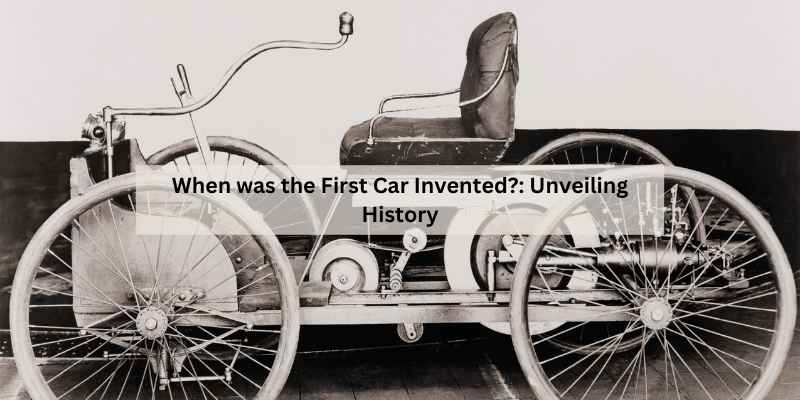
No. Henry Ford built his first car, the Quadricycle, in 1896—a decade after Karl Benz’s Patent-Motorwagen. Ford’s genius wasn’t inventing the car; it was the moving assembly line that made cars cheap enough for average people to buy.
What was the first car ever made in the United States?
The Duryea brothers, Charles and Frank, built the first successful American gasoline-powered car in 1893 in Springfield, Massachusetts. It was a used horse carriage with a one-cylinder engine and friction transmission. The company later claimed to have built the first car to be manufactured and sold in the U.S.
Why did France and Germany develop cars before America?
Europe had two advantages: better infrastructure and fewer entrenched horse industries. France and Germany had a network of paved roads left over from Roman times and maintained by central governments, while American roads were mostly local dirt tracks. European inventors also had a closer network of engineering schools and patent laws that encouraged filing inventions. America caught up quickly, but it started a decade behind.
Was the first car electric or gasoline?
The first practical electric car appeared around 1881, while the first practical gasoline car followed in 1886. But the earliest self-propelled vehicle of all—Cugnot’s 1769 tractor—was steam-powered. So the first car was none of the above: it was steam. Electric and gasoline cars developed in parallel from the 1880s onward.
Do the original Benz Patent-Motorwagen cars still exist?
Yes. The original 1886 Patent-Motorwagen is preserved in the German Museum in Munich, and several authentic replicas exist. The Benz family also reconstructed one for official events. You can see a working replica at the Mercedes-Benz Museum in Stuttgart.
What Matters Most From This History
- The “first car” depends on your definition: steam prototype (1769), internal-combustion vehicle (1863), or purpose-built automobile (1886).
- Karl Benz’s 1886 Patent-Motorwagen is the standard answer because it was the first integrated, purpose-designed gasoline car, not a converted carriage.
- Bertha Benz’s 1888 road trip wasn’t a casual joyride—it proved the car’s usability and literally invented brake lining.
- The first car company was Benz & Cie., founded in 1883, and France led the world in automotive production before the U.S. caught up.
- Ransom Olds built the first American mass-produced car in 1901; Ford’s Model T then made cars universally affordable.
- The steering wheel, electric starter, gas stations, and traffic laws all took decades to develop—the first cars had none of them.
- Electric vehicles aren’t new; they competed with gasoline in the 1900s and lost on range and refueling speed, not on concept.
For more context on how this story unfolded in specific places and brands, check out inventor of the first car details, or read about where was the first car invented to see the geographic side of the story.
Products related to this article
Sponsored / affiliate links. As an Amazon Associate I earn from qualifying purchases. I may earn additional commission from eligible campaigns.
 10 Pcs Carburetor Adjustment Tool Kit for Common 2 Cycle Small Engine, Carb Adjusting Tool, Carburetor Adjuster Tool for Echo Poulan Homelite String Trimmer
 Solar Powered Car Window Fan - Universal Solar Car Front/Rear Window Exhaust Fan Car Window Cooler Fan Air Ventilator Exhaust Radiator, Eliminate Smell (Black)