
Where Are Mazda Cars Made: Proven Essential Facts
Mazda vehicles are primarily manufactured in Japan, with major assembly plants located across Honshu island. However, key models for North America are also assembled in the United States through joint ventures, ensuring local availability and adherence to regional standards.
Ever wondered where your reliable Mazda actually rolls off the assembly line? It’s a common question, especially as vehicles seem to come from all over the world. Knowing where your car is built can matter for everything from quality perception to understanding warranty specifics. It can feel a little confusing with global supply chains.
Don’t worry; we’re breaking down the exact locations where Mazda builds its fantastic cars, from their home base in Japan to factories serving American drivers. You’ll walk away with clear facts, no confusion, and confidence about your vehicle’s origin. Let’s simplify where Mazda keeps its manufacturing magic happening!
Understanding Mazda’s Global Manufacturing Footprint
Mazda Motor Corporation, often simply called Mazda, is a Japanese company through and through. While its headquarters and primary engineering innovation happen in Hiroshima, Japan, building cars for a global market means setting up factories in key regions. This strategy helps them manage shipping costs, react quickly to local market demand, and sometimes, take advantage of favorable trade agreements.
For the everyday driver, it’s helpful to know that “Made in Japan” often signifies a certain level of quality control Mazda is famous for. However, models sold right here in North America might have a different factory sticker. We will explore the main hubs where these popular vehicles take shape.
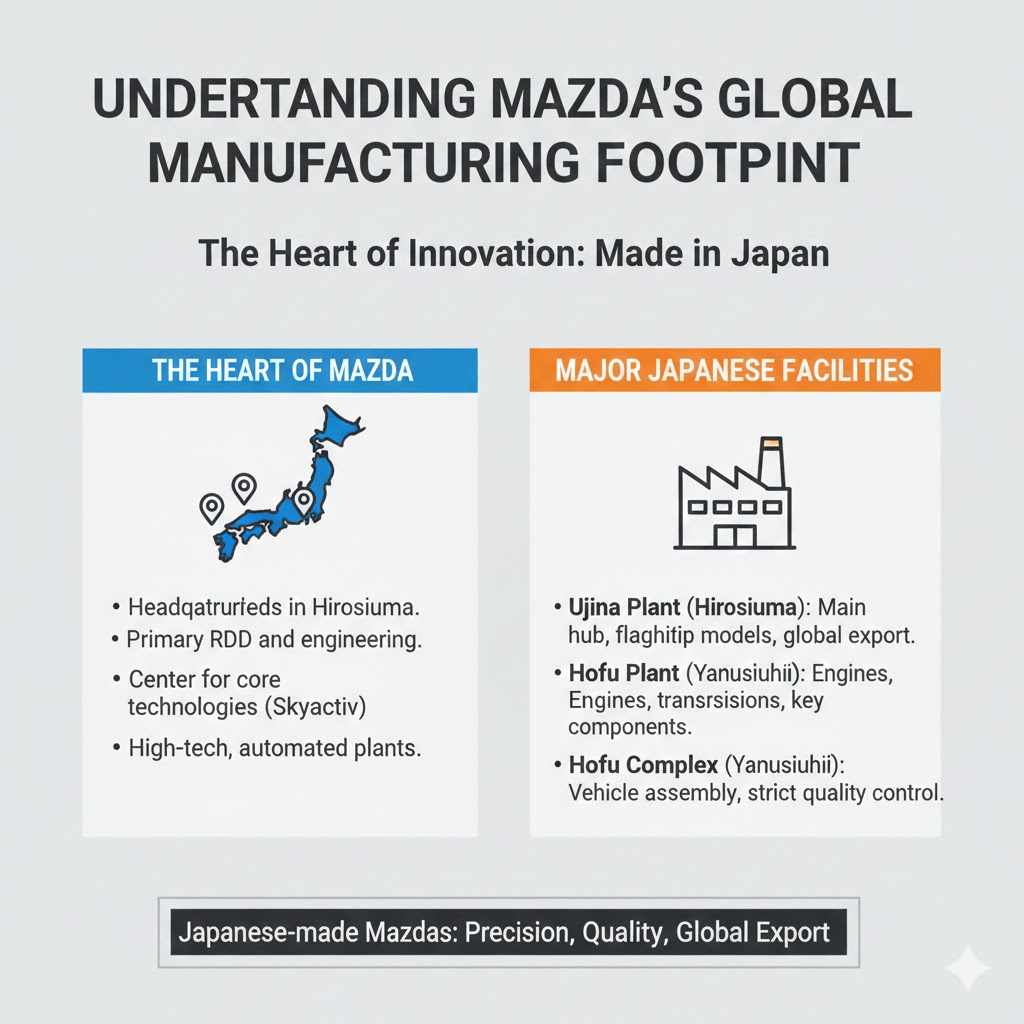
The Heart of Mazda: Manufacturing in Japan
Japan remains the undisputed center for Mazda’s most important operations. This is where the company develops its core technologies, like the Skyactiv engines, and where many of its flagship vehicles are assembled for worldwide export.
Major Japanese Production Facilities
Mazda operates several high-tech plants across Japan. These facilities often handle the production of the latest models or specialized, high-trim versions destined for global markets, including Europe and Asia.
- Ujina Plant (Hiroshima): This is often considered the main hub. It produces a vast range of Mazda vehicles and houses significant research and development facilities. If you own a high-end or export-bound Mazda, there’s a good chance it started here.
- Hofu Plant (Yamaguchi Prefecture): This location specializes in producing engines, transmissions, and major body components. It’s crucial for supplying the other assembly lines, both domestically and internationally.
- Nofu Plant (Yamaguchi Prefecture): Primarily focused on vehicle assembly, the Hofu complex is large and highly automated, ensuring consistent build quality.
Japanese-made Mazdas are often highly sought after because they benefit from Mazda’s strictest internal quality standards, sometimes exceeding baseline requirements for other regions. This dedication to precision engineering is a cornerstone of the brand.
Mazda’s Presence in North America: The U.S. Plant
When you buy a Mazda in the United States or Canada, it is highly likely that at least some portion of its production took place on American soil. This is usually achieved through strategic joint ventures to serve the vast North American customer base efficiently.
The Mazda Toyota Manufacturing U.S.A. (MTMUS) Plant
The most significant non-Japanese manufacturing site for Mazda currently operating is in Huntsville, Alabama. This facility represents a massive investment and a key partnership that serves the entire region.
A Closer Look at the Alabama Plant
This massive complex is the result of a collaboration between Mazda and Toyota, leveraging shared expertise and infrastructure. While it builds Toyota models, it is also the primary North American assembly point for specific, high-volume Mazda SUVs designed specifically for the US market.
Key Facts about the MTMUS Plant:
- Location: Huntsville, Alabama, USA.
- Primary Mazda Product: Currently focuses on building the Mazda CX-50, a crossover specifically tailored for North American outdoor lifestyles and market preferences.
- Investment & Scale: It is a state-of-the-art facility designed for high volume, emphasizing automation and environmental efficiency.
Building cars locally allows Mazda to respond faster to changes in consumer taste—for example, if demand for a specific trim level suddenly spikes in the Midwest, production can be adjusted quickly without waiting for overseas shipping.
The Legacy of Partnership Manufacturing
Before the dedicated MTMUS plant, Mazda utilized other partnerships to assemble vehicles in the US. While these specific operations may have shifted, it demonstrates Mazda’s long-term commitment to the American driver.
For instance, historically, Mazda vehicles were assembled or partially built at facilities owned by Ford (due to past ownership ties) or through joint ventures that have since evolved. For today’s buyer, focusing on the current Alabama plant for newer SUVs and Japanese plants for sedans and imports provides the clearest picture.
Where Specific Mazda Models Are Made
The location of assembly often depends on the specific model you are looking at. Mazda strategically places production based on the target market for that vehicle.
To make this easy, here is a general guide. Remember, specifications can change yearly, so always double-check the Vehicle Identification Number (VIN) sticker on the specific car you are viewing!
| Mazda Model | Primary Manufacturing Location(s) | Target Market |
|---|---|---|
| Mazda3 (Sedan & Hatchback) | Japan (Hiroshima/Hofu) | Global (Including North America) |
| Mazda CX-5 | Japan (Hiroshima) | Global |
| Mazda CX-50 | Huntsville, Alabama, USA (MTMUS) | North America Only |
| Mazda CX-9 / CX-90 | Japan (Hiroshima) | Global |
| Mazda MX-5 Miata | Japan (Hiroshima) | Global (Iconic Model) |
How to Confirm Your Car’s Origin with the VIN
If you want the absolute, guaranteed answer for your specific vehicle, you don’t need a mechanic; you just need to look at the VIN plate. The first character of the Vehicle Identification Number tells you the country of origin.
Here’s what the first letter/number means:
- J: Indicates the vehicle was manufactured in Japan. This is the most common indicator for imported Mazdas.
- 1 or 4: Indicates the vehicle was manufactured in the United States (like the CX-50 from Alabama).
- 2 or 3: Indicates manufacturing in Canada or Mexico (less common for mainline Mazda, but possible depending on the year and specific JV).
If you are shopping for a used car or just curious about your current one, grabbing a flashlight and checking the driver’s side dashboard corner (where the VIN is visible through the windshield) gives you the quickest, most reliable answer.
The Role of International Partnerships and Suppliers
It’s important to remember that even if a Mazda car is assembled in the USA, many of the high-tech components—like the Skyactiv transmission or engine control unit—might still come from Japan or a specialized supplier in another country. Modern car manufacturing is a highly complex global dance.
Why Global Sourcing Matters for Quality
Mazda maintains incredibly strict standards for all its suppliers, regardless of where the final assembly happens. This is key to their reputation for building cars that last.
Think about safety components. These must meet rigorous governmental standards. For example, components must meet standards set by agencies like the National Highway Traffic Safety Administration (NHTSA) in the US. Whether built in Hiroshima or Huntsville, the structure must pass these tests. You can review the latest safety ratings from organizations like the Insurance Institute for Highway Safety (IIHS) to see the results of this standardized quality control.
Here are some key areas where global sourcing is standard practice:
- Engine Technology: Core Skyactiv powertrain components are often proprietary and produced in dedicated, highly specialized facilities, usually in Japan.
- Electronics: Advanced infotainment and driver-assist systems often rely on specialized global suppliers for microchips and sensors.
- Raw Materials: Steel, aluminum, and other materials are sourced globally based on price, quality, and regional availability.
Mazda Manufacturing Outside of Japan and the US
While Japan and the US are the primary assembly points for vehicles sold in those respective markets, Mazda has also operated plants in other regions, often for local market consumption or historical reasons.
Historically, Mazda had assembly operations in countries like:
- Thailand: Assembly operations here serve the growing Southeast Asian market.
- Mexico: Certain models or components might be assembled here depending on trade routes and agreements to serve Central and South American customers.
- China: Through joint ventures, Mazda vehicles are assembled locally to meet Chinese domestic demand, which is one of the world’s largest automotive markets.
However, for readers primarily interested in cars sold in North America or Europe, Japan and Alabama are the two locations you need to focus on for final assembly.
The Philosophy Behind Mazda’s Build Locations
Why doesn’t Mazda just build everything in one massive factory? The answer lies in philosophy and practical business sense. Mazda focuses intensely on what they call “Jinba Ittai”—the feeling of oneness between the driver and the car. This philosophy extends to their manufacturing.
Localized Production for Local Drivers
Building vehicles like the CX-50 in Alabama ensures that Mazda engineers and assembly line workers are keenly aware of what American drivers need. They can incorporate feedback on ride height, suspension tuning for rougher roads, or interior features that appeal specifically to US buyers much faster than if everything were built overseas.
This localization helps Mazda compete against rivals who have had US plants for decades. It shows a commitment to the local economy and quicker product refinement.
Quality Control: The Universal Standard
Whether a car is built by a team in Hiroshima or a team in Huntsville, Mazda imposes a singular quality standard globally. This means the processes, tooling, and inspection checklists are remarkably similar across all their facilities.
When you are looking at a Mazda, the brand quality often rests more on the standardized engineering principles (like Skyactiv) than just the geographical sticker on the door jamb. Mazda invests heavily in training its international teams to replicate the meticulous attention to detail found at its Japanese headquarters.
This focus on transferable, high-quality processes is why Mazda has consistently ranked highly in reliability surveys over the past decade. They build the same high standard everywhere.
Comparing Global Factory Quality Perception vs. Reality
In the automotive world, there’s a common perception that vehicles built in the brand’s home country (Japan, in this case) are inherently superior to those built in international satellite plants. While this perception exists, for modern, large-scale manufacturers like Mazda, the reality is often different.
Myth Busting: Is a “Made in Japan” Mazda Better?
The short answer is: Not necessarily. While Japanese plants are the birthplace of the engineering, the production standards in the US plant are subject to the same intense scrutiny.
Here’s a breakdown of why the quality gap has narrowed significantly:
| Factor | Japanese Plant | US Plant (Huntsville) |
|---|---|---|
| R&D Integration | Highest direct link to initial design teams. | Strong link, but primarily focused on assembly and market tuning. |
| Process Control | The origin point for all process documentation. | Trained extensively to replicate Japanese process control exactly. |
| Component Sourcing | Often sources first-run, cutting-edge proprietary components. | Sources many components globally, but final assembly quality is mandated by Mazda HQ. |
The key takeaway for you as a driver is that Mazda doesn’t rely on geography for quality; they rely on standardized training, sophisticated robotics, and mandatory quality checks that apply universally.
The Benefit of US Assembly (CX-50 Example)
For models like the CX-50, US assembly offers distinct advantages:
- Faster Parts Supply: If a common part needs replacement under warranty or recall, the supply chain within North America is much quicker.
- Market-Specific Testing: Vehicles are tested on local roads and in local climates (e.g., dealing with salt in the winter belt) before they even reach the dealership.
- Economic Impact: Supporting a US factory means contributing to the local economy where you live, which many drivers appreciate.
Why Knowing Where Your Car is Made Matters to You
As a practical car owner, understanding the manufacturing site isn’t just trivia; it informs a few key decisions.
1. Warranty and Service Standardization
No matter where it’s built, your Mazda is covered by the standard Mazda factory warranty. However, sometimes knowing the origin can help mechanics diagnose issues faster if they know which region’s specific part numbers might have been used, though modern systems usually track this perfectly.
2. Resale Value Considerations
In some niche collector circles, a “Made in Japan” model might fetch a slight premium, especially for performance vehicles like the MX-5 Miata. For mainstream crossovers and sedans, the difference in resale value between a Japanese-built Mazda3 and a US-built Mazda is usually negligible. Reliability and maintenance history matter far more.
3. Trade and Tariff Impact
While you don’t need to track international trade policy, factory locations are often chosen to minimize tariffs (taxes on imported goods). When a car is built locally, that cost saving can sometimes translate into a more competitive sticker price for you.
For reliable, general information regarding international trade and its effect on the auto industry, you can always consult resources from the U.S. Department of Commerce, which often publishes data on automotive production statistics.

FAQ: Beginner Questions About Mazda Manufacturing
Q1: Does Mazda still make the majority of its cars in Japan?
Yes. Japan remains Mazda’s primary manufacturing hub, housing the oldest and most technologically advanced plants where the core engineering and assembly of many global models occur.
Q2: Which Mazda SUVs are made in the USA?
Currently, the Mazda CX-50 is the primary model assembled in the United States at the Mazda Toyota Manufacturing U.S.A. plant in Huntsville, Alabama. This plant was specifically built for North American production.
Q3: Is the engine in my US-built Mazda made in the USA too?
It depends on the specific engine and model year. While final assembly of the vehicle happens in the US, the highly advanced Skyactiv engines and transmissions are often manufactured in Japan (especially the Hofu plant) and shipped to the US assembly line.
Q4: How can I tell if my Mazda was built in Japan or the US without looking at the VIN?
For most drivers, the easiest way is to check the small sticker usually found on the driver’s side door jamb, near the latch. This sticker often lists the plant location or provides the VIN which contains the origin code (J for Japan, 1 or 4 for the US).
Q5: Do cars made in Japan have better build quality than those made in Alabama?
For modern Mazdas, the quality difference is minimal. Mazda imposes the exact same strict quality control standards and manufacturing processes across all facilities to ensure every vehicle meets the same high reliability benchmark.
Q6: Does Mazda have any factories in Europe?
Mazda does not currently operate major final assembly plants for passenger vehicles in Europe. Most European-market Mazdas are imported from Japan or the US facilities, depending on the model.
Conclusion: Confidence in Your Mazda’s Origins
Now you have a clear map of where your Mazda comes from! The essential truth is that while the brand is deeply rooted in Japan—where the engineering soul of every Skyactiv vehicle originates—Mazda is smart about global production.
For drivers in North America, you can be confident that key models are built right here in the USA, tailored for our roads, while the rest of the lineup is assembled in highly advanced Japanese facilities dedicated to world-class standards. Regardless of the final assembly plant, you benefit from Mazda’s unwavering commitment to quality, reliability, and that fun-to-drive feeling. Next time someone asks where your Mazda is made, you can give them the complete, expert answer!