Where to Get Reliable Car Service Near You: How to Choose
To find reliable car service, choose a shop with verified reviews, ASE-certified technicians, clear written estimates, and a published warranty; if two of those are missing, keep looking. Skip that check, and you may miss repairs, face surprise charges, or get the same problem back. Use this guide to compare local options, check trust before booking, and spot red flags fast.
What reliable car service looks like in practice



Reliable service is not a slogan. It is a set of proofs you can verify before you hand over the keys: proper licensing, insurance, a written estimate, clear warranty language, and a contact path that works when something goes wrong. A provider that cannot explain these basics in one call is already weak on process.
The proof matters more than the promise
Words such as “trusted,” “on time,” or “easy booking” tell you very little on their own. Ask what is included in the quote, who handles complaints, how cancellations work, and whether the shop documents the work order before starting repairs. Those answers matter more than a polished homepage.
Which signals you can verify before booking
Start with public and paper proof: business license, insurance coverage, technician certification, and a written estimate. For auto repair, ASE certification can matter because it suggests a mechanic has passed standardized testing in areas such as engine repair, brakes, and electrical systems. It does not guarantee perfect work, but it gives you a better trust baseline than testimonials alone.
How local, airport, and branded providers differ
Local shops may be best for routine repairs and repeat maintenance because you can ask direct questions and inspect the facility. Branded providers often have more formal dispatch, broader coverage, and tighter process controls. Airport-focused operators should also prove pickup timing, backup vehicles, and real-time status updates, since a missed ride has a higher cost than a missed oil change.
How do you know if a car service center is reliable?

You know by checking evidence, not tone. A reliable automobile repair shop should be able to show operating authority, insurance, a written estimate with clear inclusions, warranty terms, and a repair-contact process that is easy to reach if the job slips or a part fails.
License, insurance, and operating authority
Ask for the shop’s business license number and proof of garage liability or similar coverage. If the provider cannot state whether it is insured for property damage and customer vehicle handling, stop there. Certification from groups such as ASE is a plus because it tells you the shop has invested in technician competency, but it should sit alongside licensing, not replace it.
Written estimate terms and what must be included
A good estimate should name labor, parts, diagnostic fees, shop supplies if they are charged, tax, and any disposal or restocking charges. It should also say whether approval is needed before extra work begins. If the quote is vague, expect a wider final bill than the first number suggests.
Warranty language and dispute handling
Reliable shops explain how long parts and labor are covered, what voids the warranty, and who pays for a comeback repair. Ask where the warranty is honored, especially if the shop has more than one location. If the answer is only “don’t worry, we take care of people,” that is not enough to rely on.

What should you ask before you book?
Before booking, ask questions that expose process gaps: who answers the phone, how long estimates stay valid, what happens if the job runs long, and whether the shop offers backup options if a vehicle is delayed or unavailable. The goal is to see how they handle friction, not how they sound when nothing goes wrong.
The first-call questions that expose weak operators
- Are you licensed and insured for customer vehicles?
- Can you send the estimate in writing before I book?
- What exactly is included in the quoted price?
- Do you require approval before extra work or parts?
- What warranty covers labor and parts?
- Who do I contact if pickup is delayed?
How fast they answer and who answers
Support quality starts with the first response. A shop that gives a direct answer, a named contact, and a reasonable follow-up time is easier to trust than one that routes every question through automation. Some providers advertise 24/7 customer support; that only matters if a person can actually solve a booking or service problem.
What to ask about delays, cancellations, and backups
Ask whether the shop provides status updates, how it handles parts delays, and whether it can reschedule without penalty if its side causes the delay. For time-sensitive repairs, ask what happens if a technician runs behind or a tow arrival changes the plan. A solid shop already has a backup procedure.
Use this first-call reliability checklist
Use this table on any local shop, then compare two or three providers side by side. Score each line on a simple scale such as 0-2: 0 if they cannot answer, 1 if the answer is partial or vague, and 2 if they give clear proof. A higher total is stronger than one built on vague reassurance.
| Check | What to verify on the call | Score 0-2 |
|---|---|---|
| License or insurance | Business license, garage liability, and proof that customer vehicles are covered | |
| Written estimate | Labor, parts, fees, tax, and approval rules for extra work | |
| Warranty terms | Coverage length, what is covered, and how comeback repairs are handled | |
| Appointment lead time | Earliest opening, expected completion time, and whether delays are communicated | |
| Review signals | Recent reviews that mention billing clarity, repairs fixed right, and complaint handling | |
| Red flags | Refusal to quote in writing, pressure to decide now, unclear fees, or evasive answers |
How to score each item
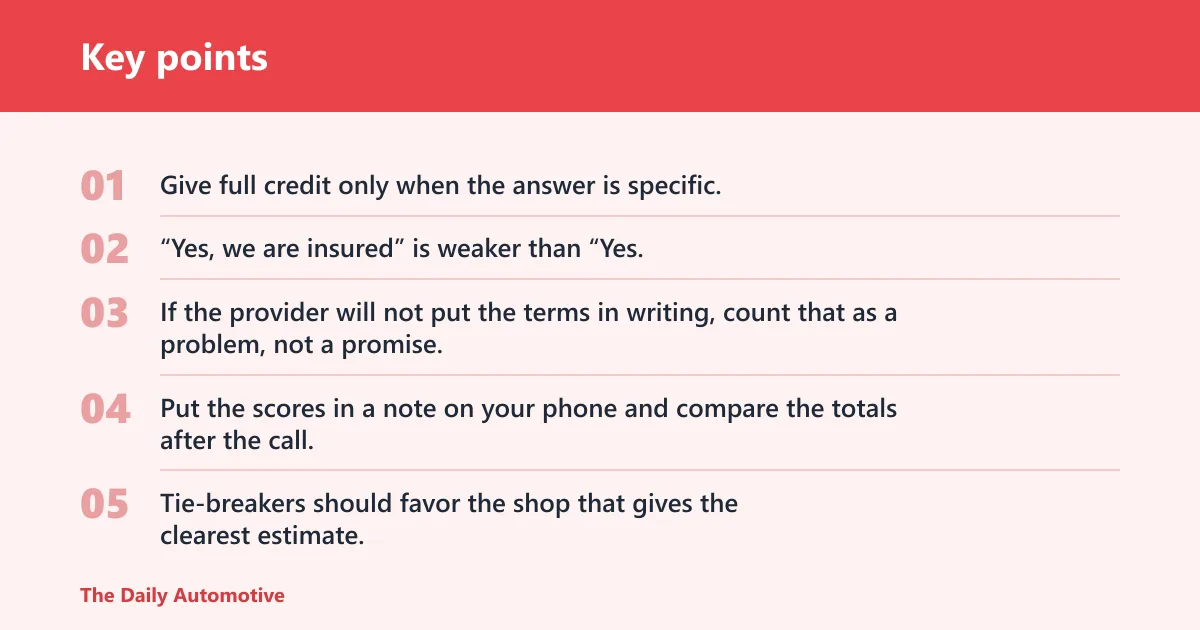
Give full credit only when the answer is specific. “Yes, we are insured” is weaker than “Yes, here is the policy type and what it covers.” The same rule applies to pricing and warranty. If the provider will not put the terms in writing, count that as a problem, not a promise.
How to compare two or three providers side by side
Put the scores in a note on your phone and compare the totals after the call. Tie-breakers should favor the shop that gives the clearest estimate, the fewest unclear fees, and the most direct support path. A lower price is not a win if it comes with poor documentation or slow communication.
How should you compare price and booking terms?
Compare the quote structure first, then the booking rules. Flat-rate pricing is easier to verify because the shop states the expected cost up front. Variable pricing can still work, but only if the provider explains the labor basis, parts markups, and which extras may change the final bill.
Flat-rate versus variable pricing
Some services promote “All-Inclusive Flat Rates,” which can be useful when the quote truly includes fees, tolls, or basic add-ons. Variable pricing is common for repair work that depends on diagnosis or parts availability. The key question is not which model sounds better; it is whether the quote tells you what can move.
What is included in the quote
Ask whether the price includes shop fees, taxes, surcharges, diagnostics, and any wait-time charge. Hidden fees often appear in the final bill when the phone quote was too narrow. If the provider cannot say what is excluded, the number is not a real estimate.
Online booking, instant quote, and advance reservation terms
Online booking is useful only when it produces a trackable confirmation and a human contact if plans change. A page that says booking can be done “in just a couple of minutes” is convenient, but speed alone does not prove reliability. For scheduled service, ask how far ahead you should reserve and what the cancellation terms are.
What matters for airport trips and time-sensitive rides?
Airport trips demand stronger proof than routine local errands. You need pickup punctuality, dispatch reliability, real-time status updates, and a backup plan if traffic or vehicle problems change the schedule. A provider with multiple locations near airports or major neighborhoods is usually easier to recover from when something slips.
Pickup punctuality and dispatch reliability
For time-sensitive rides, ask whether the provider guarantees pickup windows and how it measures missed arrivals. One useful example of process confidence is a company that states “Guaranteed On-Time Service.” That claim still needs proof in the form of dispatch tracking, a support line, and a written remedy if the vehicle is late.
Real-time status updates and backup plans
Status updates should tell you when the vehicle is assigned, en route, delayed, or reassigned. Backup procedures matter because a flat tire, a cancelled driver, or a repair hold should not leave you guessing. If the provider cannot explain its contingency plan, it is not ready for airport timing.
Location coverage near airports and neighborhoods
Check whether the provider actually covers the area you need. A company with locations in Belgium, the United States, and China may have broad reach, but broad reach is not the same as local availability near your terminal, hotel, or home neighborhood. Coverage should be verified against your route, not the brand name.
Which providers fit commuters, families, and business users?
Different riders need different service depth. Commuters want fast turnaround and simple booking. Families need enough space for people and bags. Business users want dependable pickup, quiet service, and prompt support if a meeting changes. The right provider is the one whose fleet and process match the trip, not the one with the biggest ad budget.
Vehicle types and capacity variants
Fleet details tell you a lot about fit. Sedans suit “quick, budget-friendly transits.” Executive black SUVs work better when there is extra luggage. Mercedes Sprinter Vans, including options for up to 14 passengers, matter for larger groups or airport runs with several bags. A good provider states these options plainly.
Support hours and human contact
Support access matters more as trip risk rises. A provider that offers 24/7 customer support is more useful if a person can confirm changes and resolve issues, not just read a script. For business and airport users, first-response speed can be the difference between a recovered plan and a missed departure.
Service scope for short trips versus longer trips
Short trips reward speed and price clarity. Longer trips reward better monitoring, backup coverage, and vehicle fit. A service with “over 11 million miles traveled” and “24,000 hours in city tours” is signaling scale, but you should still verify whether its current local setup matches your route and timing needs.
What proof should you look for before trusting a car service?
Look for proof you can check in one call: license, insurance, written estimate terms, warranty language, response speed, and a clear way to reach a person if plans change. Reviews help, but they sit below documented policies, because policies determine what happens when the day goes wrong.
A practical call-and-compare workflow
- Call three providers and ask the same six questions.
- Write down the exact answers, not impressions.
- Score license, estimate, warranty, lead time, reviews, and red flags.
- Compare what is included in each quote.
- Choose the shop that gives the clearest proof, not the loudest pitch.
Say your trip is early and non-negotiable
Say your flight leaves early in the morning and you need a pickup from a hotel near the airport. A provider with direct status updates, a backup vehicle, and a specific pickup window is safer than one that only says it is “convenient.” Time pressure exposes weak dispatch systems quickly.
Frequently asked questions
Where can I get reliable car service near me?
Start with local shops that can prove licensing, insurance, written estimates, and a warranty. Then compare response speed and how clearly they explain fees. A nearby provider is only useful if it can document the work and answer follow-up questions after you book.
What should I check before booking a car service?
Check license, insurance, estimate terms, warranty, appointment lead time, and who will answer if something changes. Also ask what is included in the price and whether approval is needed before extra work. Those details matter more than a general promise of good service.
Do reliable car services offer flat rates?
Some do, especially for routine or fixed-scope work. Others use variable pricing because diagnosis and parts can change the final bill. The key is not whether the rate is flat, but whether the quote states exactly what is included and what could add cost.
How do I avoid hidden fees at a car service?
Ask for a written estimate that lists labor, parts, taxes, diagnostics, shop fees, and any other charges. Confirm whether approval is required before extras are added. Hidden fees usually appear when the first quote is too general or the shop will not put terms in writing.
What makes a car service reliable for airport trips?
For airport trips, reliability means punctual pickup, real-time status updates, a backup plan, and local coverage that matches the route. A provider with strong support hours and clear dispatch communication is better suited to a hard departure time than one that only advertises convenience.
Products related to this article
Sponsored / affiliate links. As an Amazon Associate I earn from qualifying purchases. I may earn additional commission from eligible campaigns.