Who Makes the Lucid Car? What Lucid Builds vs Buys (2026)
Ask who makes the Lucid car and most answers stop at the company name. The more useful question is what Lucid actually builds itself and what it buys from suppliers. Lucid Group says in its annual report that it designs, engineers and manufactures its EVs, powertrains and battery systems in-house. But the battery cells inside those packs, thousands of other parts, and the roadside help behind the warranty come from other companies. This guide sorts it component by component, using Lucid’s FY2025 annual report (10-K) and Lucid’s own owner pages, read on October 12, 2026.
Who Makes the Lucid Car? Lucid Builds the Core, Buys the Cells
| Best DIY EV Learning Pick | |
 |
Build Your Own Electric Vehicle, Third Edition: $15.51 Best for: readers who want a hands-on look at the parts an EV is built from: motor, controller, charger and battery Why we picked it: it is a practical build-it-yourself guide, and it was in stock at $15.51 on Amazon when checked on October 12, 2026 Main drawback: it is a conversion-project book, not a Lucid book, and it will not show you how a modern production EV like the Air is engineered |
As an Amazon Associate we earn from qualifying purchases. Pick based on the listing, not a hands-on test.
Short version: Lucid designs and builds its own electric motors, inverters, battery packs, on-board charger, control software and car body at its Arizona plant. It buys the lithium-ion cells that go inside the packs, plus most of the other parts of the car. Who owns the company and who runs it is a separate question that we cover on our who makes Lucid cars, owner and factories page, so this page stays on the hardware.
The table below shows each major system, who builds it and where we got the fact. All rows come from Lucid’s FY2025 10-K (the SEC filing) unless noted.
| System | Built by | Source and detail |
|---|---|---|
| Vehicle design and engineering | Lucid, in-house | 10-K: Lucid designs, engineers and manufactures EVs, EV powertrains and battery systems in-house |
| Electric motor | Lucid, in-house | 10-K: permanent magnet motors developed in-house |
| Drive unit (motor, inverter, gearbox, differential) | Lucid, in-house | 10-K: an integrated unit that weighs 163 lbs (74 kg) |
| Battery pack and battery management system | Lucid, in-house | 10-K: pack developed in-house; battery packs assembled at the Arizona plant (AMP-1) |
| Battery cells | Bought from outside suppliers | 10-K: cell supply agreements with ‘leading suppliers’, co-designed with them; suppliers are not named in the filing |
| Wunderbox (on-board charger and inverter) | Lucid, in-house | 10-K: developed in-house and assembled at AMP-1 |
| Controls software and computing platform | Lucid, in-house | 10-K: core software fully conceived in-house, including the Ethernet Ring architecture |
| Micro Lens Array headlights | Designed by Lucid | 10-K: technology created in-house (the filing does not say who makes the parts) |
| Driver-assist computing (next generation) | Partner platform | 10-K: October 2025 roadmap built on the NVIDIA DRIVE AV platform for Gravity and Midsize |
| Stamping, body shop and paint | Lucid, at AMP-1 | 10-K: stamping, paint shop and a new Gravity body shop completed in 2024 |
| Most other parts and materials | Outside suppliers | 10-K: thousands of parts from suppliers worldwide, the majority single-source |
| Roadside assistance and some collision repair | Third-party partners | 10-K: contracted roadside partner and approved collision repair shops |
The second-to-last row matters for owners. Lucid says the majority of its suppliers are single-source, meaning there is often no second company that can supply the same part quickly. That is a business risk Lucid reports itself, and it is one reason a part shortage can slow production even at a plant that does most of the work itself.
What Cars Does Lucid Actually Make? (Air and Gravity)
Lucid builds two model lines today, the Air sedan and the Gravity SUV, and both share the same in-house powertrain approach. Midsize-platform vehicles are scheduled to start production in late 2026 according to the 10-K, so they are not on sale as of this writing. For current prices see Lucid’s own pages and our electric car cost guide; here are the in-house hardware claims that differ by trim.
- Air Pure: 84-kWh battery pack and 420 miles of EPA-estimated range with 19-inch wheels, per the 10-K.
- Air Grand Touring: 512 miles of EPA-estimated range with 19-inch wheels, per the 10-K.
- Air Sapphire: 1,234 horsepower and 0-60 mph in 1.89 seconds, per the 10-K.
- Gravity Grand Touring: up to 450 miles of EPA-estimated range (20-inch front, 21-inch rear wheels, 2-row 5-seat setup), per the 10-K.
- Gravity GT-S: 1,070 horsepower and 0-60 mph in 3.1 seconds, per Lucid’s Gravity page as of October 12, 2026.
Range numbers depend on wheels and seating, which is why the 10-K attaches those conditions. Treat any single range figure you see in an ad as the best case for that configuration.
Inside a Lucid Battery Pack: What Lucid’s Label Page Shows
This is the angle most ‘who makes’ articles miss. Lucid is required to publish battery information for MY26 and newer cars under California rules (13 CCR 1962.6), and its public battery lookup page lists each pack’s design. We read it on October 12, 2026. It names the pack, module count, cell count, minimum voltage and capacity, but it identifies the cells only by code, not by maker.
| Pack description on Lucid’s page | Modules | Cells | Min voltage | Capacity |
|---|---|---|---|---|
| Pack 2.6, Pure, 16M_2170N | 16 | 4,800 | 400 V | 151 Ah |
| Pack 2.6, Standard, 18M_50GV2 | 18 | 5,400 | 450 V | 151 Ah |
| Pack 2.6, Extended, 22M_50GV2 | 22 | 6,600 | 550 V | 151 Ah |
| Pack 2.6, Sapphire, 22M_50GV2 | 22 | 6,600 | 550 V | 151 Ah |
| Pack 2.6, Extended, 22M_2170N | 22 | 6,600 | 550 V | 151 Ah |
A pattern shows up when you divide: 4,800 cells over 16 modules, 5,400 over 18 and 6,600 over 22 are each 300 cells per module (our arithmetic from Lucid’s numbers). Lucid changes the pack size by adding modules, not by redesigning the module, which fits the 10-K’s description of a scalable, modular pack. The cell codes in the pack names (2170N and 50GV2) are the only cell identifiers published, so we do not name a supplier. The 10-K adds one number about the buying side: as of December 31, 2025, Lucid had roughly $2.56 billion of remaining minimum purchase commitments for lithium-ion cells.
Charging hardware: the Wunderbox
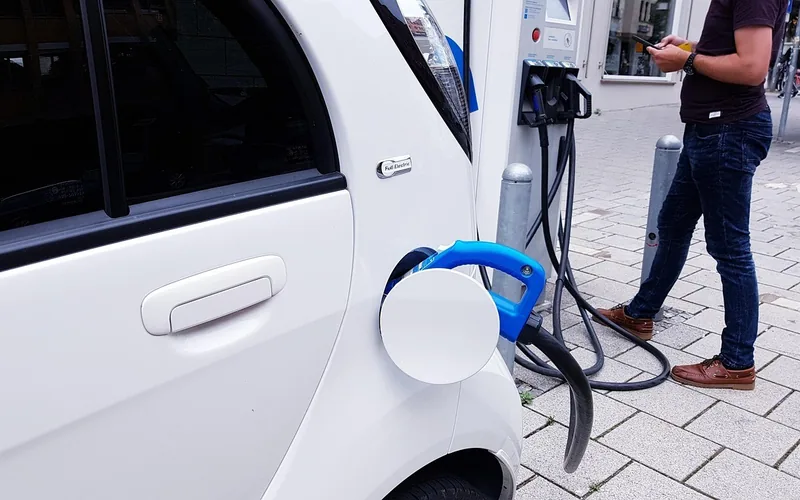
Charging is where the in-house claim is easiest to see. Lucid says it designed the Wunderbox, a combined on-board charger and inverter, to handle everything from Level 1 AC up to DC fast charging, and to support a 900V-plus electrical architecture. The 10-K says the Gravity Grand Touring can charge at up to 400 kW and add 200 miles in about 11 minutes, under ideal conditions with a capable fast charger. Real sessions depend on the charger, battery temperature and charge level, so use that as a ceiling. Plug types and adapters are a separate topic: see our guides on whether EV plugs are universal and which non-Tesla cars can use Superchargers.
Safety: do not open the pack
These packs run at several hundred volts. Lucid’s own page points owners to the Battery Safety Guidelines in the owner’s manual, and the battery label sits under the hood and on the pack housing for service use. Do not open, cut into or probe a high-voltage pack or its orange cabling yourself. If a warning light, smell, smoke or damage appears, stop driving, move away from the car and call Lucid or emergency services. You can check any open safety recall for your car by VIN on the NHTSA recalls page. For how long packs last in general, see our EV battery life guide.
Where Are Lucid Cars Built? From Stamping to Kits
Lucid assembles the Air and Gravity at Advanced Manufacturing Plant-1 (AMP-1) in Casa Grande, Arizona. The 10-K says AMP-1 had 90,000 vehicles a year of installed capacity after the 2024 expansion, with stamping, paint, the Gravity body shop and most of the powertrain shop on one site. That is capacity, not output: the filing’s number says what the plant can build, not what it did build. The flow looks like this.
| Step | Where | What the 10-K says |
|---|---|---|
| Stamping, body, paint | AMP-1, Arizona | Key manufacturing activities completed in the 2024 phase 2 expansion |
| Powertrain: packs, drive units, Wunderbox | AMP-1, Arizona | Complete electric powertrain manufactured and assembled at AMP-1 |
| Older powertrain plant (LPM-1) | Arizona | Shifted from dedicated powertrain production to remanufacturing; mostly done in 2025 |
| Final assembly of Air and Gravity | AMP-1, Arizona | Both models assembled there |
| Kit re-assembly (SKD) | AMP-2, Saudi Arabia | Re-assembles Air and Gravity kits pre-manufactured at AMP-1; 5,000 vehicles a year installed capacity |
| Planned full local production (CBU) | AMP-2, Saudi Arabia | Planned for Midsize platform vehicles; target 150,000 vehicles a year |

The kit detail corrects a common assumption. The car assembled in Saudi Arabia is not built from scratch there: its major pieces are made in Arizona and shipped as kits, then re-assembled. The ownership side of that Saudi plant is covered on our Lucid owner and factories page.
What ‘Made by Lucid’ Means for Warranty and Service
Building the powertrain in-house also shapes ownership. Lucid sells and services its cars directly rather than through dealers, and the 10-K says it runs its own service centers and a fleet of mobile service vehicles, alongside approved collision shops. Its New Vehicle Limited Warranty page (read October 12, 2026) lists these coverage periods, and says the model-year booklet for your car is the final word.
| Coverage | Duration |
|---|---|
| Basic vehicle | 4 years or 50,000 miles |
| Powertrain | 8 years or 100,000 miles |
| High-voltage battery | 8 years or 100,000 miles, retaining 70% capacity |
| Corrosion perforation | 10 years, unlimited miles |
| Body and paint | 4 years, unlimited miles |
| Supplemental restraint system (SRS) | 5 years or 60,000 miles |
| Certified pre-owned add-on | 12 months or 12,000 miles after basic coverage |
Three details are easy to miss. First, Lucid says you are not required to use a Lucid Service Center, but coverage may be excluded if improper maintenance or repairs are done by a shop Lucid has not authorized. Second, roadside assistance is a separate Lucid program, not part of the warranty. Third, the page lists a separate warranty document for each model year, so check the one that matches your VIN and purchase date.
Three Things ‘Built In-House’ Does Not Mean
- Not every part. The cells, most other components and the roadside and some repair services come from outside companies, and the 10-K calls the supply chain a risk because so much of it is single-source.
- Not a plant that builds itself from nothing. The Saudi plant re-assembles kits made in Arizona today, and full local production there is planned, not running, per the 10-K.
- Not guaranteed range. Lucid’s headline range figures come from specific wheels and seating configurations, so your car may be rated lower.
As for who owns the company that does all this building, Lucid Group is a publicly traded company, and the details of ownership are on our who makes Lucid cars page.
Frequently Asked Questions
Who makes the batteries in a Lucid?
Lucid designs and assembles its own battery packs and battery management system at its Arizona plant, but it buys the lithium-ion cells inside them from outside suppliers. Lucid’s annual report says it has cell supply agreements with leading suppliers, and it does not name them in the filing.
Does Lucid make its own electric motors?
Yes. Lucid’s 10-K says it developed its permanent magnet motors in-house, and combines them with an inverter and an integrated gearbox and differential into a drive unit that weighs 163 pounds.
Where are Lucid cars assembled?
The Air and Gravity are assembled at Lucid’s AMP-1 plant in Casa Grande, Arizona. A second plant in Saudi Arabia re-assembles Air and Gravity kits that are pre-manufactured in Arizona, with full local production planned for later models.
Does the Lucid warranty cover the battery?
Yes, within limits. Lucid’s warranty page lists the high-voltage battery at 8 years or 100,000 miles, whichever comes first, with coverage tied to the battery retaining 70% capacity. Check the warranty booklet for your model year.
Does Lucid sell its cars through dealers?
No. Lucid’s annual report describes a direct sales and service model in the U.S., Canada and Saudi Arabia, with its own service centers and mobile service vehicles.
So who makes the Lucid car? Lucid does, for the parts that define the car: the motors, drive units, pack design, charger, software and body. What it buys is the cells and most of everything else, and knowing that split tells you where the technology, the warranty and the supply risks really sit.
Products related to this article
Sponsored / affiliate links. As an Amazon Associate I earn from qualifying purchases. I may earn additional commission from eligible campaigns.