Why Car Insurance Is a Waste: When It Actually Is Worth It
Car insurance is rarely a waste: keep liability coverage, and consider dropping collision or comprehensive only when the annual premium is relatively high compared with the car’s value or you could replace the car yourself. Skip the math, and you can pay for coverage that no longer fits the car, or leave yourself exposed after a crash, theft, or lawsuit. This guide shows which coverages are mandatory, which optional protections matter, and when raising deductibles or dropping collision makes financial sense.
Why car insurance feels like a waste
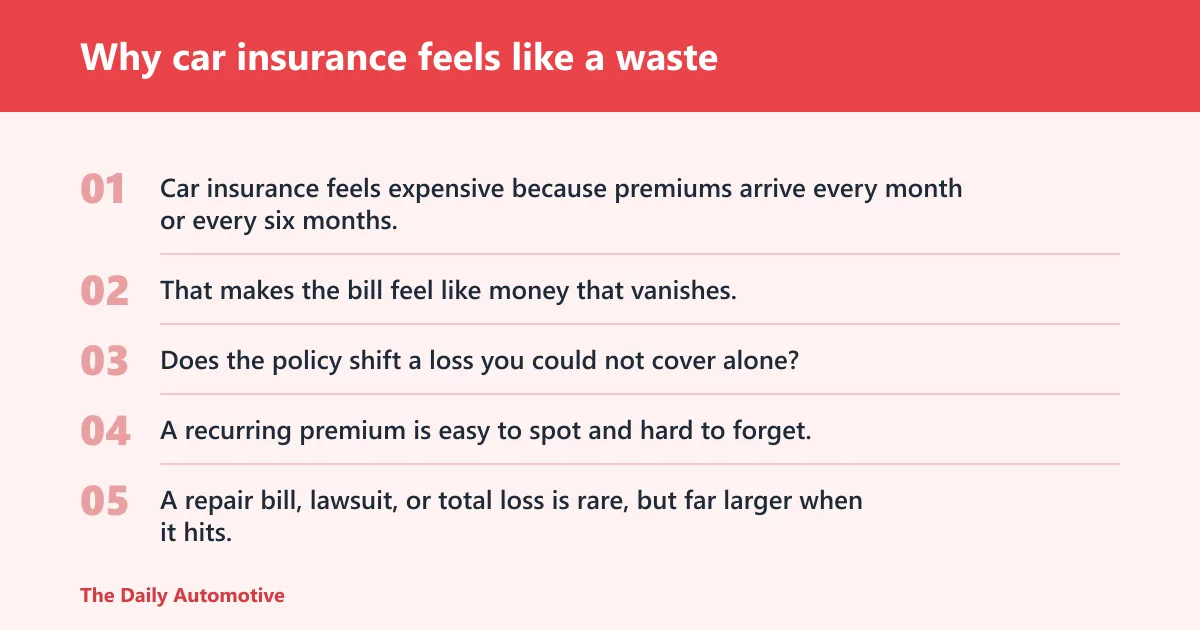
Car insurance feels expensive because premiums arrive every month or every six months, while many drivers go years without filing a claim. That makes the bill feel like money that vanishes. The real question is simpler. Does the policy shift a loss you could not cover alone?
Why premiums feel expensive month after month
A recurring premium is easy to spot and hard to forget. A repair bill, lawsuit, or total loss is rare, but far larger when it hits. That gap drives the frustration, especially on older cars where the payout may look small next to years of payments.
The difference between paying for peace of mind and paying for protection
Some coverage buys convenience. Some buys financial protection. Liability insurance sits in the second group because it protects your balance sheet if you injure someone or damage their property. Collision and comprehensive are more of a tradeoff, because you are buying back risk to your own car.
When frustration is about cost, not value
Many drivers think insurance is a waste when the premium rises faster than the car’s value. That is often a pricing problem, not proof that all coverage is pointless. If a policy no longer fits the vehicle’s value, loan balance, or cash reserves, trimming it can be the right move.
Is car insurance actually a waste of money?
No, not when it covers losses you could not comfortably pay yourself. Compare the annual premium with the size of the loss and the chance you would have to absorb it. Insurance can feel wasted in calm years and still make sense over the life of the policy.
The financial test: premium versus likely loss
If an annual premium prevents a much larger repair bill or liability claim, the coverage is doing its job. The math changes when you are paying a large premium to protect a car worth only a little more than the deductible and likely payout. Then the numbers start to fail.
Why a claim is not the same as a payout that beats your premiums
People often judge insurance by whether they “get their money back.” That is the wrong standard. Insurance spreads risk across many policyholders. A policy can still be worth it even if you never file a claim, because it protected you from a loss that would have been much larger than the premiums.
When insurance is still rational even if you never file a claim
Liability coverage is the clearest example in most places. It is required in most states, with minimum limits set by state law, and it covers injury and property damage to other people. One serious crash can cost far more than years of premiums. That makes it protection, not a savings plan.
What each type of coverage really pays for
Vehicle insurance has different layers, and each one covers a different kind of loss. Liability is the legal baseline in most states. Collision and comprehensive are optional in many cases, but they matter when the car has real value, loan debt, or a repair bill you could not absorb easily.
Liability insurance and the state-minimum baseline
Liability insurance covers injury and property damage you cause to others. State minimum coverage varies by jurisdiction, and it is often too low for a serious crash. It may keep you legal, but legal minimums are not the same as enough protection.
Collision coverage and crash damage to your car
Collision coverage pays for damage to your car after a crash, minus your deductible. It matters more for newer vehicles or financed cars because the repair bill or total-loss payout can be high relative to the car’s value. A $500 or $1,000 deductible changes how much loss you keep.
Comprehensive coverage and losses that are not crash-related
Comprehensive coverage applies to non-collision losses such as theft, vandalism, fire, hail, and animal strikes. It also uses a deductible. For drivers in hail-prone areas, high-theft ZIP codes, or rural routes with deer risk, this coverage can be worth more than its price suggests.
Deductibles, actual cash value, and why payouts are not full replacement
A deductible is the amount you pay before insurance starts paying. A higher deductible usually lowers the premium. Actual cash value is the amount many total-loss claims are settled for, and it reflects depreciation, not replacement cost. That means the payout can be less than what it would cost to buy the same car again.
When is full coverage car insurance not worth it?
Full coverage is often not worth it when the annual premium is too close to the car’s actual cash value, the deductible eats too much of any payout, and you could absorb a loss without strain. The break point depends on value, savings, and the odds of a claim.
Older cars with low market value
If a car is worth a few thousand dollars and collision plus comprehensive costs close to a four-figure amount a year, you may be spending a large share of the car’s value annually. That may be too much unless the car is unusually expensive to replace, or the driver would struggle to buy another vehicle without insurance proceeds.
High deductibles and low expected payout
High deductibles can make optional coverage less useful on a low-value vehicle. If the deductible is $1,000 and the car’s actual cash value is only a few thousand dollars, a total loss may leave a small payout after the deductible and depreciation. That makes the premium easier to question.
When the annual premium is too close to the car’s value
A simple rule of thumb is to recheck collision and comprehensive when the annual premium gets to around that level relative to the car’s value. That is not a law. It is a quick screen. Above that level, the coverage may still make sense only if the car would be hard to replace.
How do loan status and car value change the answer?
Loan status changes the answer because the lender or lessor has a financial stake in the car. Financed and leased vehicles often require collision and comprehensive, and gap insurance may be needed if the loan balance can exceed the payout after a total loss. Cash buyers have more flexibility.
Why financed and leased cars are different
If you owe money on the car, dropping collision or comprehensive can leave you responsible for a loan on a vehicle that no longer exists. Leasing is even stricter, since the contract often requires broad coverage and sometimes specific limits. The coverage is not optional in practical terms.
When gap insurance matters
Gap insurance covers the difference between the loan or lease balance and the actual cash value payout after a total loss. It is most relevant for newer financed vehicles, long loan terms, and small down payments. Without gap coverage, you can owe more than the insurance check.
How to compare loan balance, actual cash value, and repair cost
Use the car’s current value, not the original sticker price. If the loan balance is higher than the payout you would expect after depreciation, keep gap coverage if available. If repair estimates regularly approach the car’s market value, collision coverage becomes more valuable, not less.
Decision table: which coverage fits which situation
| Situation | Liability | Collision | Comprehensive | Gap insurance | Why it fits |
|---|---|---|---|---|---|
| Old car worth under $5,000, no loan, enough savings to replace it | Keep | Often drop | Often drop | Not needed | The premium can exceed the likely payout on an actual cash value claim. |
| Car worth $12,000, financed with 3 years left | Keep | Keep | Keep if weather/theft risk is real | Consider | The lender cares about the vehicle and the loan balance can outrun the payout. |
| Newer car worth $28,000, driver parks on street in a hail area | Keep | Keep | Keep | Maybe | Repair and total-loss exposure are both meaningful, and non-crash losses are plausible. |
| Cash-paid car worth $8,000, emergency fund is thin | Keep | Usually keep if premium is modest | Usually keep if theft or animal risk is high | Not needed | Low savings can make even a moderate loss hard to absorb. |
| Rideshare driver with personal-use policy only | Keep, but check endorsements | Usually keep | Usually keep | Maybe | Commercial exposure can create coverage gaps if the policy excludes rideshare use. |
What kind of car insurance do I really need?
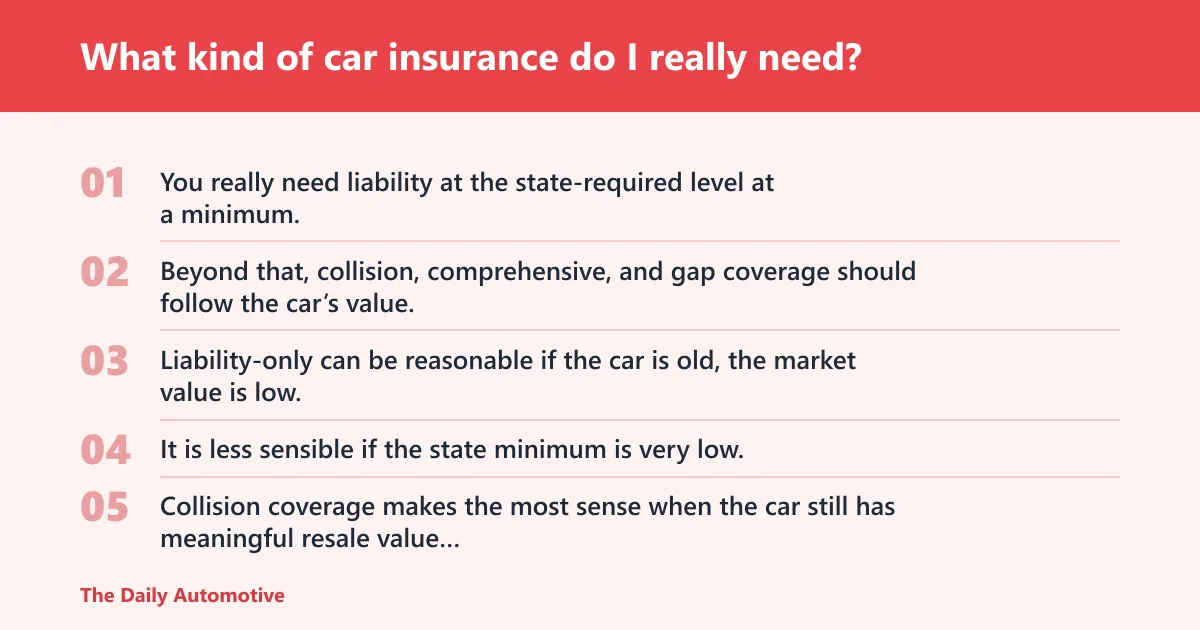
You really need liability at the state-required level at a minimum, and often more than the minimum if your assets or income would be at risk in a serious crash. Beyond that, collision, comprehensive, and gap coverage should follow the car’s value, loan balance, driving environment, and your emergency savings.
Liability-only for low-value cars with enough savings
Liability-only can be reasonable if the car is old, the market value is low, and you can replace it without borrowing. It is less sensible if the state minimum is very low, if you have significant savings to protect from a lawsuit, or if the vehicle is still worth several thousand dollars.
Collision coverage for newer or financed vehicles
Collision coverage makes the most sense when the car still has meaningful resale value or a lender requires it. It also helps when a single crash could erase more money than you can comfortably set aside. The deductible should fit your cash flow, not just the premium.
Comprehensive coverage for theft, weather, and animal risk
Comprehensive coverage is worth more in places with hail, flooding, deer strikes, frequent vandalism, or higher theft rates. If the car lives outside and the premium is modest, the coverage can pay for itself over time. If the car is cheap and the deductible is high, it may not.
Full coverage for drivers who could not absorb a total loss
Drivers with thin savings, a loan balance, or a car that would be hard to replace should lean toward full coverage. That does not mean buying every add-on. It means buying the layers that protect against the losses you cannot fund out of pocket.
How do I know if I am overpaying for car insurance?
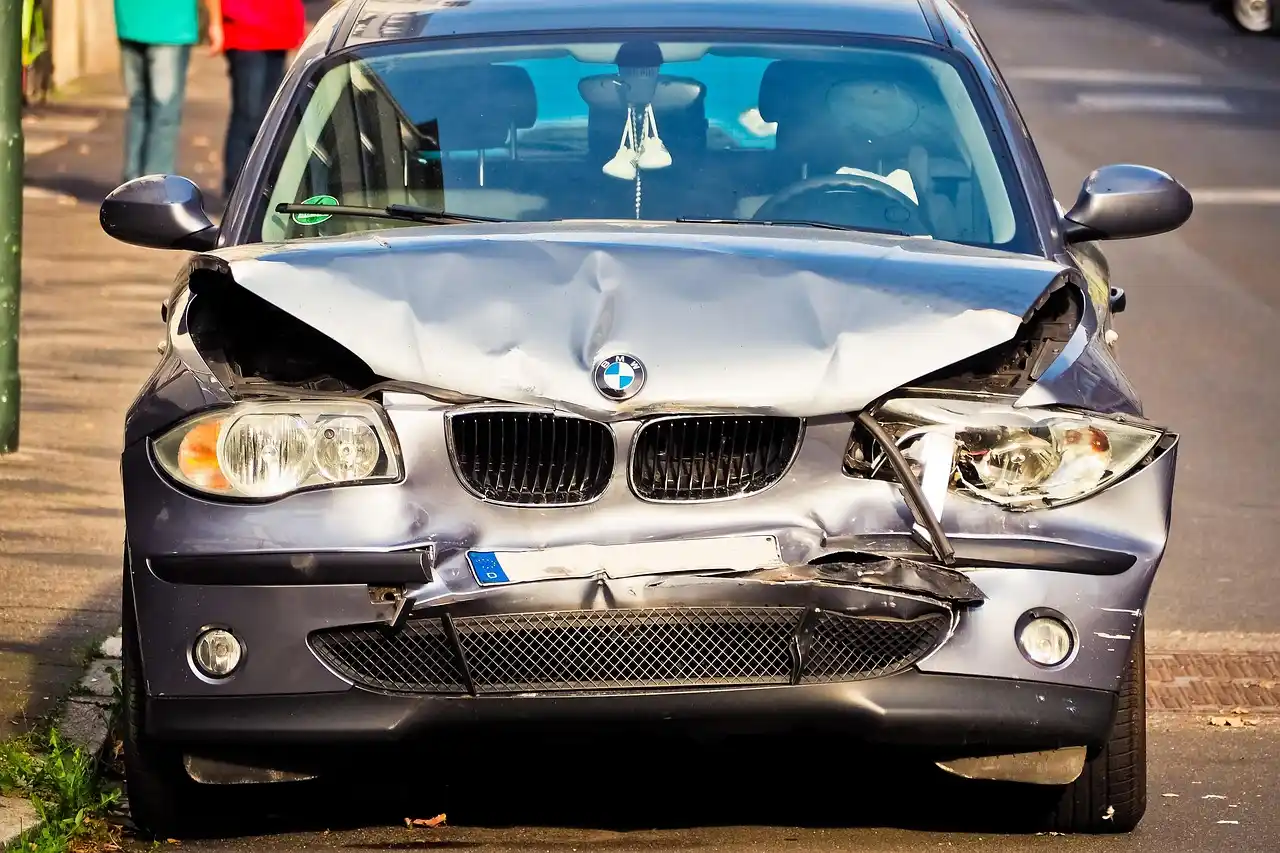
You are probably overpaying if the premium is high relative to the car’s value, your deductible is too low for the price, or you are carrying coverage that no longer matches the loan balance or the car’s actual cash value. Premiums rise with vehicle type, location, driving record, and coverage limits.
Premium drivers: vehicle, location, record, and limits
A sports car, dense city parking, recent moving violations, and high liability limits all push premiums up. That does not mean the policy is bad. It means the risk profile is expensive. The fix may be a different vehicle, a different deductible, or a different coverage mix.
Raising deductibles without creating cash-flow problems
Moving from a $500 deductible to $1,000 can lower the premium, but only if you can pay the larger deductible tomorrow. A deductible should be an amount that sits comfortably in savings. If it would require credit card debt, it is too high.
What to compare before you cut coverage
Before you cut collision or comprehensive, compare three numbers: the annual premium, the car’s actual cash value, and your emergency savings. If the premium is small relative to the payout risk, keep the coverage. If the premium is high and the car is replaceable from savings, cut it carefully.
- Check your car’s current actual cash value, not the original purchase price.
- Look at the annual cost of liability, collision, comprehensive, and gap insurance separately.
- Compare each premium against the likely payout after the deductible.
- Confirm any lender, lease, or rideshare insurance requirements first.
- Keep the coverage you would need after a crash, theft, or lawsuit.
Say your 11-year-old sedan is worth $5,500 and collision plus comprehensive costs $780 a year with a $1,000 deductible. That policy may be expensive relative to the payout. If the same sedan is financed and the loan balance is still $7,000, the answer changes fast.
How much car insurance should I carry on an older car?
On an older car, carry enough insurance to cover liability risks first, then decide whether collision or comprehensive still makes sense based on value, savings, and theft or weather exposure. Age alone is not the test. A well-kept older car with a strong resale market can still justify more coverage.
Older does not always mean bare-bones
An older truck or hybrid can still hold value, and some parts are expensive to source. If the car would cost a lot to replace, or if your savings are thin, dropping everything except liability can create a false economy. The lower premium may not offset the larger risk.
Common first-timer mistake is cutting too much too soon
A common first-timer mistake is dropping collision and comprehensive because the car “feels old,” then finding out that a deer strike, storm damage, or parking-lot hit would have been costly. Age matters, but replacement cost and cash reserves matter more.
Frequently asked questions
Is car insurance a waste of money?
No. Liability insurance is usually the legal baseline and protects against injury and property damage to other people. Collision and comprehensive can be wasteful only when the premium is high relative to the car’s actual cash value, the deductible, and your ability to absorb a loss.
Does car insurance ever pay off after years of premiums?
Yes, even if you never file a claim. Insurance pays off by moving rare but expensive losses away from you. A single serious crash, theft, or liability claim can cost far more than many years of premiums, which is why the right comparison is risk, not refund.
What coverage can I drop to save money on car insurance?
Collision and comprehensive are the usual candidates, but only after checking loan status, actual cash value, and savings. If the car is old, paid off, and inexpensive to replace, dropping one or both can make sense. Liability should stay, and state minimums may still be too low.
Products related to this article
Sponsored / affiliate links. As an Amazon Associate I earn from qualifying purchases. I may earn additional commission from eligible campaigns.