Why Did My Car Payment Go Down: Genius Savings
Your car payment might have gone down due to a successful refinance, a negotiated lower interest rate, or completing a significant portion of your loan term. Discover smart strategies to lower your car payment and keep more cash in your pocket.
Ever notice your monthly car payment suddenly seem a little lighter? It can feel like a pleasant surprise, a little budget breathing room you didn’t expect. But why did this happen? Understanding the reasons behind a lower car payment is the first step to making that saving work for you. It’s not magic; it’s usually a result of smart financial decisions or changes in your loan terms.
Many car owners wonder if this decrease is permanent or just a blip. The good news is that often, it’s a sign of progress or an opportunity you can actively pursue. We’ll break down the common reasons your payment might have decreased and, more importantly, how you can work towards that kind of saving yourself. Get ready to unlock some genius savings for your ride!
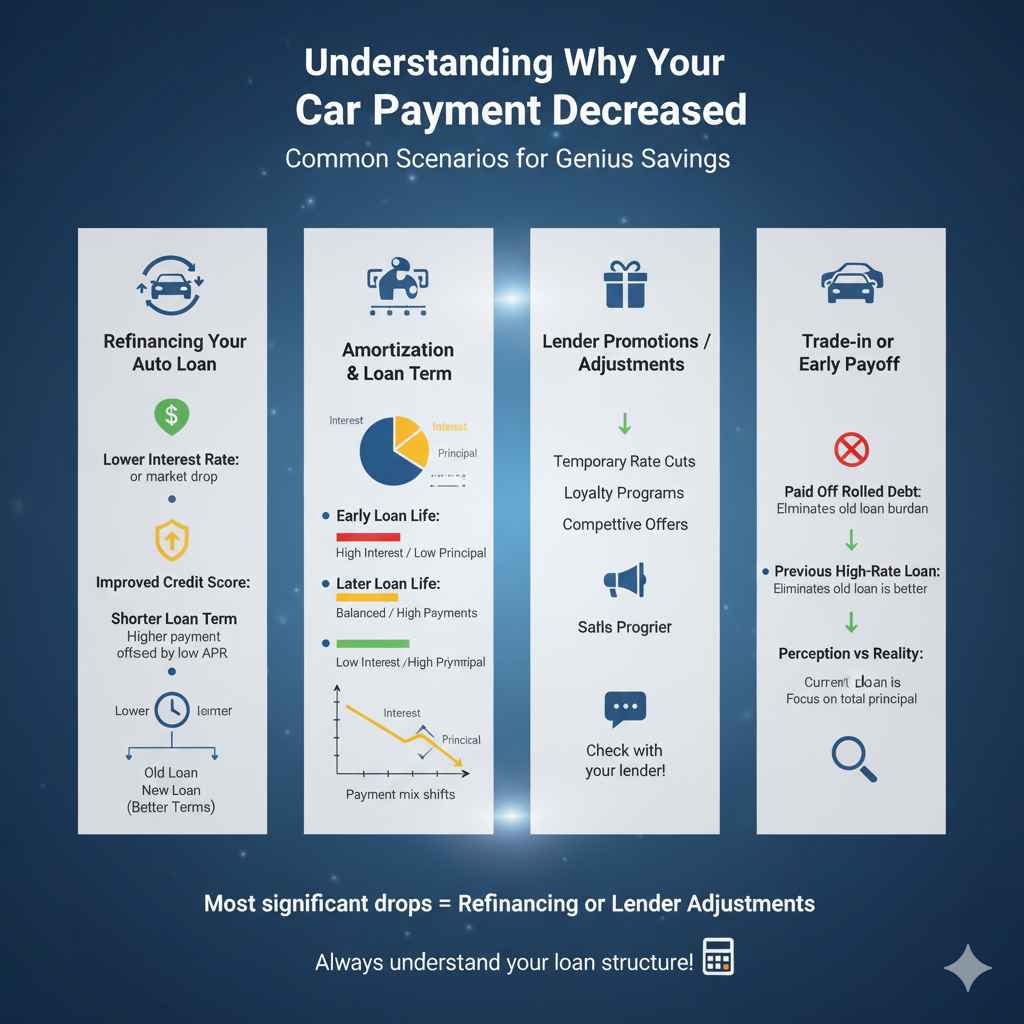
Understanding Why Your Car Payment Decreased
A lower car payment isn’t just a lucky break; it signals a positive change in your loan’s structure or your financial journey. Let’s explore the most common scenarios that lead to this welcome reduction.
1. Refinancing Your Auto Loan
This is one of the most frequent and powerful ways to lower your car payment. When you refinance, you essentially get a new auto loan to pay off your old one. The key is to secure a new loan with better terms.
- Lower Interest Rate: This is the golden ticket. If your credit score has improved since you first took out the loan, or if market interest rates have dropped, you might qualify for a lower Annual Percentage Rate (APR). A lower APR means less money goes towards interest over the life of the loan, which can significantly reduce your monthly payment.
- Shorter Loan Term (Sometimes): While a shorter loan term usually increases your monthly payment, it can sometimes lead to a lower payment if combined with a drastically lower interest rate. Lenders might offer enticements to shorten the term. More often, refinancing is done to maintain payments or slightly lower them over a similar or slightly extended term to achieve immediate relief.
- Improved Credit Score: A better credit score is your superpower when seeking new loans. Lenders see you as less risky, which translates into better interest rates. If your credit score has noticeably improved since you bought your car, you’re in a prime position to refinance.
Refinancing can seem daunting, but it’s a straightforward process. You apply for a new loan, and if approved, the new lender pays off your old loan. You then start making payments on the new, more favorable loan.
2. Amortization and the Loan Term
Auto loans are amortizing loans. This means that in the beginning, a larger portion of your payment goes towards interest, and a smaller portion goes towards the principal (the actual amount you borrowed). As you continue to make payments, this ratio slowly shifts.
- Early Loan Life: High proportion of interest paid.
- Mid-Loan Life: Interest and principal payments become more balanced.
- Later Loan Life: A larger portion of your payment goes towards the principal.
While the total monthly payment itself doesn’t usually decrease as you pay off a standard loan, understanding amortization helps explain how your money is working for you and why consistent payments mean you’re steadily owning more of your car.
However, if your loan had a specific structure, like an interest-only period followed by a principal-and-interest phase, your payment would jump up after the interest-only part. Conversely, some unique loan products might have structures that see a payment reduction later on, but this is less common for standard auto loans. The most significant decrease in payments is almost always due to refinancing or a specific promotion/adjustment by the lender.
3. Lender Promotions or Adjustments
Occasionally, lenders might offer incentives or make adjustments to loan terms, especially in competitive markets. This could include temporary interest rate reductions or specific programs aimed at helping borrowers. While not as common as refinancing, it’s worth checking with your current lender periodically, especially if you’ve been a loyal customer.
4. Trade-in or Early Payoff of a Previous Loan
If you traded in a vehicle and rolled negative equity (owed more than the car was worth) into your current auto loan, your initial payments might have been higher to account for that debt. As you pay down the loan, especially if you’ve paid off that rolled-in debt, the actual amount allocated to the car’s principal reduces, which can feel like a decrease in the effective loan principal, though the payment amount itself typically remains fixed unless you refinance.
A more direct way this can happen is if you had a previous loan with a very high rate, and your current car loan represents a significant improvement over that. The initial payment might have been set at a level that, while lower than the previous loan, still felt substantial. As you pay it down over time and the principal fraction grows, the perception or actual mechanics of the loan might shift.
Genius Strategies to Make Your Car Payment Go Down
Waiting for your payment to decrease on its own is rarely an effective strategy for immediate savings. The real “genius” comes from proactively taking steps to lower it. Here’s how you can turn that hope into reality:
1. Refinance Your Auto Loan
As mentioned, this is the most powerful tool in your arsenal. Shopping around for a new auto loan can lead to significant savings. Here’s a step-by-step approach:
- Check Your Credit Score: Your credit score is the biggest factor in determining your interest rate. Knowing it beforehand helps you understand what offers you might qualify for. You can get a free credit report from sites like AnnualCreditReport.com, which is a service mandated by federal law.
- Gather Loan Details: Know your current loan balance, interest rate (APR), and the remaining term.
-
Shop Around: Don’t just go to one bank. Contact multiple lenders:
- Your current bank or credit union
- Other credit unions (they often have competitive rates)
- Online lenders specializing in auto loans
-
Compare Offers Carefully: Look beyond just the interest rate. Consider:
- APR: This is the true cost of borrowing, including fees.
- Loan Term: A longer term will lower monthly payments but increase total interest paid. A shorter term does the opposite.
- Fees: Are there origination fees or prepayment penalties?
- Apply and Choose: Once you find the best offer, apply. Be mindful that multiple inquiries in a short period for the same type of loan are often treated as a single one by credit bureaus.
2. Make Extra Principal Payments
While this doesn’t immediately lower your monthly payment, it’s a smart way to pay off your loan faster and reduce the total interest you pay. If you have a little extra cash, applying it directly to the principal can accelerate your loan payoff.
How to Do It: Clearly indicate on your payment that the extra amount is to be applied to the principal. Some lenders might automatically apply extra payments to future installments, which doesn’t help you get out of debt faster. You might need to call your lender to confirm how they handle extra payments.
The “Genius” Angle: While it doesn’t lower your current payment, consistently making extra principal payments for a period and then refinancing can result in a lower balance and a potentially better interest rate, leading to a lower payment down the line. It’s a two-step savings strategy.
3. Negotiate with Your Current Lender
Before you go through the process of refinancing with a new lender, try negotiating with your current one. If you’ve made consistent on-time payments and your credit score has improved, they might be willing to work with you.
What to Say: “I’ve been a loyal customer with a good payment history, and my credit score has improved significantly since I took out this loan. I’m exploring options to lower my monthly payment, and I was hoping you might be able to offer a more competitive interest rate or adjust my loan terms.”
Be Prepared: Have offers from other lenders in hand. This gives you leverage. If your current lender can match or beat another offer, it might be simpler and faster to stay with them.
4. Consider a Car Loan Calculator
Understanding the impact of different interest rates and loan terms is crucial. Online car loan calculators can be incredibly helpful:
- You can input your current loan details and see how much you could save by refinancing at a lower rate.
- You can explore how changing the loan term affects monthly payments and total interest paid.
For example, using a calculator from a reputable source like the Consumer Financial Protection Bureau (CFPB) can give you a clear picture of potential savings before you even start applying.
The Pros and Cons of Lowering Your Car Payment
Making your car payment more manageable is often a great idea, but like anything, there are trade-offs. Understanding these can help you make the best decision for your financial situation.
Pros of a Lower Car Payment:
- Increased Disposable Income: More money in your pocket each month for savings, investments, or other expenses.
- Reduced Financial Stress: A lower payment can alleviate budget pressures and provide peace of mind.
- Improved Cash Flow: Essential if you’re facing unexpected expenses or income fluctuations.
- Potential for Faster Debt Payoff (with discipline): If you apply the savings to other debts or investments, you can improve your overall financial health faster.
Cons of a Lower Car Payment:
- Longer Loan Term: If you lower your payment by extending the loan term, you’ll pay more interest over time, and you’ll own the car for longer.
- Total Interest Paid: Even without extending the term, if the new loan has a longer term than originally remaining on your old loan, you could pay more interest overall.
- Depreciation: Cars are depreciating assets. The longer you own it, the more value it loses. If your loan term extends beyond the useful life of the car, you could end up owing more than the car is worth.
- Risk of “Payment Shock”: If you get used to the lower payment and then need a new car in a few years, you might unconsciously borrow more than you can comfortably afford based on your old, lower payment habit.
The key is to analyze your goals. If immediate cash flow is your priority, extending the term might be acceptable. If minimizing total cost is paramount, try to keep the term similar to what you had remaining and focus on getting the lowest interest rate possible.
Illustrative Savings Example: Refinancing
Let’s look at a hypothetical scenario to show the power of refinancing. Imagine you bought a car a couple of years ago with a $25,000 loan at 7.99% APR for 60 months.
| Loan Detail | Original Loan | Refinanced Loan (Example) |
|---|---|---|
| Original Principal | $25,000 | $25,000 |
| Original APR | 7.99% | 4.99% (Improved Credit) |
| Original Term | 60 months | 60 months |
| Estimated Monthly Payment | $525.76 | $491.87 |
| Total Interest Paid Over Life of Loan | $6,545.60 | $4,512.20 |
| Total Cost of Loan | $31,545.60 | $29,512.20 |
| Instant Monthly Savings | – | $33.89 |
| Total Savings Over Loan Term | – | $2,033.40 |
In this example, refinancing from 7.99% APR to 4.99% APR over the same 60-month term results in a monthly payment reduction of approximately $33.89. While this might seem small, over the remaining life of the loan, it translates to over $2,000 in savings on interest and a slightly faster payoff when considering the principal reduction.
Now, imagine you had less than 36 months remaining. If you refinanced and kept the term the same (e.g., 36 months), the savings would be even more pronounced in terms of total interest paid, and the monthly payment could potentially be even lower than the $491.87 if the principal was significantly paid down already.
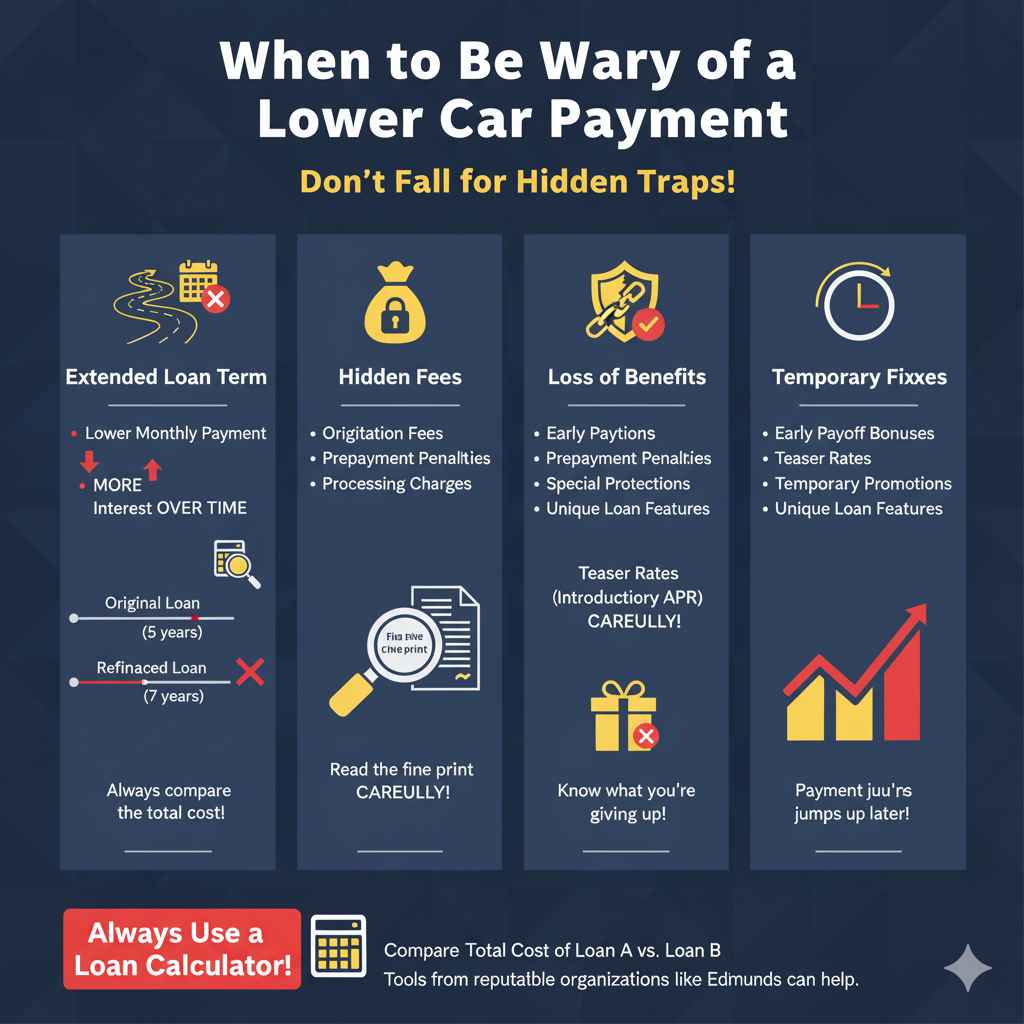
When to Be Wary of a Lower Car Payment
While a lower payment is usually good news, there are scenarios where you should proceed with caution:
- Extended Loan Term: If the only way your payment went down is because the lender extended your loan term significantly, you’re likely paying more interest in the long run. Always compare the total cost.
- Hidden Fees: Make sure no new, hefty fees are being added that offset your savings. Read the fine print carefully.
- Loss of Benefits: Some original loan structures might have included unique benefits (like early payoff bonuses) that you’d lose by refinancing.
- Temporary Fixes: Be aware if a lower payment is due to a teaser rate or a temporary promotion that will expire, leading to a much higher payment later.
It’s always wise to use a loan calculator to compare the total cost of your original loan versus the proposed new loan. Tools from reputable organizations like Edmunds can help you dissect these numbers.
Frequently Asked Questions (FAQ)
Q1: How often can I refinance my car loan?
You can typically refinance your car loan as many times as you want, provided you meet the lender’s eligibility criteria each time. There’s usually no mandatory waiting period between refinances, but it’s often wise to wait until you see a significant benefit, like an improved credit score or a favorable shift in market interest rates.
Q2: Will refinancing affect my credit score negatively?
Checking your credit score for a refinance application will result in a “hard inquiry” on your credit report, which can cause a small, temporary dip in your score. However, the benefit of a lower interest rate and reduced loan cost often outweighs this minor impact. Applying to multiple lenders within a short timeframe (usually 14-45 days, depending on the credit scoring model) for the same type of loan is typically treated as a single inquiry to avoid penalizing comparison shopping.
Q3: My car is old. Can I still refinance it?
It can be more challenging to refinance older cars, especially if they have high mileage. Many lenders have age and mileage limits for auto loans. You’ll also need to ensure the car’s value is still sufficient to secure the loan. However, some lenders specialize in financing for older vehicles or might offer better terms if your credit is excellent.
Q4: What if my car payment went down because I made extra payments?
If your payment went down solely because you paid ahead on your loan, your lender might have simply applied your extra payment to future installments rather than reducing the amount or term. To ensure extra payments truly go towards the principal and shorten your loan, you must clearly instruct your lender. If they did adjust your payment down due to principal reduction, it implies you’ve paid a significant portion off, and this is a sign of great progress!
Q5: Should I refinance if my interest rate is already low?
If your current interest rate is already very low (e.g., below 4% for a well-qualified borrower) and your credit score hasn’t significantly improved, the benefits of refinancing might be minimal. You’d need to carefully weigh any potential savings against the hard inquiry and potential fees. However, if market rates drop further or your credit score substantially improves, it might still be worth exploring.
Q6: Can I refinance to take cash out?
Yes, this is known as a cash-out refinance. If you have a significant amount of equity in your car (meaning you owe much less than the car is worth), you might be able to refinance for more than you currently owe.