Why Does Carfax Show No Service Records?
Many folks wonder Why Does Carfax Show No Service Records? It can be confusing when you look up a car and see empty slots where maintenance history should be. This happens more often than you think, and it doesn’t always mean a car was neglected. It can feel like a puzzle, especially if you’re new to buying cars.
But don’t worry, figuring this out is simpler than it seems. We’ll walk through why this happens and what it really means for the car you’re looking at.
Reasons For No Carfax Service Records
Seeing a blank service history on a Carfax report can be puzzling for many car buyers. It often leads to questions about the vehicle’s actual maintenance. This section will explore the various reasons why a Carfax report might not show any service records, helping you understand the full picture beyond just a clean or empty report.
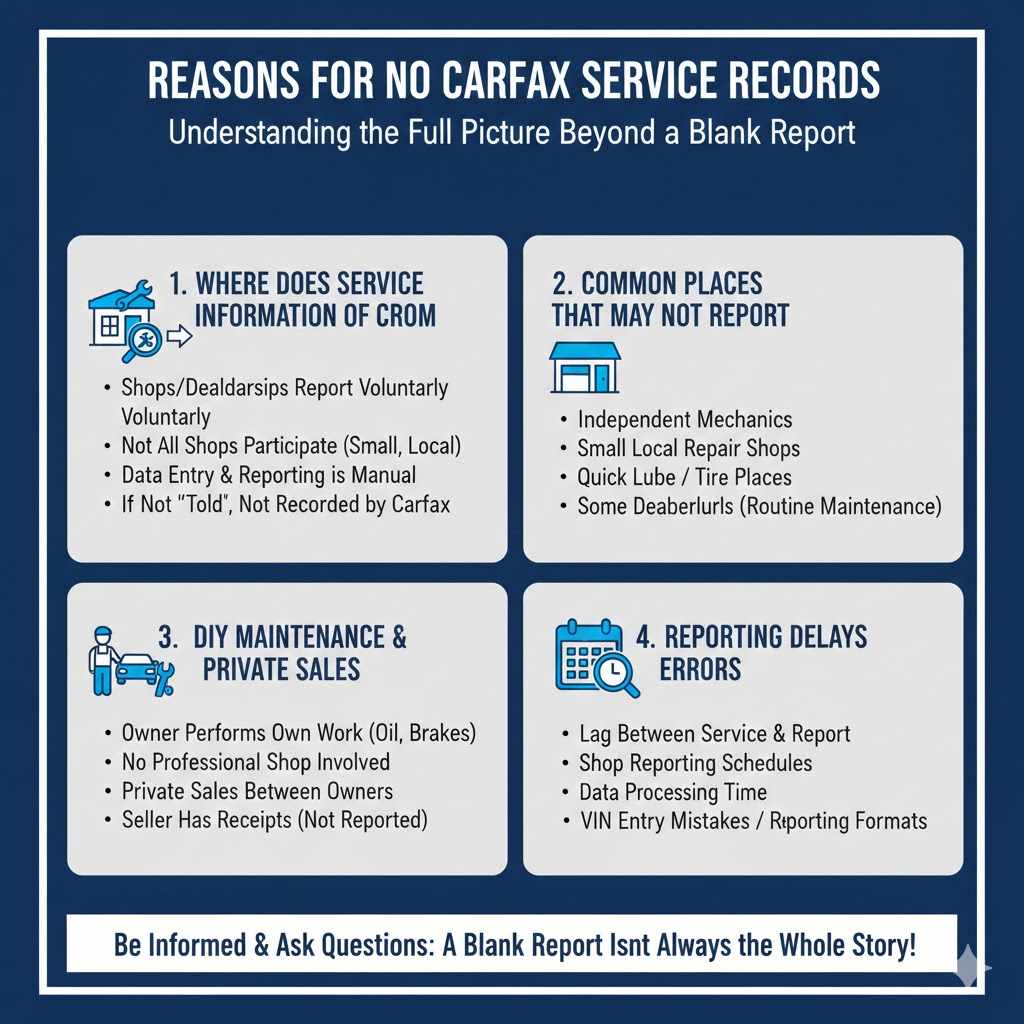
Where Does Service Information Come From
Carfax gathers its service data from many places. Repair shops, dealerships, and even some quick lube places send in records of the work they do. When a mechanic changes your oil or fixes a part, they often report this to services like Carfax.
This information is then added to the vehicle’s history report.
The key is that reporting is usually voluntary for these shops. Not every single place that works on cars sends in every bit of information. Some smaller shops might not have the systems to do it easily.
Other times, they might forget or choose not to report certain services. This means that even if a car had work done, it might not show up on Carfax.
Think of it like this: If you go to a friend’s house and they bake cookies, but they don’t tell anyone, then no one outside knows about the cookies. Carfax only knows about the services that were “told” to it. So, if a shop doesn’t “tell” Carfax, the record stays missing.
Common Places That May Not Report
Many independent mechanics and smaller repair shops are great at fixing cars. However, they might not have advanced systems to report every service to a company like Carfax. They focus on the car in front of them, not on sending data to a third party.
Also, some quick oil change places or tire shops might not report all their work. They might focus on quick services and not on detailed record-keeping for external reports. This is especially true if they are part of a small, local chain or a single owner shop.
Even some larger dealerships may not report every single service. They might report warranty work or major repairs, but routine maintenance like oil changes might be handled differently. The process for reporting can be complicated, and sometimes details get missed in the busy workflow of a service department.
DIY Maintenance and Private Sales
One of the biggest reasons for a lack of service records is when owners perform maintenance themselves. If someone is handy with cars, they might do their own oil changes, brake replacements, or even more complex repairs. This kind of work is never reported to Carfax because there’s no professional shop involved.
Similarly, if a car is sold directly from one private owner to another, and no mechanic was used for maintenance between those sales, there will be no official records to report. The seller might have receipts, but those aren’t automatically added to a Carfax report. This is common for older cars or vehicles where the owner takes pride in keeping up with upkeep themselves.
While DIY maintenance is great for saving money and staying on top of your car, it creates gaps in the documented history. Buyers often rely on these reports, so this is a key factor to consider when you see no service records.
Reporting Delays and Errors
Sometimes, service records do exist, but they just haven’t made it to Carfax yet. There can be a delay between when a service is performed and when it is reported to the vehicle history database. This lag can be due to the shop’s own reporting schedule or the processing time of the data aggregator.
Errors can also happen. A mechanic might accidentally enter the wrong VIN for a service, or the data might be entered into the wrong vehicle’s record. These mistakes can lead to legitimate service being missed or attributed to another car entirely.
While not as common as missing reports, these errors can still contribute to a lack of clear service history.
It’s also possible that a service was reported, but not in a way that Carfax could easily link to that specific car. Different reporting systems use different formats, and sometimes data doesn’t match up perfectly. This is another way a record can go missing, even if the work was actually done.
Understanding the Impact of Missing Records
When a Carfax report shows no service history, it raises questions about how well the car has been maintained. However, it’s important to remember that this doesn’t automatically mean the car is a bad choice. This section will help you understand what missing records can imply and how to assess a vehicle’s condition despite them.
What It Might Mean For The Car
A lack of service records could mean a few things. It might suggest that previous owners did not keep up with regular maintenance. This can lead to more wear and tear on the car’s parts.
Components that should be replaced or serviced at certain intervals might be overdue.
Another possibility is that the car was only serviced at places that don’t report to Carfax. This doesn’t mean the car wasn’t cared for. It just means the evidence isn’t on the report you’re looking at.
For example, a long-time owner might have always used the same trusted local mechanic who doesn’t report to Carfax.
It could also mean the car had very few services performed, perhaps because it was driven very little or had fewer complex systems prone to needing frequent attention. For some vehicles, especially older ones or those driven only short distances, fewer services might be expected.
Finally, it could indicate that maintenance was done, but records were not kept or were lost. This is less ideal, as it offers no proof of work. This is why it’s crucial to look beyond just the Carfax report.
How To Assess A Car Without Service History
When a Carfax report lacks service history, it becomes even more important to do a thorough inspection. The first step is always a pre-purchase inspection by an independent, trusted mechanic. They can physically check all the critical components of the car.
This includes looking at the engine, transmission, brakes, tires, and suspension. The mechanic can tell if parts are worn out, if fluids need changing, or if there are any leaks or other issues that indicate neglect. They can also check for signs of recent work that might not be on the report.
Ask the seller for any maintenance records they might have. They may have receipts from shops, or even just notes they kept themselves. While not official reports, these can offer valuable insights into the car’s care.
A seller who is open about providing this information is usually a good sign.
Take the car for a comprehensive test drive. Listen for strange noises, feel how it handles, and check that all the systems are working correctly. Unusual sounds or a rough ride can point to problems that maintenance records might have otherwise revealed.
Importance of a Pre-Purchase Inspection
A pre-purchase inspection (PPI) is absolutely vital when buying any used car, but it’s especially critical when there’s no service history on the report. This is your best chance to catch potential problems before they become expensive repairs.
An independent mechanic has the tools and expertise to spot issues that an average buyer might miss. They can examine the car’s undercarriage, check for frame damage, assess the condition of belts and hoses, and test the electronic systems. They can often estimate the lifespan of parts and recommend upcoming maintenance.
The cost of a PPI is usually a few hundred dollars, but it can save you thousands in the long run. It’s a small investment that provides peace of mind and helps you make an informed decision. If a seller refuses to allow a PPI, it’s a major red flag.
Talking To The Current Owner
Open communication with the current owner is key when you have questions about a car’s history. Don’t hesitate to ask them directly about how they’ve maintained the vehicle.
You can ask questions like “Have you performed regular oil changes?” or “What kind of repairs has this car needed since you’ve owned it?” Listen carefully to their answers. Are they detailed and honest, or vague and evasive? Their responses can give you clues about the car’s condition and how it’s been treated.
Ask if they have any personal records or receipts from mechanics. Even if they don’t use a reporting service, they might have kept some documentation. A car owner who is willing to share what they know is typically more likely to have taken good care of their vehicle.
Sample Scenario 1: The Mechanic’s Regular
Imagine you are looking at a 2018 Honda Civic. The Carfax report shows no service records. You speak with the owner, an older gentleman named John.
John explains that he has owned the car since new and has always taken it to his trusted local mechanic, “Bob’s Auto Repair,” for every oil change and check-up. Bob’s Auto Repair is a small, independent shop that has been in business for 30 years. They are excellent mechanics, but they do not report their services to any national databases like Carfax.
John has kept all the paper receipts from Bob’s and shows them to you. The receipts clearly document every oil change, tire rotation, and brake pad replacement done over the past six years.
In this scenario, the lack of Carfax records is not a cause for alarm. The detailed personal records from a reputable mechanic confirm the car has been well-maintained. A pre-purchase inspection by another mechanic would still be a good idea to confirm the condition, but the evidence of maintenance is strong.
When Does Carfax Actually Get Service Records
Carfax relies on a network of reporting partners to build its vehicle history reports. Understanding which entities report and how the data flows can shed light on why some records appear and others don’t. This section details the primary sources of service information that Carfax utilizes.
Dealerships Are Key Reporters
Car dealerships are one of the most significant sources of service information for Carfax. When you take your car in for scheduled maintenance, repairs, or even a warranty claim at a dealership, that information is often recorded. Many dealerships use sophisticated management systems that can easily transmit this data.
These systems are designed to track every vehicle that comes through their service bay. From routine oil changes to major engine overhauls, most of this work is logged. Dealerships understand the value of detailed service records for their customers and for the resale value of the vehicles they sell.
Therefore, they are generally diligent about reporting this information.
This is why you often see a good amount of service history for cars that have primarily been serviced at dealerships. If a vehicle has had all its maintenance done at franchised dealerships for brands like Toyota, Ford, or BMW, its Carfax report is more likely to be rich with service entries.
Independent Repair Shops And Their Role
Independent repair shops, while often providing excellent and more affordable service, have a varied record when it comes to reporting to services like Carfax. Some larger independent chains or shops that cater heavily to fleet vehicles might have robust reporting systems in place.
However, many smaller, family-owned repair businesses do not have the resources or the incentive to connect their service management software to third-party data aggregators. Their priority is fixing cars and keeping their customers happy, not necessarily contributing to national vehicle history databases.
This means that if a car has been maintained by a series of smaller, independent shops, its Carfax report might be sparse. It’s not a reflection of the quality of the work, but rather the reporting practices of the shops themselves. This is why, as mentioned before, a pre-purchase inspection is so crucial.
Fleet Maintenance Records
Companies that operate large fleets of vehicles, such as delivery services, rental car companies, or utility companies, have a strong incentive to keep detailed maintenance records. Their business depends on vehicles being reliable and on the road.
These fleet operators often use specialized fleet management software. This software is designed for comprehensive tracking of all maintenance activities, parts used, and costs. Many of these fleet management systems are integrated with data providers that feed information to Carfax.
Therefore, vehicles that were previously part of a commercial fleet might have extensive service records on their Carfax report. This can be a positive sign, as these vehicles are typically maintained according to strict schedules. However, it’s also important to consider how the vehicle was used.
A fleet vehicle might have been driven extensively in a short period, leading to higher mileage and potentially more wear, even with good maintenance.
Quick Lube And Tire Shops
Quick lube and tire shops are common places for routine maintenance like oil changes, tire rotations, and battery checks. Whether these services get reported to Carfax can vary widely. Some of the larger national chains might have systems in place to report their service data.
Smaller, independent quick lube places or local tire shops may not have this capability. Their primary focus is speed and convenience for the customer. The administrative burden of reporting to multiple databases might be too much for their operational model.
If a car’s service history consists solely of services from such places that do not report, its Carfax report would likely show no records. This is why it’s important to look for evidence of maintenance beyond just the Carfax report. If a car had many oil changes at a shop that doesn’t report, it doesn’t mean those oil changes didn’t happen.
Carfax’s Data Sources Explained
Carfax works with thousands of data providers across North America. These providers include vehicle service and repair facilities, collision repair shops, new and used car dealerships, and government agencies. The data is collected through various methods, including direct data feeds from shop management systems, fax, mail, and electronic uploads.
The company also collects information from vehicle auctions and from law enforcement agencies regarding vehicle recovery after theft. Salvage yards and state DMVs contribute information about vehicle titles, such as salvage or flood brands. This broad net helps create a comprehensive picture of a vehicle’s history.
However, the effectiveness of this system relies on the participation of these various entities. If a particular type of service provider is not reporting, or if there are technical issues with data transmission, gaps in the report can occur. Carfax continuously works to expand its network of reporting partners to capture as much vehicle history as possible.
Sample Scenario 2: A Well-Maintained Rental Car
Consider a 2020 Toyota Camry that was previously part of a large rental car fleet. During its time as a rental, it was serviced regularly by the rental company’s in-house maintenance department. This department used a specialized fleet management software that was configured to automatically send all service records to a major data aggregator.
This aggregator, in turn, supplies data to Carfax. Consequently, the Carfax report for this Camry shows a detailed history of oil changes, tire rotations, fluid checks, and even minor body shop repairs due to customer damage.
Even though the car was used extensively by many different drivers, the consistent reporting of its maintenance offers reassurance. A buyer in this situation can see a clear pattern of upkeep, even if the car has high mileage for its age. The absence of unexplained gaps in service is a positive indicator.
What Does No Service Records REALLY Mean For You
When faced with a Carfax report showing no service history, it’s easy to feel uneasy. However, understanding what this truly signifies can help you make a more informed decision. This section aims to demystify the implications of missing records and guide you on how to proceed with confidence.
It Is NOT Necessarily A Red Flag
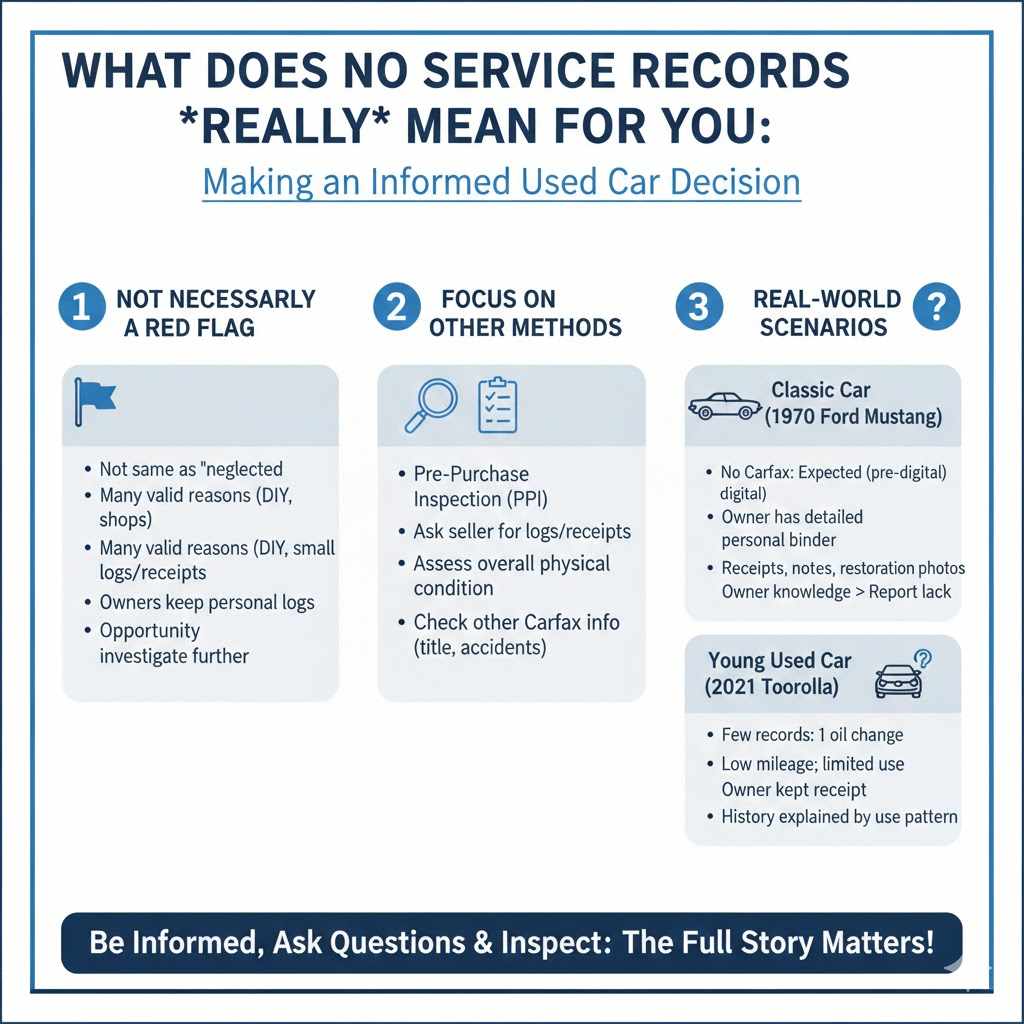
It’s a common misconception that a lack of Carfax service records automatically means a car has been neglected. This is simply not the case. As we’ve discussed, there are many legitimate reasons for this.
For instance, a car might have been maintained by a mechanic who doesn’t report data, or the owner might have performed DIY maintenance.
Many car owners take excellent care of their vehicles without needing a national report to prove it. They might keep detailed personal logs, have receipts, and have a strong relationship with a trusted mechanic. Their commitment to maintenance is genuine, even if it doesn’t appear on Carfax.
Therefore, instead of dismissing a car with no service records, view it as an opportunity to investigate further. It means you need to rely on other methods to assess the vehicle’s condition and history, rather than solely on the report itself.
Focus On Other Verification Methods
Since the Carfax report isn’t providing service details, you need to lean on other tools and strategies. The most important is the pre-purchase inspection (PPI) by an independent mechanic. This hands-on evaluation is crucial.
Beyond the PPI, you can ask the seller for any available maintenance logs or receipts they might have. While not official reports, these documents can offer valuable insights. A seller who is transparent and cooperative about sharing these details is often a good sign.
Also, consider the car’s overall condition. Does it look well-cared-for? Are there signs of wear and tear that suggest neglect, or does it appear to be in good shape?
These visual clues, combined with the PPI and any seller-provided documentation, form a more complete picture.
The Role Of Vehicle History Beyond Service
Carfax reports provide more than just service history. They also include information about title issues (like salvage, flood, or lemon titles), odometer readings, previous ownership, and accident reports. Even if service records are missing, these other pieces of information can be very telling.
For example, if a car has a clean title, no reported accidents, and a reasonable number of owners, it might still be a good buy, even without service records. These other aspects of the report help paint a broader picture of the vehicle’s past.
It’s about piecing together all available information. A lack of service history might be less concerning if other aspects of the report are positive and if the physical inspection confirms the car is in good condition. You’re looking for a complete story, not just one chapter.
Sample Scenario 3: A Well-Kept Classic Car
Imagine you are interested in a 1970 Ford Mustang. Carfax reports show no service records, as this was before detailed digital reporting was common for such vehicles. The current owner is a collector who has meticulously maintained the car himself for the past 20 years.
He has a large binder filled with receipts for parts purchased from specialty classic car suppliers, detailed notes on every maintenance task he has performed, and even photographs of the car’s restoration. He can clearly articulate the work done and the parts used.
In this case, the absence of Carfax records is expected and irrelevant. The owner’s detailed personal records and his deep knowledge of the car are far more valuable. A mechanic specializing in classic cars would still be consulted to verify the condition, but the core maintenance history is well-documented by the owner.
Sample Scenario 4: A Young Used Car With Limited History
You find a 2021 Toyota Corolla with very few miles. The Carfax report shows only one oil change listed, done at a dealership when the car was about a year old. After that, there are no further service records.
You speak with the current owner, a young professional who bought the car a few months ago. She explains that she primarily uses public transport and only drives the car for occasional weekend trips. She hasn’t needed any maintenance beyond that first oil change.
She has kept the oil change receipt.
In this situation, the lack of service records is understandable due to the car’s low mileage and limited use. The single recorded oil change, plus the owner’s explanation and the receipt, suggest the car hasn’t been neglected. A PPI would still be wise, but the limited history is explained by the car’s recent use pattern.
Frequently Asked Questions
Question: Can a Carfax report be wrong about service records
Answer: Yes, Carfax reports can sometimes have missing or inaccurate information. This can happen if service facilities do not report their data, if there are reporting delays, or if errors occur during data entry.
Question: Should I avoid a car if its Carfax report has no service records
Answer: Not necessarily. A lack of service records doesn’t automatically mean a car is in poor condition. It simply means you need to rely more on other methods like a pre-purchase inspection and the seller’s history.
Question: What is the best way to check a car’s maintenance history if Carfax shows nothing
Answer: The best approach is a thorough pre-purchase inspection by an independent mechanic. Also, ask the seller for any personal maintenance logs or receipts they may have.
Question: Do all mechanics report services to Carfax
Answer: No, not all mechanics report their services to Carfax. Many independent shops and smaller repair facilities do not have the systems or choose not to report their data.
Question: Can I add my own service records to Carfax
Answer: Generally, you cannot directly add your personal service records to Carfax. The data is collected from reporting partners. However, you can provide your own records to a potential buyer as proof of maintenance.
Summary
When a Carfax report shows no service records, it doesn’t automatically mean a car is a bad choice. Many honest reasons exist for this gap, from independent mechanics not reporting to DIY maintenance. Focus on thorough inspections and seller communication.
A trusted mechanic’s opinion and any receipts the owner has are your best guides to ensure a well-maintained vehicle.