
Why No Front License Plates? Essential Reasons Explained
Why No Front License Plates? It’s Usually About State Laws. Some states don’t require a front plate, while others do. It’s often a choice based on aesthetics or the car’s design, but always check your local regulations to avoid tickets.
Driving down the road, you might notice some cars sport only a rear license plate. It’s a common sight in certain areas, and it often leads to a simple question: why? The most straightforward answer is that the laws in their state or region don’t require a front license plate. But there’s more to it than just following rules. Many drivers choose to go plate-less up front for looks, or because their car’s design makes mounting one tricky. This guide will dive into the essential reasons behind this trend, helping you understand the rules and the appeals of a front-plate-free ride. We’ll explore legal requirements, design considerations, and what you need to know to stay on the right side of the law.
Why Some Cars Go Without a Front License Plate: A Deep Dive
It’s a question many drivers ponder when they see a sleek ride with a blank bumper: why no front license plate? The reasons are a blend of legal mandates, personal preference, and a splash of automotive design strategy. Let’s break down the most common explanations.
1. State and Local Laws: The Biggest Factor
The primary, and most critical, reason some cars lack a front license plate is state law. Not all states in the U.S. mandate a front license plate. This is the single biggest determinant.
States Requiring Front License Plates:
Most states do require drivers to display both front and rear license plates. This is often for better identification and easier law enforcement. Think of it as an extra layer of visibility should a car pass by too quickly or be involved in an incident where its identity needs to be confirmed from both directions.
States Not Requiring Front License Plates:
A select group of states have done away with the front plate requirement. These states prioritize a cleaner aesthetic and have determined that identification from the rear plate is sufficient for their enforcement needs.
This map from License Plate Matters typically shows which states require front plates. It’s always wise to check your specific state’s Department of Motor Vehicles (DMV) website for the most current information, as laws can change.
Why the Difference?
States that don’t require front plates often cite a few reasons:
- Aesthetics: A cleaner front bumper can enhance the car’s design.
- Enforcement Efficiency: They may feel that rear plate identification is adequate.
- Ease of Compliance: For consumers and manufacturers.
For drivers in states that do require front plates, ignoring this can lead to a traffic ticket. The penalty varies but can range from a minor infraction to a more significant fine, and it can sometimes be a fix-it ticket where you’re required to show proof you’ve installed the plate.
2. Vehicle Design and Aesthetics: The ‘Look’ Factor
Beyond legal requirements, the design of a car plays a huge role in whether a front license plate is even desirable, let alone installed.
Bumper Design Challenges:
Many modern sports cars, luxury vehicles, and even some sedans have sculpted bumpers with integrated grilles and aerodynamic elements. Installing a universal front license plate bracket can disrupt these clean lines and awkward protrusions. Sometimes, the bumper itself doesn’t have a flat, suitable surface for mounting.
The Desire for a Clean Look:
Car enthusiasts and owners often appreciate the uncluttered aesthetic of a car’s front end. A license plate, while functional, can be seen as an eyesore that detracts from the car’s design. When legally permissible, many drivers opt to forgo the front plate to maintain the vehicle’s intended visual appeal.
Aftermarket Solutions (and their drawbacks):
For cars where a front plate is required but difficult to mount cleanly, owners might look at specialized aftermarket brackets. These can be:
- Tow hook mounted brackets: These screw into the front tow hook receptacle. While often effective, they can position the plate off-center.
- Bumper adhesive mounts: These use strong adhesives to attach the plate without drilling. Reliability can vary with weather and car washes.
- Drilling new holes: The most direct method, but one many owners wish to avoid on high-end vehicles.
Even with these options, the effort or potential for damage can lead drivers to explore alternatives or, if legal, skip it altogether.
3. Cost-Saving and Simplicity (Less Common, but relevant)
While not a primary driver, for some, reducing complexity and potential costs can be a minor consideration.
Fewer Parts to Buy:
In states where it’s optional, not purchasing a front plate and associated mounting hardware saves a small amount of money.
Easier Maintenance:
Not having a plate means one less thing to worry about damaging during minor bumps, scrapes, or car washes. It simplifies detailing the front of the vehicle.
However, it’s crucial to remember that in states requiring front plates, the potential cost of a ticket far outweighs any minor savings from omitting the plate.
4. Historical Context and Evolving Regulations
The requirement for front license plates has evolved over time. In the early days of automobiles, regulations were less standardized. As vehicle density increased and parking enforcement became more sophisticated, the need for easier identification grew, leading many states to adopt the dual-plate system.
More recently, some states have re-evaluated these requirements, considering factors like the increased effectiveness of rear identification methods (like advanced cameras) and the growing emphasis on vehicle aesthetics. This can lead to changes like those seen in Pennsylvania, where a front plate requirement was recently removed.
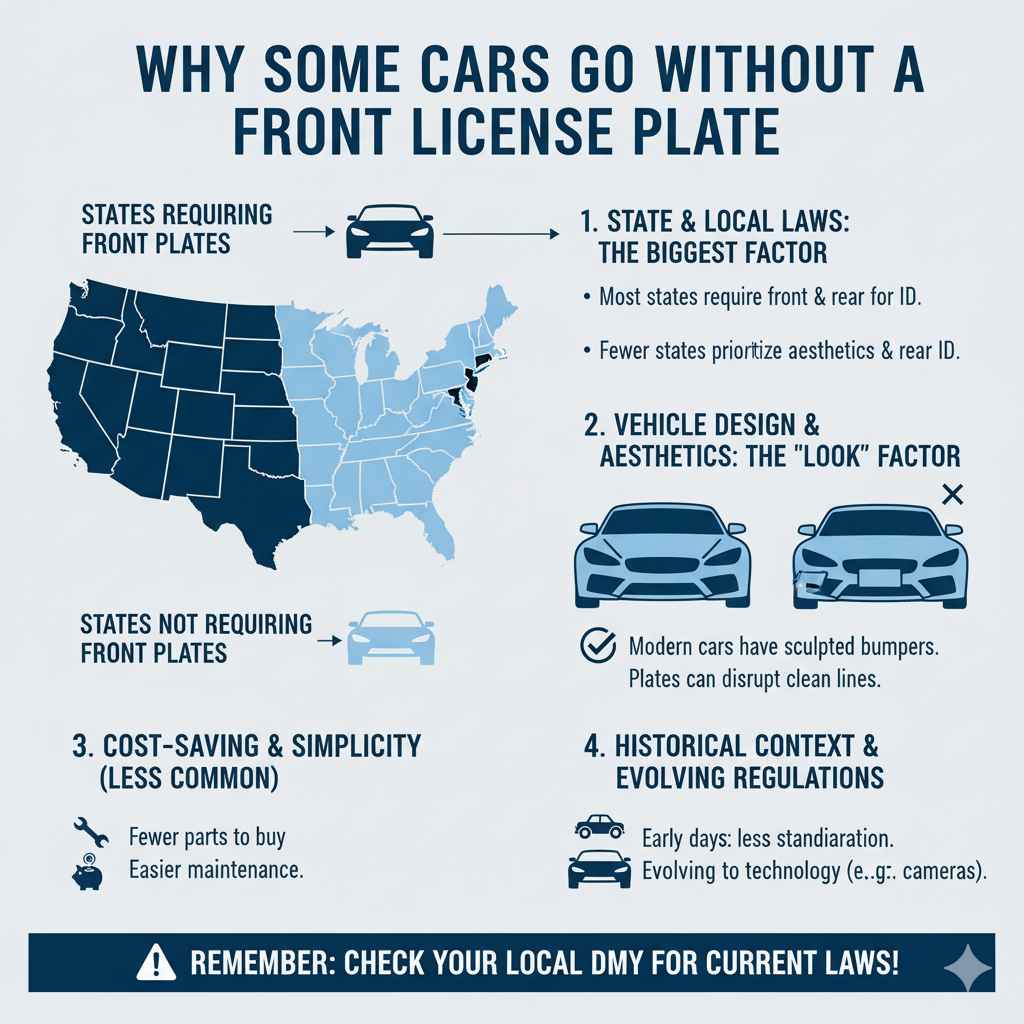
Table: Comparing Front Plate Requirements by State (Illustrative Example)
To give you a clearer picture, here’s an illustrative example of how front license plate requirements can vary. Please note that this is a simplified overview, and verifying with your local DMV is always the best practice.
| State | Front License Plate Required? | Notes |
|---|---|---|
| California | Yes | Mandatory for most vehicles. |
| Florida | Yes | Mandatory for most vehicles. |
| Texas | Yes | Mandatory for most vehicles. |
| New York | Yes | Mandatory for most vehicles. |
| Pennsylvania | No (as of recent changes) | Law changed to remove front plate requirement. |
| Arizona | Yes | Mandatory for most vehicles, though enforcement may vary. |
| New Hampshire | No | No front plate required. |
| North Dakota | No | No front plate required. |
| New Mexico | No | No front plate required. |
| Tennessee | Yes | Mandatory for most vehicles. |
Disclaimer: State laws can change. Always consult your official state DMV or equivalent agency for the most up-to-date information.
When is it Okay to Not Have a Front License Plate?
The decision to run without a front license plate hinges almost entirely on your local laws. If your state doesn’t require it, then it’s perfectly fine. However, if your state does mandate two plates, and you choose not to have one, you’re opening yourself up to potential trouble.
Understanding Your Local Laws
The first and most important step is to know your specific state’s vehicle code. Traffic laws are generally enforced at the state level, although some cities might have local ordinances that are related. The easiest way to find out is to:
- Visit your state’s Department of Motor Vehicles (DMV) or equivalent agency website. They usually have a section on vehicle registration and requirements.
- Search online for “[Your State] front license plate law.”
- Check your state’s driver handbook, which is often available for download online. For example, the California Driver Handbook clearly outlines registration requirements.
If you live in a border area or commute to another state regularly, be aware of the rules in all areas you drive frequently. A police officer in a state that requires front plates can issue a ticket, regardless of where your car is registered.
Common Scenarios Where No Front Plate is Legal
You live in a state that doesn’t require one. This is the most common and straightforward reason. Examples include states like New Hampshire, North Dakota, New Mexico, Montana, Delaware, and now Pennsylvania.
Your vehicle is a specific type or model where mounting is impossible and exempted. While rare, some antique vehicles or custom builds might have exemptions, though this usually requires special paperwork.
You are visiting a state that doesn’t require a front plate, and your home state does. In this case, you are subject to the laws of the state you are in. So, if you’re visiting a state without front plate requirements, you likely won’t be ticketed there for not having one. However, as soon as you cross back into a state that does require them, you must have it installed.
When it’s NOT Okay
Your state requires a front license plate, and you simply don’t want to put one on. This is the most common reason people get tickets for missing front plates.
Your car is registered in a state that requires a front plate, and you are driving in a state that also requires one. You must comply with the laws of the road you are traveling on.
You have a front plate but it’s obscured, damaged, or unreadable. Even if you have one, it must be clearly visible.
Dealing with Front License Plate Tickets and Requirements
Getting a ticket for a missing front license plate is frustrating, especially if you thought you were in the clear. Here’s how to approach it.
If You Receive a Ticket
The first step is to remain calm and polite if you are pulled over. If you’re issued a ticket, carefully read it. It will specify the violation and the penalty.
1. Assess Your Situation:
Did you make a mistake? Double-check your state’s laws using the resources mentioned earlier. Was your state ticket-issuing state one that requires front plates?
Is it a “fix-it” ticket? Many jurisdictions issue “corrective equipment” tickets, often called fix-it tickets. These give you a grace period to resolve the issue and provide proof to the court or police agency.
2. Take Action (if it’s a fix-it ticket):
Install the Plate: If you are in a state that requires a front plate, your best bet is to get one and install it. If you are in a state that does not require one, but you were ticketed because your home state requires it, you’ll need to address this with the issuing authority. This can be complicated.
Gather Proof: Once the plate is installed, you’ll likely need to get a law enforcement officer to sign off on a form or go to a police station for verification before you can get the ticket dismissed or reduced. Some courts accept photos as proof.
Appear in Court (if necessary): If you believe the ticket was issued in error (e.g., you were in a state with no front plate requirement and were ticketed by an officer from a state that does), or if you cannot get it resolved otherwise, you may need to appear in court to contest it. Be prepared with your evidence and knowledge of the law.
Installing a Front License Plate: A Quick Guide
If you’ve determined you need a front plate and want to install it properly, here’s a general overview.
Tools and Materials You Might Need:
Your front license plate and mounting hardware (often screws or bolts provided when you register your vehicle, or available at auto parts stores)
A drill and drill bits (if you need to create mounting holes)
A screwdriver or wrench (depending on the type of hardware)
A tape measure and pencil (for marking holes)
Painter’s tape (to protect the bumper while marking)
A specialized license plate bracket (if your car requires one for proper fitment)
Simple Steps for Installation:
1. Confirm Location: Identify the designated area for the license plate on your bumper. Many cars have pre-drilled holes or a marked area. If not, carefully determine the best placement that is visible and doesn’t obstruct airflow to radiators or intercoolers.
2. Mark Holes: Hold the plate (or bracket) against the bumper. Use painter’s tape to mark the exact spots where you will drill or fasten. Ensure it’s level and centered as much as possible.
3. Drill Holes (if necessary): If no holes exist, use a drill with an appropriate bit size for your screws. Start with a small pilot hole and, if needed, enlarge it. Be cautious not to drill too deep.
4. Attach the Plate:
Direct Mount: Use self-tapping screws or bolts to attach the license plate directly to the bumper. Don’t overtighten.
Bracket Mount: Install the bracket first according to its instructions, then attach the license plate to the bracket.
5. Secure Tightly: Ensure the plate is firmly attached and won’t vibrate loose or fall off.
Pro Tip: Avoid drilling into important sensors or under-hood components. If you’re unsure, consult your car’s manual or a professional. Consumer Reports often has detailed guides on vehicle maintenance tasks like this.
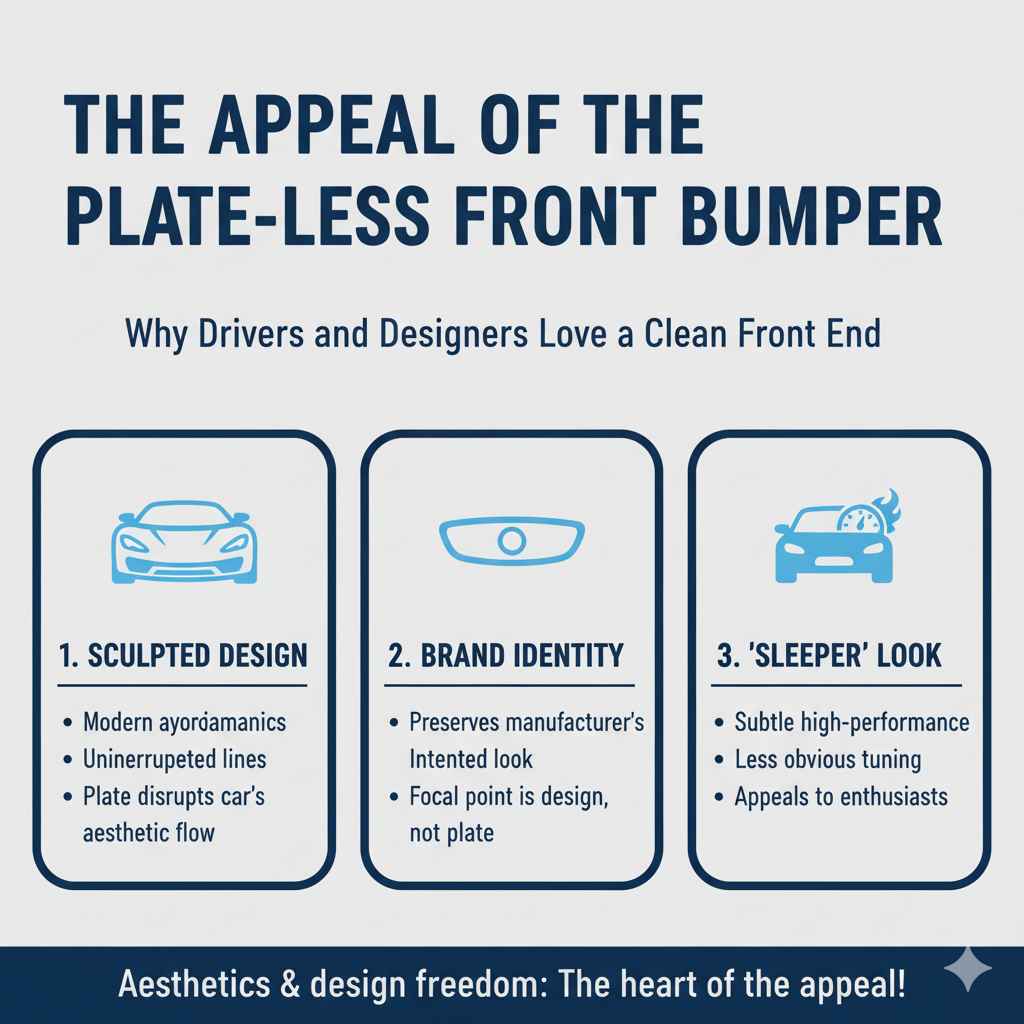
The Appeal of the Plate-less Front Bumper
Even for those who must legally display a front plate, the idea of a clean front end is appealing. Why is this?
Sculpted Design: Modern car design often emphasizes flowing lines and aerodynamic shapes. A license plate mount can interrupt this. This is especially true for performance-oriented vehicles and luxury cars, where the front fascia is a key design element.
Brand Identity: Car manufacturers spend millions on design to create a recognizable and attractive look for their vehicles. A front license plate can sometimes feel like an imposed accessory that detracts from this carefully crafted identity.
“Sleeper” Look: In some cases, especially with high-performance cars, owners might prefer a discreet look. A missing front plate can add to the stealth or “sleeper” aesthetic, making the car less obviously a performance model at first glance.
This desire for aesthetic purity is a significant reason why manufacturers offer cars without pre-drilled holes for front plates, and why owners in states where it’s optional are happy to leave that part of the bumper blank.
FAQ
Q1: Do all states require a front license plate?
No, not all states require a front license plate. The requirement varies by state law. Many states mandate both front and rear plates for vehicle identification purposes, while a smaller number of states have eliminated the front plate requirement.
Q2: How can I find out if my state requires a front license plate?
The best way to determine your state’s requirement is to visit the official website of your state’s Department of Motor Vehicles (DMV) or equivalent agency. You can usually find this information in the driver handbook or by searching for “[Your State] license plate requirements.”
Q3: What happens if I get a ticket for no front license plate?
If you receive a ticket for a missing front license plate, it can typically result in a fine. In many places, this is considered a “fix-it” ticket, meaning you can have the ticket dismissed or reduced by installing the required plate and providing proof to the court or issuing authority.
Q4: My car has a very specific bumper design. Can I still install a front license plate?
Yes, even vehicles with unique bumper designs can usually accommodate a front license plate. Many cars come with pre-drilled holes. If yours doesn’t, you might need a specialized bracket (like a tow hook mount or adhesive mount) or you may need to drill new holes carefully. Always check your car’s manual or consult a professional if you’re unsure.
Q5: If my state doesn’t require a front license plate, can I still get a ticket for not having one?
Generally, no. If you are driving in your home state and that state does not require a front license plate, you should not receive a ticket for not having one. However, if you are traveling in a state that does require front plates, you are subject to that state’s laws and could receive a ticket.