Will a 94 Silverado Motor Fit a 95 GMC Sierra
On 1994-1995 GMT400 trucks, the engine may bolt in if it is the same GM small-block or another matching engine family, but wiring, emissions, and transmission control can still keep it from running correctly. Get those wrong and you can end up with a no-start, bad shifting, check-engine lights, or a swap that needs a second teardown. This guide breaks the swap into physical fit, electronics, transmission, and emissions so you can decide what actually works.
Key compatibility checks for 94 to 95 engine swaps
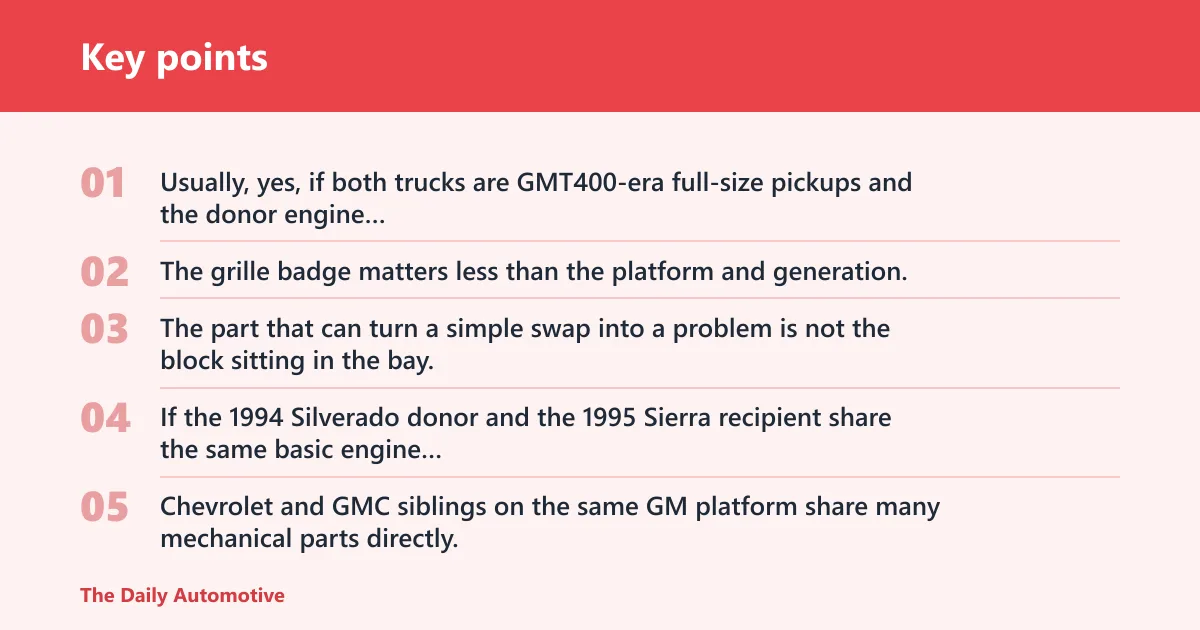


Usually, yes, if both trucks are GMT400-era full-size pickups and the donor engine matches the recipient’s engine family and mounting pattern. The grille badge matters less than the platform and generation. The part that can turn a simple swap into a problem is not the block sitting in the bay, it is the wiring, transmission setup, and emissions equipment.
When the answer is likely yes
If the 1994 Silverado donor and the 1995 Sierra recipient share the same basic engine family, the engine often fits the frame, mounts, and bay layout. Chevrolet and GMC siblings on the same GM platform share many mechanical parts directly, and brand differences are often cosmetic, not mechanical, on the same generation.
That means a 1994 Chevrolet Silverado 1500 and a 1995 GMC Sierra 1500 can be a good match when the engine code, transmission family, and drivetrain setup line up. The key is to verify the exact powertrain, not to assume all 1994 and 1995 full-size trucks are the same.
When the answer is no or needs parts changes
The swap becomes a problem when the donor and recipient use different engine families, different bellhousing patterns, different transmission controls, or different emissions hardware. A motor can physically sit in the truck and still fail because the ECU does not like the sensors, the wiring loom is wrong, or the transmission interface does not match.
A common first-timer mistake is buying an engine because it “came from a 1994 Chevy truck” and skipping the VIN check. That can leave you with a 2WD donor engine, a 4WD recipient, and missing brackets, lines, or accessory pieces that were never meant to match.
What decides whether the swap fits?
The decision path starts with engine family, then transmission family, then 2WD or 4WD details, and then accessory drive and mounts. If those pieces line up, the swap is often straightforward. If they do not, you may still make it work, but it stops being a simple bolt-in.
Engine family first
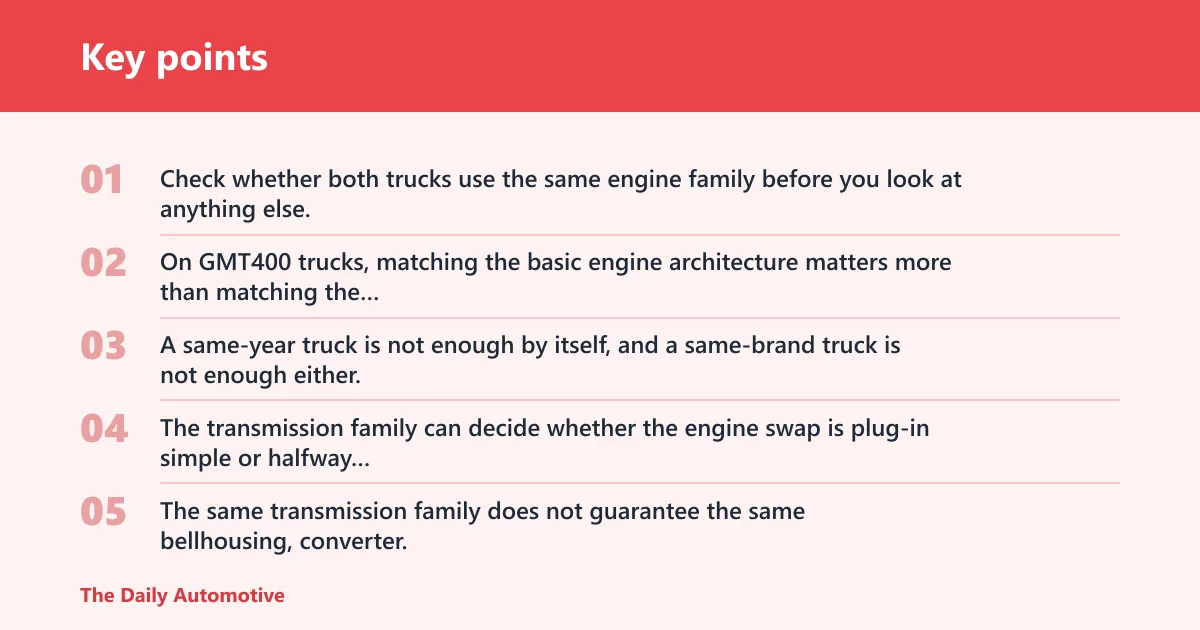
Check whether both trucks use the same engine family before you look at anything else. On GMT400 trucks, matching the basic engine architecture matters more than matching the badge or trim package. A same-year truck is not enough by itself, and a same-brand truck is not enough either.
Transmission family second
The transmission family can decide whether the engine swap is plug-in simple or halfway custom. The same transmission family does not guarantee the same bellhousing, converter, or control setup. A 2WD and a 4WD truck may share broad transmission naming, but the hardware around them can differ enough to block a direct swap.
2WD vs 4WD details
Two-wheel-drive and four-wheel-drive trucks need different attention because transfer case, output shaft, front accessory clearance, and crossmember details can change. A motor that looks identical on the stand may still need different brackets or related parts once it is in the truck.
Accessory drive and mounts
Accessory brackets, pulleys, and front dress parts can make or break the install. Even when the long block is right, mismatched accessory drive pieces can create belt alignment problems or interfere with steering and front-end hardware. The safest move is to compare the donor engine with the recipient engine by code, not by appearance.
How do you confirm the engine by VIN?
Use the 8th VIN character to identify the engine, then compare that code with the emissions label and the RPO codes on the truck. That is the cleanest way to avoid guessing. If the donor and recipient codes do not agree, treat the swap as an identification problem before you treat it as a parts problem.
Use the 8th VIN character
The 8th VIN character identifies the engine. That single character helps you confirm the exact powertrain family, which is better than assuming the engine is correct because the truck is a 1994 or 1995 model year. Write both VINs down before you buy parts.
Check the emissions label and RPO codes
The emissions label and glove-box RPO codes can often help confirm what the truck was built with. Those codes matter because an engine may physically fit while still being wrong for the truck’s calibration, sensor set, or emissions package. The donor engine should match the recipient’s intended setup as closely as possible.
Match the donor and recipient engine code
When the engine code matches, your chances improve sharply. When it does not, expect extra parts or a different donor. Picture a 1995 Sierra 1500 with the correct small-block family but a mismatched emissions package: the engine may bolt in, yet the truck may still throw codes until the sensor and calibration issues are addressed.
Will 94 silverado motor matrix
This matrix separates physical fit from the rest of the swap. Use it as a quick screen before you pull the donor motor.
| Engine family | Transmission family | 2WD/4WD | Required swap checks | Verdict |
|---|---|---|---|---|
| Same GM small-block family | Same family, same bellhousing pattern | Same drivetrain layout | Confirm 8th VIN character, mounts, accessory drive, ECU/wiring, emissions label | Likely fit |
| Same GM small-block family | Same family, different control setup | Same drivetrain layout | Check torque converter, sensors, wiring, calibration, and transmission control | Needs modification |
| Different engine family | Any family | Any layout | Compare mounts, bellhousing pattern, accessories, ECU, and emissions equipment | No-go or major conversion |
| Same engine family | Different family | 2WD donor to 4WD recipient | Check output shaft, transfer case fit, brackets, and crossmember clearance | Needs modification |
| Same engine family | Different family | 4WD donor to 2WD recipient | Check tailhousing, driveshaft length, transmission controls, and mount points | Needs modification |
| HD truck engine | HD-specific transmission | 1500 recipient | Verify frame, mounts, transmission, axle, brake, and spring differences | No-go for simple swap |
What can block a bolt-in swap?
Three problems stop a “fits” engine from becoming a working truck: ECU and wiring mismatch, transmission mismatch, and emissions mismatch. A motor can sit correctly in the bay and still fail to start, idle, or shift properly if any of those systems are wrong.
ECU and wiring loom match
Engine electronics can make or break the job. Different sensors, injector setups, or calibration files can trigger fault codes or a no-start condition. Reprogramming or a loom change may be required, especially if the donor truck used a different emissions package or transmission control strategy.
Bellhousing and transmission issues
The bellhousing pattern and transmission family must agree with the engine. Even when a transmission looks close, the wrong pattern or control setup can stop the swap cold. Do not assume that because the transmission came from another GMT400 truck it will bolt to the donor engine without checking the details.
Emissions equipment and sensor differences
Emissions gear is easy to ignore and hard to fix later. The wrong EGR setup, oxygen sensor arrangement, or calibration can leave the truck running poorly even if the engine physically fits. This is why VIN and emissions label checks belong at the start of the job, not after the engine is already hanging from the hoist.
What parts usually interchange between Silverado and Sierra?
On the same GM platform, many mechanical parts interchange directly, and that includes engines and transmissions on the same platform. Suspension and brake parts often swap too. Body parts are a different story, because grilles, headlights, hoods, and bumpers can vary by brand even when the truck underneath is nearly the same.
Engine and transmission parts
Within the same platform generation, Silverado and Sierra engines and transmissions are often identical. That is the main reason these swaps are common. The exact part still needs to match the recipient truck’s engine code, transmission family, and drivetrain layout.
Suspension and chassis parts
Interchange commonly includes control arms, shocks, springs, sway bars, spindles, calipers, rotors, pads, and brake lines. Those parts are useful donor candidates when the trucks share the same platform and generation. Even then, 1500 and HD applications need separate checking before you buy anything.
Body and trim parts
Grilles, headlights, hoods, and bumpers may look close but still differ between Chevrolet and GMC. Mechanical parts usually interchange more readily than exterior sheet metal. That is why a truck can accept a donor engine easily while still refusing the donor front fascia.
What years of Silverado and Sierra share the same platform?
The article divides Silverado and Sierra into four platform generations, and that boundary matters more than the badge on the tailgate. The “Classic” year trap matters because 2007 sold old and new platforms at once. Always match the actual platform generation before assuming interchange.
That is why a 1994 Silverado and a 1995 Sierra can share many parts even though later Silverado and Sierra trucks use different architectures.
What is the difference between 1500 and 2500/3500 GM trucks?
1500 trucks are generally not the same as 2500 or 3500 trucks. The frame, springs, brakes, and axles are different enough that many suspension and chassis parts do not interchange. A heavy-duty donor can look close and still be the wrong base for a half-ton swap.
If you are shopping for an engine donor, confirm whether both trucks are 1500s or both are heavy-duty models. That is a fitment boundary, not a minor detail.
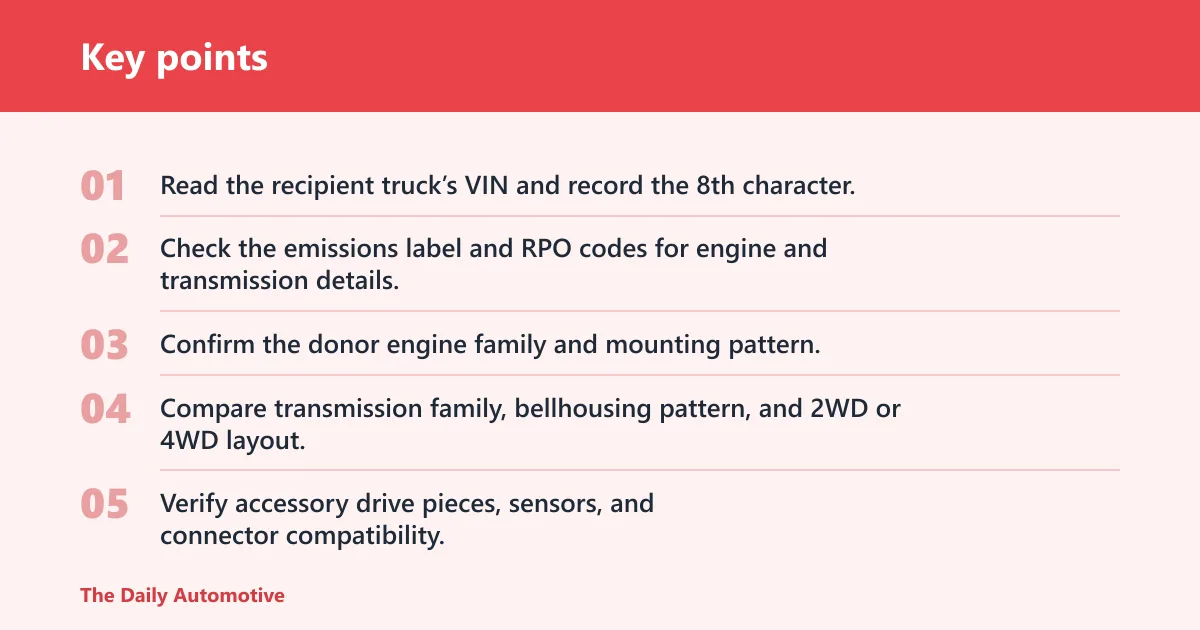
- Read the recipient truck’s VIN and record the 8th character.
- Check the emissions label and RPO codes for engine and transmission details.
- Confirm the donor engine family and mounting pattern.
- Compare transmission family, bellhousing pattern, and 2WD or 4WD layout.
- Verify accessory drive pieces, sensors, and connector compatibility.
- Separate 1500 parts from 2500/3500 parts before buying anything.
The engine may physically fit, but if the donor used different electronics or a different transmission control setup, you may still need wiring loom work or calibration changes before the truck runs right.
Frequently asked questions
Will a 1994 Silverado motor fit a 1995 GMC Sierra?
Usually yes, if the engine family matches and the trucks share the same GMT400 setup. The important checks are the 8th VIN character, transmission family, drivetrain layout, and emissions package. A year match alone is not enough, and electronics can still force extra work.
What engine codes fit a 1995 GMC Sierra?
Any engine code that matches the truck’s intended engine family, mounts, and emissions setup is the real target. Use the 8th VIN character and the emissions label to confirm it. Do not shop by model year alone, because a correct-looking engine can still have the wrong calibration or sensor layout.
Are 1994 Chevy Silverado and GMC Sierra engines interchangeable?
Often yes, because Silverado and Sierra share the same GM platform and many mechanical parts. On the same generation, engine and transmission parts are frequently identical. The limits are engine code, transmission family, and electronics, which can turn a direct swap into a partial one.
Do I need to change the wiring loom or ECU for an engine swap?
Sometimes yes. Wiring and ECU differences can cause fault codes, a no-start, or bad shifting even when the engine physically fits. If the donor and recipient do not share the same calibration and sensor setup, plan on loom checks or reprogramming before you turn the key.
How do I tell if my truck is a 1500 or HD before swapping?
Check the door label, VIN, and the truck’s original equipment codes before you buy parts. Then confirm the frame, brake, spring, and axle package.
What parts from a Silverado also fit a Sierra?
On the same platform and generation, many mechanical parts fit: engines, transmissions, control arms, shocks, springs, sway bars, spindles, calipers, rotors, pads, and brake lines. Exterior parts such as grilles, headlights, hoods, and bumpers can differ, so check those separately before ordering.
Products related to this article
Sponsored / affiliate links. As an Amazon Associate I earn from qualifying purchases. I may earn additional commission from eligible campaigns.