3 Best Kids Headphones for Cars (2026): We Compared
For car rides, the best headphones for kids are usually wired over-ear models for toddlers and younger kids, wireless on-ear or over-ear sets for older kids, and volume-limited options for long trips. Pick the wrong type and you get tangled cords, dead batteries, broken audio, and a backseat full of arguments. This guide compares three kid headphone types for toddlers, siblings sharing a car, and road-trip families, plus when to buy wired versus wireless.
Quick comparison
| Product | Badge | Best for | Price | ||
|---|---|---|---|---|---|
 |
JoySpark Kids Bluetooth Headphones Over-Ear, 60Hrs,JoySpark | Our pick | Over-Ear · 60Hrs · Purple | $14.99
Price as of 22 Oct 2026
|
View |
 |
IMYB V1 Kids Headphones, 85dB Wired for School, ToddlerIMYB | Budget pick | Wired · 85dB · Green | $8.99
Price as of 22 Oct 2026
|
View |
 |
gorsun Active Noise Cancelling Kids Bluetoothgorsun | Upgrade pick | ANC · 70H · Foldable | $12.99
Price as of 22 Oct 2026
|
View |
The main trade-off is simple: wired sets need the least upkeep, wireless sets are easier to move around with, and shared-audio features matter most when two kids fight over one screen. The right answer depends less on the headphone label and more on the backseat setup.
How we chose
We compared these picks on the things that matter in cars: age fit, comfort on a long ride, charging burden, screen-sharing support, and whether the volume cap is fixed or easier to bypass. A strong car pick also has to survive drops, pack flat, and work with tablets, school devices, or seat-back screens.
Safety came first. The WHO recommends a maximum of 85dB for children, so a good kids model should keep volume in that range and make it hard to defeat the limit by accident.
Practicality came next. In a car, the best set is the one your child can put on without help, keeps working on a two-hour drive, and does not turn into a charging headache before school pickup.
Kids headphones decision table
| Pick | Age fit | Wired or wireless | Battery life | Volume limit | Comfort | Portability | Sharing | Mic support |
|---|---|---|---|---|---|---|---|---|
| JoySpark Kids Bluetooth Headphones | Preschool to older kids who can manage Bluetooth | Wireless | 60Hrs | 85/94dB selectable | Memory foam ear cushions | Lightweight, travel-friendly | No special two-child sharing feature listed | Built-in mic |
| IMYB V1 Kids Headphones | Ages 2 to 12 | Wired | No charging needed | Factory-locked 85dB | Hypoallergenic soft memory foam earpads | Foldable, durable cord | No sharing port listed | Tablet and school-device friendly via 3.5mm |
| gorsun Active Noise Cancelling Kids Bluetooth Headphones | Older toddlers through school-age kids who tolerate an over-ear fit | Wireless | 70H playtime | 85dB limiter | Over-ear, adjustable, travel-friendly | Foldable | No sharing port listed | Microphone included |
For a quick rule: choose wired for the least maintenance, choose wireless for long drives, and choose a shared-audio setup when two children watch the same screen in the backseat. The best fit often depends on whether the child is a toddler, a preschooler, or old enough to handle buttons and pairing.
What are the best headphones for kids in cars?
The best headphones for kids in cars are the ones matched to the ride length, the child’s age, and the device in use. For most families, a wired 85dB model is the easiest low-stress choice for short trips and screen-heavy backseat use, while a wireless set makes more sense when you need cord-free movement on long drives.
A car asks more from headphones than a living room does, because the set has to work with seat belts, car seats, shared screens, and stops where battery life suddenly matters.
Quick verdict by use case
Best for toddlers: IMYB V1, because the wired setup avoids pairing steps and the fit is sized for ages 2 to 12. That matters when a child needs the headphones to work on the first try.
Best for long road trips: JoySpark, because its 60Hrs battery and Bluetooth 5.3 make it the most flexible wireless pick here for extended travel.
Best for two kids sharing one screen: a wired model with a sharing port is usually the cleanest answer. That setup keeps both children on the same audio feed without needing a second charging cycle.
How do I stop kids headphones from hurting little ears?
Start with an 85dB limit and do not rely on a parent-friendly app slider alone. Hardware-enforced limiting is stronger than software-only caps, because device settings can sometimes bypass a software limit or reset the volume higher than you intended.
Fit matters as much as volume. If the earcups are shallow, the headband is stiff, or the clamp pressure is too high, children push the cups off their ears and turn the volume up to compensate.
Volume cap details that matter
The WHO recommends a maximum of 85dB for children, so that is the benchmark to look for first. Some kids headphones offer selectable limits, such as 85dB and 94dB, but the safer family choice for routine car use is usually the lower setting.
For car rides, the safest model is one that keeps the limit in the headphone hardware or in a factory-locked setting. A limit you can change with a phone setting is easier to forget, and that makes it less dependable in a busy backseat.
Say your child is in a rear-facing seat and you are trying to keep a tablet movie at a comfortable level on a 90-minute drive. If the earcups seal poorly, the child may raise the volume to fight road noise, which defeats the purpose of the limiter.
JoySpark Kids Bluetooth Headphones: best for long road trips
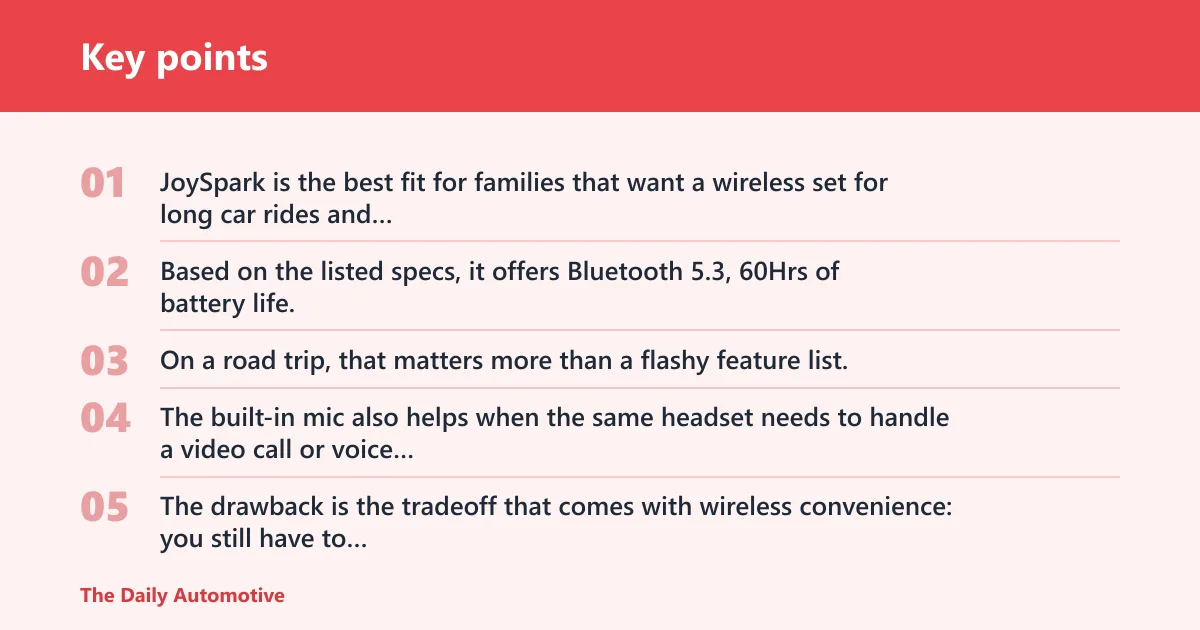
JoySpark is the best fit for families that want a wireless set for long car rides and travel days. Based on the listed specs, it offers Bluetooth 5.3, 60Hrs of battery life, memory foam ear cushions, and a volume-limited design that fits the long-haul use case better than a short-trip-only headset.
What stands out is the battery cushion. On a road trip, that matters more than a flashy feature list, because the backseat is where dead batteries turn into arguments. The built-in mic also helps when the same headset needs to handle a video call or voice prompt.
The drawback is the tradeoff that comes with wireless convenience: you still have to charge it, and Bluetooth is one more thing to pair before departure. The selectable 85/94dB limit is useful, but the lower setting is the one most parents should favor in the car.
IMYB V1 Kids Headphones: best for siblings sharing a screen
IMYB V1 is the clearest pick for parents who want a simple wired set for backseat sharing, tablet playback, or school-device compatibility. Its 3.5mm connection, factory-locked 85dB limit, foldable design, and adjustable fit for ages 2 to 12 make it a practical, low-maintenance car headphone.
The main advantage is that it does not need charging at all. That makes it especially useful for errands, school pickup lines, and plane screens where you want one less battery to manage. The soft memory foam earpads are also a plus for younger kids who need a gentle fit.
The drawback is obvious: the cord can get in the way in a car seat, especially if two children are reaching toward the same screen. It is also less flexible than wireless when a child wants to stand up, turn around, or move between seats.
Gorsun Active Noise Cancelling Kids Bluetooth Headphones: best for noisy travel
gorsun is the pick for parents who want active noise cancellation in a kid-friendly wireless set. The listed specs include a built-in 85dB volume limiter, Bluetooth 6.0, about 70 hours of playtime, a foldable design, and a microphone, which makes it a strong fit for louder cars and longer travel days.
ANC matters most when the ride is genuinely noisy, such as highway driving or a trip with constant road and wind noise. In quieter cars, passive isolation from over-ear pads may be enough, so ANC can be more feature than necessity.
The drawback is the same one that comes with most ANC headphones: higher cost and another battery load to manage. Younger children may also find over-ear ANC sets bulkier than a simpler wired model, especially on short errands.
Which one should you buy?
Choose the wired pick if you want the least maintenance and the widest compatibility. IMYB V1 is the cleaner choice for toddlers, tablets, school devices, and any car setup where you do not want to think about charging.
Choose the wireless pick if your child sits through long drives or you want fewer cord tangles in the backseat. JoySpark is the better fit when battery life and Bluetooth convenience matter more than absolute simplicity.
Choose the noise-cancelling wireless pick if your family does a lot of highway travel and your child is old enough to handle a more advanced headset. gorsun makes the most sense when road noise is part of the problem you are trying to solve.
Suppose you have a preschooler in a booster seat and a tablet mounted to the headrest. A wired set is usually easier to manage because there is no pairing step, no charging reminder, and no battery to run down before the trip is over.
A common first-timer mistake is buying a set with tiny buttons and a stiff headband because the specs look good on paper. In a car, that often means a child cannot adjust it alone and keeps asking for help every 10 minutes.
What makes kids headphones safe in cars?
The safest car headphones keep volume near 85dB, fit the child’s head well, and avoid easy bypasses. A hardware limit is better than a software-only one, because car use is often hands-on and hurried, and that is when settings get changed without anyone noticing.
Comfort also affects safety. If the earcups are too shallow or the clamp is too tight, children pull the headphones off, raise the volume, and miss the point of the limit altogether.
Hardware limits versus device settings
A hardware-enforced cap is the strongest option because the headphone itself controls the ceiling. By contrast, app-based or phone-based limits can be altered, disabled, or ignored if the child switches devices.
That is why a factory-locked 85dB design is more reassuring for car rides than a set that only asks the connected tablet to behave. One stays consistent across devices; the other depends on the device behaving exactly as planned.
Comfort and fit in the backseat
Look for padded headbands, soft earcups, and enough adjustability to fit growing heads. Toddlers usually need lighter pressure and simple controls, while older children can handle a firmer fit if it stays comfortable for a full drive.
Durability matters too. Foldable hinges, reinforced joints, and a cord or shell that can survive backpack storage are worth more than decorative lights in a car, where headphones get stuffed, dropped, and stepped on.
Frequently asked questions
Wired or wireless headphones for kids in the car?
Wired headphones are usually better for toddlers, simple tablet setups, and short car rides because they do not need charging and work with most 3.5mm devices. Wireless headphones make more sense for older kids on long drives, especially if you want fewer cords around car seats and seat belts.
What dB limit is best for kids headphones?
An 85dB cap is the most widely used safety benchmark for children and the one parents should look for first. Some models add a higher optional setting, but the lower limit is the better default for car rides, where children may listen longer than intended.
Which kids headphones work best for long car trips?
Wireless models with long battery life work best for road trips, especially when the headset offers a comfortable over-ear fit and a reliable Bluetooth connection. A long battery matters more on a five-hour drive than on a 20-minute school run, where wired is often simpler.
Do kids headphones need noise cancelling for car rides?
No, not always. Active noise cancellation is useful in loud highway traffic or when road noise is constant, but many children do fine with passive isolation from padded earcups. ANC adds cost and battery drain, so it is most useful when the car is truly noisy.
What headphones are easiest for toddlers to use in the car?
Wired over-ear headphones with a simple 3.5mm plug are usually easiest for toddlers because there is no pairing step and no charging to remember. Look for a light frame, soft earcups, and controls that are simple enough for small hands to manage without constant help.
Products related to this article
Sponsored / affiliate links. As an Amazon Associate I earn from qualifying purchases. I may earn additional commission from eligible campaigns.