3 Best Bluetooth Speakers for Car Use (2026): We Compared
The best Bluetooth speaker for car use depends on cabin size and job: pick a compact clip-on for short commutes, a larger long-battery speaker for road trips, or a speaker with stronger mic pickup for hands-free calls. A poor match means weak volume, muddy voice prompts, and missed calls. This guide compares three main car-friendly Bluetooth speaker picks plus one call-first specialist by use case, sound, battery life, mounting, and call quality.
Quick comparison
| Product | Badge | Best for | Price | ||
|---|---|---|---|---|---|
 |
JBL Charge 5 – Portable Waterproof Speaker – Blue | BoldJBL | Our pick | JBL Charge 5 · 20H Battery · Blue Color | $179.95
Price as of 23 Oct 2026
|
View |
 |
Anker soundcore 2 Portable Bluetooth Speaker, 24-HourAnker | Budget pick | Anker Soundcore 2 · 24H Playtime · 12W Power | $29.98
Price as of 23 Oct 2026
|
View |
 |
Tribit StormBox Blast Bluetooth Speaker, 90W Loud Sound,Tribit | Upgrade pick | Tribit StormBox Blast · 90W Sound · 30H Playtime | $179.99
Price as of 23 Oct 2026
|
View |
The short version: the JBL Clip 5 suits tight cabins and quick storage, the JBL Charge 5 fits most daily-driver use, and the Tribit StormBox Blast is the strongest road-trip choice when battery and volume matter more than compact size. Storage fit, call quality, and placement matter as much as the brand name.
How we chose
This comparison focuses on cabin fit, battery runtime, call behavior in road noise, and how easy each speaker is to store or mount in a car. The three picks also cover different buyer needs: compact commuting, long-trip listening, and stronger output for larger cabins.
Battery claims were separated from likely real-world use. That matters because a speaker listed at 20 or 24 hours rarely delivers that figure at louder in-car levels.
We also weighed IP ratings, Bluetooth version, and whether a speaker is physically suited to a cupholder, a door pocket, a console, or a clip point such as a grab handle.
One more filter: call quality. A speaker can sound fine for music and still fail badly for voice in a noisy cabin if the microphone is weak or echo control is poor.
Car speaker decision matrix
Use this matrix before you look at brand names. It maps car size, main task, and storage preference to the right form factor, then adds a yes/no fit check for the details that cause problems in real cabins.
| Car size | Primary use | Storage preference | Best form factor | Cupholder fit | Battery target | Microphone priority |
|---|---|---|---|---|---|---|
| Small car or compact hatchback | Podcasts, navigation, short music sessions | Stow in door pocket or glove box | Ultra-compact clip speaker | Yes, if the body is slim and round enough | 8 to 12 hours is usually enough | No, unless you take calls often |
| Midsize sedan | Mixed music and podcasts | Keep in center console or cupholder | Compact cylinder speaker | Yes, cupholder stability matters most here | 12 to 20 hours is a safer target | Maybe, if you answer calls on the road |
| SUV or truck | Music-first listening and longer drives | Store in cargo area or on a seatback point | Larger speaker with wider dispersion | No, larger bodies often break cupholder fit | 20 hours or more is the better target | Yes, if you want true speakerphone use |
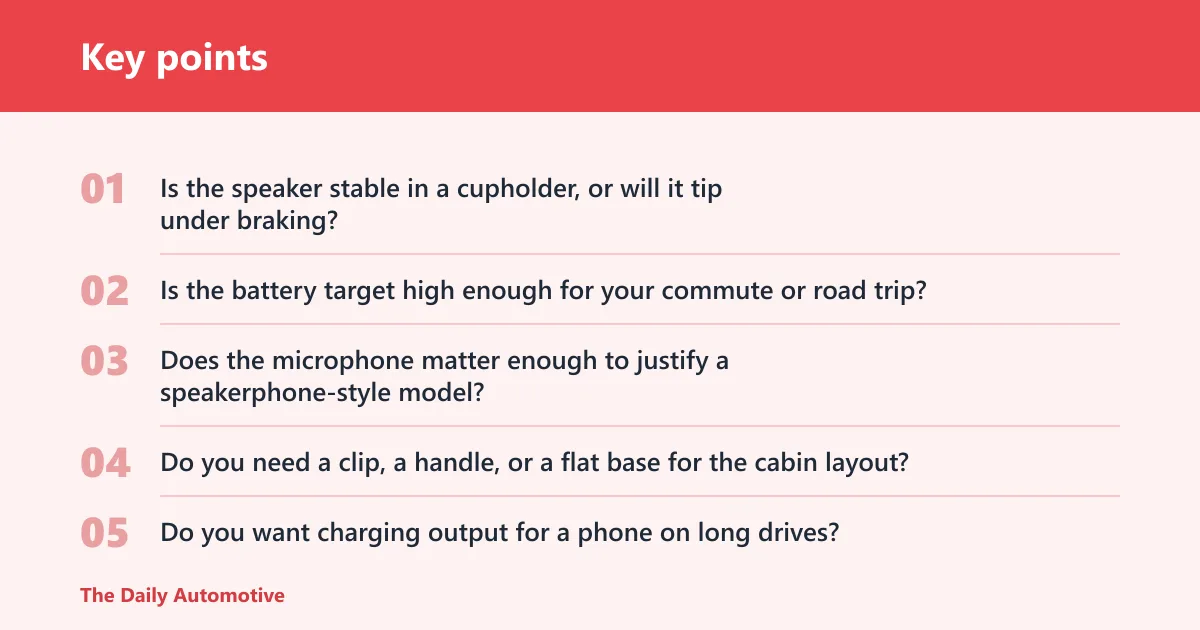
- Is the speaker stable in a cupholder, or will it tip under braking?
- Is the battery target high enough for your commute or road trip?
- Does the microphone matter enough to justify a speakerphone-style model?
- Do you need a clip, a handle, or a flat base for the cabin layout?
- Do you want charging output for a phone on long drives?
Yes/no checklist:
- Cupholder fit: Yes if the speaker is slim, round, and low enough to sit flush; no if it needs a wider base than your cupholder allows.
- Battery target: Yes if the listed runtime clears your longest regular drive with margin; no if you need to recharge before the end of the trip.
- Microphone priority: Yes if calls are a main use; no if you only need music and directions.
- Mounting: Yes if the speaker has a clip, hook, or stable flat base; no if it slides around on the dash.
Say your hatchback has one deep cupholder and a small center console. A cylinder speaker that drops into that holder is easier to live with than a wider unit that must ride on the seat and slide every time you brake.
Suppose your truck has a large cabin and you drive four hours at a time. A larger speaker with longer battery life and wider sound spread makes more sense than a tiny clip model that gets buried by road noise.
Which Bluetooth speaker fits in a car?
The best fit depends on where the speaker will sit during braking, cornering, and storage. A compact, round speaker works best in a cupholder or door pocket. A clip speaker works better when you need to hang it from a grab handle or strap it to a seatback. Large party-style speakers usually fail the fit test.
For the tightest cabins, shape matters more than raw output. A narrow cylinder can stay upright in a cupholder and remain reachable when you want to pause navigation or answer a call.
A clip or carabiner mount is better when cupholders are already occupied. Headrest or grab-handle attachment can also keep the speaker from sliding, which helps in SUVs and trucks with more cabin movement.
A larger speaker is the wrong choice when the cabin is small and storage is limited. Bigger cabinets can block shifter space, spill into passenger legroom, or become a loose object in hard stops.
JBL Clip 5: best for cupholder fit
The JBL Clip 5 is the most practical choice for drivers who want an ultra-compact speaker that disappears into a small cabin. It is described as an ultra-compact pick, and its about 12 hours of battery life is enough for short commutes, school runs, and errand-heavy days.
Its form factor is the main advantage. A clip speaker is easy to hang from a grab handle, backpack hook, or seatback point, and it stores without taking up much space. That matters when the car already has a phone mount, a drink, and a key fob in the console.
The drawback is simple: ultra-compact size trades away low-end weight and maximum cabin fill. If your music priority is bass, this is not the strongest choice for a larger SUV cabin.
It is a better match for podcasts, navigation prompts, and lighter music than for full-volume listening on the highway. For drivers who value storage ease first, that tradeoff is reasonable.
What is best for long road trips?
The best road-trip Bluetooth speaker is the one that keeps playing after the second fuel stop and still has enough reserve for navigation or a phone call. For that job, battery target matters more than small size. A speaker with powerbank output is even better because it can charge your phone while it plays.
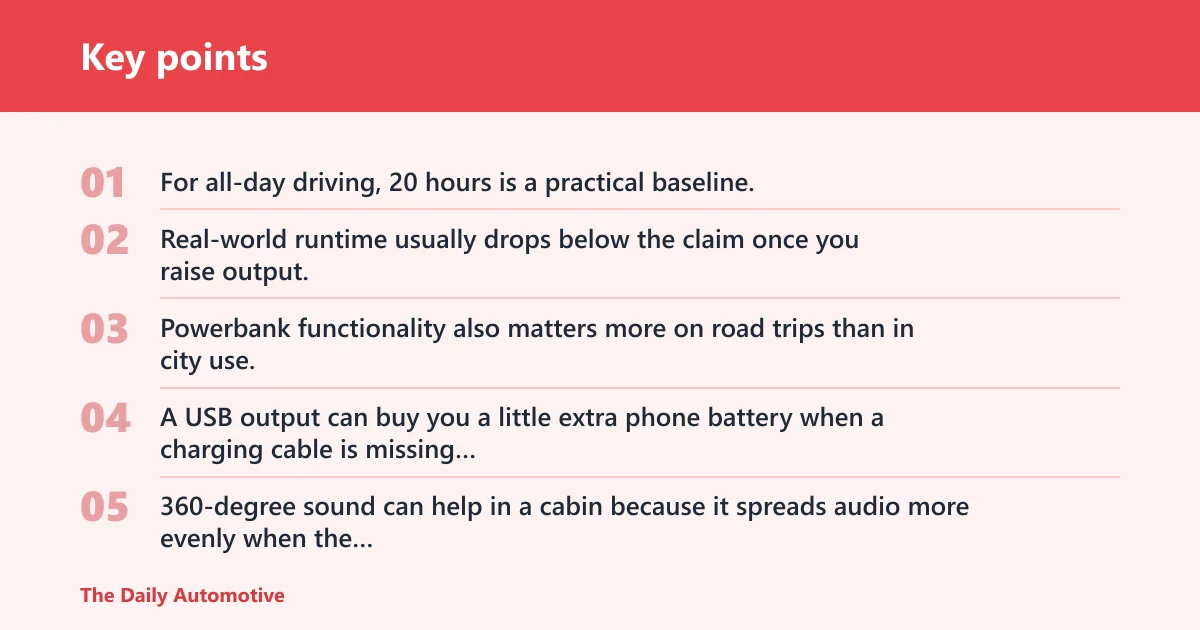
For all-day driving, 20 hours is a practical baseline, and more is better if you keep volume high. Real-world runtime usually drops below the claim once you raise output, stream continuously, or leave the speaker active for long stretches.
Powerbank functionality also matters more on road trips than in city use. A USB output can buy you a little extra phone battery when a charging cable is missing or already in use for navigation.
360-degree sound can help in a cabin because it spreads audio more evenly when the speaker sits in the center console area. That helps passengers hear podcasts and vocals without turning the volume up as aggressively.
Tribit StormBox Blast: best for battery life
The Tribit StormBox Blast is the strongest long-trip pick here because it is listed at 30H Playtime and 90W loud sound. That makes it the best fit for drivers who want extended runtime, more output, and a speaker that can handle larger cabins or louder road conditions.
It also includes Bluetooth 5.3, which can help connection stability and pairing speed compared with older radios, especially when you reconnect after short stops. The IPX7 waterproof rating adds useful spill and splash protection for cabin use.
The drawback is size. A speaker built for big sound is harder to store in a small sedan and is unlikely to fit neatly in a cupholder. It is a better cargo-area or seatback speaker than a console buddy.
If your road trips are long and your cabin is medium to large, this is the most convincing battery-first choice of the three. Its battery claim is also the most generous in this group, even before you account for real-world derating at higher volume.
Is a portable Bluetooth speaker good for hands-free calls in a car?
Yes, but only if the speaker is built for voice pickup, not just music. A portable Bluetooth speaker can work for hands-free calls when it supports HFP, has decent microphone placement, and handles echo well enough to stay clear over tire noise, wind noise, and HVAC fan noise.
The limits show up fast in a noisy cabin. If the microphone is too far from your mouth, or if the speaker sits near a window or air vent, the other person may hear more road noise than voice. That is the main failure mode most roundups ignore.
Echo cancellation matters because a small cabin can reflect sound off glass and hard trim. A speakerphone with better echo control usually keeps your voice more natural and reduces the hollow sound that happens when the microphone hears its own output.
HFP support is a must for call use. Without it, the speaker may still stream audio, but call behavior can be inconsistent or unavailable.
AGPTEK car speakerphone: best for calls
The AGPTEK car speakerphone is the call-first pick because it is shown with Bluetooth 5.3 and is aimed at hands-free use rather than music-first listening. That makes it the best fit for drivers who want a dedicated voice device for commuting, delivery work, or frequent call handling.
For calls, microphone quality and mounting matter more than bass. A speakerphone style unit belongs on the visor, dash, or another fixed point where it can stay aimed at the driver and avoid sliding around during turns.
The drawback is that speakerphones usually give up deeper music playback and wider sound for voice clarity. If you want one device for playlists and road-trip audio, this type is the less flexible choice.
It is the safest recommendation when call reliability matters more than stereo feel. In a busy cabin, that tradeoff is often the right one.
Which one should you buy?
Choose the JBL Charge 5 if you want the best all-round balance for daily driving. It is compact enough for regular use while still offering about 20 hours of battery life and IP67 protection.
Choose the JBL Clip 5 if you want the easiest speaker to store, clip, and carry in a small car. It is the best fit when storage space is tight and your main use is short drives, podcasts, and navigation.
Choose the Tribit StormBox Blast if battery life and loud output matter more than compact size. It is the strongest road-trip pick, especially for SUVs, trucks, and longer drives where 30H Playtime is more useful than a tiny footprint.
The other product listings in this group fill narrower roles. The AGPTEK car speakerphone is the call-first option, while the Anker Soundcore 2 is the budget option with 24-hour playtime and IPX7 protection. If you want one speaker that leans toward general car use without a premium price, that budget model is the value route.
A common mistake is choosing a bass-heavy speaker for a compact car and then struggling to hear navigation prompts over the music. The sound may be fine on a desk, but in a car it can become awkward to store, unstable under braking, and harder to aim for calls.
JBL Charge 5: best for all-round use
The JBL Charge 5 is the best all-round compromise in this set because it is compact enough for daily-driver use while still offering about 20 hours of battery life. Its IP67 waterproof and dustproof rating also makes it easy to live with when spills, dust, and cabin clutter are part of the picture.
This is the pick for drivers who want one speaker to cover commuting and occasional road trips without moving up to a much larger body. Its bold JBL sound and long-excursion driver plus tweeter setup should suit mixed music and spoken audio better than ultra-small clip speakers.
The drawback is that it does not have the marathon runtime of the biggest road-trip option, and it is not a dedicated call device. If hands-free calling is your top priority, the AGPTEK speakerphone is the more targeted tool.
For many drivers, though, this is the safest middle ground. It is easier to carry than the large party-style unit and more capable than the smallest clip speaker when the cabin gets noisy.
Anker Soundcore 2: best budget pick
The Anker Soundcore 2 is the budget pick, and its 24-hour playtime gives it more endurance than many cheap speakers in its class. It also brings 12W stereo sound with BassUp technology, which helps it stand out when you want a low-cost option that is still usable for music and podcasts in a car.
Its IPX7 waterproof rating protects against splashes, and Bluetooth support is a useful bonus for pairing speed and connection stability. For drivers watching spending, that is a very strong spec mix for a sub-$30 speaker.
The drawback is that budget speakers usually make tradeoffs in refinement. Call quality is not the main reason to buy this model, and its bass improvement will not turn it into a large-cabin speaker.
If your goal is a cheap, dependable speaker for everyday driving, this is the one to compare first. It is the value answer, not the luxury answer.
What to look for in a Bluetooth speaker for a car?
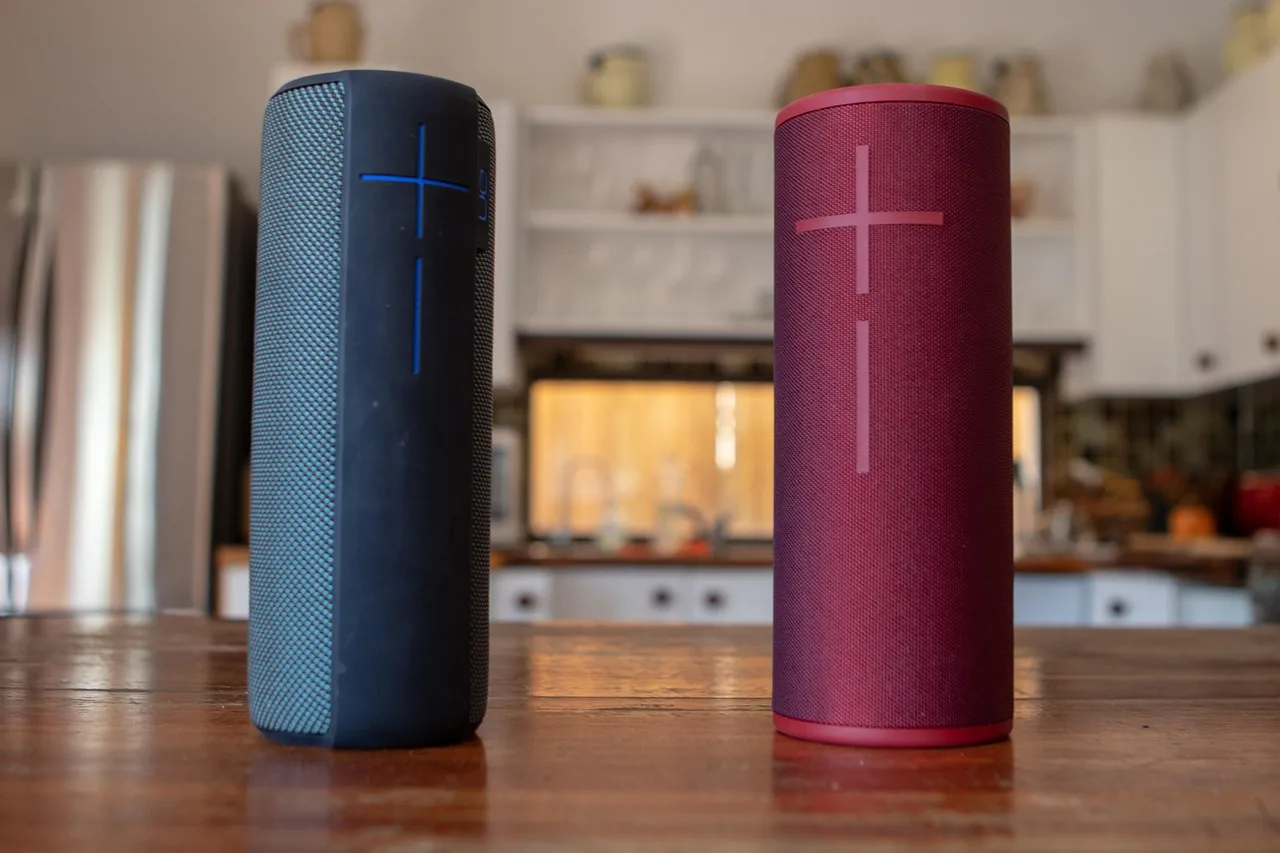
Start with fit, then battery, then call behavior. A speaker that fits your cupholder or clips where you want it is more useful than a louder model that slides around, blocks storage, or has to be wedged into place.
Battery life should be judged in two ways: claimed runtime and expected road use. A speaker listed at 16, 20, or 24 hours may deliver less in real driving, especially at higher volume or with frequent pauses and reconnects.
IP rating matters because cars collect dust, drink spills happen, and a speaker can get tossed into a wet bag or damp console area. IP67 and IP68 are stronger dust-and-water ratings than basic splash protection, and they are especially useful if the speaker will move between car and outside use.
Bluetooth version matters too. Newer radios such as Bluetooth 5.3 or 6.0 can improve connection stability and pairing speed, though the real result still depends on the speaker design and the phone on the other end.
Mounting should match the cabin. A carabiner clip works for grab handles and seatbacks. A visor or vent-friendly shape is better for voice calls. A round base is better for cupholders.
Picture a midsize sedan with one driver, one phone mount, and a full console. In that setup, a cupholder speaker makes sense if you mainly want podcasts and navigation, but a visor-mounted speakerphone is the better choice if you take work calls every morning.
For bass, the better car speaker is usually the one with more cabinet volume and better placement, not just the one with a louder badge number. A larger speaker placed in the center console or on a stable seatback can fill the cabin more evenly, while a tiny clip model may thin out at highway speeds.
A portable Bluetooth speaker can replace a car stereo only in limited cases. It is fine for temporary use, rental cars, older vehicles without audio inputs, or short commutes. It is not a true substitute for an installed stereo, an aux adapter, or an FM transmitter when you want consistent integration, charging, and driver controls.
What is the most durable Bluetooth speaker for car use?
The most durable car-friendly speaker is usually the one with the strongest dust and water rating plus a body shape that is hard to knock over. In this group, the JBL Charge 5 stands out with IP67 dust and water resistance, while the Anker Soundcore 2 and Tribit StormBox Blast both offer splash-friendly ratings.
For daily cabin use, durability is less about surviving a storm and more about surviving spills, dust, and repeated handling. That is why a sealed body and stable shape matter so much.
If you want the toughest overall rating, IP68 is the top figure in this set. If you want a speaker that is also practical in a car, a strong rating has to be paired with a shape that fits the cabin.
Frequently asked questions
What is the best Bluetooth speaker for car use?
The best Bluetooth speaker for car use depends on what you need most. For storage ease, the JBL Clip 5 is the easiest to place and carry. For long trips, the Tribit StormBox Blast is stronger on battery. For calls, the AGPTEK car speakerphone is the clearest fit because it is built around voice use.
Which Bluetooth speaker fits in a cupholder in a car?
The JBL Charge 5 and JBL Clip 5 are the safer fit-oriented choices here, with the Clip 5 being the most compact. A true cupholder speaker should have a stable round base and a body that does not wobble when you brake or turn. Larger party speakers are usually too wide and top-heavy.
What Bluetooth speaker has the longest battery life for car trips?
Among these picks, the Tribit StormBox Blast has the longest listed battery life at 30H Playtime. The Anker Soundcore 2 follows with 24-hour playtime, and the JBL Charge 5 is listed at about 20 hours. Real-world runtime is usually lower than the claim at louder in-car volumes.
What should I look for in a Bluetooth speaker for a car?
Focus on fit, runtime, durability, and call behavior. Cupholder size, clip points, and storage space matter first. Then look at battery life, IP rating, Bluetooth version, and whether the speaker supports hands-free calling. If you take frequent calls, microphone quality should move to the top of the list.
Can you use a Bluetooth speaker instead of a car stereo?
You can, but only as a temporary or simple-use solution. A portable speaker works for short trips, rental cars, or older vehicles without built-in audio inputs. It does not replace the convenience, power integration, and control of a proper stereo, aux adapter, or FM transmitter for everyday use.
Products related to this article
Sponsored / affiliate links. As an Amazon Associate I earn from qualifying purchases. I may earn additional commission from eligible campaigns.