Best Car Safety Features in 2026
The best car safety features in 2026 are standard automatic emergency braking with pedestrian detection, blind-spot monitoring, and well-tuned lane-centering assist; buy AEB first, then BSM, and only pay extra for packages that add rear cross-traffic alert and reliable lane keeping. Skip weak systems, and you can still end up with higher crash risk and paying for tech that nags, misses, or disengages at the wrong time. This guide ranks the features by crash-prevention value, occupant protection, standard availability, package cost, and known failure modes in 2026 vehicles.
Safety priorities for 2026
Crash prevention comes before convenience. AEB and intersection collision avoidance act before impact; blind-spot monitoring and rear cross-traffic alert reduce lane-change and backing risk; occupant-protection gains come from the car structure, airbags, rear-seat crash performance, and restraint tuning. Adaptive cruise control is useful, but it sits below those layers.
That order matters for shoppers because many 2026 vehicles bundle the flashier aids into trims and packages while the strongest protection may already be standard. Newer models add stronger crash structures and more avoidance tech than older ones, but the gap between trims can still be large.
What matters most for families and commuters
Families should start with front AEB, rear-seat crash protection, rear cross-traffic alert, and blind-spot monitoring. Commuters who spend hours in traffic can add adaptive cruise control and lane-centering, but those features should never replace the core crash-avoidance tools.
For a parent loading a child into the second row, rear-seat crash results matter more than a faster lane-change beep. For a daily highway driver, driver-attention warnings and stop-and-go ACC can reduce fatigue, yet they still depend on clear sensors and alert supervision.
Where cost and standard equipment change the decision
Buyers often overpay for packages that add comfort before safety. Standard equipment on a lower trim can be a better value than a high trim with a flashy screen and the same basic driver aids. The key question is simple: does the trim add a meaningful safety feature, or just a nicer version of the one you already get?
One common trap is a low-cost trim that includes AEB but leaves out blind-spot monitoring and rear cross-traffic alert. Another is a premium package that adds automatic crash notification and connected services while the vehicle still lacks a strong rear-seat score. Those are very different buys.
📊 Consumer Reports says the list will be updated throughout the year as new IIHS results arrive. Source: Consumerreports.
Safety prioritization matrix
| Feature | Crash-prevention impact | Occupant-protection impact | Standard availability | Common failure cases | Value for money | Recommendation |
|---|---|---|---|---|---|---|
| Automatic emergency braking | Very high for front crash reduction | Indirect, by reducing impact severity | Often standard on many 2026 models | Low-speed misreads, sensor occlusion, poor weather | Very strong when bundled at no extra cost | Make this the first non-negotiable feature. |
| Blind-spot monitoring | High for lane-change risk | Indirect only | Common on many trims, not all base models | Motorcycles, fast-approaching vehicles, dirty sensors | Strong if included in the base trim | Add it early, especially for multi-lane driving. |
| Rear cross-traffic alert | High in backing maneuvers | Indirect only | Often bundled with blind-spot or parking tech | Limited view in crowded lots, slow alerts, rain and snow buildup | Good when paired with blind-spot monitoring | Worth paying for if you back out of tight spaces. |
| Lane keep assist | Moderate for lane departure reduction | Indirect only | Frequently standard on newer models | Faded lane markings, construction zones, driver overreliance | Useful when included, less so as a paid add-on | Take it, but do not rank it above AEB. |
| Adaptive cruise control | Moderate on long drives and traffic flow | Indirect only | Common, but often trim dependent | Cut-ins, stop-and-go confusion, sensor blockage | Good for frequent commuters, less for city-only driving | Buy for fatigue relief, not for crash prevention alone. |
| Driver-attention warning | Moderate for distraction and drowsiness | Indirect only | Appears in many newer suites | False alerts, sunglasses, camera obstruction | Decent if it comes standard | Helpful on long trips and night driving. |
| Intersection collision avoidance | High in cross-traffic and turning conflicts | Indirect only | Still limited to newer safety suites | Complex intersections, occluded views, late detection | Very good where available at modest cost | Prioritize this if your commute includes busy intersections. |
| Automatic crash notification | None before impact | Moderate after impact through faster response | Often tied to connected-service plans | Subscription expiry, cellular dead zones, delayed response | Mixed if it becomes a recurring fee | Nice to have, but not a reason to overspend. |
| Lane-centering assist | Moderate on controlled roads | Indirect only | Often grouped with ACC | Roadwork, weak lane paint, driver tuning complaints | Good in traffic, less valuable on surface streets | Pay for it only if you drive long highway stretches. |
| Parking assist camera systems | Low to moderate in tight-space maneuvering | Indirect only | Common, but feature depth varies | Dirty lenses, glare, misjudged objects, overtrust | Convenient, not a top safety buy | Useful, but keep it below the core prevention tech. |
Which safety features matter most?
Automatic emergency braking matters most. Blind-spot monitoring and rear cross-traffic alert are next because they catch conflicts the driver may miss during lane changes and reversing. Adaptive cruise control is useful, but it belongs in the comfort-and-fatigue bucket, not the top crash-prevention tier.
Automatic emergency braking first
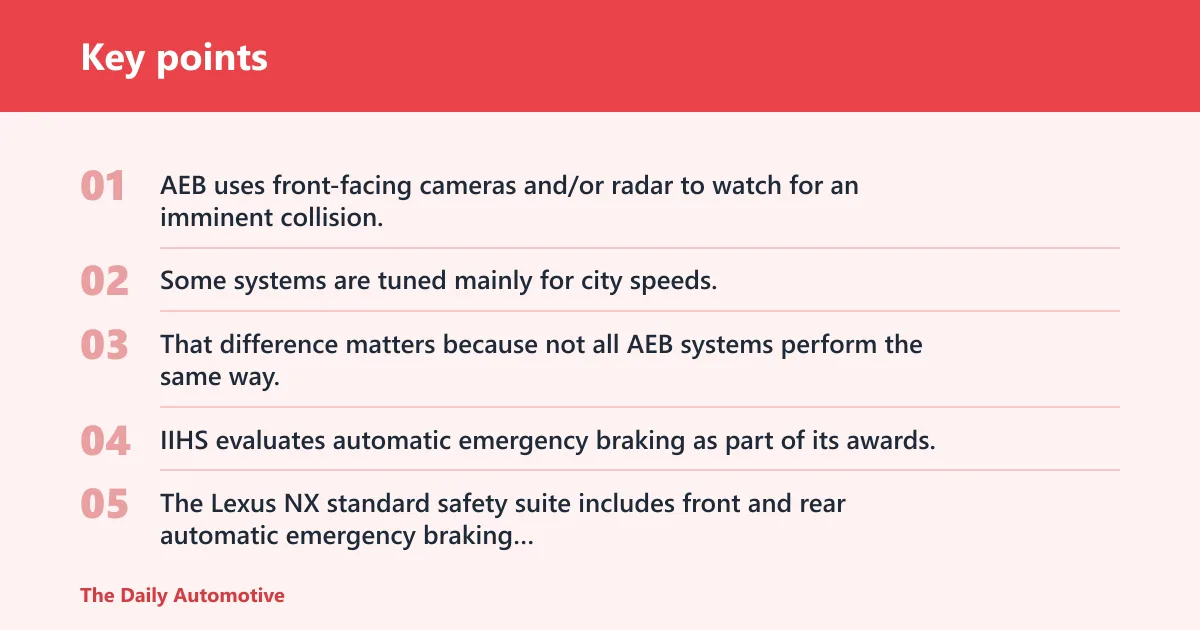
AEB uses front-facing cameras and/or radar to watch for an imminent collision, warn the driver, and brake on behalf of the driver if needed. Some systems are tuned mainly for city speeds, while more advanced versions work at highway speeds too. That difference matters because not all AEB systems perform the same way.
IIHS evaluates automatic emergency braking as part of its awards, and 2026 shoppers should treat standard AEB as the floor, not a bonus. The Lexus NX standard safety suite includes front and rear automatic emergency braking and lane keep assist, while the BMW X3’s standard safety features include front automatic emergency braking, lane keep assist, and blind-spot monitoring. (Motortrend)
Blind-spot monitoring and rear cross-traffic alert next
Blind-spot monitoring uses rear radar sensors, sometimes with camera support, to alert you to vehicles in adjacent lanes. The warning often appears as a light near the exterior mirror, and some systems add a beep if you signal into an occupied lane. Rear cross-traffic alert matters in backing situations, especially in crowded lots.
These systems help most when visibility is poor, but they are not perfect. A motorcycle can be harder to detect, a dirty bumper sensor can mute the alert, and a fast-approaching car can arrive after the system has already cleared the lane. Still, they are worth more than most convenience features.
Adaptive cruise control and driver-attention warnings
Adaptive cruise control uses radar and/or camera modules to alter cruising speed and maintain a set following distance. It can include stop-and-go functionality, which reduces driver fatigue in dense traffic. Driver-attention warning systems monitor steering corrections or eye focus and aim to reduce distracted or drowsy driving.
Those systems help on long, repetitive drives. They do not make the car safer in the same direct way as AEB, and they should not be treated as a substitute for head-up attention. A common mistake is to assume adaptive cruise control will stop a sudden lane-cutting delivery van in bumper-to-bumper traffic; it cannot.
How do the main driver-assistance systems work?
The key systems all rely on sensors, but they solve different problems. AEB and intersection collision avoidance aim to avoid or soften a crash. Blind-spot monitoring and rear cross-traffic alert warn about vehicles you may not see. ACC and driver-attention warnings reduce fatigue and distraction risk over time.
Automatic emergency braking and intersection collision avoidance
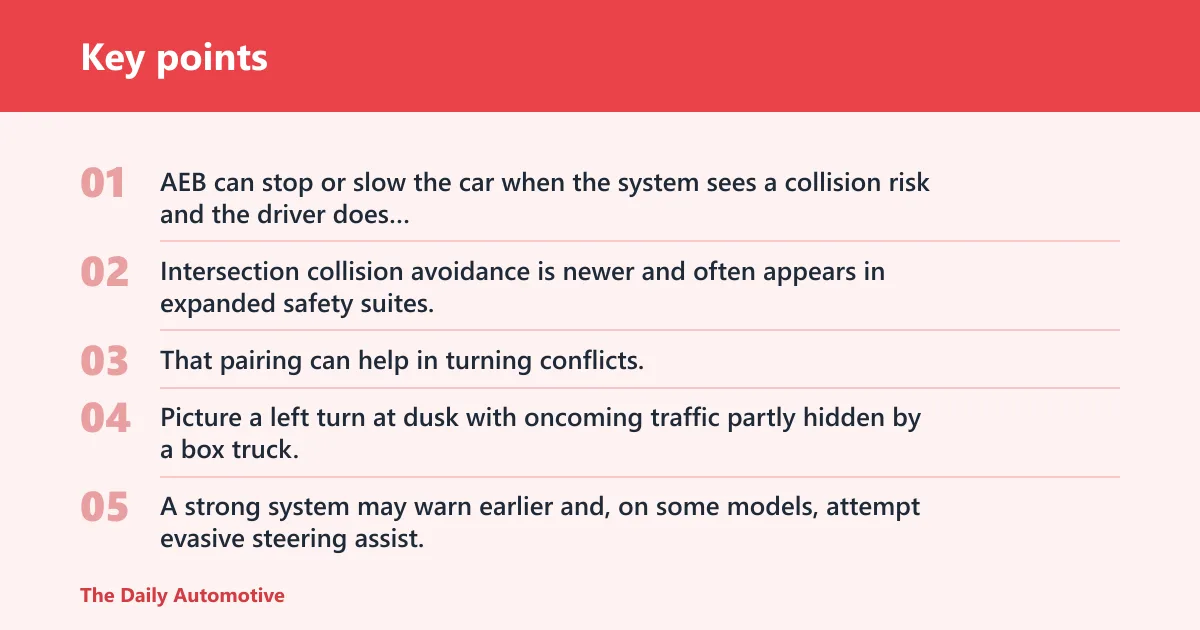
AEB can stop or slow the car when the system sees a collision risk and the driver does not respond in time. Intersection collision avoidance is newer and often appears in expanded safety suites, sometimes with evasive steering assist. That pairing can help in turning conflicts, where front-collision warning alone may not be enough.
Picture a left turn at dusk with oncoming traffic partly hidden by a box truck. A strong system may warn earlier and, on some models, attempt evasive steering assist. A weaker one may only beep late, which is why shoppers should read the trim sheet carefully.
Blind-spot monitoring and rear cross-traffic alert
BSM is most useful in lane changes. Rear cross-traffic alert is most useful when you reverse out of a parking space and another vehicle, cyclist, or pedestrian is crossing behind you. Both features are often bundled with parking or luxury safety tech, so the package contents matter as much as the feature name.
Say your SUV sits between two tall pickups in a store lot. The backup camera may show almost nothing from the sides, but rear cross-traffic alert can warn you before the nose reaches the traffic lane. That is the kind of real-world problem these systems are meant to solve.
Adaptive cruise control and driver-attention warnings: aCC is a distance-control aid
ACC is a distance-control aid, not a collision shield. It can reduce fatigue on commutes and long road trips, and that is why many buyers like it. Driver-attention warnings add another layer by checking for steering patterns or eye focus that suggest distraction or drowsiness.
Both systems are useful when tuned well. Both can fail when the camera view is blocked, lane markings disappear, or the driver leans on automation too hard. They help, but they do not change the basic rule: you still drive the car.
Which ratings should you trust in 2026?
Use NHTSA and IIHS together. iSeeCars ranks safest vehicles using NHTSA and IIHS ratings averaged over the last five model years, which is helpful for spotting patterns over time but is not the same as current-model-year crash performance for a specific 2026 trim. That makes it a useful cross-check, but it should not replace looking at the current trim.
Top safety Pick and Top safety Pick+
Top Safety Pick and Top Safety Pick+ are the key 2026 safety awards from IIHS. The IIHS evaluates automatic emergency braking and headlight systems as part of its awards, so the badge is more than a crash-test trophy. It blends crash protection with crash-avoidance performance.
Consumer Reports says the list will be updated throughout the year as new IIHS results arrive. That matters because a car that qualified early can move when stricter results land later.
Why rear-seat crash tests changed some 2026 outcomes
IIHS rear-seat crash safety evaluations appear to have influenced award outcomes, and some reports say no minivans made the list partly because of those rear-seat results. That is a major clue for family buyers: second-row protection is no longer an afterthought. It can decide the rating.
For shoppers choosing among SUVs, that shift should push attention to rear-seat performance, tether access, and restraint design, not only front crash results. A model can look strong on paper and still miss where families sit most often.
Standard features vs paid packages
More 2026 cars come with core active safety gear standard, but the spread is uneven. AEB and lane keep assist are increasingly common, while blind-spot monitoring, rear cross-traffic alert, and intersection collision avoidance may still sit behind a trim or package wall. Luxury models usually bundle more, but the price step is real.
What is standard on more 2026 cars?
AEB is now common enough that shoppers should expect it on many new models, and many 2026 vehicles also include lane keep assist. The Lexus NX standard safety suite includes front and rear automatic emergency braking and lane keep assist, while the BMW X3 includes front automatic emergency braking, lane keep assist, and blind-spot monitoring.
The Volvo EX90 includes automatic emergency braking, rear and side cross-traffic alert, and blind-spot monitoring. The Genesis GV60 offers blind-spot monitoring, side and rear cross-traffic alert, lane keep assist, and adaptive cruise control. The Audi Q5 has front automatic emergency braking, lane departure warning, and emergency evasive steering assist.
When a trim upgrade is worth it
Buy the upgrade if it adds one of the top-tier features that the base trim lacks, especially blind-spot monitoring or rear cross-traffic alert. It is also worth paying more if the higher trim improves rear-seat safety equipment or gives you a stronger safety suite without forcing you into unrelated luxury extras.
Do not pay extra just because a package adds a bigger screen and a safety menu. If the package does not add a material crash-avoidance feature or a real rear-seat gain, the money is better kept for a better trim on another model.
Subscription paywalls for automatic crash notification and connected services
Automatic crash notification uses sensors in the car to alert first responders after a crash. That can matter if the occupants cannot call for help. The concern is that some connected services expire after a trial, turning a safety feature into a recurring bill.
That is why subscription wording matters. If ACN is tied to paid connected services, ask how long the alerting functions remain active, what happens after the trial, and whether emergency response still works without a monthly plan.
Are safety subscriptions worth paying for?
Sometimes, but only for features that keep doing real work after the purchase. Automatic crash notification can be worth it if the car is used in remote areas or by a driver who wants automatic emergency response. A paid plan for remote lock, map updates, or app perks is a different question.
Automatic crash notification and emergency response
ACN can matter after a severe crash, especially if the driver is unconscious or unable to make a call. If the system is part of a broader emergency-response package that stays active, it has real value. If it is only a short trial, its value drops fast once the fee starts.
Connected services that may expire after a trial
Many connected features look useful at delivery and less useful a year later. Remote alerts, app-based diagnostics, and concierge-style extras can expire. That is not the same as a safety system that actively helps avoid a collision every day.
When a subscription adds real value and when it does not
Pay for a subscription only if it keeps an emergency feature active, improves access to emergency response, or adds a function you will genuinely use often. Do not pay for a monthly plan just to keep a convenience feature alive if the car already has strong AEB, BSM, and rear cross-traffic alert built in.
Frequently asked questions
What is the safest car in 2026?
There is no single safest car for every buyer. A practical shortlist starts with the Volvo EX90, Lexus NX, Genesis GV60, Audi Q5, and BMW X3, then narrows to the exact trim with strong current IIHS and NHTSA results, standard AEB, strong headlights, and good rear-seat crash performance. Because the IIHS list changes as new results arrive, the answer can shift during the year.
Which cars have the best safety features in 2026?
The best-equipped 2026 vehicles tend to bundle front and rear AEB, blind-spot monitoring, rear cross-traffic alert, lane keep assist, and sometimes evasive steering assist. The Volvo EX90, Lexus NX, Genesis GV60, Audi Q5, and BMW X3 are examples of models with strong standard safety content from the supplied data.
What safety features should I look for in a new car?
Start with standard AEB, then blind-spot monitoring, rear cross-traffic alert, and a lane-keeping system that does not feel twitchy. If you drive long distances, add adaptive cruise control and driver-attention warnings. For families, rear-seat crash protection deserves more attention than a premium audio upgrade.
Is automatic emergency braking standard on 2026 cars?
It is increasingly common, but not universal across all trims. Many 2026 vehicles include it standard, and it should be treated as a must-have rather than a premium extra. Check whether the system works only at low speeds or also at highway speeds before you buy.
Does blind-spot monitoring really help avoid crashes?
Yes, especially in lane changes and highway merges. It uses rear sensors or cameras to alert you to vehicles in adjacent lanes, and some systems add a warning when you signal into occupied space. It still misses some hazards, so mirror checks and shoulder checks remain necessary.
Which safety features matter most for families in 2026?
Families should put AEB, rear-seat crash safety, blind-spot monitoring, and rear cross-traffic alert at the top of the list. That mix protects the front of the vehicle, the second row, and the most common low-speed family maneuvers. ACC is useful, but it comes after those priorities.
Products related to this article
Sponsored / affiliate links. As an Amazon Associate I earn from qualifying purchases. I may earn additional commission from eligible campaigns.