Best Car Seat Features for Toddlers
The best car seat features for toddlers are a five-point restraint, easy-to-check installation indicators, strong side-impact protection, recline and head support for naps, and a cover that comes off without a fight. Skip those basics, and you raise the odds of loose installation, poor fit, unsafe sleep positions, and a seat you avoid cleaning. This guide covers the features that matter most for safety, fit, everyday use, and travel.
Quick picks

| Best for | Key features to prioritize | What makes it a smart fit | What to verify before buying |
|---|---|---|---|
| Small cars and 3-across | Slim profile, narrow shell, clear buckle access, seat-belt install option | Leaves more room for doors, passengers, and neighboring seats | Check the seat width and whether the manual says it allows 3-across use in your vehicle |
| Frequent car swaps | LATCH installation, seat-belt installation, no-rethread adjustment, visible tightening path | Reduces setup errors when the seat moves between cars or caregivers | Confirm both install methods are allowed in your vehicle seating positions |
| Frequent naps | Multiple recline positions, strong head support, straps that stay snug at the shoulders | Helps limit head slump and makes rear-facing rides less fussy | Look for recline guidance that changes with installation mode and child size |
| Travel and cleaning | FAA approval, FMVSS 213 or 213B compliance where relevant, machine-washable cover | Makes flights, spills, and quick turnarounds less stressful | Check airline rules and whether the cover removes without disturbing strap routing |
📊 Chicco KeyFit infant seat weight range is 4-22 lbs. Source: Car Seat Ratings & Reviews.
Toddler car seat features
Why the 5-point restraint still matters
A 5-point restraint is the standard toddler restraint because it holds the shoulders, hips, and crotch area in place. It matters most when a child is still too small for a booster and still likely to wiggle. The best versions tighten smoothly and adjust without making the straps hard to position.
That ease matters more than the marketing language. If the restraint pinches, twists, or is awkward to retighten, adults are more likely to leave it loose. A snug fit is one of the simplest ways to cut daily misuse.
How LATCH and seat-belt installation differ
LATCH installation can make setup easier, especially in tight backseats and in cars that see frequent seat swaps. Seat-belt installation still matters because some vehicles, seating positions, or child seat models work better that way. A good toddler seat should support both methods unless the manual says otherwise.
Always follow the vehicle and product manual; never work under a vehicle supported only by a jack, never exceed the vehicle’s rated roof, hitch, tow, or payload limit, keep items out of airbag zones and the driver’s view, and check local laws. For child restraints, the seat and vehicle manuals must both allow the installation method you choose.
Why no-rethread adjustment reduces setup mistakes
A no-rethread adjustment lets you raise the headrest and straps together as a child grows, without taking the straps apart. That reduces the odds of threading errors and makes it easier to keep the shoulder straps near the right height after each growth spurt. It is common on higher-value toddler seats for a reason.
For daily use, the appeal is simple: fewer parts to move, fewer chances to put the straps back wrong, and less resistance to making a needed adjustment. If several caregivers use the seat, that matters even more.
What recline changes in daily use
Recline positions affect more than comfort. They help set the correct angle for rear-facing installation and can keep a sleeping toddler from slumping forward. More recline options also give you some room to balance legroom, head position, and vehicle fit.
Do not confuse recline with extra padding. A reclined seat that fits the manual’s angle guidance is useful. A cushy seat that forces a bad angle is not. When in doubt, the installation angle in the manual wins.
Toddler car seat feature scorecard

| Must-have feature | Why it matters in real use | What to avoid | Best fit by family scenario |
|---|---|---|---|
| 5-point restraint | Improves restraint before booster age and gives a clear buckle point for adults | Straps that are hard to tighten, twist easily, or make the buckle hard to reach | Most toddlers, especially younger rear-facing riders |
| LATCH installation plus seat-belt installation | Helps with easier installs and gives you a backup when moving between vehicles | A seat that is difficult to install correctly unless you use one exact method | Grandparents’ cars, rideshares, and shared family vehicles |
| No-rethread adjustment | Adjusts with the headrest without removing straps, which cuts setup errors as the child grows | Straps that require full rethreading every time height changes | Busy households and fast-growing toddlers |
| Recline positions | Help with sleeping comfort and rear-facing installation angle | Seats with one fixed angle and no clear installation guidance | Nappers and rear-facing toddlers |
| Slim profile / 3-across fit | Helps in compact vehicles and lets multiple seats fit across one row | Bulky shells that block adjacent buckles or door closure | Families with three kids in one row or narrow backseats |
| Rear-facing to forward-facing conversion | Matches growth stages when height and weight limits are reached | A seat that is marketed for longevity but has limits that do not match your child | Families wanting one seat through more than one stage |
| Machine-washable cover | Important for spills and frequent messes, and it improves day-to-day usability | Covers that are difficult to remove or need a deep clean for every spill | Snack-heavy toddlers and commuters |
| FAA approval and FMVSS 213 / 213B compliance where relevant | Useful for travel seats and vests; signals compliance with U.S. child restraint standards | Assuming every toddler seat is flight-friendly or travel-approved | Frequent flyers and occasional caregivers who travel |
| Highback booster mode | Extends seat usefulness for older kids and offers belt-positioning support | Treating booster mode as a toddler requirement instead of a later-stage benefit | Families choosing an all-in-one seat for longer use |
Which features matter most in your car?
Start with the fit problem you actually have, not the feature that sounds most premium. Small cars need a narrow shell and workable buckle access. Three-across setups need a seat that can sit close to others without forcing the belt path or buckle into awkward angles.
Small cars and tight backseats
In a compact vehicle, the seat’s width and shape matter as much as its label. A slim profile can leave room for front-seat movement and for another passenger beside it. Pay attention to whether the seat can be installed with the belt if LATCH anchors sit awkwardly.
Three-across seating
Three-across fit depends on more than raw width. Buckle stalk position, armrest shape, and whether the shell flares near the base can decide whether the row works. A narrow seat with poor buckle access can still be frustrating.
Picture a family with two full-size child seats and one toddler seat in a midsize sedan. If the toddler seat needs a wide base or blocks the buckle for the seat next to it, the whole row becomes harder to use, even if the car seat looks compact in photos.
Frequent rides with grandparents or rideshares
When a seat moves a lot, choose low-drama features: clear belt paths, no-rethread adjustment, and an install method that works in more than one vehicle. A seat that only feels secure in one car creates avoidable mistakes when a different caregiver installs it.
Easy cleaning for messy toddlers
Washability matters because toddler messes are routine, not rare. A machine-washable cover helps after snacks, spills, and motion sickness. Check how the cover comes off and whether the straps still rethread cleanly afterward.
Should I buy a convertible seat or a 3-in-1 seat for my toddler?
A convertible seat is usually the cleaner choice if you want rear-facing to forward-facing conversion without extra clutter. A 3-in-1 seat adds highback booster mode, which can extend usefulness for older kids. The better choice depends on whether you want one long-term seat or a simpler toddler-stage setup.
Rear-facing to forward-facing conversion
Convertible and all-in-one seats matter because they carry a child from rear-facing into forward-facing mode. The right choice is the one whose height and weight limits match your child’s real growth path. Do not buy for the promise of longevity if the strap fit or installation quality is weak.
When highback booster mode adds value
Highback booster mode is useful if you want the same shell to last into the belt-positioning stage. It is not a toddler-only feature, and it should not distract from the toddler years, where strap fit and install quality matter more. Think of it as a future bonus, not the reason to buy.
How to match limits to your child’s size
Check the listed rear-facing and forward-facing limits, then compare them with your child’s current height and weight. If the seat’s usable range is a poor match, the extra modes do little good. A seat that fits now and installs well is better than one with more stages but weaker daily usability.
What makes naps safer and more comfortable?
Recline positions and head support are the main nap features to watch. They help keep the child within the seat’s intended angle and reduce forward head slump. Comfort should support correct positioning, not replace it. If the seat cannot hold a snug fit while the child sleeps, comfort features will not solve the problem.
Recline positions and head support
Multiple recline positions help most for rear-facing toddlers who fall asleep often. A deeper recline can support sleep better, but it still has to meet the manual’s installation angle. Good head support keeps the head from dropping forward without forcing the child into an awkward posture.
What to check for head slump
Watch for a chin-to-chest position or a head that leans far forward during sleep. If the seat angle is too upright, the straps are too loose, or the child has outgrown the best rear-facing fit, the nap position can become sloppy. Fix the fit first, then look at comfort features.
Say your toddler naps often on a 25-minute drive home. A seat with one usable recline setting may keep the head in place in one car but not another. The issue is not the nap itself. It is whether the installation angle and strap fit stay consistent across vehicles.
Comfort features that help without adding confusion
Padding, adjustable headrest height, and easy strap tightening help more than padded extras that are hard to maintain. Cup holders are fine as baseline convenience, but they should not crowd buckle access or interfere with the seat’s width in a tight row.
What certifications and travel features should you check?
For U.S. use, look for child restraint compliance with FMVSS 213, and for travel-related products or restraints, check whether FMVSS 213B applies. FAA approval matters for flights, but not every toddler seat is approved for air travel. The label matters only if it matches your actual use case.
FMVSS 213 and 213B
FMVSS 213 is a standard to look for on child restraint seats sold for roadway use in the U.S. FMVSS 213B is relevant for travel restraints and some portable products. If a product claims compliance, confirm exactly which standard it meets and whether that matches your needs.
FAA approval for flights
FAA approval matters when you plan to use the seat on an airplane. A seat that is fine in a car may still be awkward or unapproved for air travel. Lightweight options can help, but portability only matters if the seat is flight-friendly and fits your child and the aircraft seat.
Machine-washable covers and travel convenience
Travel turns spills into a bigger issue. A machine-washable cover saves time after airport snacks, car-rental rides, or rideshare transfers. If a seat is light enough to carry but hard to clean, it solves only half the problem.
A common first-timer mistake is picking the lightest-looking seat and ignoring the install process. A seat that is easy to carry but hard to tighten or recline correctly can be more frustrating than a heavier one with clearer setup steps.
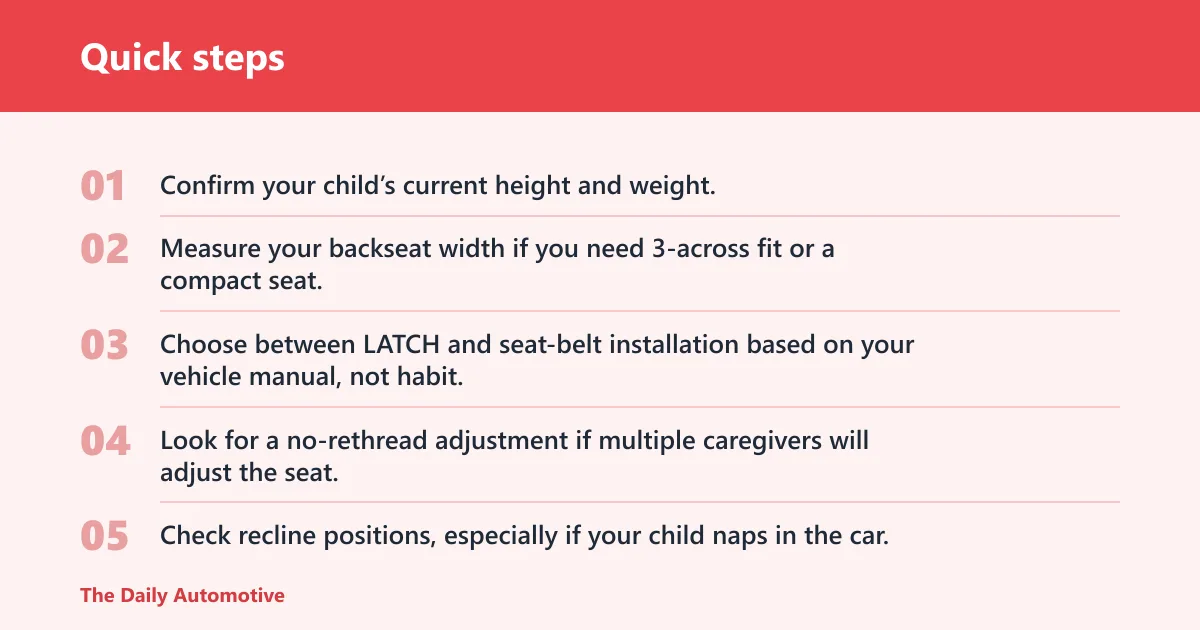
- Confirm your child’s current height and weight, then check the seat’s rear-facing and forward-facing limits.
- Measure your backseat width if you need 3-across fit or a compact seat.
- Choose between LATCH and seat-belt installation based on your vehicle manual, not habit.
- Look for a no-rethread adjustment if multiple caregivers will adjust the seat.
- Check recline positions, especially if your child naps in the car.
- Verify the cover is machine-washable and that removal is manageable.
- For travel, confirm FMVSS 213 / 213B relevance and FAA approval before you buy.
How to choose
If your main problem is misuse, start with a seat that tightens easily, installs clearly, and fits your vehicle without wrestling. For most families, the smartest order is: strap fit first, installation next, then recline and cleanup. Extras only matter after those basics are covered.
If you drive a compact car, prioritize slim fit and buckle access. If the seat will move between cars, prioritize both LATCH and belt installation. If your child naps a lot, prioritize recline and head support. If you travel, prioritize FAA approval and low carry burden. Safety starts with proper installation and the right limits, but the seat that gets used correctly every day is the one that usually wins.
Frequently asked questions
What features should I look for in a toddler car seat?
Start with a five-point restraint, clear installation indicators, and a model that fits your vehicle well. Then check recline, no-rethread adjustment, machine-washable fabric, and whether the seat works with both LATCH and the seat belt. The best feature set is the one that reduces daily mistakes.
What is the difference between an infant car seat and a toddler car seat?
An infant seat usually carries a smaller baby in a rear-facing carrier, while a toddler seat is built around a larger child and usually uses a 5-point restraint. Toddler seats often add broader adjustability, longer use ranges, and conversion options for rear-facing to forward-facing use.
Which toddler car seat fits small cars best?
The best fit for a small car is usually a slim seat with a narrow base, good buckle access, and installation that works without forcing the front seat forward. A compact shell alone is not enough. Check whether the seat’s shape and belt path suit your backseat.
What toddler car seat features make naps safer and more comfortable?
Multiple recline positions and good head support matter most. They help keep a sleepy child from slumping forward and make rear-facing rides more comfortable. The key is still correct angle and snug strap fit. Comfort should support proper position, not replace it.
How important are no-rethread adjustments on toddler car seats?
Very important if the seat will be adjusted often or used by more than one caregiver. A no-rethread adjustment lowers the chance of threading mistakes and makes growth adjustments faster. It is not required, but it is one of the clearest convenience features for daily use.
Products related to this article
Sponsored / affiliate links. As an Amazon Associate I earn from qualifying purchases. I may earn additional commission from eligible campaigns.