225 Slant Six Carburetor Upgrade: What Works, What Doesn’t, and How to Tune It
Your 225 Slant Six stumbles when you crack the throttle from a stoplight. The idle hunts. Fuel smell hangs around the front of the car after a long drive. You have checked for vacuum leaks, replaced the plugs, and set the points twice. The problem is the carburetor. The original 1-barrel was never a performance part. It was built for economy and emissions compliance in 1975, not for how you drive today.
This guide sorts out the real options for a 225 slant six carburetor upgrade. You will learn which carburetors actually fit, what adapters you need, how to handle the throttle linkage and kickdown, and how to tune the final setup. The focus is on the 225 specifically, not generic small-engine advice. You get jet sizes, screw turns, and the order of operations that works on this engine’s uneven firing order.
AFcBa
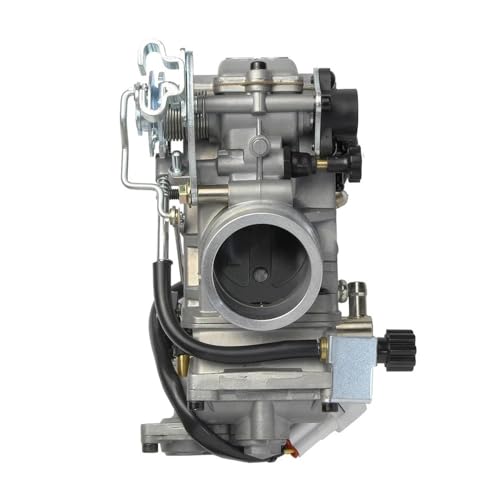
Fit For FCR 39 39MM Motorcycle Carburetor…
- High-Quality Material:Crafted from durable Aluminum alloy, this FCR 39 39MM carburetor ensures longevity and performance.
- Versatile Fitment:Designed for 600 620 625 640 SM SXC models, this carburetor is a perfect match.
- Comprehensive Kit:Includes a Tps, filter, and jet pilot options for optimal tuning and customization.
One option some owners try is a motorcycle-style flat slide carburetor. The AFcBa FCR 39mm flatslide is built for a different application, but it shows how far people go to get sharper throttle response. It is not a bolt-on for a Slant Six, but it demonstrates the appeal of precise air/fuel control. Stick with the dedicated automotive options below for a setup that fits without fabrication.
Why the Stock 225 Slant Six Carburetor Fails
The factory 1-barrel, usually a Holley 1920 or a Carter BBS, has a few design flaws that show up with age. The throttle shaft bores wear out. Air leaks past the shaft and leans out the idle circuit. The idle mixture screws on these carbs are tiny and clog easily. The accelerator pump shot is weak, which causes that off-idle stumble you feel.
There is also the manifold heat problem. The stock intake manifold has a heat riser passage that cooks the base of the carburetor. Over years of heat cycles, the aluminum pot metal warps. The throttle plate no longer seats flush. You adjust the idle speed screw, but the plate is still open too far, exposing the transition slots. That makes the idle mixture screw almost useless.
Replacing the stock unit with a fresh OEM rebuild often just resets the clock. The new gaskets help for a while, but the same design limitations remain. The 1-barrel simply cannot deliver enough air/fuel mixture for any meaningful power increase. The torque curve is flat and the top end falls off hard after 3,500 rpm.
Top Carburetor Upgrade Options for the 225
You have three practical routes. Each has trade-offs in cost, complexity, and result. Here is the honest breakdown.
Direct-Fit 1-Barrel Replacements
This is the least exciting but most reliable option. A remanufactured Holley 1920 or a new Carter replacement bolts directly onto the stock manifold. No adapter plate needed. The throttle linkage hooks up exactly as before. Your kickdown rod for the automatic transmission connects without modification.
The performance gain is minimal. You might recover the power the engine lost when the old carb wore out. If your goal is a dependable daily driver and you want zero headaches, this is the sensible choice. Budget around $150 to $250 for a quality reman unit. Check the casting date and core condition before you buy. Some remans are just cleaned up cores with new gaskets, not properly bushed throttle shafts.
2-Barrel Conversion Kits (Intake & Adapter)
This is where a real 225 slant six carburetor upgrade starts. You swap the intake manifold for a 2-barrel version from a later model, or you use an adapter plate to mount a 2-barrel carb on the stock 1-barrel manifold. The adapter plate route is cheaper but has a height issue. The carb sits higher, which can interfere with the hood on some A-body cars. Check your hood clearance before you commit.
The best carburetor for this conversion is the Weber 32/36 DGV. It is a progressive 2-barrel. The primary venturi is small for good fuel economy, and the secondary opens only when you need it. It has an electric choke, which is a massive improvement over the old water-heated or divorced choke setups. Jetting for the 225 typically lands around 135 primary and 140 secondary with the standard 50 idle jets. That is a starting point, not a final answer. Your altitude and exhaust setup will shift those numbers.
Another solid choice is the Carter BBD, which was factory equipment on many 225s in the late 70s. It is a non-progressive 2-barrel, meaning both barrels open together. It flows more air than the Weber at wide-open throttle but uses more fuel in normal driving. The BBD is a direct bolt-on if you find the correct 2-barrel intake manifold from a 1977-1980 Slant Six.
Intake Manifold and Adapter Plate Compatibility
The stock 1-barrel manifold has a small, single bore. A 2-barrel carb needs a larger opening. You have two choices: find a factory 2-barrel manifold or use an adapter plate.
The factory 2-barrel manifold is the cleaner solution. It flows better, has the correct heat crossover for the choke, and positions the carb at the right height. Look for casting number 4006634 or similar from the late 70s. These are not rare. They show up on forums and eBay for under $100. Verify it is for the 225, not the 198, because the bolt spacing differs.
Adapter plates are a mixed bag. A cheap 1-to-2 barrel adapter can work, but it creates a sharp step in the airflow path. That turbulence hurts low-end torque. If you must use an adapter, get a tapered one that transitions smoothly. Expect to pay $40 to $80 for a decent aluminum unit. The extra height is the real problem. Measure your hood clearance with clay or a ruler before you bolt everything down.
Also check the EGR provisions. Many late-model 2-barrel intakes have an EGR passage that needs to be blocked off if your carb does not support it. Use a block-off plate and a new gasket. A vacuum leak here will cause a lean condition that is hard to diagnose.
Throttle Linkage, Kickdown, and Fuel Line Modifications
This is the part most guides skip, and it is where installs go wrong. The stock throttle cable or rod from the pedal is set up for a specific carburetor arm geometry. A new carb has a different arm length and angle.
For a manual transmission, you just need full throttle travel. Adjust the cable bracket so the carb hits the wide-open stop exactly when the pedal hits the floor. If the cable runs out of travel first, you lose top-end power. If the carb bottoms out first, you stretch the cable and risk breaking it.
For an automatic, the kickdown linkage is more complex. The Slant Six uses a mechanical rod from the throttle linkage to the transmission. This rod controls shift points and downshifts. If it is not adjusted correctly, the transmission shifts early, shudders, or refuses to downshift. You must set the rod length so the transmission lever is at its full travel position when the carb is wide open. Most factory service manuals specify a 1/16-inch gap between the rod end and the lever at idle. Start there and test drive.
The fuel line is another issue. The stock steel line comes up from the fuel pump with a specific bend that fits the stock carb inlet. A Weber or Holley has a different inlet location. You will likely need a short rubber hose and clamps, or a new pre-bent steel line. Use a fuel pressure gauge. The stock mechanical pump puts out 4 to 6 psi, which is fine for most carbs. If you see over 7 psi, you need a regulator. High pressure forces the needle valve open and floods the engine.
Step-by-Step Tuning Guide (Idle, Mixture, and Jetting)
The Slant Six has an uneven firing order. That makes it run rougher at idle than a V8. Do not chase a perfectly smooth idle. You are looking for the smoothest point that still holds a stable rpm.
- Start the engine and bring it to operating temperature. The choke must be fully open.
- Set the base idle speed. Turn the idle speed screw so the engine runs at about 700 rpm in Park (automatic) or 750 rpm in Neutral (manual).
- Adjust the idle mixture screws one at a time. Turn each screw in until the rpm drops, then back it out until the rpm peaks. If the engine has two mixture screws, adjust them equally. Expect to find the best setting between 1.5 and 2.5 turns out from the seat.
- Re-check the idle speed. Adjusting the mixture changes the idle speed. Re-set the speed screw to the target rpm.
- Check the manifold vacuum with a gauge. You want the highest steady reading, usually 17 to 20 inches of mercury at idle. A fluctuating needle indicates a vacuum leak or a sticking valve.
- Test for off-idle stumble. Snap the throttle open quickly. If the engine hesitates, the accelerator pump shot is too weak. Increase the pump shot duration or install a larger pump nozzle.
- If the engine runs lean at cruise, the main jets are too small. You will feel a surging sensation at steady throttle. Go up one jet size at a time.
Jetting for the Weber 32/36 on a 225 with stock exhaust and a clean air filter: primary main jet 135, secondary main jet 140, idle jet 50, air correction jet 170. For a Holley 2-barrel (the 2300 series), start with 58 jets and a 6.5 power valve. For a Carter BBD, start with 51 jets. These are starting points. Altitude above 5,000 feet means dropping one jet size on the mains.
The idle mixture screw on the Weber is on the primary side only. The secondary has no idle circuit. That is normal. Do not try to adjust a screw that is not there.
Common Installation Mistakes and How to Avoid Them
The biggest mistake is skipping the base gasket check. The intake manifold flange is often warped. Lay a straightedge across it. If you see daylight under the straightedge, the manifold needs to be machined flat. A thick gasket will not fix a warped flange. It will just leak again in a month.
Another error is over-tightening the carb mounting nuts. The carb base is thin aluminum. Over-tightening warps the base and causes vacuum leaks. Use a crisscross pattern and torque to the spec for your carb, usually 10 to 12 ft-lbs.
People also forget to plug unused vacuum ports. The stock setup has a ported vacuum line for the distributor advance. Your new carb may not have that port. You need to cap it or connect it to manifold vacuum, depending on the carb. A manifold vacuum advance is often better for drivability on a modified Slant Six. Test both and see which gives you steadier timing at cruise.
Ignoring the fuel filter is a classic mistake. Old fuel tanks have rust and sediment. A new carburetor will be destroyed by that debris. Install a new inline fuel filter before the carb. Change it after the first 500 miles.
Finally, do not forget the throttle return spring. The stock spring may not fit the new linkage. A weak or missing return spring is a safety hazard. The throttle can stick open. Use a dual spring setup for redundancy.
Emissions and Legal Compliance When Upgrading
This is not a fun topic, but it matters. If you live in a state with emissions testing, removing the original carburetor and intake manifold is likely illegal. The 225 was originally certified with the Holley 1920 and the EGR system. Swapping to a Weber or a 2-barrel intake removes the EGR provision.
You have a few paths. Keep the stock parts and swap them back for the test. This is common but tedious. Or find a 2-barrel intake that retains the EGR passage and use a carb with an EGR port. The Carter BBD from a late 70s car is a good choice here because it was factory equipment with EGR.
The PCV system must remain functional. The Slant Six has a large PCV valve on the valve cover. Route it to a manifold vacuum port on the new carb. A plugged PCV system causes oil leaks and sludge buildup.
If your car is exempt from testing, you have more freedom. But still keep the PCV and a functional charcoal canister if you care about fuel smell. The Weber has a vent line that can be routed to the canister.
Check your local laws before you buy parts. A $300 carburetor is a waste of money if you cannot pass inspection.
Budget Breakdown: Rebuild vs. New vs. Performance
Here is the real cost picture. A rebuild kit for the stock Holley 1920 costs about $30 to $50. That includes gaskets, a needle and seat, and an accelerator pump diaphragm. It does not include a new throttle shaft or bushings. If the shaft is worn, add $40 to $80 for a machine shop to install bushings. The total rebuild cost is around $100, but you still have the same restrictive 1-barrel design.
A remanufactured stock carburetor from a reputable supplier runs $150 to $250. It is a direct bolt-on. No other parts needed. This is the cheapest way to get a running car, but it does not improve performance.
A Weber 32/36 DGV kit with the adapter and linkage parts costs $300 to $400. You will also need the intake manifold if you do not have one, adding another $100. Total cost is around $450 to $500. This is the sweet spot for performance per dollar. You get a noticeable mid-range pull and better throttle response.
A Holley 2300 2-barrel is priced similarly, around $350 for a new one. It flows more air than the Weber at the top end, but it is less efficient at part throttle. Expect worse fuel economy on the highway.
Here is the comparison table:
| Option | Cost Range | Power Gain | Complexity | Best For |
|---|---|---|---|---|
| Rebuild Stock 1-Bbl | $30 – $100 | None (restores original) | Low | Budget fix, originality |
| Reman Stock 1-Bbl | $150 – $250 | Minimal | Low | Daily driver, no fuss |
| Weber 32/36 DGV | $300 – $400 (plus intake) | Moderate, better mid-range | Medium | Street performance, economy |
| Holley 2300 2-Bbl | $350 – $450 (plus intake) | High top-end | Medium | Track days, aggressive driving |
| Carter BBD 2-Bbl | $200 – $300 (used) | Moderate | Medium | OEM+ look, EGR compatibility |
Do not forget the hidden costs. A new air cleaner assembly, fuel line, gaskets, and possibly a throttle cable bracket add up. Budget an extra $50 to $100 for incidentals.
Frequently Asked Questions
Will a 2-barrel carburetor ruin my fuel economy on the 225?
Only if you choose a non-progressive carb like the Holley 2300 or Carter BBD and drive with a heavy foot. The Weber 32/36 has a progressive linkage. The secondary barrel stays closed until you open the throttle past about 70 percent. In normal driving, you run on the small primary barrel, which uses less fuel than the stock 1-barrel at the same throttle position. Expect similar or slightly better highway mileage with the Weber.
Do I need to change the distributor when I upgrade the carburetor?
Not necessarily. The stock electronic ignition is fine. The vacuum advance curve is the issue. The stock distributor has a ported vacuum source that changes with throttle position. A new carburetor may have a different port configuration. You can use manifold vacuum instead. The engine will idle with more advance, which helps the Slant Six’s rough idle. If you have points, upgrade to a Pertronix or similar electronic ignition. It eliminates point wear and keeps the timing stable.
Why does my new carburetor still hesitate on acceleration?
Three common causes. The accelerator pump is not adjusted correctly. The pump shot is either too weak or delivered too late. Second, the ignition timing is too retarded. Set the base timing to 10 degrees BTDC and re-check. Third, the main jets are too lean. A lean condition at the transition from idle to main circuit causes a stumble. Go up one jet size on the primary main jet and test again.
Can I use a 4-barrel carburetor on a 225 Slant Six?
You can, but you will not like the result. The 225 does not flow enough air at low rpm to keep a 4-barrel’s primary venturis happy. The engine will feel soggy and unresponsive below 3,000 rpm. The intake manifold needed for a 4-barrel is rare and expensive. The torque curve will be worse than the stock 1-barrel in daily driving. Skip it.
Is the 225 Slant Six carburetor upgrade worth the cost on a low-mileage engine?
Yes, if you drive the car regularly. The stock 1-barrel is the single biggest restriction in the intake system. A Weber 32/36 with a 2-barrel intake manifold wakes up the engine noticeably. The throttle response is sharper, the engine pulls harder through the mid-range, and the electric choke improves cold starts. It is the best single upgrade for the money on a stock 225.
Final Verdict: Best Carburetor for Your Driving Style
Match the carburetor to how you actually drive. If the car is a weekend cruiser and you care about originality, rebuild the stock Holley 1920. It is cheap and honest. If you drive the car daily and want reliability, a remanufactured stock 1-barrel is the low-stress choice.
If you want the best all-around performance and are willing to spend a Saturday on the install, the Weber 32/36 DGV is the answer. It is the most forgiving to tune, offers real power gains, and does not punish you at the pump. Pair it with a factory 2-barrel intake manifold and take your time on the throttle linkage.
For the budget-minded, a used Carter BBD from a late-70s donor car is a great option if you can find one in decent shape. It is a direct fit on the correct manifold and has a robust design.
- The stock 1-barrel is the bottleneck. Replacing it is the highest-impact upgrade for a 225.
- A Weber 32/36 DGV offers the best balance of power, economy, and tunability.
- Factory 2-barrel intakes are cheap and better than adapter plates. Look for casting 4006634.
- Automatic transmission kickdown linkage must be re-set. A 1/16-inch gap at idle is the starting spec.
- Start with 135/140 main jets on the Weber and adjust from there. Altitude changes jetting.
- Cap unused vacuum ports and keep the PCV system functional to avoid oil leaks.
- Check your local emissions laws before buying parts. A swap may not be legal in your county.
Take your time with the tuning. A carburetor upgrade is not a bolt-on-and-forget deal. Spend an hour with a vacuum gauge and a timing light. The result is an engine that starts cleanly, idles steadily, and pulls hard when you ask it to. That is worth the effort.
Products related to this article
Sponsored / affiliate links. As an Amazon Associate I earn from qualifying purchases. I may earn additional commission from eligible campaigns.