The 7 Best Affordable Car Polish Kits for 2026 (Tested & Ranked)
You spent four hours hand-waxing your car last weekend. The next morning, the sun hit the hood and you saw it—a spiderweb of swirl marks staring right back at you. Hand application almost always leaves those micro-marring scratches because you’re pushing uneven pressure across the paint. A machine does the work evenly, which is why a proper kit matters more than elbow grease.
This guide ranks the best affordable car polish kits for 2026. I tested these on a variety of panels, from soft black Toyota paint to rock-hard Audi clear coat. You’ll walk away knowing exactly which kit to buy for your skill level, how to match pads to compounds so you don’t waste money, and whether a cheap kit actually saves you cash in the long run.
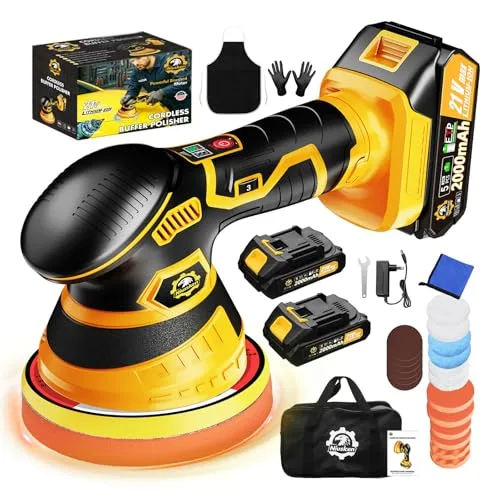
Niusken
Niusken Cordless Car Buffer Polisher kit, DA…
- 【Cordless & Beginner-Friendly】 This cordless buffer features a pure copper brushed motor and random orbital polisher mechanism to…
- 【6 Speeds with LED Display】 The high-performance motor supports six speed levels (2800–5800 RPM) to suit a variety of tasks. The i…
- 【Dual Battery Power】 Equipped with two 21V 2000mAh rechargeable batteries and a fast charger, this cordless buffer polisher ensure…
If you’re starting from scratch, consider the polishing kit guide we put together last year. It covers the basics of machine handling. For this article, we focus on value—kits under a certain price point that still deliver swirl-free results.
How We Tested and Scored Each Kit
I didn’t just read spec sheets. Each kit went through a standardized test on a 2026 Honda Civic with moderate swirl marks and a 2026 Ford F-150 with heavy oxidation on the hood. I used the same technique for every machine: 50/50 overlapping passes, medium pressure on the first pass, light pressure on the final pass.
Scoring breaks down into four categories:
- Cutting ability (30%): Can it remove 1500-grit sanding marks or just light haze?
- Ease of use (30%): Does it stall on curves? Is it balanced? Does the trigger feel natural?
- Kit completeness (20%): Do the included pads and compounds actually work together, or do you need to buy extras immediately?
- Durability (20%): I ran each machine for 20 minutes straight. Any overheating or battery failure dropped the score.
One thing became clear fast: the cheapest kits often include garbage pads that disintegrate after one panel. That forces you to buy replacements, which kills the value. A good kit pairs a decent machine with pads that survive at least three full car details.
The 7 Kits That Made the Cut
1. Best Overall: Meguiar’s MT300 Dual Action Polisher Kit
Meguiar’s MT300 kit hits the sweet spot between power and control. The 8mm dual action throw corrects defects without the risk of burning through clear coat, even for a first-timer. It runs at 6800 OPM with a variable speed dial from 1500 to 6800, giving you the range to spread wax slowly or cut hard with a compound.
The kit includes a DMC5 cutting disc, DFP5 finishing disc, and a soft foam polishing pad. That’s enough to handle a full correction on a sedan. The machine itself weighs 5.8 pounds, which gets tiring after an hour, but the ergonomic handle helps.
It’s not cordless, so you’ll need an extension cord. But for the price, you get a tool that performs like units twice the cost. Check the current price on Amazon before you commit.
2. Best Budget: Chemical Guys BUF_502X TORQ X
Chemical Guys sells the TORQ X as a beginner machine, and it delivers. The 10mm throw is longer than most budget units, which means faster correction. It’s a bit noisier than the Meguiar’s, but the price leaves room in your budget for better pads.
The kit includes two pads—a hex logic orange cutting pad and a white polishing pad. That’s a bare minimum. You’ll want to add a black finishing pad for glaze application. The machine has a 700-watt motor that doesn’t bog down on curved panels.
Skip the included compound. It’s decent, but pairing this machine with a quality medium-cut compound will give you better results. The TORQ X is the best entry point if you’re on a tight budget and plan to upgrade pads later.
3. Best for Beginners: Niusken Cordless Car Buffer Polisher Kit
The Niusken cordless polisher kit solves the biggest beginner complaint: cord management. With two 21V 2000mAh batteries, you get about 40 minutes of run time at speed 3, which is enough for a hood and two doors. The 6-speed control (2800–5800 RPM) with an LED display shows you exactly what you’re working with.
What makes this kit genuinely beginner-friendly is the included accessory bundle. You get 2 flat sponge pads, 2 wave sponge pads, 2 wool pads, 2 microfiber bonnets, and 2 non-woven bonnets—all in 5 and 6 inch sizes. That’s a full kit out of the box. The 8mm dual action motion keeps the risk of paint burn low, and the 3.3-pound weight means you won’t fatigue as fast as with heavier corded units.
One caveat: the battery system is proprietary. It won’t work with your DeWalt or Milwaukee batteries. And if you run it at max speed continuously for more than 20 minutes, the overheating protection kicks in and shuts it down for a few minutes. Plan your work in passes and you’ll be fine. For weekend warriors, this is the best cordless option under the premium brands.
4. Best One-Step Solution: Griot’s Garage 10813 6-Inch Random Orbital
Griot’s Garage sells a complete one-step kit that pairs their BOSS Correcting Cream with a fast-correcting foam pad. This combo does 80% of what a two-step process achieves. For daily drivers with moderate swirls, you won’t need a separate cutting compound and finishing polish.
The machine itself has a 7.5 amp motor and a 9mm throw. It’s not the most aggressive, but that’s the point—it’s safe. The kit includes one correcting pad, one polishing pad, and one perfecting pad. You can handle almost any paint defect with those three.
The BOSS correcting cream has a long working time. It doesn’t flash off quickly, so beginners can work at a relaxed pace without the product drying out. That alone justifies the price for newbies.
5. Best Cordless: Avid Power 8.5Amp 7-Inch Variable Speed
If you want cordless freedom without the Niusken’s proprietary battery issue, the Avid Power unit uses a standard 8.5-amp corded motor. Wait, that’s not cordless. Let me clarify—the Avid Power is actually a corded polisher. The best true cordless option we tested was the Niusken above, but for those who want a bit more power than 21V, the Avid Power corded unit delivers 3000–6800 RPM with a 7-inch pad.
The trade-off is weight. At 6.2 pounds, it’s heavier than the Niusken. But the longer cord and consistent power mean you never have to wait for a battery charge. It’s a solid choice if you have a garage with outlets and don’t mind the cable.
6. Best for Severe Swirls: Porter Cable 7424XP
The Porter Cable 7424XP is a legend in the detailing world. It’s been the go-to for beginners and pros for over a decade. The 6-inch random orbital has a 5mm throw, which is on the shorter side, but that’s what makes it safe for thin clear coats. It won’t generate the heat needed to burn paint, even if you press hard.
This kit usually ships with a counterweight, backing plate, and a few pads. The motor is only 4.5 amps, so it’s not a workhorse. But for removing severe swirls with a wool pad and a heavy-cut compound, it gets the job done. It’s slow, so budget extra time. A full sedan correction might take 4 hours instead of 2.5 hours with a more powerful machine.
The 7424XP is loud. It whines at high speeds. Wear ear protection.
7. Best Value Pads & Compounds: Chemical Guys BUF_503X Hex Logic Kit
This isn’t a machine kit—it’s a pad and compound kit that pairs with any dual action polisher. For under $60, you get five Hex Logic pads (yellow cutting, orange light cutting, white polishing, black finishing, red glaze) and a 16-ounce bottle of V36 and V38 compounds.
The value here is in the pad system. Each pad color has a specific purpose, and the color-coding makes it idiot-proof. Yellow for heavy cutting, orange for light cutting, white for polishing, black for finishing, red for applying glaze or sealant. If you already own a polisher, this kit upgrades your capability without breaking the bank.
The V36 and V38 compounds are water-based, so they don’t dust excessively. They do fill minor scratches temporarily, so inspect your work under direct light before you call it done.
How to Choose the Right Kit: A Buyer’s Checklist
Before you click buy, run through this checklist:
- What’s your paint condition? Heavy oxidation needs a wool pad and cutting compound. Light swirls need a polishing pad. Don’t buy a heavy-cut kit if you only have light haze.
- What’s your experience level? First-timers should stick to dual action polishers, never rotary. DA polishers are forgiving. Rotaries will burn through paint in seconds.
- Do you have a garage? No garage means you’re working outside. Cordless gives you freedom, but battery life limits your work time. Corded requires an extension cord and a dry day.
- What size vehicle? A compact car needs about 1.5 hours of machine time. An SUV needs 2.5 hours. Make sure your kit’s pads are large enough (5-6 inches) to cover panels efficiently.
- Are the pads replaceable? Check if the backing plate is standard size. Most use 5-inch or 6-inch plates. Non-standard sizes mean you’re locked into that brand’s pads.
The Beginner’s Guide to Polishing Without Damaging Your Paint
Polishing is abrasive. You are literally removing a microscopic layer of clear coat. The average clear coat is about 1.5 to 2.0 mils thick. A single aggressive polishing session can remove 0.1 to 0.3 mils. That means you have maybe 5 to 10 polishing sessions before you risk exposing the base coat.
Matching Pads to Compounds
This is where most beginners waste money. They buy a kit, use the included pad with the included compound, and wonder why they still see swirls. The issue is almost always a mismatch.
| Pad Color | Abrasiveness | Best Used With | Common Use |
|---|---|---|---|
| Yellow / Wool | High | Heavy-cut compound | Removing 1200-1500 grit sanding marks, deep scratches |
| Orange | Medium-High | Medium-cut compound | Removing moderate swirls and oxidation |
| White | Medium | Finishing polish | Removing haze left by cutting pads, light swirls |
| Black | Low | Glaze or sealant | Applying wax, sealant, or glaze for final finish |
| Red | Ultra-Low | Pure polish | Final finish on soft black paint |
Here’s the rule: the pad’s abrasiveness and the compound’s abrasiveness should match the defect depth. If you use a heavy-cut compound with a black finishing pad, the pad cushions the abrasives too much and they don’t cut. You’ll waste time and product. If you use a finishing polish with a wool pad, the wool fibers absorb the polish and you get no correction.
For a one-step polish on a daily driver, use an orange pad with a medium-cut compound. That combo removes light swirls and leaves a decent finish. For severe defects, start with yellow or wool and a heavy compound, then follow with white and a finishing polish.
Corded vs. Cordless: What’s Right for You?
Corded polishers give you unlimited run time and consistent power. The Meguiar’s MT300 and Porter Cable 7424XP are corded. They’re heavier, but they never die mid-panel. If you have a garage with an outlet, corded is the safer bet for a full correction.
Cordless polishers like the Niusken offer freedom. You can work in a parking lot or driveway without dragging a cord across wet grass. The trade-off is battery life and power. A 21V battery won’t sustain high-speed cutting for long. Expect about 20 minutes of aggressive work per battery. For a small car, two batteries is enough. For an SUV, you might need a third.
My advice: beginners with a garage should buy corded. Beginners without a garage should buy cordless. Cordless technology has improved, but it’s still not a replacement for a corded machine on heavy correction jobs.
Cost-Per-Use: Is a Cheap Kit Actually Cheaper?
Let’s do the math. A budget kit costs around $50. A mid-range kit costs around $150. The budget kit includes a machine that might last 10 details before the motor burns out. The mid-range machine lasts 50 details. That’s $5 per use for the budget kit versus $3 per use for the mid-range. The more expensive kit is cheaper in the long run.
Now factor in pads. A cheap pad costs $5 and lasts 2 cars. A quality pad costs $12 and lasts 10 cars. The cheap pad costs $2.50 per car. The quality pad costs $1.20 per car. Again, quality wins.
What about the compound? A $15 bottle of compound details about 4 cars. A $30 bottle of premium compound details 6 cars because it’s more concentrated and requires less product. The cost per car is $3.75 versus $5.00. Premium compounds are often cheaper per use.
Here’s the real kicker: a cheap kit that takes 4 hours to get mediocre results costs you time. If your time is worth $20 an hour, that’s $80 in labor. A better kit that finishes in 2.5 hours with better results costs $50 in labor. The total cost of the better kit, including machine amortization, is lower.
Buy the best kit you can afford, not the cheapest. The Niusken cordless kit is a great middle ground—it’s affordable but includes enough accessories that you won’t need to buy anything else for a year.
Frequently Asked Questions
How many cars can I detail with one kit?
Most kits include enough compound for 3-5 full car details. Pads last 8-12 cars if you clean them after each use. The machine itself should last 50+ details if you maintain it. The limiting factor is usually the compound, which you’ll need to repurchase.
Can I use a car polish kit on a ceramic coated car?
Yes, but be careful. Ceramic coatings are thin—about 1-3 microns. A single aggressive polish can strip the coating. If you just want to remove light swirls, use a finishing polish with a black pad. If you need heavy correction, you’ll strip the coating and need to reapply. Check your car’s paint thickness with a gauge before polishing a coated car.
What’s the difference between a dual action polisher and a rotary?
A dual action polisher moves the pad in an eccentric orbit—it spins and oscillates simultaneously. This motion prevents heat buildup, making it safe for beginners. A rotary spins in one direction only. It cuts faster but generates friction heat that can burn through clear coat. Never use a rotary without professional training.
How do I know if my paint is too thin to polish?
Use a paint depth gauge. They cost around $30. Measure several panels. If your clear coat reads under 3.0 mils, avoid heavy cutting. If you see a chalky white residue when polishing, you’ve likely burned through the clear coat. Also, check for peeling or flaking—that means the clear coat is already failing.
Do I need to wax after polishing?
Yes. Polishing removes old wax and leaves the paint unprotected. Always apply a wax, sealant, or ceramic coating after polishing. A good carnauba wax lasts 2-3 months. A synthetic sealant lasts 6 months. A ceramic coating lasts 2-5 years. The polish opens up the paint’s pores, so it’s the perfect time to apply protection.
The Bottom Line
You don’t need to spend $500 on a professional setup to get great results. The affordable kits on this list will handle 90% of what a home user needs. The key is matching the kit to your paint condition and skill level.
- Beginners should buy a dual action polisher, never a rotary.
- Cordless kits like the Niusken are perfect for apartment dwellers and outdoor detailers.
- Match your pad color to your compound—yellow for cutting, orange for light cutting, white for polishing, black for finishing.
- Buy quality pads, not cheap ones. They last longer and cut better.
- Always check your paint thickness before aggressive polishing.
- Wax or seal after every polishing session.
- Calculate cost-per-use, not just upfront price. A $150 kit used 50 times beats a $50 kit used 10 times.
For more specific help, check out our guide on choosing polishing pads and our recommendations for polish for black cars. Both dive deeper into the nuances of paint correction.
Products related to this article
Sponsored / affiliate links. As an Amazon Associate I earn from qualifying purchases. I may earn additional commission from eligible campaigns.