Best Capacitor for Car Audio (2026): Based on Specs and Reviews
The best capacitor for car audio is the smallest one that matches the real voltage-sag problem: often 1 farad per 1,000 watts RMS as a starting point, but only after you confirm the alternator, battery, and wiring are not the true bottleneck. Buy the wrong cap and you can waste money, hide a failing charging system, and still get dimming lights or amp protection trips. This guide shows how to diagnose the issue first, then choose farad size, low-ESR design, and protection features for your build stage.
Quick comparison
| Product | Badge | Best for | Price | ||
|---|---|---|---|---|---|
 |
SoundBox SCAP2D, 2.5 Farad Digital Capacitor for Car AudioSoundBox | Our pick | $39.95
Price as of 24 Oct 2026
|
View | |
 |
Pyle 6.0 Farad Digital Power Capacitor – High-PerformancePyle | Also great | 6 Farad · 12-24V · Over-voltage & polarity protection | $63.99
Price as of 24 Oct 2026
|
View |
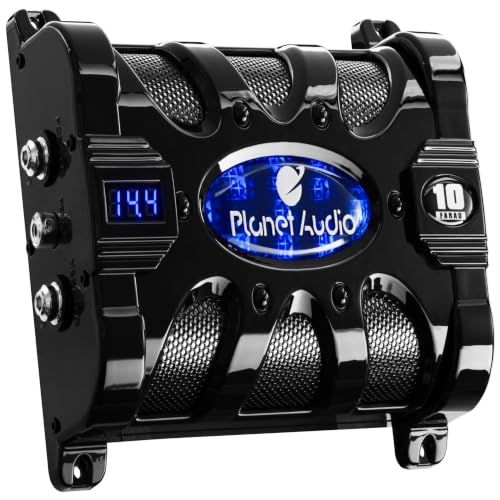 |
Planet Audio PC10F 10 Farad Car Capacitor for EnergyPlanet Audio | Upgrade pick | 10 Farad · ±0.1V accuracy · Full protection suite | $75.12
Price as of 24 Oct 2026
|
View |
 |
YukiHalu 6.0 Farad Digital Power Capacitor for Car Audio,YukiHalu | Also great | 6 Farad · Surge 20VDC · Red LED display | $53.99
Price as of 24 Oct 2026
|
View |
Use this as a short list, not a final sizing formula. The right pick depends on whether the symptom is brief bass-hit sag, repeated idle voltage drop, or a charging-system problem that needs wiring or alternator work first.
CherryPicks analyzed 209 car audio capacitor products and evaluated 30 in its ranking, which is a reminder that the category is broad. The useful differences are usually in capacitance, ESR, voltage rating, display quality, and installation hardware.
How we chose
Capacitance and system fit
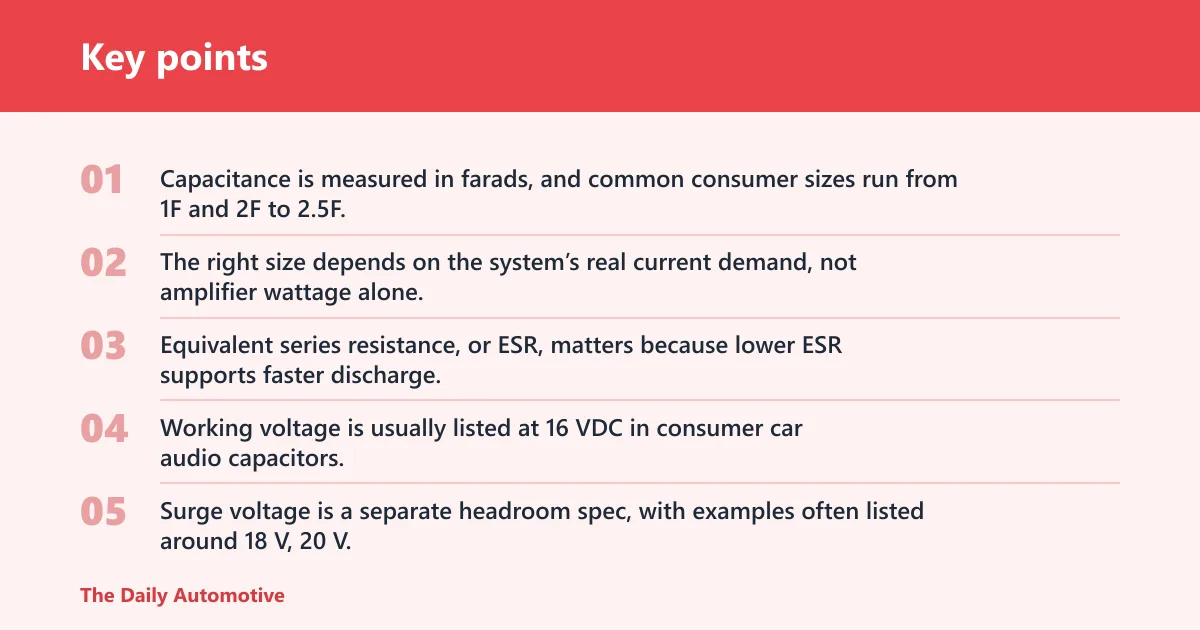
Capacitance is measured in farads, and common consumer sizes run from 1F and 2F to 2.5F, 3.5F, 5F, 10F, 18F, and 50F. The right size depends on the system’s real current demand, not amplifier wattage alone.
ESR, voltage rating, and surge headroom
Equivalent series resistance, or ESR, matters because lower ESR supports faster discharge. Working voltage is usually listed at 16 VDC in consumer car audio capacitors, though some models advertise 10 to 16 VDC or 12 to 24 VDC ranges. Surge voltage is a separate headroom spec, with examples often listed around 18 V, 20 V, and 24 V on 12-volt systems.
Display, protection, and hardware
Digital voltage displays, usually 3-digit LED meters with blue or red readouts, help you monitor system voltage in real time. Protection features such as reverse polarity protection, over-voltage protection, low battery voltage warnings, and audible alarm tones are useful, but they do not turn a weak charging system into a strong one.
Mounting size and form factor
Mounting hardware matters as much as electrical spec sheets. Brackets, post kits, and bolt-down terminals make installation safer and cleaner, while cylindrical, rectangular, and oval or round form factors affect fit under seats, in trunks, and beside amps.
Capacitor decision table
| headlights dim at idle | sub-bass peaks only | multi-amp daily driver | alternator upgraded already | recommended capacitor range | better first upgrade than capacitor | why |
|---|---|---|---|---|---|---|
| Yes | No | No | No | 1F to 2.5F | Big three wiring upgrade, battery check | Idle dimming points to system voltage sag first, not a lack of storage alone. |
| No | Yes | No | No | 1F to 3.5F | Verify ground quality and fuse placement | Brief transients can benefit from local storage when the rest of the charging path is healthy. |
| Yes | Yes | Yes | No | 3.5F to 10F | Big three wiring upgrade, battery, alternator test | High draw needs stronger charging support before capacitor capacity becomes useful. |
| No | Yes | Yes | Yes | 2F to 6F | Check terminal fit and charging procedure | A stable charging system can make a capacitor useful for short bass transients and voltage monitoring. |
 As an Amazon Associate we earn from qualifying purchases. Prices and availability are accurate as of the date shown and are subject to change.
SoundBox SCAP2D: best for compact mid-power builds
The SoundBox SCAP2D is the cleanest fit for buyers who want a modest-capacity capacitor without jumping into a bulky high-farad unit. At 2.5 farads, it sits in the middle of the common consumer range and can suit a single-amp system where the goal is brief voltage support, not charging-system rescue.
Its appeal is straightforward: the rating is easy to place in a smaller build, and 2.5 farads gives more cushion than a 1F entry unit. Based on the listed spec style in the market, this is the type of capacitor that fits a daily driver with short bass peaks and a reasonable wiring setup.
The drawback is equally clear. It is not the right answer for sustained idle sag, multi-amp demand, or a weak alternator, and buyers should not treat 2.5 farads as a fix for undersized power wire or poor grounds.
As an Amazon Associate we earn from qualifying purchases. Prices and availability are accurate as of the date shown and are subject to change.
Pyle 6.0 Farad digital capacitor: best for display and protection
The Pyle 6.0 Farad digital capacitor is for buyers who want a larger reserve and a visible voltage readout without moving into extreme system sizes. Its blue digital display, over-voltage protection, and 12-24V support make it a practical choice for installers who want monitoring plus a mid-to-upper range capacitance figure.
Based on the published details, the 6 farad class makes sense for systems that are beyond a basic single-amp setup but still need a sane fit and a relatively simple installation path. The protection circuits are useful for guarding against wiring mistakes and charging spikes, especially in mixed-use daily drivers.
The drawback is that the display can make the unit feel more capable than it is. A voltage readout is a monitoring feature, not a substitute for battery health, alternator output, or proper cable sizing.
Planet Audio PC10F: best for higher-demand systems
The Planet Audio PC10F is the strongest all-around pick here for buyers who need a larger reserve and a more feature-rich package. Its 10 farad rating, claimed voltage accuracy to ±0.1VCD, and warning tones for reverse polarity, over-voltage, and low battery make it the most complete option in this group for a serious daily driver or a more demanding sub system.
CherryPicks’ broader ranking work included 30 capacitors drawn from 209 products, and this kind of 10 farad class is where buyers tend to look once a smaller unit no longer matches the system’s transients. It is the most plausible choice when the electrical system is healthy but the bass load is large and brief voltage dips still show up.
The drawback is size and expectation management. A 10 farad capacitor can help with short peaks, but it should not be used to excuse weak charging hardware, and it can be more capacitor than a smaller single-amp build really needs.
As an Amazon Associate we earn from qualifying purchases. Prices and availability are accurate as of the date shown and are subject to change.
YukiHalu 6.0 Farad capacitor: best for tight installs
The YukiHalu 6.0 Farad capacitor is the best fit for buyers who want a moderate farad rating, a red digital display, and included mounting brackets without jumping to a large can. The 20V surge rating gives useful headroom above a 12-volt car system, and the automatic shutdown on reverse connection adds a layer of mistake protection.
That mix makes it a sensible option for tight installs where bracketed mounting matters and the system needs more than entry-level storage. A 6 farad unit is also easier to justify than a very large capacitor when the build is still in the middle stage and the charging system is otherwise healthy.
The drawback is that the headline 6 farads can still be oversold if the vehicle has real voltage sag from wiring or alternator limits. It helps with brief dips, not chronic power deficiency.
Which one should you buy?
If the symptom is idle dimming, start with the big three wiring upgrade and a charging-system check. A capacitor can help only after the wiring, battery, and alternator are not the real problem.
If the issue is only short bass peaks, the SoundBox SCAP2D or YukiHalu 6.0 Farad unit is the safer buy. The smaller option fits modest systems; the 6 farad unit gives more reserve if the amp and wiring are already in decent shape.
If you already upgraded the alternator, the Planet Audio PC10F is the strongest choice here. Higher reserve and warning tones make more sense once the electrical side is stable.
If space and mounting are tight, choose the unit with the bracket and terminal layout that fits cleanly. Form factor matters, and a rectangular or compact cylindrical design can be easier to secure than a larger can with awkward post access.
Say your system is a single 800-watt RMS amp and the lights only flicker on heavy kicks. A 1F to 2.5F capacitor may be enough if the battery, ground, and charging path are healthy. If the same car also has slow cranking or weak idle voltage, the capacitor is the wrong first move.
Suppose a two-amp daily driver already has upgraded power wire and a healthy battery, but bass hits still pull voltage down for a second. A 6F to 10F capacitor can make sense there, because the problem is brief peak demand rather than a failed charging system.
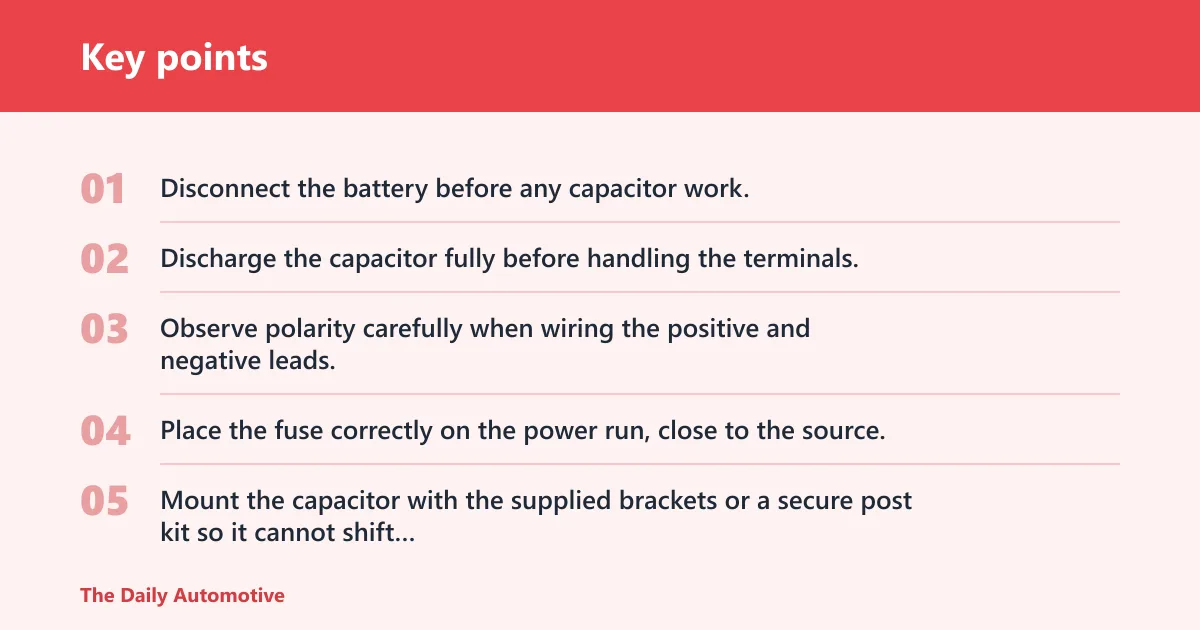
- Disconnect the battery before any capacitor work.
- Discharge the capacitor fully before handling the terminals.
- Observe polarity carefully when wiring the positive and negative leads.
- Place the fuse correctly on the power run, close to the source.
- Mount the capacitor with the supplied brackets or a secure post kit so it cannot shift under braking.
- For very large capacitors, follow the manufacturer’s charging procedure and treat inrush current as a real installation concern.
What size capacitor do I need for my car audio system?
Start with the problem, not the farad number. A capacitor size should match the system’s real current demand and the kind of voltage drop you see, with 1F to 2.5F fitting smaller single-amp systems and 6F to 10F making more sense for healthier, higher-demand setups.
The common 1F per 1,000W RMS shortcut is generally treated as a shopping shortcut, not a strict rule. It fails when the alternator is weak, the battery is tired, or the wiring is undersized, because those faults overpower whatever storage the capacitor can provide.
Do car audio capacitors actually help with bass and voltage drop?
Yes, but only in the narrow case they are built for. A capacitor can help with brief voltage dips during bass hits, and it can cut light flicker when the charging system is otherwise healthy, but it will not fix chronic sag from bad grounds, a weak battery, or a small alternator.
That is why buyers should read capacitor specs as support hardware, not repair hardware. When the system is already close to right, the extra storage can smooth short transients and keep amplifier supply steadier.
Is a 1 farad capacitor enough for a 1000 watt amp?
Sometimes, but not by wattage alone. A 1F capacitor can be a reasonable starting point for a 1,000W RMS amp if the charging system is healthy and the problem is only brief peak demand, but it is not a universal sizing rule.
If the vehicle already shows idle dimming or repeated voltage drop, a 1F cap may be too small to matter. In that case, the better first move is wiring, battery, and alternator diagnosis.
Should I choose a digital capacitor or a basic one?
Choose digital if you want live voltage monitoring and easier troubleshooting. A 3-digit LED meter, especially in blue or red, makes it simpler to see whether voltage is dipping during bass hits, while a basic capacitor is fine if you only want storage and the install is simple.
The display is not a performance upgrade by itself. It is useful because it gives you data, and protection features such as reverse polarity, over-voltage protection, or low battery warnings add practical safety.
What features matter most in a car audio capacitor?
The most important features are the ones that match the job: proper capacitance, low ESR, the right working voltage, and secure mounting hardware. After that, look for useful monitoring and protection rather than flashy extras that do not change how the capacitor behaves under load.
Low ESR matters most in higher-demand builds because it supports faster discharge. For a daily driver, a 16 VDC rating with a sensible surge headroom such as 18 V, 20 V, or 24 V is a better sign than a giant farad number alone.
Can a capacitor fix headlights dimming on bass hits?
It can help if the dimming happens only on short bass peaks and the rest of the electrical system is healthy. It cannot fix lights that dim because the alternator is weak, the battery is worn out, or the ground and power wiring are undersized.
A common first-timer mistake is buying a bigger capacitor when the correct fix is the big three wiring upgrade. If the voltage falls at idle, correct the charging path first and use the capacitor only as support.
How do I install a car audio capacitor safely?
Install safety starts with discharge, polarity, fuse placement, and secure mounting. A capacitor stores energy, so you should treat it like an active electrical component during the entire install, especially if the unit has a large farad rating or a high surge spec.
Use the supplied brackets, post kit, or bolt-down terminals where appropriate, and do not assume every terminal fits every cable size. For larger units, follow the charging procedure in the manual before connecting the system fully.
Products related to this article
Sponsored / affiliate links. As an Amazon Associate I earn from qualifying purchases. I may earn additional commission from eligible campaigns.