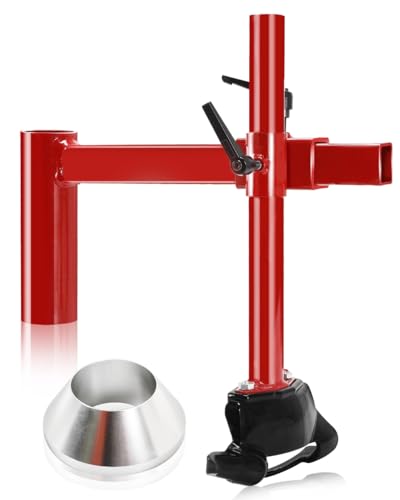
2 Best Car Tire Changers in 2026
For most buyers, the two best tire changers are a manual budget model for home garages and a powered changer with a helper arm for low-profile and run-flat tires. Pick the wrong one, and you waste money, slow every swap, and risk bead-seat or wheel damage. This guide compares the two by tire type, floor space, air and electric needs, and price.
Powered vs manual tire changer


The trade-off is simple: speed and tire coverage versus lower-cost simplicity. A powered changer with a 2.0 HP motor, bead blaster, and balancing support handles tougher passenger-car and light-truck work faster; a manual changer costs less, needs less setup, and suits small wheels and occasional home use.
The powered pick here is the Weize combo with a 2.0 HP tire changer and 250W balancer. The manual pick is a budget-style manual changer such as the Montary unit listed with a 4″ to 21″ range. Those two cover the widest split in buyer needs: one for mixed service, one for basic garage work.
Tire changer decision matrix
| Criterion | Weize powered combo | Montary manual changer |
|---|---|---|
| Wheel range | Clamping data is listed at 10″–20″ outside and 12″–22″ inside on the standalone Weize changer; the combo is the better choice when you need powered service for passenger cars and light trucks. | Listed at 4″ to 21″ by BeginsWithN, with the practical sweet spot in smaller wheels and simpler home-garage work. |
| Motor power | 2.0 HP tire changer motor, with 110V compatibility on related models; better for quicker mount/demount work on heavier tires. | No motor. Lower purchase cost, but every step depends on manual effort. |
| Bead-seating method | Air-assisted bead seating with a bead blaster listed at 8–10 bar, or 120–145 psi. | No built-in bead blaster. You rely on manual bead-seating methods and more patience with stubborn beads. |
| Assist arms | Best fit for a powered setup with helper-arm support; that is the point for low-profile and run-flat work, where rollback control matters. | No assist arms. Good for basic tires, weaker for stiff sidewalls and low-profile assemblies. |
| Footprint | Needs dedicated floor space, compressor access, and power. | Smaller setup burden. Easier to store or move, especially if the garage is tight. |
| Setup needs | Electrical supply, air supply, and more room for the balancer make total ownership cost higher. | No compressor required and no powered balancer to wire in. |
| Tire types handled | Better for passenger cars, SUVs, and light trucks; strongest choice for low-profile and run-flat frustration. | Better for small tires, basic passenger-car work, and special light-duty use such as small wheels or motorcycle-adjacent applications where the size range fits. |
| Who should buy each | Small shops, mobile-to-fixed hybrid setups, and home garages that service mixed modern tires. | Budget home users who want a low-risk, low-cost path and do not need frequent tough sidewall work. |
Best for: The powered Weize combo is best for mixed passenger-car and light-truck service, especially when low-profile or run-flat tires show up often. Do not buy if: you have no air compressor, little floor space, or only change a few basic tires a year.
Best for: The Montary manual changer is best for a budget home garage, small wheels, and occasional tire swaps. Do not buy if: you need fast bead seating, helper-arm support, or regular run-flat work.
How the 2.0 HP changer compares
A 2.0 HP tire changer motor is the right starting point for passenger cars and light trucks because it gives the machine enough muscle to mount and demount tires faster without making the setup feel weak. CherryPicks also lists a Senhontal unit at 2.0 hp with a 110V, 60Hz, 1Ph supply, which matters for garages that want standard household-compatible power.
Motor power and 110V setup
Two horsepower does not make every tire easy, but it does cut down the slow, repeated fighting that happens with stiff beads and heavier assemblies. For a garage that already has 110V power, that matters more than a flashy spec sheet, because the machine can actually be plugged in and used without a special electrical project.
For many home garages, 2.0 HP is often treated as a practical floor for powered tire work. It is not a luxury figure; it is what keeps the tool from feeling strained on wider passenger tires and many light-truck jobs.
Clamp range and wheel fit
Clamp range is not the same thing as every wheel you can touch. The standalone Weize model clamps 10″–20″ outside and 12″–22″ inside, while CherryPicks lists the BILT HARD combo at 10″ to 24″ rims. That spread shows the real issue: outside clamp and inside clamp values can differ, and actual wheel width still has to fit the machine safely.
If you see a claim like 10″ to 24″, check whether that is rim diameter, not wheel width. A wider wheel or an awkward offset can still create clearance problems even when the diameter fits on paper.
Bead blaster and assist arms
The Weize combo’s bead blaster runs at 8–10 bar, listed as 120–145 psi, and that matters for stubborn beads that refuse to seat cleanly. Without that air-assisted burst, you may need more manual coaxing, more lubricant, or repeated inflation attempts.
Helper arms matter for a different reason. Single-arm help can steady a difficult mounting point; dual helper arms are better when low-profile and run-flat tires want to roll back off the rim. That rollback is where damage and wasted time show up first.
Say your garage mostly sees 225/40R18 and 245/45R18 tires. A powered changer with helper-arm support and a bead blaster will make those jobs far less frustrating than a plain machine with no helper gear.
Wheel balancer integration
The Weize combo pairs the changer with a 250W balancer, and that is more useful than it sounds. The balancer includes an auto-measuring ruler, supports dynamic and static balancing, and is listed below 70 dB, which keeps shop noise down compared with louder improvised setups.
If you want one purchase that handles mounting and balancing, this combo is the cleaner path. It costs more up front, but it also avoids a second round of setup later.
Best for: The 2.0 HP powered changer is best for mixed tire work, light trucks, and buyers who want faster mount/demount speed with real bead-seating help. Do not buy if: your garage cannot support 110V power, air tools, and enough floor space for the machine and balancer.
How the manual changer compares
A manual tire changer is the budget-friendly option for smaller wheels, lower tire volume, and garages that do not want a compressor or powered machine. One listing also gives manual coverage from about 4″ to 21″ on one unit, and also gives other manual coverage in ranges such as about 4″ to 16.5″ and 8″ to 16″ for smaller-duty use cases.
No-compressor setup and portability
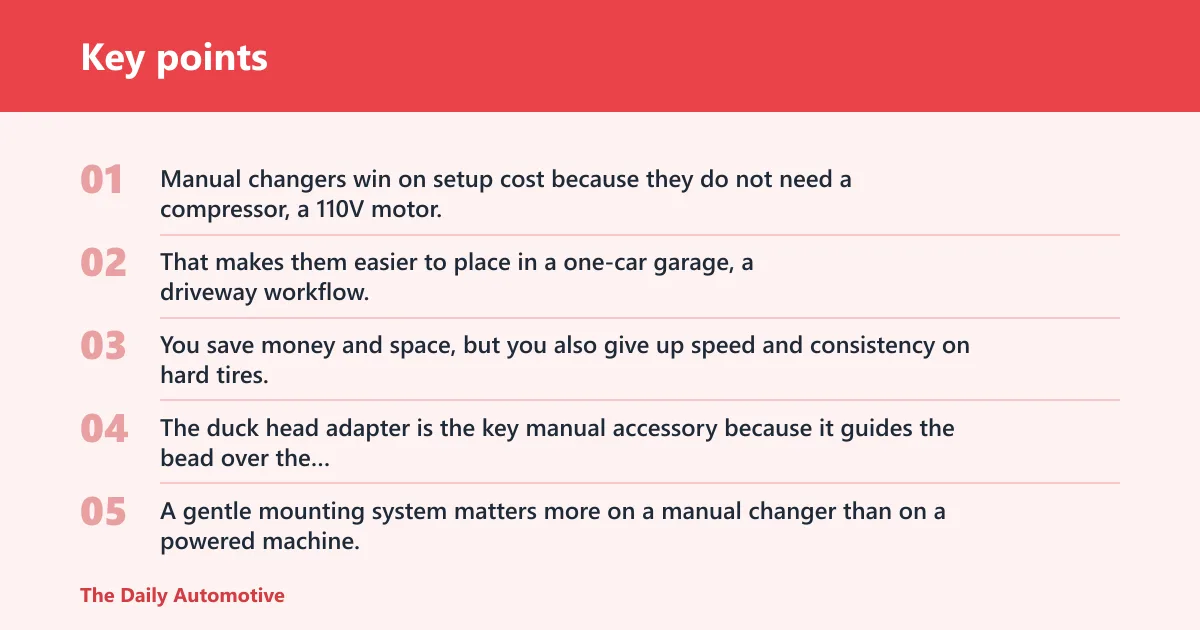
Manual changers win on setup cost because they do not need a compressor, a 110V motor, or a balancer tied to the same station. That makes them easier to place in a one-car garage, a driveway workflow, or a storage corner where a powered machine would be excessive.
The trade-off is physical effort. You save money and space, but you also give up speed and consistency on hard tires.
Duck head adapter and rim protection
The duck head adapter is the key manual accessory because it guides the bead over the rim without the rough contact that scratches alloy wheels. A gentle mounting system matters more on a manual changer than on a powered machine, because the operator is doing more of the work by hand.
Protective tools matter too. Plastic rim guards, proper lubrication, and careful force control reduce the risk of marring the wheel lip.
Small tire compatibility and limits
Manual changers are at their best with small tires and simpler assemblies. That includes many compact passenger-car wheels and some special-use small tires, but not every modern wheel and not every stiff sidewall.
A common first-timer mistake is assuming a manual changer covers the same range as a powered 10″-24″ unit. It does not. The listed range can look broad, but tire stiffness and wheel profile still decide whether the job is comfortable or miserable.
Suppose a home garage owner only swaps a set of 15-inch winter tires twice a year. A manual changer is enough if the workflow stays simple and the owner accepts slower seating and more hand work.
Best for: The manual changer is best for budget home use, small wheels, and owners who want the lowest total setup cost. Do not buy if: you regularly see run-flats, low-profile tires, or stubborn beads that need air-assisted seating.
Do you need a bead blaster?
Not always. A bead blaster is most useful for stubborn beads, low-profile tires, and some wide or stiff sidewalls that will not pop out to the rim easily. If your tire mix is basic passenger-car rubber, a manual seating method can be enough; if you see frequent low-profile or run-flat jobs, the bead blaster becomes much more useful.
Low-profile and run-flat use cases
Low-profile tires often need more help because the sidewall has less flex. Run-flat tires are even less forgiving. If bead seating is inconsistent, the job slows down fast, and you start risking rim contact while trying to force the issue.
That is why a powered machine with air-assisted seating is the safer buy when those tires are common.
Manual bead-seating alternatives
If your machine does not have a bead blaster, use proper tire lubricant, make sure the bead is centered correctly, and inflate in a controlled way. Some jobs still seat cleanly without air blast support, but you need more patience and a lower target for what the machine should handle quickly.
Best for: The bead blaster is best for low-profile tires, stubborn beads, and mixed-shop work. Do not buy if: your tire list is mostly easy passenger-car tires and you want the simplest possible setup.
What tire size range should you buy?
Buy the range around the wheels you actually service, not the biggest number on the box. For small home garages, 10″ to 22″ or 4″ to 21″ coverage is often enough; for mixed service and light-truck work, a 10″ to 24″ machine is the safer choice when the rest of the setup supports it.
Passenger cars, SUVs, and light trucks
Passenger cars sit comfortably in the middle of both ranges. SUVs and light trucks push you toward the larger end, especially if you expect wide rims or heavy tires. That is where the powered changer’s motor and bead seating begin to matter more than the sticker size range alone.
Clamping range versus actual wheel width
Clamp numbers can mislead buyers. A wheel may fit the diameter range and still be awkward because of width, offset, or lip shape. The difference between outside clamp and inside clamp also matters, because a machine that clamps 10″–20″ outside and 12″–22″ inside is not the same as one that claims 10″ to 24″ rim support.
The safe rule is simple: choose the machine for the wheel sizes you service most, then leave room for the occasional larger wheel only if the clamp setup and helper tools can handle it cleanly.
Choose the 2.0 HP tire changer if… / Choose the manual tire changer if…
Choose the 2.0 HP tire changer if you want faster work on passenger cars and light trucks, expect low-profile or run-flat tires, or plan to use a balancer and air-assisted bead seating in the same bay. Choose the manual tire changer if you want the cheapest workable setup, do not want a compressor, and mostly handle smaller or simpler wheels.
Choose the 2.0 HP tire changer if…
- You service mixed modern tires and want the mount/demount process to move faster.
- You need help with low-profile or run-flat tires and want less bead rollback.
- You can support 110V power, air supply, and the floor space for a combo machine.
Choose the manual tire changer if…
- Your tire changes are occasional and mostly basic.
- You want a no-compressor setup with lower total ownership cost.
- You work on smaller wheels and can accept slower, more hands-on bead seating.
Frequently asked questions
What are the 2 best car tire changers in 2026?
The best two picks for most buyers are a powered 2.0 HP changer with a balancer, like the Weize combo, and a manual budget changer such as the Montary unit. The powered choice is for mixed passenger-car and light-truck work; the manual choice is for low-cost home use and smaller wheels.
How do I use a tire changer safely?
Use the correct clamp method for the wheel, keep the rim protected with guards or the right duck head, and do not force a stiff bead across the lip. Check tire lubrication, keep hands clear of pinch points, and make sure the wheel is seated and balanced before the car goes back on the road.
How much horsepower do I need in a tire changer?
For most home and small-shop buyers, 2.0 HP is the practical target. It is enough for passenger cars and many light-truck jobs without feeling slow. Lower-power machines can work on easy tires, but they are more likely to struggle when the sidewall is stiff or the tire is larger.
Do I need a bead blaster for low-profile tires?
You do not need one for every low-profile tire, but it helps a lot when beads are stubborn or seating is inconsistent. If low-profile and run-flat tires are common in your shop, a bead blaster is worth paying for. If they are rare, manual seating methods may be enough.
Is a manual tire changer good enough for home use?
Yes, if your tire work is occasional, your wheels are smaller, and you want the lowest setup cost. A manual changer is good enough for many home garages, but it is not the right tool for frequent run-flats, larger rims, or jobs where speed and bead seating consistency matter.
Which tire changer works best for run-flat tires?
A powered changer with helper arms is the better choice for run-flat tires. The extra help reduces rollback during mounting and makes stiff sidewalls easier to control. A manual changer can work on some tires, but it is the wrong bet if run-flats are part of your regular workload.
Products related to this article
Sponsored / affiliate links. As an Amazon Associate I earn from qualifying purchases. I may earn additional commission from eligible campaigns.