Amplifier vs Head Unit for Car Audio
If your factory radio already has the features you need, add an amplifier first; if it lacks Bluetooth, CarPlay, EQ, or proper outputs, start with the head unit. Choosing the wrong order can leave you with weak sound, hidden OEM limits, and money tied up in gear that cannot do its full job. This guide compares output, speaker sensitivity, factory integration, and upgrade order so you can choose head unit, amplifier, or both.
| Decision factor | Amplifier | Head Unit for Car Audio | Winner |
|---|---|---|---|
| Main job | Boosts the low-level signal and sends more usable power to speakers | Main control center for source selection, setup, and many built-in features | Tie |
| Sound at higher volume | Usually the stronger move for output, clarity, and control at volume | Helps only if the factory unit is the bottleneck or clipping early | Amplifier |
| Feature gain | Few source features; controls are mostly gain, crossover, phase, and EQ | Adds CarPlay, Android Auto, Bluetooth, USB, AUX, and more source control | Head Unit for Car Audio |
| OEM integration limits | Can be blocked by missing pre-outs, weak factory signal, or factory DSP | Can be blocked by retained factory amps, displays, climate controls, or vehicle data | Tie |
| Best first move | When the source already has the features and usable outputs you need | When the radio lacks the connectivity or control you want | Tie |
Amplifier vs head unit at a glance
The clean split is simple: an amplifier changes power, while a head unit changes the source side of the system. If the car already has Bluetooth, USB, and the inputs you want, the amplifier usually addresses sound limits first. If the radio lacks CarPlay or good outputs, the head unit can be the better first step.
What each part controls
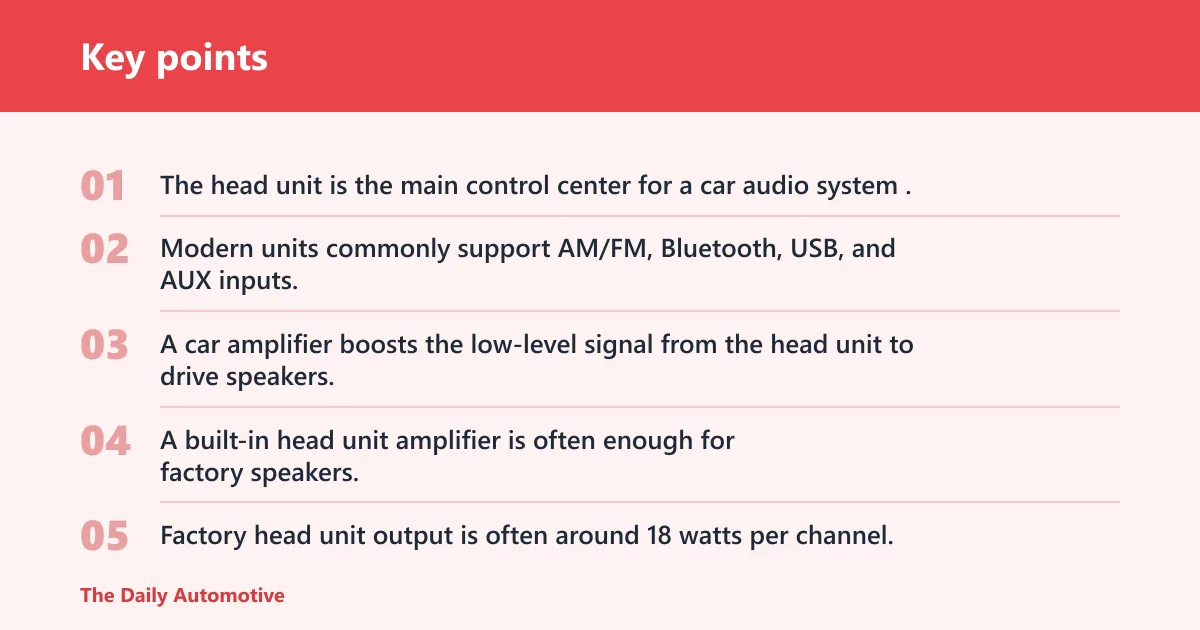
The head unit is the main control center for a car audio system. Modern units commonly support AM/FM, Bluetooth, USB, and AUX inputs, and many also offer CarPlay or Android Auto. A car amplifier boosts the low-level signal from the head unit to drive speakers, and many models include gain, crossover, phase, and equalization controls.
A built-in head unit amplifier is often enough for factory speakers. Factory head unit output is often around 18 watts per channel, which is one reason aftermarket speakers can feel underfed on the stock radio. Some Alpine head units can accept a separate power pack to reach closer to 50 watts per channel.
Sound-quality gains versus feature gains
Do not treat CarPlay or Android Auto as audio power; they are source and interface features, not amplifier output. Those are source and interface upgrades. A new head unit may change sound only a little if the old unit already has clean pre-outs and no factory amp is in the way, while an amplifier can improve clarity, richness, and depth when the speakers and signal chain can make use of the extra power.
Suppose a commuter wants easier phone integration and also notices distortion at highway volume. A new head unit fixes the phone side first, but it may still leave the same weak output if the speakers need more power. In that case, the best result often comes from both upgrades in sequence.
Where the built-in amp fits
Many factory systems run fine on the built-in head unit amp, especially with stock speakers. The problem shows up when the radio is pushed hard: the DIY forum notes that many factory head units clip at high volumes. That clipping is one reason a separate amp can sound cleaner even before it sounds louder.
What does a car amplifier actually do?
An external car amplifier takes the head unit’s low-level signal and turns it into the power speakers need. That added power can improve clarity and output at higher volumes, especially when the speakers are not very sensitive or the factory radio clips early. It does not fix every problem, but it often solves the power mismatch.
Why gain, crossover, phase, and EQ matter
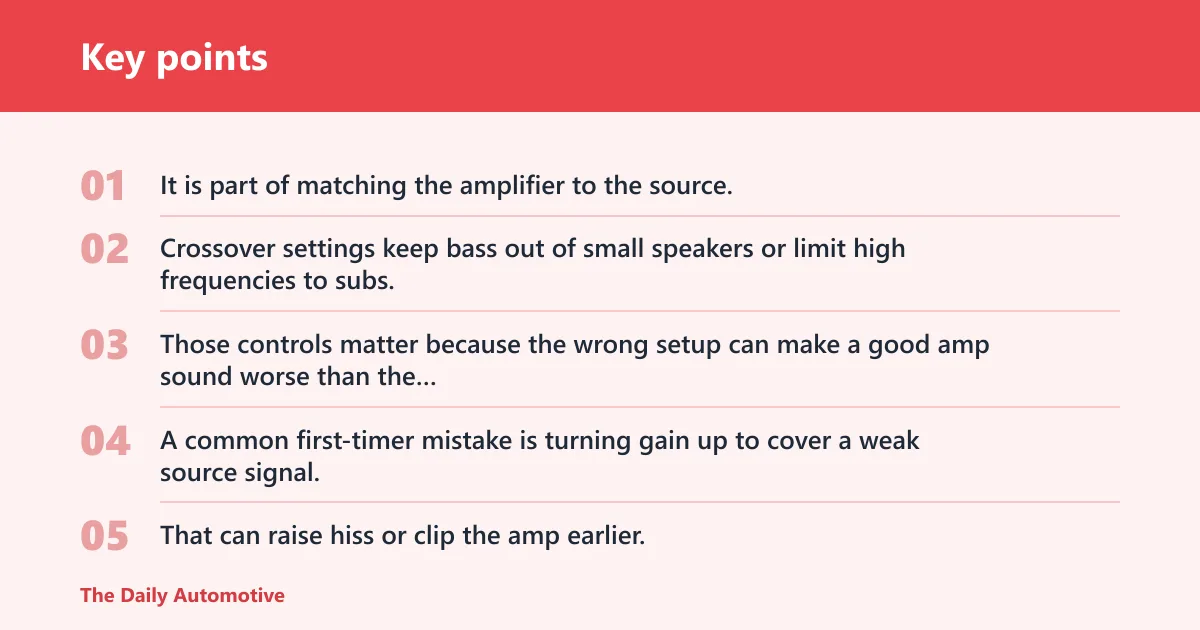
Gain is not a volume knob. It is part of matching the amplifier to the source. Crossover settings keep bass out of small speakers or limit high frequencies to subs, phase helps align drivers, and EQ can correct broad peaks or dips. Those controls matter because the wrong setup can make a good amp sound worse than the stock radio.
A common first-timer mistake is turning gain up to cover a weak source signal. That can raise hiss or clip the amp earlier, which makes distortion more obvious instead of less obvious. Clean setup matters more than raw wattage on paper.
Why clipping can happen with weak source output
When the source runs out of clean voltage, the waveform flattens. That is clipping. The factory radio’s limited output, the lack of proper pre-outs, or a bad gain match can all push the system into distortion before the speakers are actually receiving useful power. That is why a weak head unit and a strong amp are not automatically a clean system.
What does a modern head unit add?
A modern head unit adds source options and control. It can provide AM/FM, CD, USB, Bluetooth, and AUX support, plus smartphone features such as CarPlay and Android Auto. It also gives you the interface and basic EQ controls that shape how the rest of the system behaves.
Source options and smartphone integration
For many drivers, the main reason to replace the radio is not output. It is connectivity. CarPlay and Android Auto can change how you navigate, take calls, and handle music apps, which makes the head unit the right first upgrade when the stock system lacks those features.
Basic EQ and setup controls
Most head units offer simple EQ and system settings that let you trim bass, midrange, or treble at the source. That is useful, but it is not the same as adding real speaker power. A head unit with built-in amplification can be a budget-friendly option, yet it still may not deliver the headroom an external amp provides.
Car audio decision table
The best upgrade order depends on what is missing now. Use the scenario that matches the car, then match the input list before buying anything.
| Scenario | Recommended upgrade order | Expected audible gain | Required inputs | Common failure mode |
|---|---|---|---|---|
| Factory speakers | Amplifier first only if the radio already has the features you want; otherwise head unit first | Modest to clear gains if the stock radio clips or lacks headroom | Pre-outs help; factory speakers usually work fine with the built-in amp | Buying power the speakers do not need, or replacing the radio when the real issue is power |
| Aftermarket speakers on stock head unit | Amplifier first | Often the biggest improvement in fullness and volume control | Speaker sensitivity, pre-outs or a line output converter, proper wiring | Weak factory output makes new speakers sound dull or thin |
| Stock speakers with weak bass | Amplifier first, then speaker tuning or sub integration if needed | Better low-end control and less strain at volume | Clean signal path, gain setup, crossover control | Trying to fix bass only with EQ while the source still clips |
| CarPlay-first buyers | Head unit first | Big feature gain; audio gain is secondary unless the old unit is poor | CarPlay support, wiring harness, steering-wheel or OEM integration parts if needed | Expecting CarPlay to add power or fix speaker mismatch |
| High-volume listeners | Amplifier first, then head unit if features are missing | Largest jump in clean output and reduced clipping risk | Pre-outs, speaker sensitivity, remote turn-on, correct wiring | Bad gain setup or weak pre-outs that waste the amplifier’s headroom |
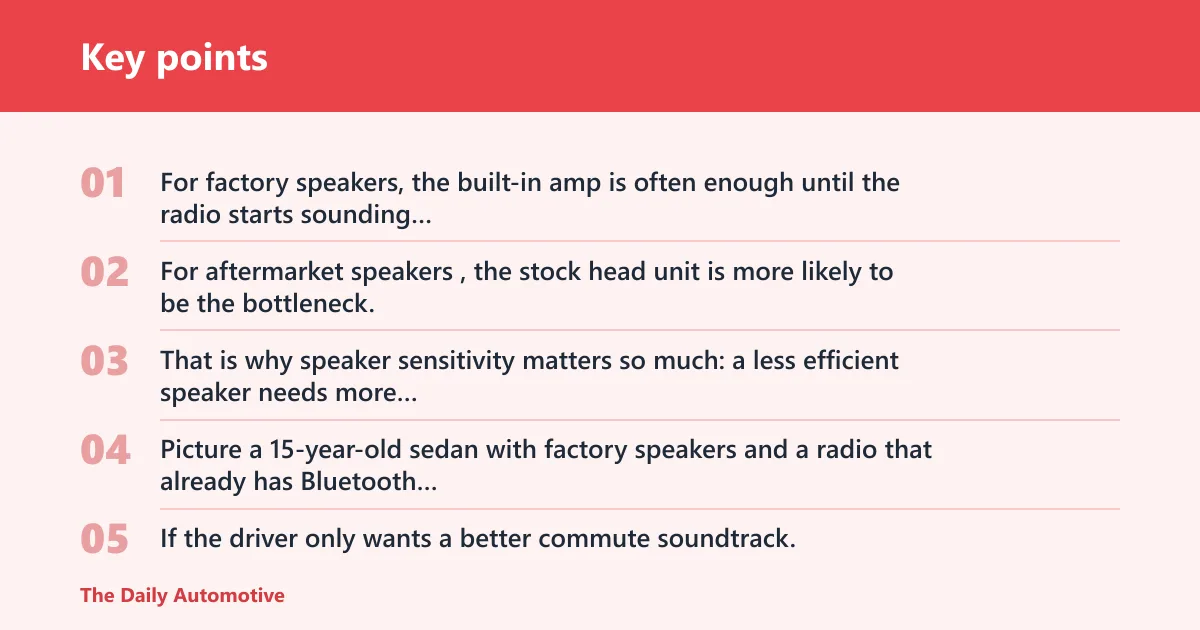
For factory speakers, the built-in amp is often enough until the radio starts sounding strained. For aftermarket speakers, the stock head unit is more likely to be the bottleneck. That is why speaker sensitivity matters so much: a less efficient speaker needs more power to reach the same output, and the stock radio may not supply it cleanly.
Picture a 15-year-old sedan with factory speakers and a radio that already has Bluetooth but no CarPlay. If the driver only wants a better commute soundtrack, an amplifier can clean up volume and reduce strain. If the driver also wants phone mirroring and navigation prompts on the dash, the head unit has to come first.
Can you keep the stock head unit and add an amp?
Yes, and that is often the right move when the factory radio already does what you need. If pre-amp outputs are present, adding a standalone amp is straightforward. If they are not, a line output converter may be needed to feed the amp a usable signal, and that extra step can affect noise and setup.
When pre-outs are present
Pre-amp outputs are the cleanest path to an external amplifier. They let the signal leave the head unit before speaker-level amplification, which helps with cleaner routing and easier integration. A head unit with pre-amp outputs is the right starting point when a system is moving beyond stock power.
When line output converters are needed
Without pre-outs, the amp must be fed from speaker-level wiring. That can work, but it adds another component and another place for mistakes. If the vehicle uses a factory amplifier or DSP, a simple swap may not be enough, and the signal path can need more than a basic converter.
Wiring and remote turn-on basics
Most amp installs need proper power wire, ground, signal input, and a remote turn-on lead. Follow the vehicle and product manual. For any electrical work, disconnect the battery as directed by the manual, and route wiring away from sharp edges and moving parts.
- Check whether the current head unit has RCA pre-outs.
- Confirm speaker sensitivity and whether the speakers need more power.
- Identify any factory amp, DSP, or retained OEM module that may change the signal path.
- Plan remote turn-on and power wiring before buying the amp.
- Use the vehicle manual for battery disconnect and trim removal steps.
When is a new head unit better than an amplifier?
A new head unit is the better first upgrade when the missing piece is source control, not output. If you want CarPlay, Android Auto, better USB playback, Bluetooth, or more useful EQ controls, the head unit gives you that directly. It is also the cleanest way to replace a radio that lacks proper outputs.
CarPlay and Android Auto priorities
CarPlay is often the main reason to replace the head unit instead of the amp. Android Auto matters for the same reason. These features change the interface, app access, and navigation experience, which makes them feature upgrades rather than sound-power upgrades.
OEM systems with factory amps or DSP
Some cars hide most of the audio work in the factory amplifier or DSP. In those systems, a new head unit can be less effective than shoppers expect because the vehicle may keep processing the signal in the background. The result is a simple swap that changes the screen but does little to the actual sound path.
Choose Amplifier if… / Choose Head Unit for Car Audio if…
Choose Amplifier if the radio already has the sources you want, the signal path is usable, and the complaint is weak volume, early clipping, or thin sound at higher levels. Choose Head Unit for Car Audio if the factory radio lacks CarPlay, Android Auto, Bluetooth, or proper outputs, or if the current interface is the reason you want an upgrade.
Choose Amplifier if you already have aftermarket speakers that need more power, or if factory speakers sound strained when the volume rises. Choose Head Unit for Car Audio if you are starting with a bare factory radio and want modern source features first. Choose both when the car needs a better source and a stronger signal path.

Frequently asked questions
What is an amplifier in a car?
A car amplifier boosts the low-level signal from the head unit so speakers can play louder and cleaner. It usually adds gain, crossover, phase, and EQ controls. In practical terms, it gives the speakers more usable power than the built-in head unit amp can supply.
Does a car amplifier improve sound quality?
It can, especially at higher volumes. An amp can improve clarity, richness, and depth when the source is clean and the speakers need more power. If the source clips early or the gains are set badly, the extra amp can also expose problems faster.
Should I replace my head unit or add an amp?
If you want CarPlay, Android Auto, or better source features, replace the head unit first. If the current radio already has the features you need and the system just sounds weak or strained, add an amp first. The right order depends on the bottleneck.
Can a factory head unit run aftermarket speakers?
Yes, but not always well. Factory head unit output is often around 18 watts per channel, which can leave aftermarket speakers underpowered if they are less sensitive or simply need more clean headroom. The result is often dull sound at higher volumes.
Can I keep my stock head unit and add an amp?
Yes. If the head unit has pre-outs, adding an amp is straightforward. If it does not, a line output converter may be needed. The main checks are wiring, remote turn-on, and whether the vehicle uses factory amplification or DSP.
Products related to this article
Sponsored / affiliate links. As an Amazon Associate I earn from qualifying purchases. I may earn additional commission from eligible campaigns.