Car AC Hissing Noise Fix: Diagnose It Yourself Before You Overpay
A brief hiss for about 1 to 3 seconds after the compressor stops usually means pressure is equalizing; a hiss that lasts longer, repeats with weak cooling, or comes with oily residue may point to a leak or valve fault. Misreading it can lead to an unnecessary recharge, a missed compressor problem, or a bigger refrigerant loss that gets expensive fast. This guide shows how to use timing, sound location, smell, and line temperature to separate normal AC behavior from faults worth paying for.
Car AC hiss basics
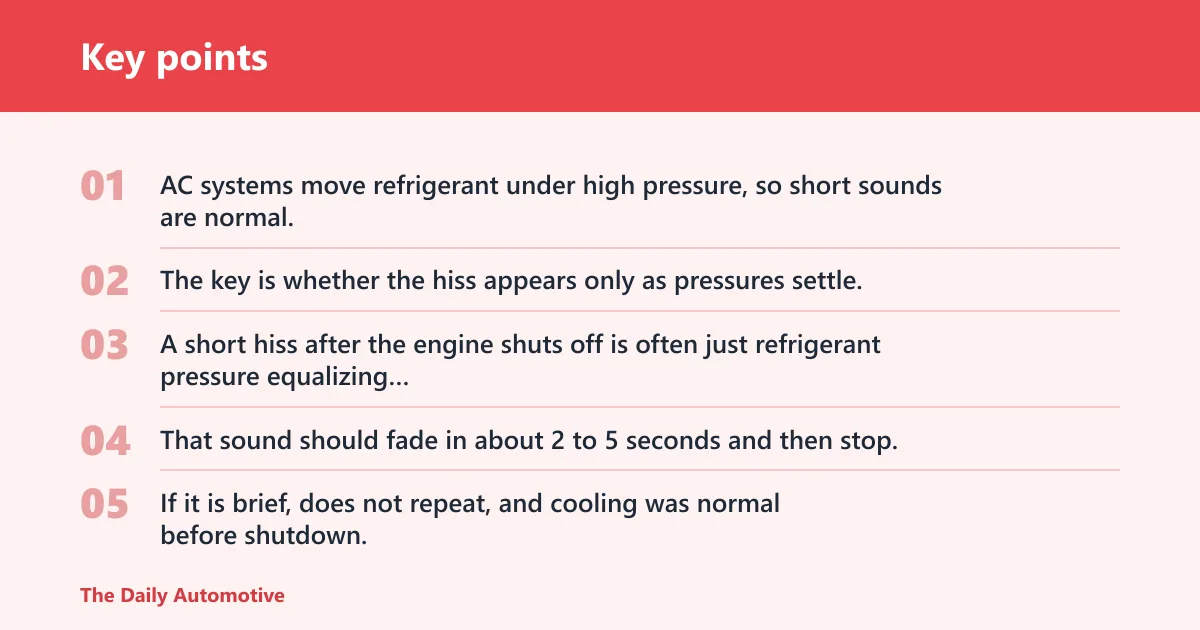

AC systems move refrigerant under high pressure, so short sounds are normal. The key is whether the hiss appears only as pressures settle, or whether it shows up while the system is running and the air stays warm or lukewarm.
What a brief hiss after shutdown can mean
A short hiss after the engine shuts off is often just refrigerant pressure equalizing across the system. That sound should fade in about 2 to 5 seconds and then stop. If it is brief, does not repeat, and cooling was normal before shutdown, it is usually not a repair cue.
When a hiss points to a fault
A hiss that continues while the compressor is running, gets louder with AC use, or shows up with weak cooling is different. That pattern points more toward a leak, a restricted expansion valve, a pressure-control issue, or a compressor fault. Refrigerant is under high pressure and can injure skin or eyes if released, so avoid loosening fittings to “listen closer.”
AC hiss diagnosis matrix
Use timing, sound location, odor, and line temperature together. One clue by itself can mislead you. Two or three clues that match are much more useful than a single hiss.
| Timing and location | Smell | Line temperature | Likely cause | DIY confidence score | Next step |
|---|---|---|---|---|---|
| 2–5 seconds after shutdown, under hood | No odor | Normal warm high side, cold low side | Normal pressure equalization | 90/100 | Monitor only if cooling stays normal |
| While running, under hood | No odor | High side warm, low side cold and slightly sweaty | Normal cycling or a minor flow change | 55/100 | Confirm vent temperature and watch for change over time |
| While running, low cooling | Possible chemical smell | Both lines warm | Low refrigerant or a leak | 80/100 | Inspect condenser, fittings, and service ports for oil or dye |
| AC button pressed, behind glovebox | Sweet, chloroform-like odor | Low side not getting cold enough | Evaporator core leak or low charge | 75/100 | Check cabin filter area and plan a dye or pressure test |
| While running, behind glovebox | No odor or faint chemical smell | Low side warm; high side not unusually hot | Expansion valve noise or restriction | 65/100 | Listen for hiss or groan when load changes |
| While running, under hood near compressor | No odor | Lines normal but noise changes with clutch engagement | Compressor noise or clutch-related problem | 70/100 | Observe whether the noise starts exactly at clutch engagement |
| After shutdown or while running near fittings | Refrigerant smell or oily residue | Low side may be warm; high side may stay too warm | Schrader valve, O-ring, or hose connection leak | 85/100 | Inspect joints with UV dye and a light if available |
| While running after recent service or overfill | No odor, or sharp chemical smell | High side unusually hot; hiss may vent briefly | Pressure relief valve opening from overcharge or a pressure spike | 60/100 | Stop guessing on charge amount and have pressures checked |
DIY confidence score and next step
Use the score to decide how far to go without tools. A score above about 80 means the symptom cluster is fairly clear, but not fixed. A score below about 60 means the hiss is too vague for a safe parts guess, and pressure testing becomes the smarter move.
Start with the easiest access points first. Condenser damage, loose hose fittings, and service-port leaks are easier to inspect than a hidden evaporator leak behind the dash. That order helps you avoid paying for the wrong labor first.
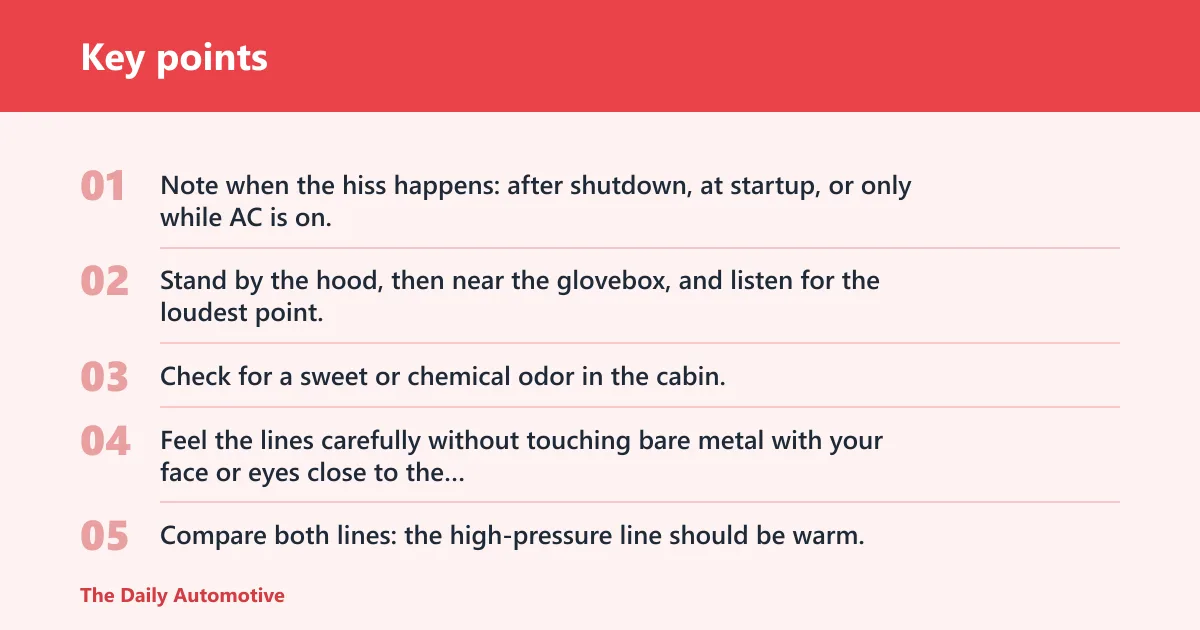
- Note when the hiss happens: after shutdown, at startup, or only while AC is on.
- Stand by the hood, then near the glovebox, and listen for the loudest point.
- Check for a sweet or chemical odor in the cabin.
- Feel the lines carefully without touching bare metal with your face or eyes close to the system.
- Compare both lines: the high-pressure line should be warm, and the low-pressure line should be cold and slightly sweaty.
- Look for oily residue, UV dye traces, or dirt stuck to wet fittings.
- Stop if the hiss is loud, constant, or paired with poor cooling.
Why does my car AC hiss after shutdown?
A short hiss after shutdown is usually pressure equalization, not a failure. When the engine stops, refrigerant pressures settle through the expansion valve and the rest of the circuit. If the sound lasts 2 to 5 seconds and then ends, that is generally normal.
Normal pressure equalization
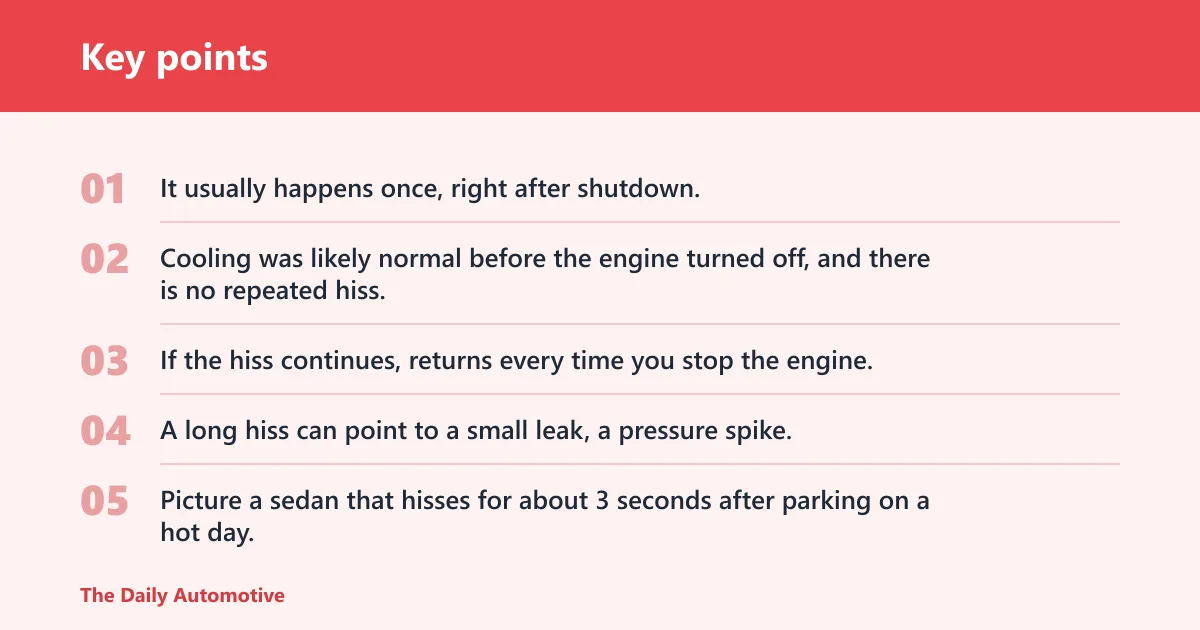
This sound is brief and predictable. It usually happens once, right after shutdown. Cooling was likely normal before the engine turned off, and there is no repeated hiss, odor, or oily film near fittings.
Signs the noise is too long or too loud
If the hiss continues, returns every time you stop the engine, or is joined by weak cooling, suspect a fault instead of normal equalization. A long hiss can point to a small leak, a pressure spike, or a valve that is not controlling flow the way it should.
Picture a sedan that hisses for about 3 seconds after parking on a hot day, then goes quiet. That fits normal equalization. If the same car starts hissing for about 15 seconds and the vents blow lukewarm air, the balance shifts toward a leak or restriction.
Why does my AC hiss only when the air conditioning is on?
A hiss that appears only with AC on usually points to active system flow, not shutdown equalization. The most common causes are low refrigerant, a restricted expansion valve, or a compressor that changes tone as the clutch engages. Poor cooling makes the fault more likely.
Low refrigerant and leak clues
Low refrigerant can cause a hiss or groan behind the glove box, and it can also leave the vent air warm or lukewarm. Because system pressure drops with leaks, both lines may feel warmer than expected. A chemical smell plus louder hiss with AC use can indicate a large refrigerant leak.
Expansion valve and compressor clues
The expansion valve controls refrigerant flow into the evaporator. If flow is restricted, it can hiss or groan, and it may freeze up when refrigerant is low. The compressor circulates refrigerant, and a failing unit can hiss, rattle, or groan when the AC clutch engages.
Say your compact SUV starts hissing only when the AC button is on, the cabin air is lukewarm, and the low side never feels cold. That pattern fits low refrigerant or a flow restriction better than a normal post-shutdown sound.
How to pinpoint the noise source
Sound location matters. Behind the glovebox points toward the evaporator area or expansion valve. Under the hood points toward the compressor, condenser, service ports, or lines. The closer the hiss is to the dash, the more careful you should be about hidden evaporator leaks.
Behind the glovebox versus under the hood
A hiss behind the glovebox often comes from the evaporator core or expansion valve area. The evaporator core sits behind the dash and can leak refrigerant into the cabin, which may create a sweet, chemical odor. Under-hood hiss is more likely to come from the condenser, compressor, Schrader valves, or hose connections.
Compressor clutch engagement as a clue
If the sound starts exactly when the clutch clicks in, the compressor moves up your list. A healthy compressor should not add a loud groan or rattle. If the noise changes with clutch engagement and vent cooling drops, that is a stronger clue than sound alone.
Which parts leak most often?
Start where leaks happen most often and where access is easiest. Condensers, Schrader valves, O-rings, and hose connections are commonly reported leak points. They are also more practical to inspect before you assume the compressor or evaporator needs replacement.
Condenser, Schrader valves, O-rings, and hose connections
The condenser is mounted in front of the radiator, where road debris and corrosion can damage it. Schrader valves at the service ports can leak refrigerant. O-rings and hose connections can dry out or split, and UV dye often shows those leak paths clearly if the leak is not too large to seal.
Evaporator core leaks hidden in the dash
Evaporator leaks are harder to reach and usually more invasive to repair. If the hiss is strongest inside the cabin, especially behind the glovebox, and a sweet, chloroform-like odor follows, the evaporator core rises on the list. That repair often costs more in labor than a visible hose leak.
Can overcharge or pressure spikes cause hissing?
A pressure relief valve can hiss when system pressure spikes, including during overcharge. That hiss is the system protecting itself, not proof that the compressor is dying. Guessing at charge amount is risky because too much refrigerant can create the same noise you are trying to solve.
Pressure relief valve behavior
The pressure relief valve is there to protect the system if pressure rises too far. If it opens, the hiss may be brief but sharp. That is different from the steady hiss of a leak and different again from the changing tone of a restricted valve.
Why charging by guesswork is risky
Overcharge can drive pressures up, trigger noise, and shorten component life. It can also mask the real issue long enough to turn a smaller repair into a larger one. A failed compressor repair can become a $1,500+ job at a shop, so it pays to verify the cause before any refill.
Frequently asked questions
Why does my car AC hiss after you turn the engine off?
A brief hiss right after shutdown is usually normal pressure equalization. If it ends in 2 to 5 seconds and cooling was normal, that is usually fine. A longer hiss, repeated hiss, or hiss with oily residue points more toward a leak or a valve problem.
Is a hissing car AC noise normal or a sign of a leak?
It can be either. Short post-shutdown hiss is often normal. Hiss while the system is running, especially with warm or lukewarm air, chemical odor, or oily residue, is much more suspicious. Timing and location are what separate normal behavior from a fault.
Why does my AC hiss only when the air conditioning is on?: that usually means the noise?
That usually means the noise comes from active refrigerant flow, not equalization after shutdown. Low refrigerant, a restricted expansion valve, or a compressor issue are the most likely paths. If the low-pressure line is not cold and slightly sweaty, low charge becomes more likely.
Can low refrigerant make a car AC hiss behind the glove box?
Yes. Low refrigerant can cause a hiss or groan behind the glove box, where the evaporator core and expansion valve sit. If that hiss comes with weak cooling and a sweet, chemical odor, a hidden evaporator leak becomes more likely than a simple airflow problem.
Does a chemical smell with AC hissing mean a refrigerant leak?
It often does. A sweet, chloroform-like odor can point to an evaporator core leak, and a stronger chemical smell plus louder hiss with AC use can indicate a larger refrigerant leak. Treat that as a repair clue, not something to ignore and recharge blindly.
How do I tell if the hiss is coming from the compressor or the expansion valve?
Watch timing and sound location. A hiss that changes with clutch engagement and comes from under the hood leans toward the compressor side. A hiss or groan behind the glove box leans toward the expansion valve or evaporator area, especially if the low-side line is not cold.
What does it mean if the AC low-pressure line is cold and sweaty?
That is usually a normal sign. The low-pressure line should be cold and slightly sweaty, while the high-pressure line should be warm. If both lines are warm, that can point to low refrigerant, which often brings weak cooling and a hiss or groan.
Can overcharging the AC system cause a hissing noise?
Yes. Too much refrigerant can raise system pressure enough to trigger the pressure relief valve, which can hiss. Overcharge can also make diagnosis harder, so a refill should not be the first move unless pressures and leak evidence support it.
Products related to this article
Sponsored / affiliate links. As an Amazon Associate I earn from qualifying purchases. I may earn additional commission from eligible campaigns.