Best Amp Rack for Car (3 Picks Compared)
The best amp rack for a car fits your trunk or wall space, leaves open space around vents and cable ends, and keeps fuses and terminals easy to reach. For most buyers, compare three models, then buy the one that matches your amp count and mounting style. Pick wrong, and you can trap heat, block service access, and end up buying twice. This guide compares three amp racks by fitment, cooling, and install access to help with choosing before purchase.
Why fit and service access outweigh capacity claims

The trade-off is simple: fit and service access matter more than marketing claims about capacity. A rack that holds more amps is not always better if it blocks a cargo cover, crowds cable bends, or makes fuse checks a chore. The three picks below split cleanly by install style and system size.
| Pick | Best use case | Mount style | Key fitment note | Why it stands out |
|---|---|---|---|---|
| STILEALUS rack | Flexible trunk or wall installs | Floor and wall mount | Useful when the install may move between mounting locations | Most adaptable layout for buyers who may revise the system later |
| Droppin Hz 2RACK | Compact two-amp layouts | Two-channel amplifier rack | Better fit when you want a smaller footprint and straightforward wiring | Best match for a 2-amp system without paying for unused capacity |
| Droppin Hz 4 Amp Rack | Larger multi-amp builds | Four-amp rack | Listed with 1.125-inch bottom clearance and 3.6875 inches between tabs | Built for bigger system planning and cleaner spacing around multiple amplifiers |
Best overall pick: STILEALUS rack
The best overall pick is the STILEALUS rack because it supports both floor and wall mounting, which gives you the most freedom when the install layout is still changing. That flexibility matters if you are working around a false floor, a trunk brace, or a later audio upgrade.
It is the safest choice when you want one rack to cover more than one installation plan. A fixed rack can be the wrong answer if your trunk layout changes after subwoofer placement or if a wall-mounted location later proves easier to service.
Best pick for two amps: Droppin Hz 2RACK
The best pick for two amps is the Droppin Hz 2RACK because it is built as a two-channel amplifier rack. That makes it a better fit than a larger rack for compact systems where you want less empty space, less visual bulk, and shorter cable runs.
For a simple front-stage amp plus sub amp layout, a two-amp rack usually gives cleaner packaging. It also reduces the temptation to spread components too far apart, which can complicate wire routing and make a trunk install harder to keep tidy.
Best pick for larger multi-amp installs: Droppin Hz 4 Amp Rack
The best pick for larger multi-amp installs is the Droppin Hz 4 Amp Rack because it is listed to hold 4 amps. It also has listed clearance figures that help buyers plan spacing before they order, including 1.125-inch bottom clearance and 3.6875 inches between tabs.
That kind of rack makes sense when you are planning for DSP, multiple full-range amps, or a system that may grow later. The point is not simply to mount more gear. It is to leave enough room for cables, heat flow, and future service without rebuilding the whole panel.
How to choose an amp rack for car audio
Pick an amp rack by matching it to your install type, your amplifier dimensions, and the way you will service the system later. The right choice depends on whether you need a compact two-amp board, a more flexible mounting platform, or a larger rack that can handle growth.
Match the rack to your install type
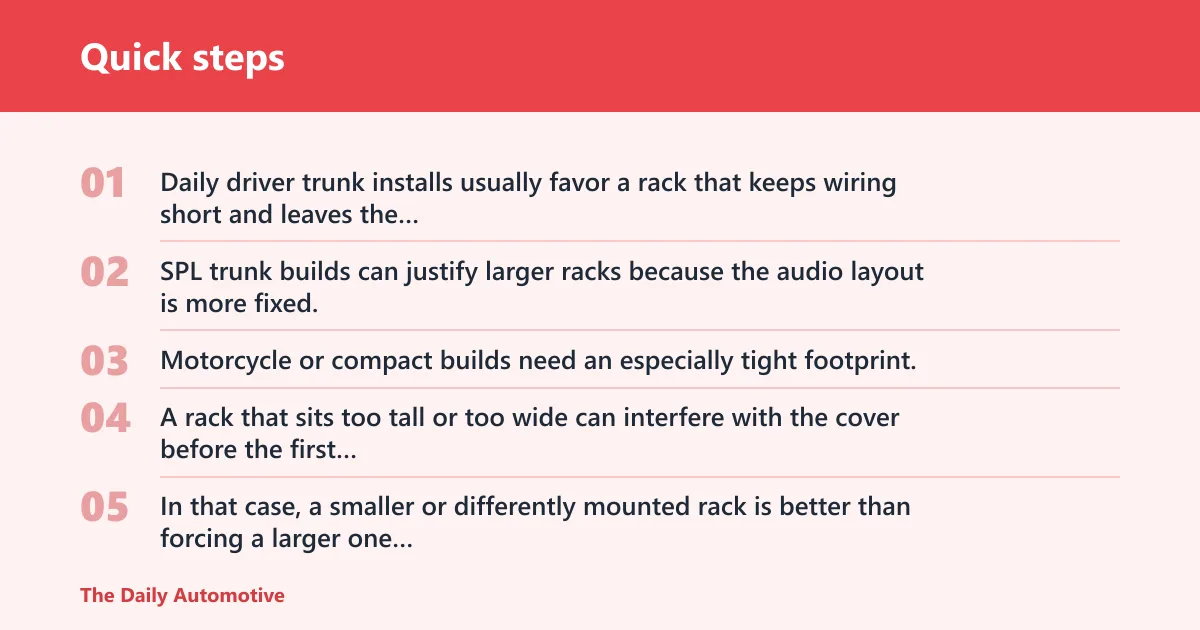
Daily driver trunk installs usually favor a rack that keeps wiring short and leaves the cargo area usable. SPL trunk builds can justify larger racks because the audio layout is more fixed. Motorcycle or compact builds need an especially tight footprint, which makes oversized racks a poor fit.
Say your trunk also carries a cargo cover. A rack that sits too tall or too wide can interfere with the cover before the first screw is tightened. In that case, a smaller or differently mounted rack is better than forcing a larger one into place.
Check amplifier dimensions and mounting points
Measure the amplifier body first, then the mounting-hole pattern, then the connector side. A rack can match the case size and still fail if the terminals point into a brace, the holes do not line up, or the cable plugs add more depth than the rack allows.
Do not assume all amp racks fit all car amplifiers. They do not. Pre-drilled holes and included screws still need a fitment check against your exact amp pattern before you commit to drilling the trunk floor or wall panel.
Plan for service access and future expansion
Choose a rack with enough open space to reach fuses, terminals, gain controls, and input connections without pulling the whole panel apart. Future expansion matters too, because a rack that is full on day one can force a complete rework when you add a second amp or a DSP later.
Amp rack fitment checklist
This is the part that saves money. Measure the amplifier and the mounting area before you order, and compare the numbers to the rack pattern, the cable entry path, and any moving parts in the car. If one item conflicts, the rack is not a fit even if the ad says it is universal.
| What to measure | How to measure it | Why it matters | Common failure if skipped |
|---|---|---|---|
| Amp width | Outside edge to outside edge of the amplifier body | Confirms the rack is wide enough for the amp and side hardware | Mounting tabs end up outside the usable panel |
| Amp height | Base to top of the amplifier housing | Protects against contact with cargo covers, seats, or trim | The amp hits a cover or seatback when the hatch closes |
| Amp depth | Front face to the farthest rear connector or heat sink edge | Prevents connector interference and rear-wall contact | RCA plugs or power leads bend too sharply |
| Mounting-hole spacing | Center-to-center distance on the amp’s mounting pattern | Checks whether the rack’s pre-drilled holes line up | Extra drilling or bracket modification becomes necessary |
| Vent clearance | Space around side vents, top vents, and heatsink fins | Keeps airflow paths open for thermal management | Blocked side vents can trigger overheating |
| Cable bend space | Room behind each terminal for power, ground, speaker, and RCA leads | Prevents sharp bends and crushed connectors | Terminal strain or cable jacket damage |
| Trunk or seat movement | Check hatch travel, cargo cover sweep, and rear seat folding range | Confirms the rack will not block moving parts | Install interferes with daily use |
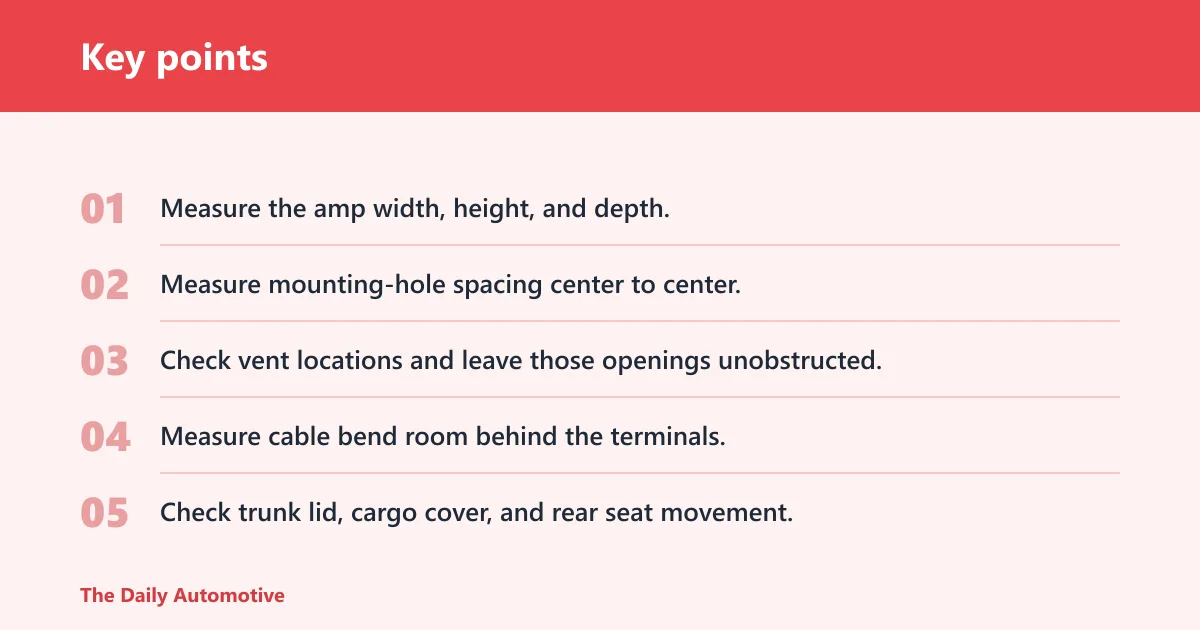
- Measure the amp width, height, and depth.
- Measure mounting-hole spacing center to center.
- Check vent locations and leave those openings unobstructed.
- Measure cable bend room behind the terminals.
- Check trunk lid, cargo cover, and rear seat movement.
- Compare those numbers against the rack before ordering.
A common first-timer mistake is buying a rack for the amp body alone and forgetting the connectors. A 2-inch-deep terminal area can become a problem fast if the cable must turn immediately after the plug. That is where a rack that looked “close enough” turns into a return.
Floor mount or wall mount?
A floor mount amp rack fits best when you want a stable trunk-floor placement and a predictable installation footprint. A wall mount amp rack fits better when space is tight, when the panel is fixed to a false floor or enclosure wall, or when you need easier reconfiguration later.
When a floor mount amp rack fits best
Floor mounting works well in trunk installs where the rack can sit on a solid base and the wiring can run under or beside it. It is usually the cleaner choice if you want the amps low, secure, and less exposed to shifting cargo.
This is the better route when the rack must stay put in a daily driver. A stable mount helps with vibration control, especially when the panel is fixed to a rigid surface rather than a thin trim piece.
When a wall mount amp rack fits better
Wall mounting makes more sense when the rack needs to save floor space or match a custom enclosure wall. It is also easier to revise if you expect the system layout to change, because a wall panel is often simpler to rework than a floor-mounted base.
Suppose your trunk has a false floor with storage underneath. A floor rack could block access to that space, while a wall mount keeps the lower area usable. The trade-off is that the wall surface must still be strong enough for the load.
Which placement is easier to service later?
Wall mounts are often easier to reconfigure in many setups. Floor mounts are often easier to keep stable in many setups. If your priority is quick fuse checks and clean cable routing, either can work. If your priority is access to the trunk area below, wall mounting usually wins.
What size rack do you need for 2 amps?
For two amps, choose a rack that gives each amplifier enough room to breathe and leaves a clear path to the terminals. A compact two-amp rack is usually the best fit when you want a tidy layout without paying for unused space or creating a panel that is larger than the install needs.
Spacing for a compact two-amp layout
Two amps can fit neatly when the rack keeps the units aligned and leaves room for side vents and cable exits. The goal is not maximum density. The goal is enough spacing that both amps can be mounted, cooled, and serviced without pulling the rack apart.
How to avoid blocked side vents
Side vents are a common failure point. If one amp sits hard against the next component, airflow can stall at the hottest part of the case. That can matter more than the total number of amps on the rack, especially in a sealed trunk.
When a larger rack is worth it
A larger rack is worth it when the second amp is only the start of the build, or when the existing amps have wide terminal blocks and deep connectors. Extra space also helps when the install must survive heat buildup, vibration, and future upgrades without being rebuilt.
Steel, finish, and vibration control
Laser-cut steel construction matters because it gives the rack rigidity, resists vibration better than thin flexible material, and usually accepts a powder-coated finish that improves scratch and corrosion resistance. That said, steel is only as useful as the structure it is mounted to. A stiff rack on a weak base still moves.
Why laser-cut steel matters for rigidity
Laser-cut steel helps keep the panel flat and the mounting holes consistent. That makes the rack less likely to flex under the weight of the amplifiers, which is important when the install lives in a trunk that sees road vibration, cargo movement, and repeated hatch use.
Steel also gives a cleaner anchor point for pre-drilled holes and mounting hardware. That does not remove the need to verify fitment, but it does make the rack more dependable once the measurements are right.
What a powder-coated finish adds
A powder-coated finish adds scratch resistance, corrosion resistance, and a cleaner appearance. It is especially useful in a trunk install where tools, luggage, or loose hardware may touch the rack during normal use.
Where acrylic or lighter materials fall short
Lighter materials can work in some builds, but they are more sensitive to flex, edge wear, and vibration. If the amplifier is heavy, the rack spans a wide area, or the car sees rough roads often, steel is usually the safer structural choice.
Can one rack hold multiple amplifiers?
Yes, one rack can hold multiple amplifiers if the layout leaves room for airflow, cable access, and future service. A 4-amp rack makes the most sense when the system plan is already fairly fixed and you want a cleaner way to organize more than one amp in the same space.
When a 4-amp rack makes sense
A 4-amp rack makes sense in larger systems where a single amplifier is no longer enough, or where multiple smaller amps are easier to package than one large unit. It also helps when the install needs a more deliberate layout for protection, cable routing, and visual order.
How to think about airflow between amps
Airflow clearance is not just about the bottom of the rack. It is also about the space between amplifiers and the open side around heatsinks and vents. If the amps sit too close together, the warm air has nowhere to go and one unit can heat the next.
When to leave room for future upgrades
Leave extra room when the build may grow into a DSP, a second sub amp, or a larger front-stage setup. If the current layout fills every hole on day one, you may lose the chance to upgrade without replacing the rack itself.
Choose STILEALUS rack if… / Choose Droppin Hz 2RACK if…
Choose the STILEALUS rack if you want a flexible install that can work as a floor mount or a wall mount. Choose the Droppin Hz 2RACK if you want a compact two-amp layout and the smallest practical footprint. Choose the Droppin Hz 4 Amp Rack if your system already needs four amp positions or is headed there soon.
Choose STILEALUS rack if…
- You are still deciding between trunk-floor placement and a wall panel.
- You may need to reconfigure the system after the rest of the build is finished.
- You want one rack that can adapt to more than one mounting location.
Choose Droppin Hz 2RACK if…
- Your build uses two amplifiers and nothing more.
- You want a compact layout that avoids wasted space.
- You are trying to keep the install simple, light, and easy to service.
Choose droppin Hz 4 amp rack if…
- You need room for four amps now.
- You want more deliberate spacing for cooling and wiring.
- You are planning a larger system and do not want to rebuild the rack later.
Frequently asked questions
How do I pick an amp rack for car audio?
Start with the amplifier count, then measure width, height, depth, and mounting-hole spacing. After that, check vent clearance, cable bend room, and whether the rack blocks trunk or seat movement. The best rack is the one that fits the gear and the car together, not the one with the biggest capacity claim.
What size amp rack do I need for 2 amps?
A two-amp rack is the right size for most compact dual-amp installs. It keeps the footprint smaller, reduces unused space, and makes service access easier. If either amp has large terminal blocks or side vents, choose a layout that leaves extra room rather than forcing a tight fit.
Should I choose a floor mount or wall mount amp rack?
Choose floor mount if you want a stable trunk-floor install and your cargo area can spare the footprint. Choose wall mount if you need to save floor space, work around a false floor, or make future reconfiguration easier. The better choice depends on the car, not the catalog photo.
How much clearance does an amp rack need for cooling?
There is no universal clearance number that fits every amplifier. Use the amplifier maker’s guidance first, then make sure the rack does not block vents, heatsinks, or cable exits. What matters most is open airflow around the amp and enough spacing that one unit does not dump heat directly into another.
Will a steel amp rack reduce vibration better than acrylic?
Steel usually does a better job of resisting flex, which helps with vibration control when the rack is mounted to a solid structure. Acrylic can work in lighter builds, but it is more sensitive to flex and edge wear. The mount itself still matters as much as the material.
Can I stack multiple amplifiers on one rack?
Yes, if the rack is sized for the total load and the amplifiers still have room for airflow and service access. Stacking more amps into less space can increase heat and make maintenance harder. If the layout looks crowded on paper, it will be crowded in the car too.
What should I measure before buying an amp rack?
Measure amp width, height, depth, mounting-hole spacing, vent clearance, cable bend room, and whether the rack blocks seat or trunk movement. That checklist catches most bad purchases before they happen. A rack that misses even one of those checks is not a true fit.
Do amp racks fit all car amplifiers?
No. Amp racks are not universal in the way buyers often hope they are. The amplifier’s dimensions, hole pattern, connector depth, and vent placement all have to line up with the rack and the car. Always compare the exact measurements before you buy, even if the rack advertises broad compatibility.
Products related to this article
Sponsored / affiliate links. As an Amazon Associate I earn from qualifying purchases. I may earn additional commission from eligible campaigns.