3 Best Car Audio Equalizers in 2026
The three best car audio equalizers in 2026 are a factory-radio cleanup EQ, a DSP equalizer for active systems, and a low-noise budget EQ; choose by system type, not brand name. Pick the wrong type, and you can add hiss, cut output, or pay to solve problems the equalizer cannot touch. This guide ranks the top picks for factory radios, aftermarket head units, amp-only upgrades, and full active builds.
Clarion EQS755 for factory radios


The Clarion EQS755 is commonly recommended as a starting point for an OEM system because it combines a 7-band graphic EQ with high-level speaker inputs, front 3.5mm AUX, rear RCA auxiliary input, and independent subwoofer level control. Its 7V RCA output helps keep signal strong enough for amplifier gain structure without forcing a factory radio to do too much work.
Why this is the safest starting point for OEM systems
Factory radios usually need compatibility more than deep tuning. The EQS755 fits that need with speaker-level and low-level input paths, a 1/2-DIN chassis, and simple front-panel control. That matters when your goal is cleaner bass balance, not a full system rebuild.
Clarion’s 4,131 reviews and 4.70/5 rating also point to broad buyer acceptance, which helps when you want a known layout instead of a more complex DSP menu. The main advantage is not “better sound” by default. It is cleaner signal handling before the amplifier stage.
Who should skip it?
Skip it if you are building a full active front stage with time alignment and per-speaker tuning. The EQS755 is a line-driver style equalizer, not a full DSP. It also makes less sense if your head unit already has strong tuning tools and you do not need extra input options or sub level control.
Quick picks
- Factory radio: Clarion EQS755 for high-level input support, easy sub control, and clean integration.
- Aftermarket head unit: Skar Audio SKA7EQ when you want 7V output, 6-channel pre-out flexibility, and simple 7-band tuning.
- Amp-only upgrade: Timpano TPT-EQ7 for a 10V line driver, 6-channel RCA output, and crossover control.
- Full active system: AudioControl DM-608 for 6-channel DSP control, 30 bands per channel, and time alignment per channel.
3 car audio equalizers comparison matrix
| Setup | Equalizer type | Input compatibility | Output voltage | Tuning complexity | Best choice | Avoid if |
|---|---|---|---|---|---|---|
| Factory radio | 7-band graphic EQ with high-level support | High-level speaker inputs, AUX, RCA | 7V on EQS755 | Low | Clarion EQS755 | You need time alignment or per-speaker crossovers |
| Aftermarket head unit | 7-band graphic EQ / line driver | RCA output from deck, RCA/AUX on unit | Up to 7V on SKA7EQ | Low to moderate | Skar Audio SKA7EQ | You want detailed phase and channel correction |
| Amp-only upgrade | Graphic EQ with line driver output | RCA input/output, high-level on some models | 10V on TPT-EQ7 and EQX764 | Low to moderate | Timpano TPT-EQ7 | Your amplifier already clips easily at low gain |
| Full active system | DSP equalizer | High-level and low-level inputs | Set by DSP gain staging | High | AudioControl DM-608 | You want quick, knob-based tuning |
Why do car audio equalizers matter?
An equalizer matters because it changes tonal balance, and in the right system it also helps match source output to amplifier input. That means less harsh treble, less muddy midbass, and better sub level control. It does not fix damaged speakers or bad wiring by itself.
What an equalizer can fix
A graphic EQ can trim a boom at one frequency band, add a little presence to vocals, or reduce a harsh peak from the cabin. In a factory-radio system, it can also help you feed the amplifier from a cleaner, stronger signal path than the radio alone.
What an equalizer cannot fix
It cannot cure clipping from an overdriven amplifier, alternator whine from poor grounding, or speaker distortion from a tired driver. If the system already sounds broken at normal volume, the equalizer is not the first repair. Wiring, gain settings, and source quality come first.
Graphic EQ versus DSP
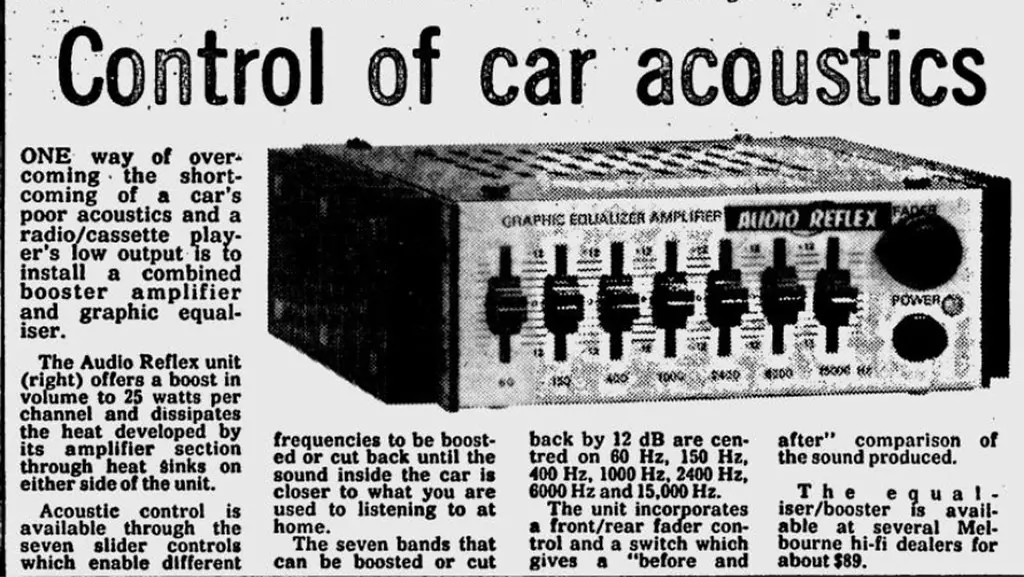
A graphic EQ is the easier buy when you want basic tone control and a straightforward install. A DSP is the better buy when you need per-channel correction, time alignment, and deeper crossover control. For a factory stereo, that difference matters more than brand names.
If your factory radio has no RCA outputs and your front doors sound thin at highway speed, a Clarion EQS755 can accept high-level signal, add sub control, and let you trim harsh upper bands without replacing the dash unit.
Which equalizer should you buy?
Start with the system you already have. A factory radio usually needs a high-level graphic EQ. A full active system needs a DSP. The rest comes down to output voltage, channel count, and how much tuning work you want to do.
Clarion EQS755
Pick this for OEM systems and simple aftermarket setups. The 7-band graphic EQ, 7V RCA output, 1/2-DIN chassis, front 3.5mm AUX input, rear RCA auxiliary input, high-level speaker inputs, and independent subwoofer level control make it the most practical cleanup tool here. It is also the clearest fit for first-time buyers who want fewer menu layers.
AudioControl DM-608
Pick this when you need a 6-channel DSP for advanced multi-speaker tuning. It is reported to offer 30 bands of EQ per channel, time alignment per channel, high-level and low-level inputs, and AccuBASS. That depth is what makes it right for a full active system, not for a simple daily-driver cleanup.
Skar Audio SKA7EQ
Pick this if you want a 7-band graphic EQ with up to 7V high-voltage RCA outputs, a 6-channel pre-amp output layout, front/rear/sub outputs, aux input, and subwoofer level control. Its 7-band half-DIN layout and 4.50/5 rating across 1,401 reviews make it a strong midrange choice for mixed factory and aftermarket builds.
Taramps TEQ 7.4
Pick this if you want a simple budget path with 7-band graphic EQ behavior, RCA input/output, auxiliary gain, fader control, 2 input channels, and 3 output channels. It is better for basic balancing than for deep correction. That fits a low-cost install where you want control without a complex learning curve.
Stetsom EQX764
Pick this if you want a 7-band equalizer with a 10V line driver output, 4 inputs, 6 outputs, dedicated sub controls, and high-level input support. The extra input and output flexibility helps in larger systems, but the install can be more involved than a simpler two-input unit.
CT Sounds CT-7EQ
Pick this if you want a 7-band parametric car audio equalizer with band points around 50Hz, 125Hz, 315Hz, 750Hz, 2.2KHz, and 12KHz, plus a claimed 25Hz to 50kHz frequency response and about ±10dB bass, mid, and treble adjustment. Its sub-bass points at 43Hz and 60Hz give you more control over low-end shaping than a plain graphic EQ.
Timpano TPT-EQ7
Pick this if you want a 10V high-voltage line driver with 6-channel RCA output, subwoofer control, crossover, 1/2 Din graphic car audio EQ layout, and high level input. It is a sensible option for signal drive and system control, especially when the amp rack needs a stronger preamp feed.
How do you choose the right EQ?
Choose source compatibility first, then output voltage, then tuning depth. A 7-band graphic EQ is enough for many daily-driver systems. A DSP is the right answer when you need channel-by-channel correction, more crossover control, or time alignment that a graphic unit cannot provide.
Match inputs to your source unit
If you are keeping a factory radio, high-level speaker inputs matter. If you have an aftermarket head unit, RCA input is usually enough. AUX support helps in mixed-source systems, but it should not be the only reason to buy a unit. Fit and wiring path matter more.
Match output voltage to your amplifier gain structure
A 7V, 8V, or 10V output can help send a stronger signal to the amplifier, which may reduce the chance that you need excessive amp gain. That can help noise rejection when the rest of the system is set correctly. It does not fix bad grounding, and it does not guarantee better sound.
Think of higher voltage as more signal headroom. If the amp gain is set too high anyway, a 10V line driver can still feed distortion into the chain. The point is cleaner gain staging, not magic.
Pick band count and tuning depth for your skill level
How many EQ bands do you need? For most car systems, 7 bands is enough to tame broad tonal issues and sub balance. If you want to correct multiple seat positions, speaker locations, and crossover behavior, a DSP with far more control is the better fit.
Plan for subwoofer control and crossover needs
If bass is the main complaint, choose a model with dedicated sub level control and, when possible, a crossover. Clarion, Skar, Stetsom, CT Sounds, and Timpano all give you some path to sub tuning. That makes daily adjustments easier than changing amplifier gain every time.
Budget for install parts and labor
Hidden costs add up fast. You may need a mounting kit for a 1/2-DIN chassis, RCA adapters, high-level adapters, a line-output converter if the source path is wrong, and professional install time if the dash or trim is difficult. The cheapest EQ on paper is not always the cheapest setup.
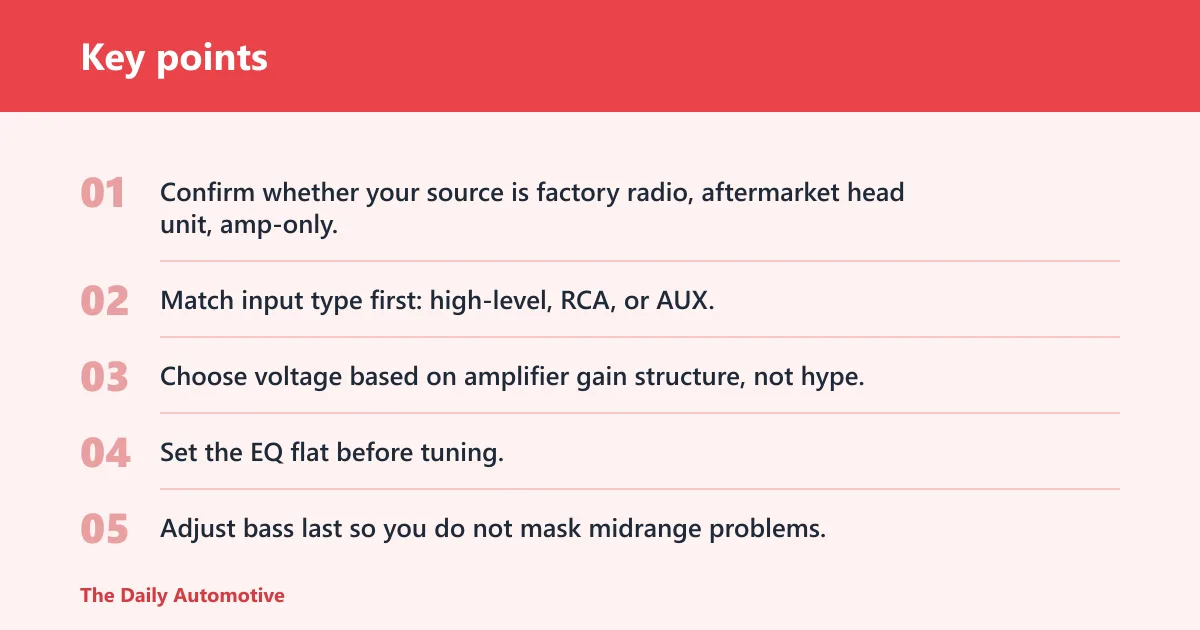
- Confirm whether your source is factory radio, aftermarket head unit, amp-only, or full active.
- Match input type first: high-level, RCA, or AUX.
- Choose voltage based on amplifier gain structure, not hype.
- Set the EQ flat before tuning.
- Adjust bass last so you do not mask midrange problems.
Equalizer setup starts here
Start flat, raise source volume to a normal listening point, then bring up amplifier gain only enough to reach clean output. After that, use the EQ in small moves. If a band needs a large cut or boost, the problem may be elsewhere in the system.
Safe starting curve
Use small changes first. Cut harsh upper bands before boosting bass, and keep the center of the curve near flat. A common first-timer mistake is turning up every low band to “fix” thin bass, which usually creates muddiness and can trigger clipping sooner.
Bass and subwoofer starting points
Set sub level low, then raise it until the bass blends with the front speakers instead of sitting on top of them. If your sub control has a center mark, begin there or slightly below it. If the bass sounds detached, reduce sub level before you touch treble.
Picture a sedan with a factory radio, a small mono amp, and a 12-inch sub in the trunk. If the sub level is too high, the low end will dominate at 30 mph and get worse as road noise rises. Pulling the sub level back a few clicks usually fixes the balance before any big EQ move does.
How to avoid clipping and noise
Do not chase loudness with EQ boosts. Boosting a band too far can clip the source or the amplifier input. If you hear engine whine, check grounds, routing, and adapter quality before blaming the equalizer. Bright LEDs and busy displays are annoyances; hiss and whine are wiring or gain problems.
Can a car equalizer fix engine noise or clipping? No. It can hide a little tonal imbalance, but it cannot repair a bad ground, a noisy alternator path, or gain that is set too hot. If the noise changes with engine speed, fix the noise source first.
When to stop and choose a DSP instead
Stop with a graphic EQ when you have basic tone control and the system now sounds balanced. Choose a DSP when you still need time alignment, separate front and rear tuning, or precise crossover control. That is the line between a cleanup tool and a full tuning platform.
Frequently asked questions
What is the best car audio equalizer for a factory stereo?
The Clarion EQS755 is the best starting point for most factory stereos because it accepts high-level speaker input, offers 7-band graphic control, and gives you independent subwoofer level control. It is the least complicated path when you want cleaner integration without moving to a full DSP.
Should I buy a graphic equalizer or a DSP for car audio?
Buy a graphic equalizer for basic tone shaping, easier setup, and lower install complexity. Buy a DSP if you need per-channel tuning, time alignment, and serious crossover control. A factory-radio cleanup job usually fits a graphic EQ; a full active build usually does not.
How many EQ bands do I actually need in a car?
Seven bands is enough for many systems because it lets you correct broad tonal problems without making setup overwhelming. If your system has multiple speakers, active crossovers, or difficult cabin reflections, more bands and more control are worth the added complexity.
What does a 7-volt or 8-volt preamp output do?
A 7V or 8V output can feed the amplifier a stronger signal, which may let you run lower amp gain and keep more signal headroom. That can help with noise rejection in a well-set system. It is useful, but only when the rest of the gain structure is right.
Products related to this article
Sponsored / affiliate links. As an Amazon Associate I earn from qualifying purchases. I may earn additional commission from eligible campaigns.