Best AWD Drivetrain for Everyday Drivers
AWD is worth paying for only if you regularly face snow, steep hills, gravel, or frequent heavy rain. For most commuters on plowed city roads, FWD is the better value. Choose it without those conditions, and you pay more up front, add maintenance risk, and often lose fuel economy for little daily gain. This guide compares AWD, FWD, and RWD for commuting, winter traction, highway stability, and ownership cost.
What AWD actually does
AWD sends power to all four wheels and can change how much torque each axle receives as road grip changes. That matters in day-to-day driving because the system reacts when one wheel starts slipping, not by locking the vehicle into one fixed split all the time.
How torque split changes
Torque split is not a single number baked into every mile of driving. A 50/50 split is only one operating condition, often used as a shorthand, while real systems may send more power forward or rearward depending on wheel slip, throttle input, and the hardware used to manage traction.
Some AWD systems use a center differential. Others use an on-demand coupling, especially in many models built on front-wheel-drive powertrains. Car and Driver notes that many AWD vehicles use that kind of on-demand setup.
Open differential basics
An open differential is simple, reliable, and cheap. It lets the left and right axle outputs rotate at different speeds, which helps in turns, but it also offers limited control over torque distribution when one wheel loses grip. That is why AWD systems often add extra control logic around the differential or coupling.
For daily driving, that difference matters most on split-grip surfaces: a wet uphill driveway, a slushy intersection, or loose gravel at the edge of pavement.
📊 Car and Driver ranks AWD vehicles using roughly 200 data points. Source: Best AWD Cars for 2026, Ranked.
AWD vs FWD for daily driving
FWD sends power only to the front wheels. It is lighter and simpler than AWD, and it usually wins on purchase price, fuel economy, and maintenance cost. For commuters who spend most of their time on dry or plowed roads, that tradeoff often makes more sense than buying traction they rarely use.
Fuel economy differences
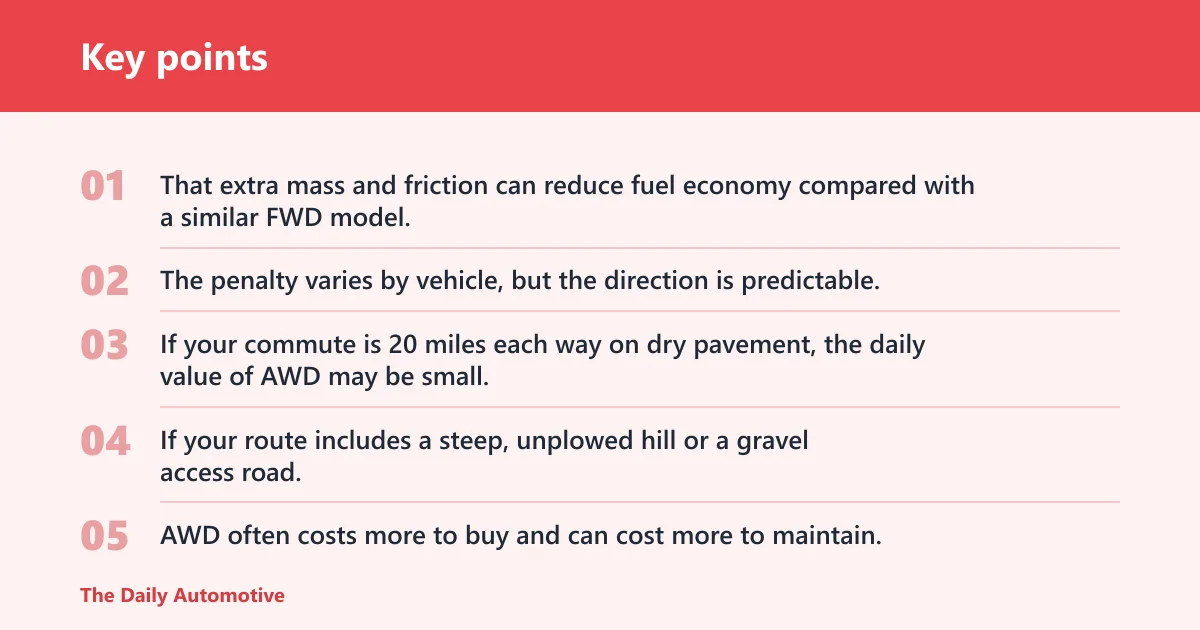
AWD usually adds weight and drivetrain drag. That extra mass and friction can reduce fuel economy compared with a similar FWD model, especially in compact cars and family crossovers where the AWD hardware is extra equipment rather than a core design feature. The penalty varies by vehicle, but the direction is predictable.
If your commute is 20 miles each way on dry pavement, the daily value of AWD may be small. If your route includes a steep, unplowed hill or a gravel access road, the value rises quickly.
Purchase and maintenance costs
AWD often costs more to buy and can cost more to maintain. More parts mean more complexity, and more complexity usually means more service exposure over time. Tires also matter: AWD vehicles should be kept on matched tires, and uneven wear can create extra strain if replacements are delayed.
FWD remains the low-friction choice for budget-conscious drivers. It is generally simpler under the floor, easier to service, and less expensive to keep on the road.
Where FWD still makes more sense
Choose FWD when your roads are mostly dry, your winters are mild, and your priority is low ownership cost. It also makes sense if you want the cheapest route into a sedan, hatchback, or small crossover and you are willing to fit winter tires when weather turns serious.
Say your daily route is a flat suburb-to-office drive with plowed streets and a garage at both ends. FWD with good all-season tires is usually the smarter buy. Add winter tires for the cold months, and you may get more real-world traction than an AWD car on worn-out all-seasons.
When AWD beats 4WD
AWD and 4WD are not interchangeable. AWD is built for everyday paved-road use and mixed conditions. 4WD is better for serious off-roading, slow terrain work, and trucks that need manual modes such as 4-High and 4-Low.
Paved-road commuting
For commuting, highway driving, and city use, AWD is the better fit. It can move power between wheels automatically when grip changes, which helps on rain-slick pavement, packed snow, and loose shoulders without requiring the driver to shift modes or think about range gearing.
Car and Driver distinguishes 4WD as mainly for trucks. That lines up with the daily use case: 4WD is built for low-speed terrain control, while AWD is aimed at mixed traction on roads.
Snow, rain, and mixed conditions
AWD helps keep a vehicle moving on snow-covered roads, and it can improve stability on wet pavement or gravel. That does not mean it shortens stopping distances by itself. Tires still do the braking and cornering work, so tread choice matters as much as the drivetrain.
Why 4WD fits rough terrain better
If your route includes ruts, rocks, deep mud, or long unpaved climbs, 4WD usually belongs on the shortlist instead of AWD. Low-speed terrain work needs gearing and lockup choices that most AWD systems are not built to provide.
Suppose a driver lives on a steep rural road that turns to packed snow for four months and ends in an unplowed gravel driveway. AWD helps at the pavement-to-gravel transition, but a truck-based 4WD system becomes more relevant only if the route turns into actual off-pavement work.
AWD daily driver tradeoffs
The daily-driver case for AWD is not only about traction. It is also about what you give up: fuel economy, purchase price, tire costs, and sometimes service complexity. Those costs are easy to ignore in a showroom and hard to ignore over several years of commuting.
Weight and fuel use
Extra AWD hardware adds mass. More mass usually means more fuel use, especially in stop-and-go driving where the vehicle repeatedly gets moving from a stop. For highway commuters, the gap may be smaller, but it rarely disappears.
Tire and brake wear
AWD does not eliminate wear. It can hide traction problems by pulling the vehicle through conditions where FWD or RWD would struggle, but that same use often means more tire rotation discipline is needed. Brake wear is mostly driven by vehicle weight, traffic, and driver habits rather than AWD alone.
The real maintenance point is consistency. Keep tire sizes and tread depth closely matched, or the system can work harder than intended.
Service complexity and cost
AWD systems can add driveline service items such as coupling fluids, extra differentials, or transfer components depending on the design. Car and Driver notes that open differentials are simple, reliable, and cheap, which is one reason basic drivetrains stay attractive for drivers who do not need extra traction hardware.
Commute drivetrain table
Use this table to match your routine to a drivetrain. The scoring rule below is simple: add 2 points for each condition that strongly fits AWD, 1 point for a mild fit, and 0 points if it does not apply. If AWD reaches about 6 points or more, it may be worth the cost. If FWD reaches about 6 points and AWD stays below about 4, FWD is generally the better value. RWD belongs where dry roads, rear-biased handling, or towing/performance priorities matter more than all-weather traction.
| Climate | Road type | Annual mileage | Winter tire use | Ownership budget | Recommended drivetrain |
|---|---|---|---|---|---|
| Mild, dry most of the year | Plowed city streets, highway | Under 10,000 | Not planned | Tight budget | FWD |
| Frequent rain, occasional slush | Mixed suburban roads | 10,000 to 15,000 | All-season tires only | Moderate budget | AWD |
| Cold winters, snowstorms several times a season | Hills, unplowed side streets | 12,000 to 18,000 | Yes, winter tires | Moderate to high budget | AWD |
| Warm climate, dry pavement | City and interstate | 15,000 to 20,000 | No | Any budget | FWD or RWD |
| Steep gravel access road | Mixed pavement and loose surface | 8,000 to 16,000 | Seasonal winter tires | Moderate budget | AWD |
| Serious off-road terrain | Ruts, mud, rocks | Any | Any | High budget | 4WD |
Winter tire use decision rule
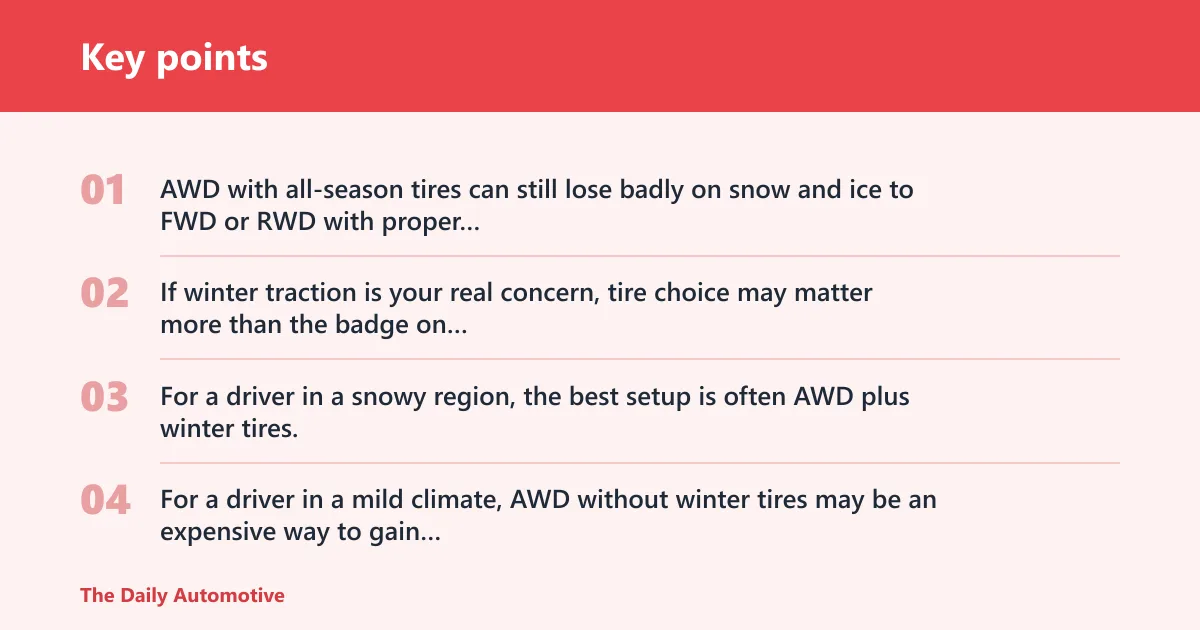
Winter tires change the answer. AWD with all-season tires can still lose badly on snow and ice to FWD or RWD with proper winter tires. That is the part many shoppers miss. If winter traction is your real concern, tire choice may matter more than the badge on the hatch.
For a driver in a snowy region, the best setup is often AWD plus winter tires. For a driver in a mild climate, AWD without winter tires may be an expensive way to gain little.
Where AWD makes the most sense

AWD makes the most sense in body styles that see mixed use: compact crossovers, sedans that need winter confidence, and some sports cars or performance sedans that need traction off the line. Car and Driver says AWD can be standard or optional on many SUVs, and it is also available on some sedans and sports cars.
Compact crossovers
Compact crossovers are the most common place to find AWD as an option. That makes sense because they are often used by commuters, family drivers, and people who live where weather changes quickly. In that segment, AWD should be chosen for actual weather and route needs, not as a default box to tick.
AWD sedans and sports cars
AWD sedans can be a smart fit for cold-weather commuters who want car-like efficiency and manners. Sports cars with AWD use the system for traction and launch grip, not for mud or trail use. Ride + Drive lists the Mazda 3 as AWD optional from 2019, the Subaru WRX as standard AWD, and the Toyota Camry as gaining AWD as an optional feature from 2020.
Hybrid and EV AWD variants
Hybrid AWD and EV AWD models use the same idea in a different package: a second axle or an electric motor on one axle can help with traction control and packaging. That can be useful for commuters who want all-weather capability without moving to a truck-based platform. The same rule still applies, though: buy it for the roads you actually drive.
A common first-timer mistake is buying AWD for a warm-climate commute and then keeping the same all-season tires for years. In that case, the driver pays extra for hardware that rarely helps, while the tires remain the weak link in rain and winter weather.
Which drivetrain should you choose?
Choose AWD if your regular driving includes snow, ice, steep hills, gravel, or heavy rain often enough that those conditions shape your commute. Choose FWD if you want the lowest cost, the best fuel economy, and you mostly drive on dry or plowed roads. Choose RWD if your priorities are performance balance or a rear-drive platform and weather is not a major issue.
Choose AWD
Pick AWD when winter weather is routine, when your driveway or work route is slippery, or when stability in poor weather matters more than fuel savings. It is the practical choice for many cold-climate crossovers and some sedans. It is not a blanket upgrade for every driver.
Choose FWD
Pick FWD when your commute is mostly urban, your winters are mild, or your budget is tight. It remains the strongest value play for many commuters because it keeps purchase price, fuel use, and maintenance lower while still handling normal daily traffic well.
Choose RWD
Pick RWD if you want a rear-drive car for handling feel, towing balance, or a performance model and your road conditions are mostly dry. It can be a fine daily driver in the right climate, but it is less forgiving than FWD or AWD on slick pavement without the right tires.
Frequently asked questions
What drivetrain is best
There is no single best drivetrain for every driver. FWD is often the best value for dry or plowed routes, AWD can make sense when weather or surface changes are frequent, and RWD is often chosen for performance or certain vehicle layouts. The right answer depends on your commute, climate, and budget.
Drivetrain fwd vs awd
FWD is lighter, simpler, and usually cheaper to buy and maintain. AWD adds traction on snow, rain, gravel, and steep grades, but it also adds cost and often reduces fuel economy. For most commuters on good roads, FWD is the more efficient choice.
All wheel drive vs awd
Those terms are usually the same thing. “All-wheel drive” is the full phrase, and “AWD” is the abbreviation. The important distinction is not the name; it is the system design, since some AWD setups are on-demand and others manage torque with more sophistication.
Is awd better than front wheel drive?
AWD is better than FWD only when traction changes are part of your normal driving life. If you face snow, ice, steep driveways, gravel, or heavy rain often, AWD can be worth the extra cost. If you do not, FWD usually gives better value with fewer ownership penalties.
Awd vs rear wheel drive
AWD usually wins for all-weather commuting because it can send power to whichever wheels have grip. RWD can feel better for handling and performance, but it needs the right tires and the right climate to shine as a daily driver. On slick roads, AWD is the easier choice.
What are the best awd vehicles?
The best AWD vehicles are the ones that fit your route, not the biggest or most expensive ones. Compact crossovers often make the strongest case for family use, while some sedans and sports cars offer AWD for traction and winter confidence. The right model is the one whose AWD matches your climate and budget.
Products related to this article
Sponsored / affiliate links. As an Amazon Associate I earn from qualifying purchases. I may earn additional commission from eligible campaigns.