Car Drivetrain Cost: What You’ll Actually Pay
Car drivetrain cost often ranges from about $500 to $6,000, but the bill depends on the layout and failed part: a U-joint or axle is often under about $1,000, while a transfer case, differential, or transmission-related repair can reach several thousand. Ignore a slipping or clunking drivetrain and you can end up with a car that will not move, or a repair that turns into a full replacement. This guide breaks costs down by front-, rear-, and all-wheel-drive layout, then by the subassembly most likely to fail.
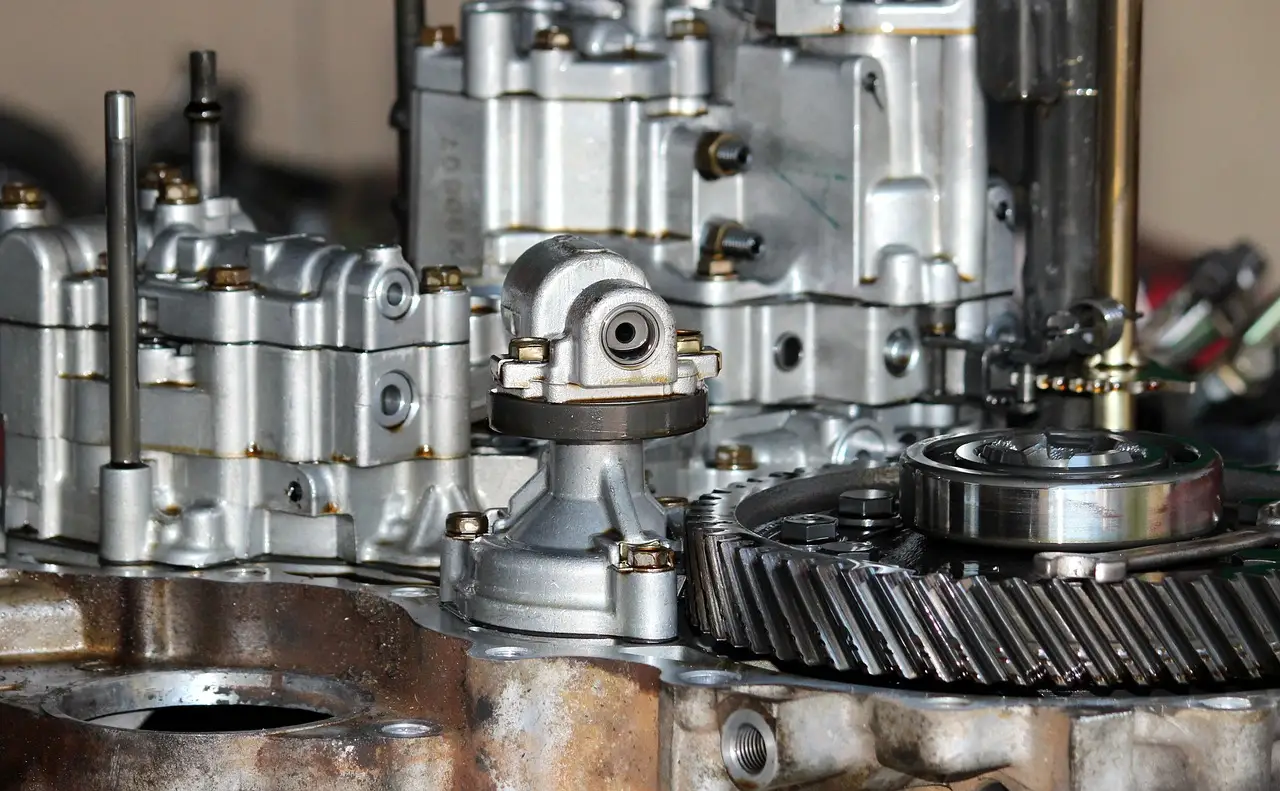
The drivetrain is the transmission, transfer case, driveshaft, axles, and CV axles that carry engine power to the wheels. In quotes, that may mean one part, a few connected parts, or a complete assembly with related hardware.
What does drivetrain cost include?
That matters because “drivetrain” is not a single part number. A shop may quote a transmission repair, a transfer case rebuild, a driveshaft replacement, or a full drivetrain swap with much more labor tied to the vehicle layout.
What a quote may cover
A small quote usually covers one failed subassembly and the labor to remove and reinstall it. A larger quote may include seals, fluids, software relearns, mounts, and a scan to confirm the fault. The biggest quotes are for complete assembly replacement, where several major pieces are changed at once.
Dealers, independents, and salvage or remanufactured parts sources price the same job differently because they buy parts at different costs and bill different labor rates. OEM-grade drivetrain components are commonly marketed as matching or exceeding manufacturing criteria, but the exact part still has to match the vehicle year, make, model, engine, and drivetrain layout.
Drivetrain cost estimator table
Use this table as a quote filter, not a final invoice. The parts-cost bands below are typical ranges for the failed subassembly itself, while labor varies with access, rust, and whether the vehicle is FWD, RWD, AWD, or 4WD. Diagnostics usually add scan and test-drive time before the repair starts.
| Failed part | Typical parts-cost band | Labor-hour range | Symptom pattern most likely to trigger it |
|---|---|---|---|
| Transmission | $1,500 to $4,500+ | 6 to 12 | Slipping, delayed engagement, hard shifting, warning light |
| Transfer case | $800 to $2,500 | 4 to 8 | Grinding, fluid leak, AWD/4WD binding or no front/rear drive split |
| Driveshaft / U-joint | $150 to $1,200 | 1.5 to 4 | Speed-related vibration, clunk on takeoff, thump under load |
| CV axle | $250 to $900 | 1.5 to 3 | Clicking on turns, vibration, torn boot with grease loss |
| Complete drivetrain replacement | $2,500 to $8,000+ | 8 to 16 | Multiple failed parts, metal contamination, repeated warning lights |
Read the table this way: if the symptom points cleanly to one part, the repair should start there. If the symptom points to a transmission plus transfer case, or to widespread metal contamination, the bill moves toward replacement scope fast.
How much does each failed part cost?
Transmission repairs are usually the most expensive drivetrain job because the unit contains many internal parts and removal is labor-heavy. Transfer cases are next in line for AWD and 4WD vehicles, while driveshafts, U-joints, and CV axles are often priced separately and usually cost less than a major gearbox repair.
Transmission
Automatic transmissions often cost more to repair or replace than manuals because they have more internal parts and more failure paths. A slipping unit, a hard-shifting unit, or one that sets a warning light can need anything from valve-body work to a full rebuild or remanufactured replacement.
For budgeting, a transmission repair often lands in the low thousands once labor is included, and complete replacement can climb much higher if the unit is buried in the chassis. If the quote is for a rebuilt or remanufactured transmission, ask whether the torque converter, seals, cooler flush, and programming are included.
Transfer case
Transfer cases apply to AWD and 4WD systems, where they send power to both axles. Grinding noises, leaks, and fluid-related wear are common triggers for repair. Because these units sit in the middle of the drivetrain, access can raise labor even when the part itself is not the most expensive item on the invoice.
If the shop finds low fluid, metal in the case, or damage from driving with a leak, the cost can move from a seal repair to a rebuild or replacement. That is why AWD and 4WD systems often cost more than a similar FWD job.
Driveshaft, U-joint, axle, and CV axle
A worn driveshaft or U-joint often shows up as vibration, clunking, or a thump on acceleration. Many driveshaft repairs stay below transmission or transfer case pricing, but a long AWD or RWD shaft, center support bearing work, or rusted fasteners can raise the labor total quickly.
Axles and CV axles are often separate line items from the full drivetrain. A damaged CV axle can click on turns, shake at speed, or leak grease from a torn boot. Front and rear axle pricing depends on whether the vehicle uses one axle shaft, a pair, or a more complex independent setup.
Say your front-wheel-drive sedan starts clicking only while turning left in a parking lot. That pattern usually points more toward a CV axle or CV joint than a transmission, so a shop should inspect the axle before quoting a major drivetrain rebuild.
Does drivetrain layout change the bill?
Yes. FWD usually costs less to service than RWD, AWD, or 4WD because it has fewer long shafts and no transfer case. RWD adds driveline length and a rear differential path, while AWD and 4WD add more parts, more fluid service points, and more removal time.
FWD cost pattern
Front-wheel-drive layouts often keep the transmission and transaxle package at the front of the vehicle, which can simplify access. CV axles are common wear items here, and a failed axle often costs less than a comparable AWD driveline fault.
RWD cost pattern
Rear-wheel-drive systems typically use a transmission, driveshaft, and rear axle path. That means one extra shaft compared with many FWD cars, so vibration diagnosis may lead to the driveshaft or U-joints before it points to a gearbox.
AWD and 4WD cost pattern
AWD and 4WD systems usually cost more because the transfer case adds complexity and the vehicle has more rotating parts. The transfer case sends power to both axles in AWD or 4WD systems, so a leak or grinding noise can become expensive if it damages the internal gears or bearings.
Suppose a crossover with AWD has a fluid leak near the transfer case and a warning light. The repair can start with seals and fluid, but if the case has been run low long enough, replacement may be cheaper than rebuilding a damaged unit after teardown.
What symptoms point to which part?
Vibration, clunking, grinding, warning lights, and fluid leaks all point somewhere different. The symptom pattern matters because it can separate a driveshaft problem from a transmission issue, or a CV axle problem from a transfer case fault.
Vibration and speed-related shudder
Vibration while driving often points to a driveshaft, U-joint, bent shaft, or a CV axle that is worn enough to shake under load. A worn driveshaft can cause vibration and poor handling feel, especially at speed, but the cause still needs a lift inspection before anyone approves parts.
Clunking, grinding, and drivetrain lash
Unusual clunking or banging noises often point to worn U-joints, loose mounts, or excessive play in a shaft or differential connection. Grinding noise is more concerning inside a transmission or transfer case, especially when it comes with low fluid or metal in the housing.
Fluid leaks, warning lights, and shift problems
Leaking fluid around the axle or transfer case should never be ignored, because low fluid drives wear. A drive train failure warning light, slipping, or shifting faults often push diagnosis toward the transmission first, then toward related sensors, wiring, or fluid condition if the unit still moves normally.
Common symptoms of drivetrain failure include odd noises, vibrations, and a drive train failure warning light. Those signs do not name the broken part by themselves, but they do tell the shop whether to focus on the shaft, case, axle, or transmission first.
Repair or replace the drivetrain?
A single-part repair makes sense when the failed piece is isolated and the rest of the system tests clean. Replacement becomes the better call when the damage is widespread, the vehicle has multiple worn parts, or teardown labor would nearly equal the cost of a remanufactured unit.
When a single-part repair is the better call
If the fault is a CV axle, U-joint, seal, or external sensor and the related hardware passes inspection, a targeted repair usually saves money. That is the point where the drivetrain cost is really a parts-and-labor decision, not a whole-system replacement decision.
When remanufactured or used parts can make sense
Remanufactured parts often make sense for transmissions and transfer cases when the labor to remove and reinstall is already high. Used parts can work for older vehicles with lower market value, but only if the part history, fitment, and mileage are acceptable and the shop is comfortable standing behind the install.
When complete replacement is the more realistic option
Complete replacement becomes more realistic when the transmission has internal damage, the transfer case has lost lubrication, or metal contamination has spread through the unit. If several linked parts are failing at once, replacing only one can leave you paying for the same labor twice.
A common first-timer mistake is authorizing the cheapest visible part without asking what failed upstream. If a noisy transfer case has already sent metal through the system, a seal-only repair may not solve the problem for long.
What drives labor and diagnostics?
Labor and diagnostics can add a large share of the final bill. Shops usually charge for scan time, test driving, lift inspection, fluid checks, and the removal and reinstall work required to get to the failed component.
Scan, test drive, and inspection time
Expect a diagnostic scan and road test before any major quote. That time is how a technician separates a driveshaft vibration from a transmission slip, or a transfer case grind from a wheel or tire issue that only feels drivetrain-related.
Removal and reinstall difficulty by layout
Layout changes labor hours. FWD jobs can be quicker for some axles, while RWD and AWD may require longer shaft removal, exhaust clearance, or transfer case work. The more parts that have to come off to reach the failed unit, the more the bill rises.
How labor rates change the final total
Labor rates vary by region, by shop type, and by whether the repair is at a dealer or an independent garage. A job that needs 6 hours at one rate and 10 hours at another can differ by hundreds of dollars before parts are added. That is why two estimates can both be reasonable yet look very different.
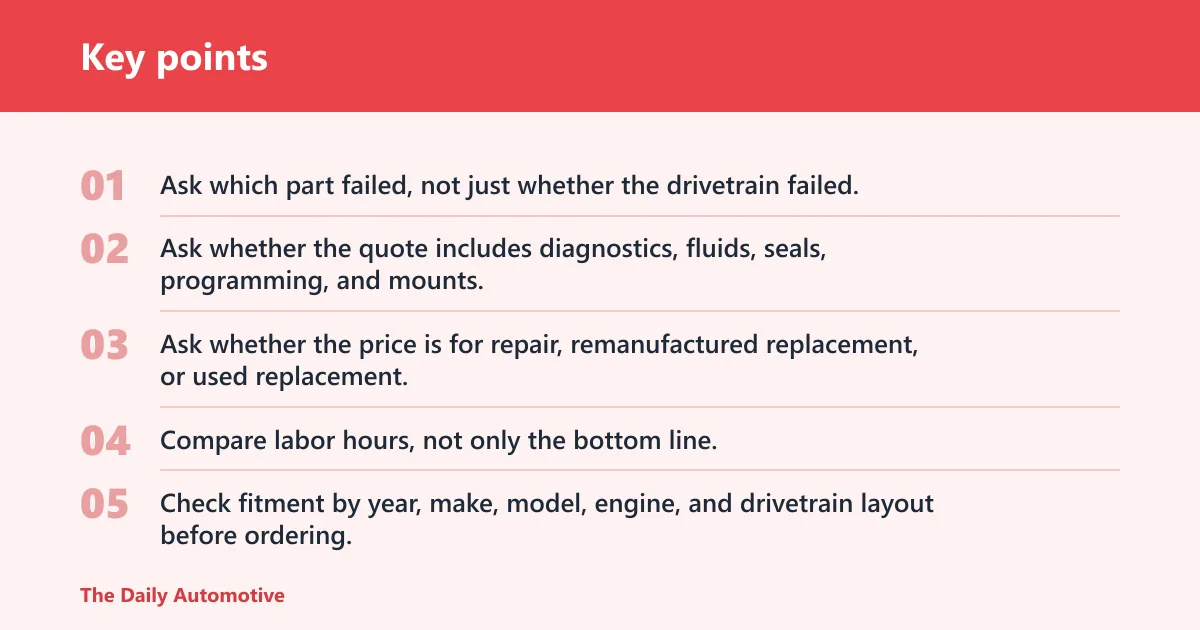
- Ask which part failed, not just whether the drivetrain failed.
- Ask whether the quote includes diagnostics, fluids, seals, programming, and mounts.
- Ask whether the price is for repair, remanufactured replacement, or used replacement.
- Compare labor hours, not only the bottom line.
- Check fitment by year, make, model, engine, and drivetrain layout before ordering.
Frequently asked questions
How much does a new drivetrain cost?
A new drivetrain usually means a replacement transmission, transfer case, axle set, or related assembly rather than one small part. Depending on layout and failure scope, the cost can run from about $500 for a simple axle job to $6,000+ for a transmission- or transfer case-heavy repair with major labor.
How much is a drivetrain to fix?
Fixing a drivetrain can be a few hundred dollars for a U-joint or CV axle, or several thousand for a transmission or transfer case repair. The final number depends on which subassembly failed, how much labor is needed, and whether the shop finds related damage during inspection.
How much does it cost to replace a drivetrain?
Complete drivetrain replacement often lands between $2,500 and $8,000+, with the higher end common when the transmission or transfer case is involved. AWD and 4WD systems usually cost more than FWD because they add parts, fluids, and labor time.
Is it cheaper to repair a drivetrain or replace it?
Repair is cheaper when the failure is isolated to one part, such as a CV axle, U-joint, seal, or external sensor. Replacement makes more sense when several linked parts are worn, the unit is contaminated with metal, or teardown labor would come close to a remanufactured assembly.
Does AWD cost more to repair than FWD or RWD?
Usually, yes. AWD and 4WD add a transfer case and more driveline parts, so they take longer to inspect and remove. FWD often has the simplest cost pattern, while RWD sits in the middle because of the driveshaft and rear axle path.
Can I drive with a bad drivetrain?
It is risky. A drivetrain problem can start as odd noises, vibrations, or a warning light, then turn into a no-move condition, more internal damage, or a roadside breakdown. If the car is slipping, grinding, or leaking fluid, limit driving and get it checked quickly.
Products related to this article
Sponsored / affiliate links. As an Amazon Associate I earn from qualifying purchases. I may earn additional commission from eligible campaigns.