Balloon Payment vs Traditional Auto Loan: Which Fits?
A balloon auto loan can lower monthly payments now, but a traditional auto loan is usually safer if you want a fixed payoff and less refinance risk at maturity. Skip the final balloon and you can face a large lump sum, forced refinancing, or negative equity if the car is worth less than the balance. This guide compares payment structure, total cost, resale timing, and the decision points that matter.
| Decision factor | Balloon Payment | Traditional Auto Loan | Winner |
|---|---|---|---|
| Monthly payment | Lower, because part of the principal is pushed to the end | Higher, because principal and interest are spread across the full term | Balloon Payment |
| Payoff certainty | Depends on refinancing, resale value, or cash at maturity | Fixed payoff date if you make every payment on time | Traditional Auto Loan |
| End-of-term risk | Large final balance can trigger payment shock or negative equity | No large final lump sum if kept to term | Traditional Auto Loan |
| Exit flexibility | Can work if you plan to sell, trade, or refinance on schedule | Works well for owners who want to keep the car and finish the loan | Tie |
| Budget simplicity | Less predictable near maturity because the balance may still be substantial | Usually simpler for budgeting over the full term | Traditional Auto Loan |
Balloon payment vs traditional auto loan: the core trade-off
A balloon auto loan can lower your monthly bill by leaving a final lump sum due at maturity, while a traditional auto loan usually pays down the full balance in equal installments. Balloon loans improve monthly cash flow, but they move more risk to the end of the term.
What a balloon payment auto loan is
A balloon payment auto loan usually has smaller monthly payments during a short or mid-length term, then a final balloon balance due at the end. That final payment can be large compared with the monthly bill, and it may require refinancing, a sale, trade-in, or a cash payoff.
How a traditional auto loan amortizes principal and interest
A traditional auto loan is generally fully amortizing. Each scheduled payment covers interest and principal, so the balance falls to zero by the end of the term if you stay current. There is no large final lump sum, which makes the payoff date more predictable.
Why the monthly payment is lower on a balloon loan
The lender collects less principal each month on a balloon structure, so the payment is lower at the front end. That can help cash flow, but it does not erase the obligation; it mainly delays it. The question is whether the lower payment is worth the maturity risk.
How do the monthly payments and total cost compare?
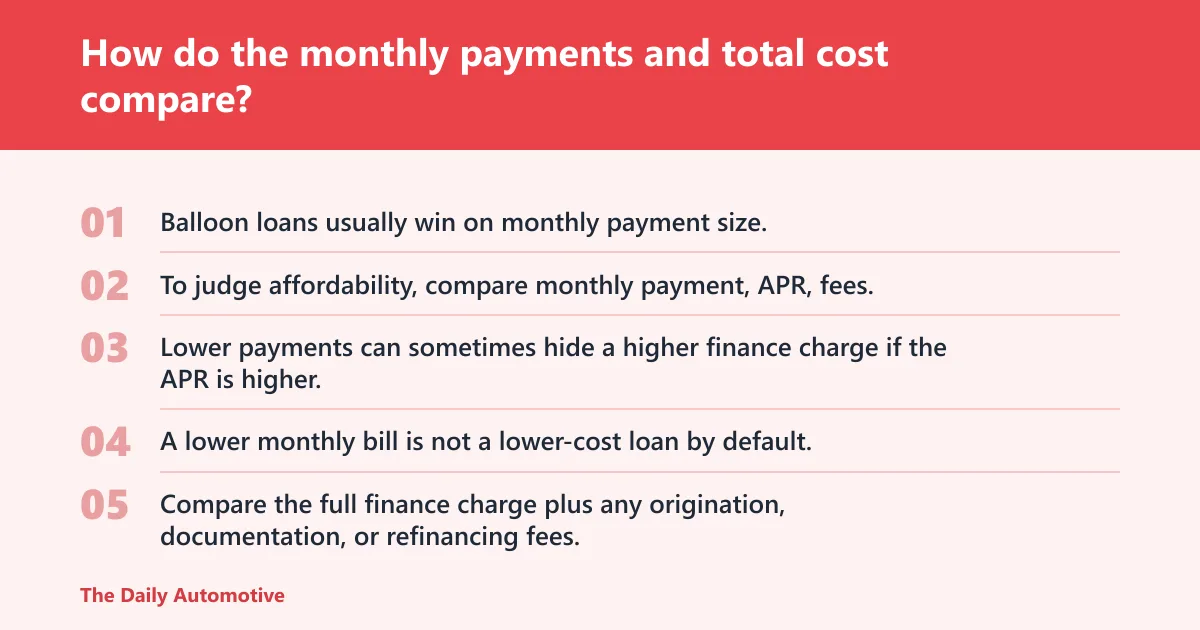
Balloon loans usually win on monthly payment size, but traditional auto loans often win on cost clarity and payoff certainty. To judge affordability, compare monthly payment, APR, fees, and the total interest you will pay over the life of the loan, not just the number on the first payment quote.
Monthly payment versus total interest and fees
Lower payments can sometimes hide a higher finance charge if the APR is higher, the term is longer, or the balloon balance is refinanced later. A lower monthly bill is not a lower-cost loan by default. Compare the full finance charge plus any origination, documentation, or refinancing fees.
Why the final balloon balance changes the real cost picture
The final balloon balance is the remaining principal due at maturity. It can be large compared with the monthly payment, and in some contracts it may be a large share of the vehicle’s projected value. That is the point where a cheap-looking payment can become a cash problem.
How loan term affects cash flow and overall affordability
A shorter effective commitment can help if your ownership plan is also short. A longer schedule can reduce pressure but may raise total interest. Match the term to your planned holding period, because paying for years beyond your expected exit creates unnecessary financing cost.
Say your monthly payment drops by a few hundred dollars under a balloon structure, but the final balance is still due in 36 months. That looks affordable until the last payment lands at the same time as taxes, insurance renewals, or a repair bill.

What happens when the balloon payment comes due?
At maturity, you usually have a few paths: pay the balance in cash, refinance it, sell the car, or trade it in. The right choice depends on the remaining balance, the vehicle’s market value, and whether your credit and loan-to-value ratio still support refinancing.
Pay the final balance in cash
If you have the money, cash payoff is the cleanest exit. You own the car free and clear, and you avoid new financing costs. The catch is obvious: the final payment can be large enough to strain your cash flow budget.
Refinance the balloon balance
Refinancing can spread the final balance into new payments, but approval is not guaranteed. Lenders will look at credit, income, and loan-to-value. New fees, a higher rate, or a longer term can make the refinance meaningfully more expensive than the original plan.
Sell or trade the vehicle to cover the payoff
If the car’s resale or trade-in value is high enough, sale proceeds can cover the balloon balance. This works best when mileage is modest, condition is strong, and the market still wants that model. It is the cleanest non-cash exit if value and timing line up.
What happens if the car is worth less than the balloon balance
That is negative equity. If the vehicle’s trade-in or sale value falls short of the payoff, you must bring cash to the table or roll the shortfall into another loan. That creates payment shock and can trap you in another round of debt.
How does vehicle value affect your exit options?
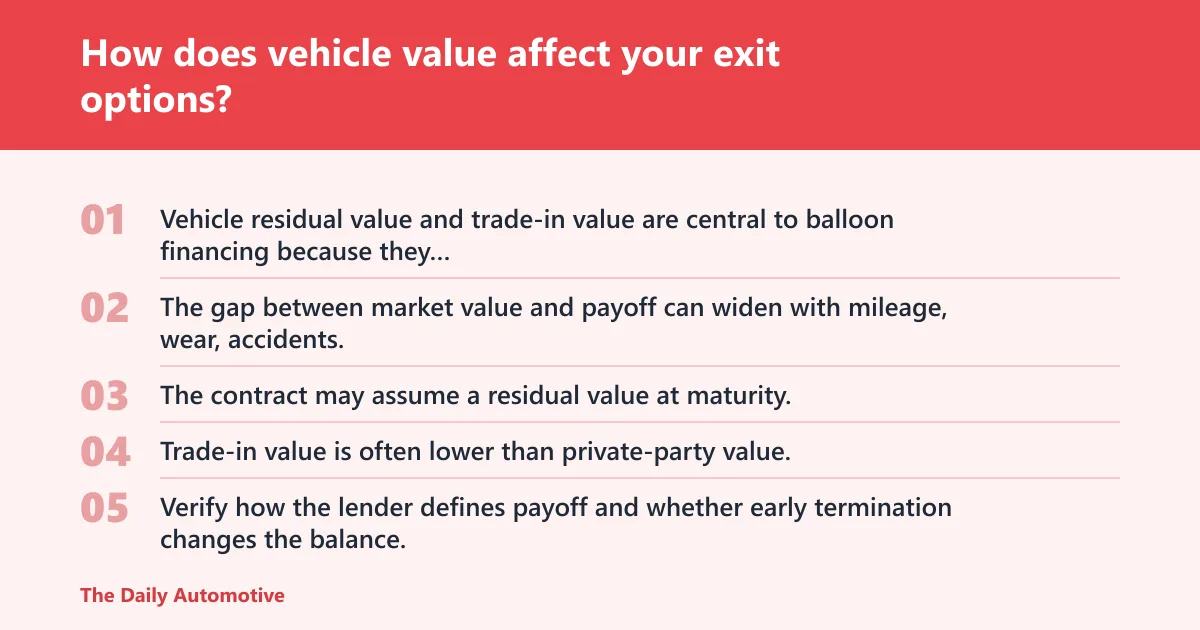
Vehicle residual value and trade-in value are central to balloon financing because they determine whether the sale covers the remaining balance. The gap between market value and payoff can widen with mileage, wear, accidents, market softening, or a lender residual assumption that was too optimistic.
Residual value, trade-in value, and payoff balance
The contract may assume a residual value at maturity, but the real market value can be higher or lower. Trade-in value is often lower than private-party value, which matters if you expect to exit at a dealer. Verify how the lender defines payoff and whether early termination changes the balance.
Why depreciation risk matters more with balloon financing
Traditional loans reduce balance steadily, so the equity picture often improves over time if the car holds value. With a balloon loan, the final balance can remain large enough that normal depreciation leaves you exposed. That is why payment shock and equity risk move together.
What to verify in the contract about mileage, condition, and residual assumptions
Check the mileage limit, wear-and-tear language, maturity payoff formula, and any residual-value assumptions used by the lender. Also confirm whether fees are added at maturity, because those charges can change the breakeven point. Small contract details matter more here than on a standard loan.
| Ownership scenario | Likely best loan type | Key risk | What to verify in the contract |
|---|---|---|---|
| Keep to term | Traditional Auto Loan | No balloon balance means less maturity stress | Amortization schedule, APR, payoff date, prepayment rules |
| Trade early | Balloon Payment | Negative equity if the market value lags behind the balance | Early payoff amount, trade-in settlement rules, fees |
| Sell before maturity | Balloon Payment | Sale proceeds may miss the payoff if depreciation is faster than expected | Title release process, payoff quote timing, mileage and condition terms |
| Refinance at maturity | Balloon Payment | Refinance may cost more or be denied if credit or value weakens | Rate adjustment terms, fees, credit review, loan-to-value thresholds |
| Face a depreciation shortfall | Traditional Auto Loan | Balloon due plus weak resale value can create a cash gap | Residual assumptions, maturity value estimate, deficiency liability |
Are balloon loans ever a rational choice?
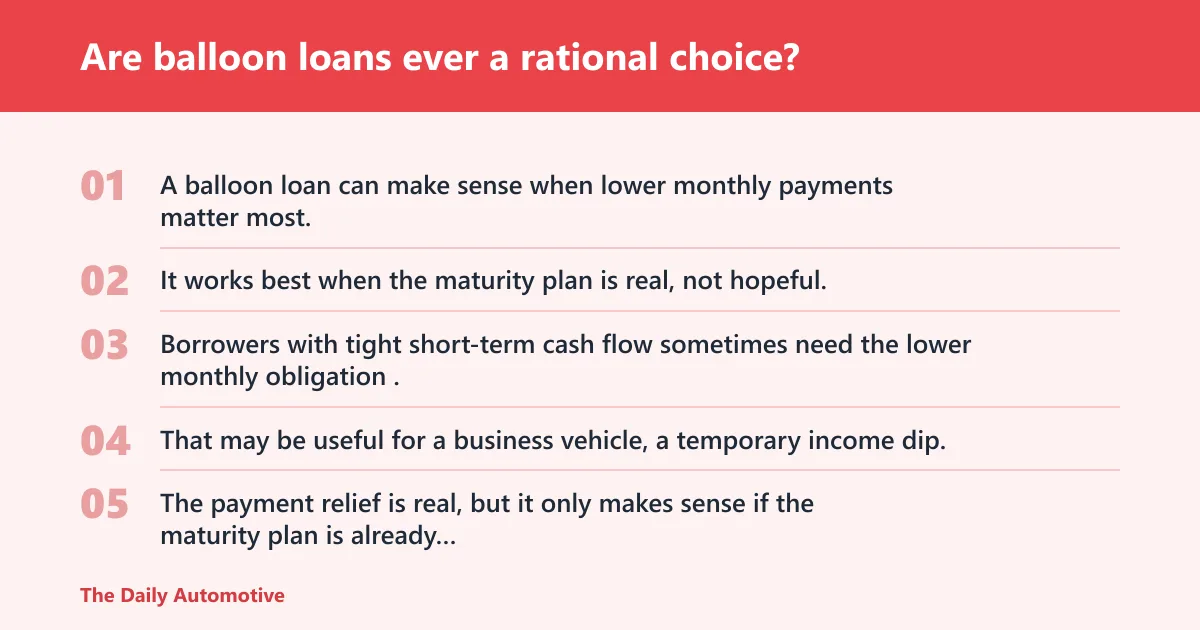
Yes, in specific cases. A balloon loan can make sense when lower monthly payments matter most, when you expect a short ownership horizon, or when a known exit path makes the final balance manageable. It works best when the maturity plan is real, not hopeful.
When lower monthly payments matter most
Borrowers with tight short-term cash flow sometimes need the lower monthly obligation. That may be useful for a business vehicle, a temporary income dip, or a planned near-term sale. The payment relief is real, but it only makes sense if the maturity plan is already funded.
When you expect a short ownership horizon
If you know you will sell or trade before the balloon comes due, the lower monthly payment can be rational. The key is that your exit timeline has to match the loan structure. If the timeline slips, the balloon problem comes back fast.
When the vehicle value or business cash flow can support the exit plan
Balloon financing can be workable when projected trade-in value is strong enough to cover the payoff or when business cash flow can absorb the final balance. That still requires stress testing for a weaker resale market. The best case is one where the car’s equity, not hope, covers the exit.
Suppose a buyer chooses a balloon loan on a multi-year term and plans to trade partway through the term. If the market softens and the trade-in quote comes in below the payoff, the buyer must either bring cash or roll debt into the next loan. The lower payment did not remove the balance; it postponed it.
Choose Balloon Payment if… / Choose Traditional Auto Loan if…
Choose a balloon payment auto loan if you can cover or exit the final balance with confidence, expect to sell or trade before maturity, or need lower monthly payments for a defined short-term reason. Choose a traditional auto loan if you want a predictable payoff path, simpler budgeting, and less dependence on resale value or refinancing.
Choose balloon payment if…
- You have a clear plan to sell, trade, refinance, or pay cash at maturity.
- You expect strong resale or trade-in value that can cover the remaining balance.
- Short-term cash flow matters more than long-term simplicity.
- You can absorb a refinance fee, rate change, or a small shortfall without strain.
Choose traditional auto loan if…
- You want equal scheduled payments that steadily reduce principal and interest.
- You plan to keep the vehicle to term.
- You want a fixed payoff date with no large final lump sum.
- You prefer a loan that is easier to budget around alongside insurance, taxes, and maintenance.
Contract terms to verify before you sign
- APR and all finance charges, including origination or documentation fees.
- Exact maturity date and final balloon balance formula.
- Prepayment rules and early payoff quote process.
- Refinance terms, fees, and any rate reset language.
- Mileage, condition, and residual-value assumptions tied to the vehicle’s exit value.
Frequently asked questions
What is a balloon payment on a car loan?
A balloon payment is a large final sum due at the end of a car loan after smaller monthly payments during the term. The structure leaves part of the principal unpaid until maturity, which lowers the monthly bill but creates a big end-of-term obligation.
How does a balloon auto loan differ from a traditional auto loan?
A balloon auto loan uses smaller monthly payments and leaves a final balance due at maturity. A traditional auto loan is fully amortizing, so each payment reduces principal and interest until the loan is paid off with no large lump sum at the end.
Are balloon payments cheaper each month than standard auto loans?
Usually yes, because the lender defers part of the principal to the final payment. That lower monthly cost can be misleading if the APR is higher, fees are larger, or you later refinance the remaining balance on worse terms.
What happens when the balloon payment is due?
At maturity, you can pay the balance in cash, refinance it, sell the car, or trade it in. If the vehicle’s value covers the payoff, the exit can be straightforward. If not, you may need cash to cover the shortfall or a new loan.
Can you refinance a balloon payment at the end of the term?
Often yes, but it depends on credit, income, and loan-to-value. Refinancing is not guaranteed, and the new loan may include fees or a higher rate. That is why the refinance path should be stress-tested before you sign the original contract.
What happens if the car is worth less than the balloon payment?
You have negative equity, which means sale or trade-in proceeds will not fully pay off the loan. You must bring cash, negotiate a settlement, or roll the shortfall into another loan. That shortfall is one of the biggest risks of balloon financing.
Products related to this article
Sponsored / affiliate links. As an Amazon Associate I earn from qualifying purchases. I may earn additional commission from eligible campaigns.
 Auto Car Dent Repair Puller Head Paintless-Dent Repair Removal Kit for Slide Hammer Pulling Tab Adapter Pulling Tabs Car Aluminum-alloy Puller Head Adapter Screw Glue-tabs for Slide Hammer and
 XICHG Universal Auto Body Alignment Bar Pulling Stick Tool, Dent Puller Tool 30 Inch Frame Puller, 3.9 inch Heavy Chain, High-Strength Rubber Pad for Auto Body Repair, Car Dent Removal (30 Inch)