Best Air Filters for Cars (2026): Based on Specs and Reviews
For smoke, fumes, pollen, and dust, choose the filter by the problem: an activated-carbon cabin air filter for odors and gases, a high-efficiency particulate cabin filter for pollen and soot, and an engine air filter matched to OEM spec for airflow. Pick the wrong filter and you can live with stale air, faster clogging, weaker HVAC flow, and a dirtier intake system.
Quick comparison
| Product | Badge | Best for | Price | ||
|---|---|---|---|---|---|
 |
CYBERBEANS Cabin Air Filter for Tesla Model 3/Y, HEPACYBERBEANS | Our pick | Tesla 3/Y · HEPA · 2-Pack | $17.98
Price as of 17 Oct 2026
|
View |
 |
Puroma 2 Cabin Air Filter Activated Carbon for CP157Puroma | Also great | Toyota/Lexus · Carbon · Multi-layer | $15.85
Price as of 17 Oct 2026
|
View |
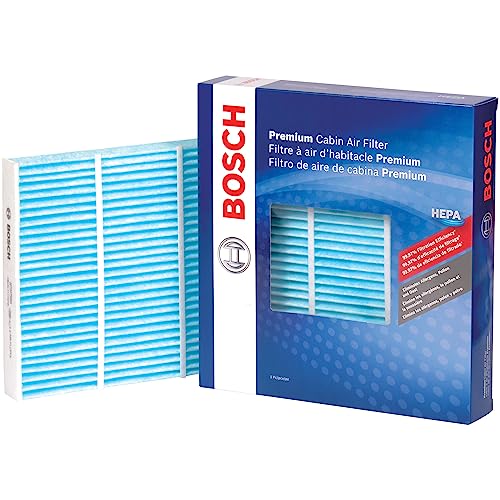 |
BOSCH 6091C HEPA Cabin Air Filter – 3 Layer Protection ForBosch | Budget pick | Chevy/GMC · HEPA · 3-Layer | $10.48
Price as of 17 Oct 2026
|
View |
Every car has two separate jobs here: feeding the engine clean intake air and cleaning the air you breathe in the cabin. If you are buying only one part, decide whether the problem shows up under the hood or through the vents.
Fast rule: most drivers should start with an OEM-style paper engine air filter and a direct-fit cabin filter. Move to activated carbon when odors and exhaust are the issue, and choose HEPA-grade when pollen, wildfire smoke, or fine particles are the main complaint.
How we chose
We compared filters on four practical points: direct-fit compatibility, air-quality need, replacement interval, and upkeep burden. We also separated engine filters from cabin filters so you do not buy the wrong part for the problem.
Preference went to options that fit with no modification, install fast, and make the tradeoff clear. That matters more than brand loyalty here.
- Direct-fit design: replacement should match the vehicle with no cutting, trimming, or adapters.
- Pollutant match: dust, pollen, smoke, fumes, or odors each point to a different filter type.
- Replacement cadence: engine filters and cabin filters wear on different schedules.
- Maintenance burden: disposable filters are simpler; reusable filters need cleaning and attention.
- Total ownership cost: the real choice includes 3-year spend, not only the sticker price.
Quick picks
- Most drivers: OEM-style paper engine filter and standard cabin filter. Lowest hassle, direct-fit, and easy to replace.
- Odors and city traffic: activated carbon cabin filter. Better match for exhaust fumes, diesel smoke, ozone, and smells.
- Allergies and wildfire smoke: HEPA-grade cabin filter. Best fit when pollen and fine particles are the main problem.
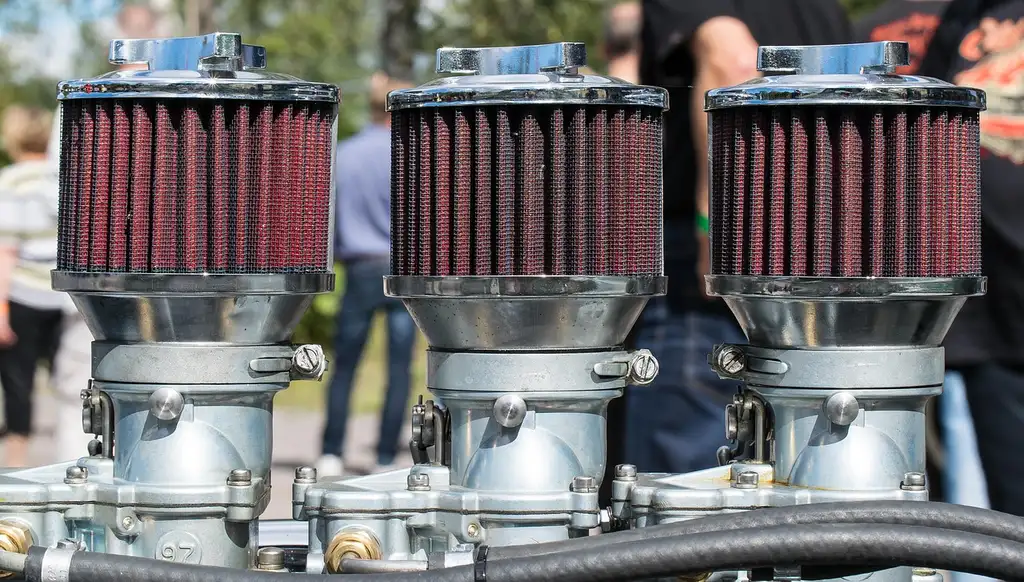
- Long-term reuse: washable K&N-style filter. Higher upfront cost, more upkeep, and a reusable design.
OEM-style paper engine air filter: best for most drivers
OEM-style paper is the right starting point for most drivers because it is a direct-fit replacement, uses a paper element, and keeps maintenance simple. A quality OEM-style paper engine air filter is described as the right choice for most drivers, with replacement commonly needed every 15,000 to 30,000 miles.
This option fits daily driving well. It is low cost, needs no modifications, and keeps airflow and protection in the range most vehicles were designed around.
The tradeoff is simple: once it loads up with dirt, airflow drops. A clogged engine filter is claimed to cost 1 to 2 MPG, so waiting too long can show up at the pump as well as in throttle response.
Best use: commuting, mixed highway driving, and owners who want the least complicated maintenance. If you want a replacement that behaves like the original part, this is the safe default.
Activated carbon cabin filter: best for city traffic
An activated carbon cabin filter is the better pick when the problem is outside air quality, not engine airflow. It absorbs gaseous pollutants and is said to block exhaust fumes, diesel smoke, ozone, and odors, which makes it a strong fit for city traffic and stop-and-go driving.
Use this when the cabin smells like traffic, parking garages, or nearby trucks. It is a direct-fit cabin filter, so installation stays quick and beginner-friendly.
The drawback is that carbon media is about odor and gas control, not every airborne particle. If pollen, pet dander, or wildfire smoke are the main issue, a HEPA-grade cabin filter can make more sense.
Best use: urban routes, tunnels, heavy traffic, and drivers who notice fumes through the vents. Cabin filters typically need replacement every 15,000 to 20,000 miles, though dirty air can shorten that interval.
HEPA-grade cabin filter: best for allergies and smoke
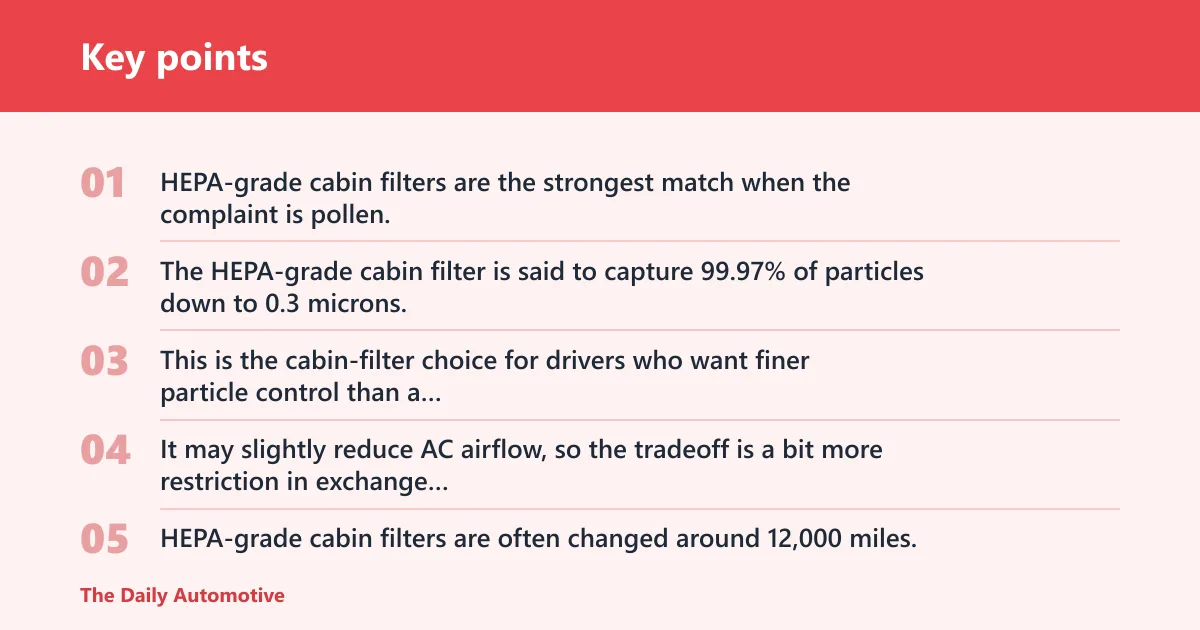
HEPA-grade cabin filters are the strongest match when the complaint is pollen, pet dander, mold spores, wildfire smoke, or PM2.5. The HEPA-grade cabin filter is said to capture 99.97% of particles down to 0.3 microns, which is why it is the best fit for sensitive noses and smoky conditions.
This is the cabin-filter choice for drivers who want finer particle control than a standard or carbon filter can offer. It may slightly reduce AC airflow, so the tradeoff is a bit more restriction in exchange for better particulate capture.
The shorter replacement cycle also matters. HEPA-grade cabin filters are often changed around 12,000 miles, which can make them more expensive over time if roads are dusty or the commute is long.
Best use: spring pollen, wildfire season, pet-heavy households, and routes with visible haze. It is a cabin-air solution, not an engine-air solution.
Washable K&N performance filter: best for long-term reuse
A washable K&N performance filter is the reusable option for drivers who want fewer replacements over the life of the vehicle. It is described as reusable for the life of the vehicle, requires a cleaning kit, carries a 10-year limited warranty, and is said to add 1 to 4 HP on most engines.
The appeal is long-term reuse. The drawback is upkeep: you need to clean and re-oil it correctly, and over-oiling can hurt airflow or contaminate sensors on some intake setups.
That maintenance makes this a premium choice, not an automatic upgrade. It also has a higher upfront cost than a paper filter, so the 3-year math only works if you value reuse and do the upkeep on schedule.
Best use: owners who keep a vehicle for years, want a reusable engine filter, and are willing to clean it properly. For most drivers, paper still wins on simplicity.
Air filter decision matrix
| Driver scenario | Best filter type | Key tradeoff | Replacement interval | Estimated 3-year ownership cost |
|---|---|---|---|---|
| Daily commuter on mixed roads | OEM-style paper engine air filter | Lowest cost, no modification, simple swap | 15,000-30,000 miles | $45-$90 |
| City driving with exhaust fumes or odors | Activated carbon cabin filter | Better odor and gas control, not a particle-specialist | 15,000-20,000 miles | $45-$75 |
| Allergies, wildfire smoke, fine dust | HEPA-grade cabin filter | Strong particle capture, may slightly reduce AC airflow | About 12,000 miles | $60-$120 |
| Long-term ownership and reusable upkeep | Washable K&N performance filter | Higher upfront cost, cleaning kit required | 30,000-50,000 miles | $70-$140 |
These cost estimates assume common replacement patterns over three years and basic aftermarket pricing. The reusable option shifts more cost to the first purchase and maintenance supplies, while disposable filters spread cost across more frequent replacements.
Which one should you buy?
If your budget is the priority, start with an OEM-style paper engine filter and a standard or direct-fit cabin filter. That choice solves most air-quality problems without extra maintenance, and paper remains the best fit for most drivers.
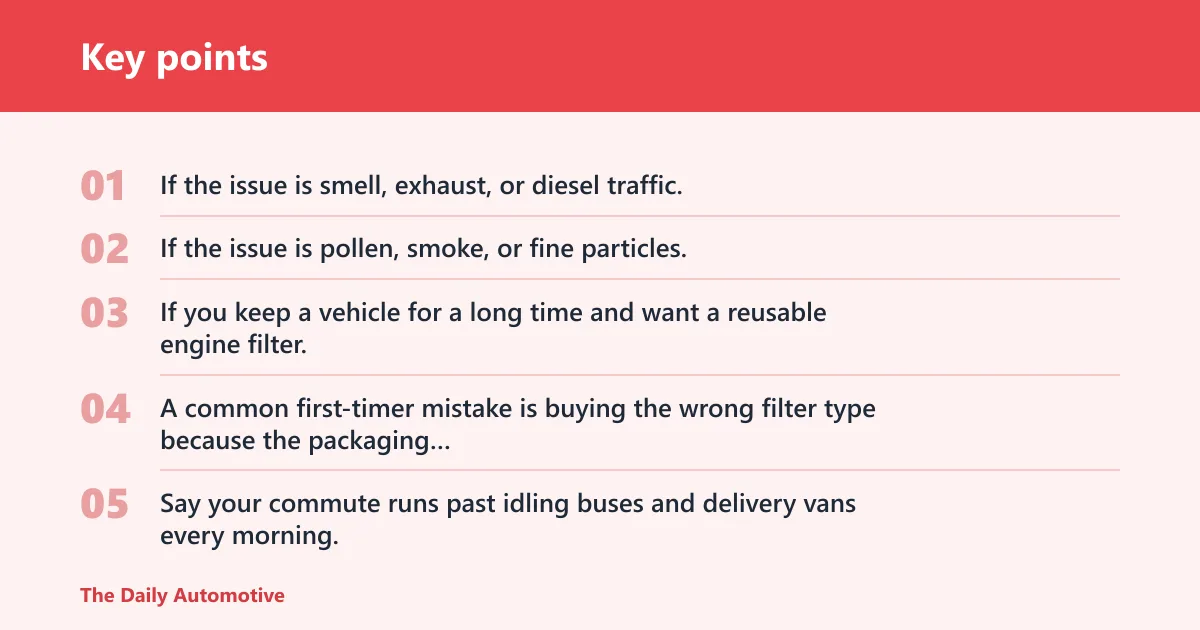
If the issue is smell, exhaust, or diesel traffic, choose an activated carbon cabin filter. If the issue is pollen, smoke, or fine particles, choose HEPA-grade cabin filtration instead.
If you keep a vehicle for a long time and want a reusable engine filter, a washable K&N-style filter can make sense, but only if you are willing to clean it correctly. A common first-timer mistake is buying the wrong filter type because the packaging sounds premium.
Say your commute runs past idling buses and delivery vans every morning. A carbon cabin filter is the first move because the complaint is fumes and odor, not engine intake dust.
Suppose spring pollen turns the cabin into a sneeze zone, but the vents still smell normal. HEPA-grade cabin filtration fits that symptom better than carbon, because the main target is fine particles.
For engine side maintenance, do not wait for a dramatic drivability problem. A clogged engine filter can cut airflow and may cost 1 to 2 MPG, so replacement on schedule is cheaper than ignoring it.
Should I buy an engine air filter or a cabin air filter?
Buy the engine air filter if your concern is intake airflow, engine protection, or fuel economy. Buy the cabin air filter if your concern is what comes through the vents. Most cars have both, and they do different jobs, so the right answer depends on where the air problem shows up.
An engine filter protects the intake tract and affects combustion airflow. A cabin filter protects HVAC airflow and affects what you breathe inside the car. If you have both dirty intake and dirty cabin symptoms, replace both on their own schedules.
How often should I replace my car air filter?
HEPA-grade cabin filters are often changed around 12,000 miles because denser media can load faster.
Dusty roads, heavy traffic, smoke, and construction can shorten those intervals. If airflow drops, odors linger, or the filter looks loaded with debris, replace it sooner.
Will a clogged air filter hurt fuel economy or airflow?
Yes. A clogged engine filter can reduce intake airflow and is claimed to cost 1 to 2 MPG, while a loaded cabin filter can reduce HVAC output and make the cabin feel stuffy. The symptom is usually gradual, so people notice weak airflow before they notice the filter itself.
The fix is simple. Replace the filter with a direct-fit part that matches the vehicle, and do not force a larger or modified element into the housing.
Are activated carbon cabin filters worth it?
They are worth it if your problem is exhaust fumes, diesel smoke, ozone, or persistent odors. Activated carbon targets gases and smells that a standard particulate filter cannot handle as well, so it makes the most sense in traffic-heavy or tunnel-heavy driving.
If your main issue is dust or pollen, carbon alone is not enough. In that case, HEPA-grade filtration may be a better fit, especially during allergy season or wildfire smoke events.
Do HEPA cabin air filters really help with allergies and smoke?
Yes, for the particles they are built to catch. HEPA-grade cabin filters are said to capture 99.97% of particles down to 0.3 microns and are used for pollen, pet dander, mold spores, wildfire smoke, and PM2.5. They are a strong match when the symptom is particulate irritation.
There is a tradeoff: denser media can slightly reduce AC airflow. If your cabin already struggles to move air, check fitment carefully and be ready for a shorter replacement cycle.
Is a washable K&N air filter better than paper?
Not automatically. A washable K&N filter is reusable for the life of the vehicle, but it needs cleaning, proper drying, and careful oiling. A paper OEM-style filter is still the better choice for most drivers because it is simpler and lower risk.
Choose washable only if long-term reuse matters more than convenience. If the filter is over-oiled or maintained poorly, airflow and sensor performance can suffer.
Which air filter is best for city driving and exhaust fumes?
An activated carbon cabin filter is the best match for city driving with exhaust fumes. It is built to absorb gaseous pollutants and help block exhaust fumes, diesel smoke, ozone, and odors. That makes it more useful than a plain paper cabin filter when the problem is smell and traffic pollution.
If the cabin issue is also pollen or smoke particulates, step up to HEPA-grade cabin filtration. Carbon and HEPA solve different parts of the air problem.
Which air filter is best for allergies and wildfire smoke?
Choose a HEPA-grade cabin air filter. It is said to capture 99.97% of particles down to 0.3 microns and is the best match for pollen, pet dander, mold spores, wildfire smoke, and PM2.5. That is the right tool when the goal is fewer airborne particles in the cabin.
If odors are also part of the problem, consider a cabin filter that combines HEPA-style media with activated carbon. The key is to match the filter to the symptom, not the badge on the box.
Frequently asked questions
What is the best air filter for a car?
For most drivers, the best default is an OEM-style paper engine air filter plus a direct-fit cabin filter. Paper is the right choice for most drivers because it is inexpensive, simple to replace, and suited to normal commuting. Move to carbon or HEPA only when the cabin symptom calls for it.
Products related to this article
Sponsored / affiliate links. As an Amazon Associate I earn from qualifying purchases. I may earn additional commission from eligible campaigns.