Best Ambient Lighting Car Kits (2026): We Compared
The best ambient lighting car option depends on your cabin, your install tolerance, and how visible you want the lighting to be. Choose OEM-style LED strips for a factory look, RGB kits for color control, or plug-and-play USB kits for the easiest install. Pick the wrong fit and you get visible wiring, dim output, or controls you stop using. This guide compares fit, install effort, control features, and interior result so you can match the kit to the cabin you want.
Quick comparison
| Product | Badge | Best for | Price | ||
|---|---|---|---|---|---|
 |
Ambient Lighting Car Led Lights Interior Kit,2PCS 43.3VAUNGIUG | Our pick | 43.3-inch · RGB · app/remote | $26.93
Price as of 24 Oct 2026
|
View |
 |
Car Led Strip Lights, Interior Car Lights, App ControlLatamil | Also great | USB · RGB · app control | $19.99
Price as of 24 Oct 2026
|
View |
 |
Acrylic Interior Car LED Strip Light with Wireless APP, RGBMAODANER | Upgrade pick | 175-inch · dreamcolor · app control | $60.83
Price as of 24 Oct 2026
|
View |
 |
Jushope Interior Car LED Strip Lights, Acrylic LED LightsJushope | Also great | 10-in-1 · dreamcolor · app/RF remote | $42.99
Price as of 24 Oct 2026
|
View |
Use the table to match the lighting style to the interior result first. Brightness, power source, and control method matter more than color count once the cabin is in the car, because a dim, awkwardly powered kit will disappoint no matter how many modes it advertises.
How we chose
This guide compares kits by the result they are meant to create, not by color count alone. The main filters are interior look, install difficulty, power source, control method, and fit for small cabins versus large ones.
It also weighs practical brightness in daylight, because a glow that looks strong in a garage can vanish in a sunlit cabin. That tradeoff matters most for footwells, under-dash accents, and trim-line lighting.
One ranking page lists 16 best ambient light kits for car, while Go Carlife says its guide covers the top 14 ambient light kits over $40 and groups them by LED strips, fiber optic, app control, music sync, and DIY friendliness. Those patterns match how shoppers usually compare these kits.
Decision matrix
| Buyer priority | Most suitable kit type | Why it fits | Watch for |
|---|---|---|---|
| Factory look | Fiber optic kit | Uniform seam lighting along dash and door-panel lines gives an OEM-style glow. | More trim work and wire routing than a simple strip kit. |
| Lowest install effort | Adhesive-backed LED strip kit with USB power | Simple placement in footwells or under the dash, with fewer hardwire steps. | Adhesion quality and visible lead placement can make or break the result. |
| Best music sync | RGB or RGBIC kit with app control and microphone sync | Rhythm-responsive scene changes suit showier interiors and evening driving. | Microphone sensitivity can miss soft audio or react to road noise. |
| Best for large vehicles | Longer LED strip kit or a multi-piece fiber optic setup | Cabin coverage matters more in SUVs, trucks, and RVs with more trim to light. | Wire length, gap coverage, and power-source placement become more important. |
| Best Tesla-specific fit | Vehicle-specific Tesla ambient lighting kit | Model 3 and Model Y owners usually want OEM-style integration with shape-matched pieces. | Compatibility can vary by trim and model year, so fit claims need to be checked closely. |
Ambient lighting car options checklist
| Failure case | What it looks like | What to check before buying |
|---|---|---|
| Brightness is too low | The glow looks fine at night but disappears in daylight. | Look for enough output for footwell or trim use, not only color variety. |
| Wiring is hard to hide | Loose leads cross open gaps or hang below panels. | Check wire length, route planning, and whether the kit suits tight trim gaps. |
| Adhesion fails | Strips lift from textured plastic or warm surfaces. | Choose a mounting method that matches the panel texture and curve. |
| App control is unreliable | Pairing drops, modes lag, or the app becomes the only way to change settings. | Confirm RF remote fallback or a simple manual control path. |
| Music sync misfires | The lights react too hard, too late, or not at all. | Check whether the kit uses microphone-based sync and whether sensitivity can be adjusted. |
LED strip kits: best for easy installation
LED strip kits are the easiest path when you want visible color in footwells, under the dash, or along lower trim without major interior disassembly. Adhesive-backed versions usually suit quick installs, and many RGB or RGBIC kits add app control, remote fallback, music sync, and cut-to-fit lengths.
They are the better choice when you want a clear upgrade without chasing a factory-perfect seam. The tradeoff is that the strip itself can be visible if the cabin has open gaps, sharp corners, or textured panels that do not hold adhesive well.
When adhesive-backed strips make sense
Choose adhesive-backed strips for flat or gently curved surfaces where the mounting line can stay hidden. They work best when you want color in the footwell, under seats, or under the dash, because those zones tolerate a little visible hardware better than a seam-line build.
A common first-timer mistake is buying a bright kit for a narrow trim gap and expecting it to disappear. If the panel edge is too tight or too open, the strip either shows too much or has nowhere clean to sit.
Footwell and under-dash coverage
Footwell and under-dash lighting gives the simplest payoff. The glow reads immediately at night, and the install usually needs less precision than door-seam or dash-line work.
That said, brightness still matters in real driving conditions. A kit that looks vivid in the driveway may become a soft accent once sunlight hits the cabin, especially if the diodes point downward instead of toward the visible zone.
Cutting, routing, and wire-length limits
Many LED strip kits are cuttable or offer customizable lengths, which helps with small cars and uneven cabin layouts. The catch is wire management: if the leads are short, large vehicles can expose gaps between lighting points and the power source.
Picture an SUV with rear footwells far from the front console. If the kit has limited lead length, the rear sections may need awkward routing or may never reach the intended mounting point cleanly.
Fiber optic kits: best for an OEM look
Fiber optic ambient lighting kits are the better match when the goal is a factory-style interior glow instead of a strip of visible LEDs. They usually use pre-threaded or acrylic fiber design, and the light tends to spread more uniformly along dashboard and door-panel seams.
These kits often take more time to install because you are fitting the light path into trim lines, not just sticking a strip under a panel. That extra work is the point if you want the result to look built in.
Seam-based door and dash lighting
Fiber optic setups excel along dash seams, door cards, and trim breaks where a narrow line of light reads as intentional. The effect is subtle during the day and more convincing at night when the glow appears to come from the panel itself.
That look is hard to duplicate with a basic strip kit. The strip can light the area, but it rarely blends into the interior the same way.
Why the glow looks more uniform
The light is distributed through the fiber rather than from separate exposed points, so hot spots are reduced. That uniformity matters most when you want a calm OEM-style cabin rather than a showy color burst.
Competitor guides often stop at “LED strip versus fiber optic,” but the real difference is where the light appears. Strip kits light the space. Fiber optic kits make the seam itself glow.
Where installation gets more involved
Fiber optic kits usually require more care around trim removal, fiber placement, and power routing. If the cabin has tight gaps or fragile clips, installation can take longer than the box suggests.
They are not the best choice if you want the fastest path to visible color. They are the better choice if you want the interior to look planned rather than added later.
Which ambient lighting kit fits your vehicle?
The best fit depends on cabin size, trim gaps, and how much of the interior you want lit. Compact cars usually do well with shorter strip kits, while SUVs, trucks, and RVs need more length, more planning, and more attention to power-source placement.
Tesla owners have a separate fit problem: the right kit needs to match Model 3 or Model Y surfaces closely enough to look integrated, not generic. Vehicle-specific pieces are usually the safer bet for that result.
Compact cars and tight trim gaps
For compact cars, prioritize a kit that can hide in narrow trim and reach the power source without extra extensions. LED strips are usually easier here because the cabin is smaller and the runs are shorter.
If the gap is very tight, fiber optic lighting can look cleaner. But it also asks for more patience during install.
SUVs, trucks, and RV cabins
Large vehicles need more than a bright kit. They need enough cable length to reach across the cabin and enough pieces to light more than one zone.
That is where many low-cost kits fail. They may light the front row well and leave the rear area dim or unfinished because the wiring was not sized for a larger interior.
Tesla Model 3 and Model Y fit
Tesla-specific ambient lighting kits are the best path if you want OEM-style integration in a Model 3 or Model Y. These kits are shaped for those interiors, which helps avoid the loose, aftermarket look that generic strips can create.
Fit still varies by trim and model year, so buyers should check the exact vehicle application before ordering. A kit made for one Tesla interior layout is not automatically the right match for another.
Ambient lighting decision matrix
The right choice depends on the cabin result you want first. This matrix maps the main buyer priorities to the kit type most likely to fit them well, based on published product details and common install patterns.
| Priority | Best kit type | Why it stands out | Typical drawback |
|---|---|---|---|
| Factory look | Fiber optic kit | Uniform seam glow along dash and doors. | More trim work and longer install time. |
| Lowest install effort | USB-powered LED strip kit | Simple power access and fast placement. | Less tidy wiring if the cabin has open gaps. |
| Best music sync | RGBIC or Dreamcolor app kit with microphone sync | Scene motion and rhythm-reactive effects. | Sync sensitivity can be uneven with road noise. |
| Best for large vehicles | Long-run multi-piece strip or fiber optic kit | Better coverage for SUVs, trucks, and RVs. | Wire-length limits and more routing work. |
| Best Tesla-specific fit | Vehicle-specific Tesla ambient lighting kit | Designed to match Model 3 and Model Y interiors. | Compatibility can be trim-specific. |
Say your SUV has open footwells and visible lower trim. A strip kit can work well if you only want a glow below the dash, but a fiber optic kit will usually look cleaner if the goal is a line of light that appears built into the cabin.
Suppose your Model Y owner wants a more OEM-style cabin at night without bright color shifts. A Tesla-specific kit is the safer starting point than a universal strip, because the fit is meant to follow the interior shape instead of fighting it.
VAUNGIUG 43.3-inch Dream Color kit: best for flexible RGB control
This VAUNGIUG kit is aimed at buyers who want a broad color palette, app-and-remote control, and a dual power option in a 43.3-inch layout. The manufacturer lists 16 million colors and 213 modes, which gives it more scene variety than a basic single-color accent kit.
It suits drivers who want a showier cabin without moving up to a fully hardwired custom setup. The drawback is that a general-purpose strip kit still depends on careful placement, and the acrylic style will only look clean if the leads and mounting points are hidden well.
Based on the published details, this is a good middle ground for color range and install flexibility. The downside is the same one most RGB kits face: strong features do not guarantee a factory-like appearance if the cabin has awkward gaps.
Latamil 5-in-1 USB kit: best for simple plug-and-play installs
This Latamil kit is the easiest fit for buyers who want a USB-powered ambient lighting setup with app control and music sync. It is described as a 5 in 1 kit with pre-installed fiber optics, which should reduce some of the threading work associated with more complex fiber builds.
It makes sense for smaller interiors or for drivers who want a fast accent around the center console and dashboard. The drawback is that a USB power source can simplify the install, but it also limits placement if the best charging port is far from the lighting path.
Go Carlife groups kits by app control and music sync for a reason: those features are what most shoppers notice first. The tradeoff here is practical fit, not feature count, because a low-cost USB kit can still look messy if the cable run is too long for the cabin.
MAODANER 175-inch Dreamcolor kit: best for large-cabin coverage
This MAODANER kit is positioned for larger cabins where length and brightness matter more than a minimal footprint. The published details call out a 175-inch layout, 593 LEDs, wireless app control, and a built-in music sensor, which points to a more immersive cabin treatment.
It is the better option for SUVs, trucks, and larger interiors that need more reach than a short footwell kit can provide. The drawback is obvious: a long-run kit can be harder to route cleanly, and more LEDs do not solve fit issues if the wire paths are not planned first.
One competitor says a Govee kit has 72 LED lights, which shows how widely LED counts can vary across the category. In large vehicles, the useful comparison is not just count; it is whether the kit has enough length and layout flexibility to cover the intended zones.
Jushope 10 in 1 kit: best for music sync and remote fallback
This Jushope kit is a strong fit for buyers who want Dreamcolor chasing effects, app control, and an RF remote in one package. It is described as a 10 in 1 ambient lighting kit, and the published details stress high brightness and uniform light.
The RF remote fallback is useful when a phone is not convenient or when you do not want every adjustment to depend on Bluetooth pairing. The drawback is that more modes can mean more setup choices, and not every driver wants to sort through many scene options just to reach one steady glow.
One competitor says a Bluetooth app can sync lighting to music, and this kit follows that same general idea. The difference is that a remote gives you a backup path when the app is slow, disconnected, or inconvenient on the move.
How to choose between app control and a remote
Choose app control if you want deep mode selection, color changes, and scene customization from your phone. Choose RF remote control if you want a quicker fallback that does not depend on Bluetooth pairing, battery life on your phone, or app stability during use.
App control is better for drivers who like to tune brightness, scenes, and sound-reactive behavior. A remote is better when the goal is quick operation and less dependence on software.
Bluetooth app pairing
Bluetooth app pairing usually opens the widest feature set: brightness control, mode changes, scene selection, and color tuning. That matters most for RGBIC and Dreamcolor kits, where the lighting can shift through multiple scene patterns instead of staying static.
The downside is phone dependency. If the app is clumsy, the pairing can become the least pleasant part of the install.
RF remote fallback
RF remote control is a practical backup because it gives you manual control without relying on the phone. It is a smart fit for drivers who want family members or passengers to change the lighting without opening an app.
The tradeoff is fewer advanced options. A remote is usually simpler, not more powerful.
When phone dependency is a problem
Phone dependence becomes annoying when the app is the only way to adjust brightness or switch modes. That can be a problem on short trips, when the phone is already tied to navigation, or when the app pairing drops after a power cycle.
For that reason, many buyers are better served by a kit that offers both app and remote control. The backup path matters more than the marketing language.
Can car ambient lights sync with music?
Yes. Music-sync lighting usually uses a microphone-based sensor that reacts to sound and changes the lighting pattern with the beat. It works best for lively cabin effects, but the sensitivity needs to be tuned well or the lights can react to road noise, bass leaks, or even voice chatter.
That is why music sync is not equally useful for every buyer. A show-style cabin benefits from it. A quiet OEM-style build may not.
Microphone-based sync
Microphone-based sync listens for sound and shifts the lighting in response. The result can be fun and lively, especially with Dreamcolor, RGBIC, or multi-mode kits that already have motion-based effects.
Bluetooth app-driven music sync, which is helpful, but the real value is whether the microphone can respond cleanly in a moving cabin. If it cannot, the effect becomes more novelty than feature.
Sensitivity and false-trigger issues
False triggers are common when sensitivity is too high. The lights may pulse from road rumble, door thumps, or bass that is not actually the beat you want to track.
Too little sensitivity is the opposite problem. Then the kit barely reacts at all.
Best use cases for rhythm effects
Rhythm effects make the most sense for show cars, night drives, and passengers who want a more animated cabin. They are less important if the goal is a quiet ambient glow that looks nearly factory.
That is why music sync should be treated as an optional layer, not the main reason to buy. Fit and brightness come first.
What is the difference between LED strip and fiber optic ambient lighting?
LED strip kits light the cabin directly, usually along the floor, under the dash, or beneath trim. Fiber optic kits spread light through a thread or acrylic path, which makes the dashboard and door seams look more uniform and closer to OEM styling.
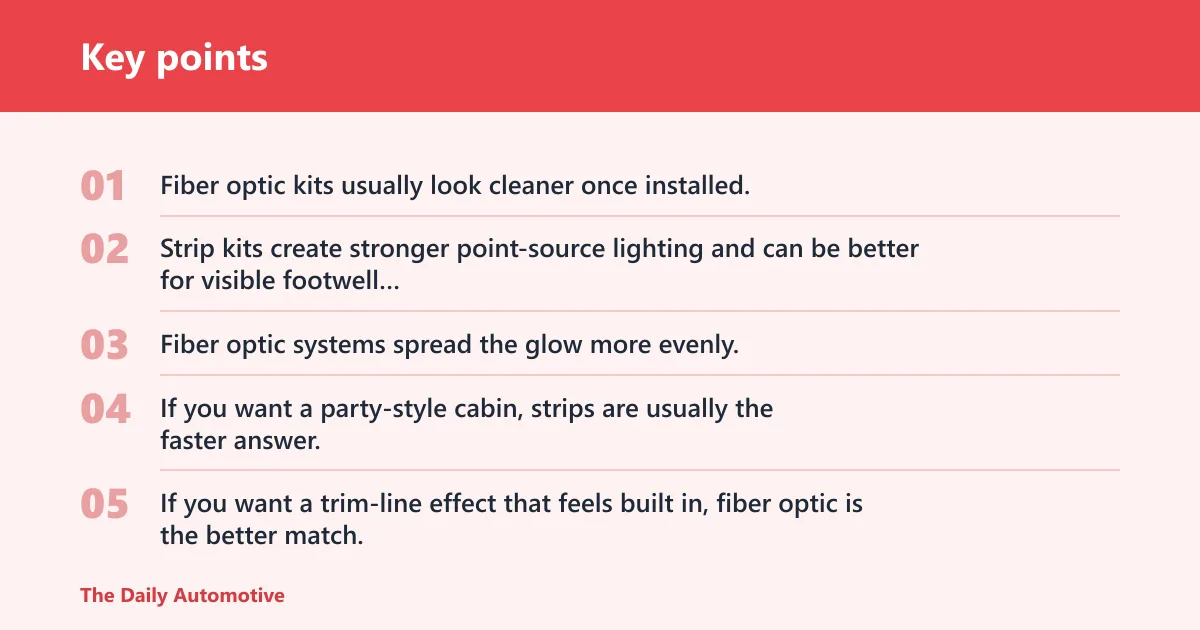
LED strips are usually easier to install. Fiber optic kits usually look cleaner once installed.
Light distribution
Strip kits create stronger point-source lighting and can be better for visible footwell effects. Fiber optic systems spread the glow more evenly, so the light line looks smoother and more integrated into the interior.
If you want a party-style cabin, strips are usually the faster answer. If you want a trim-line effect that feels built in, fiber optic is the better match.
Install difficulty
Strip kits are usually less involved because they can be adhesive-backed and placed where access is easy. Fiber optic kits often need more patience because the light path must follow seams and panel edges cleanly.
That matters most in tight cabins. A small gap can look tidy with fiber optic lighting, while a strip may reveal itself too clearly.
Which car ambient lights sync with music?
Music-sync kits are usually the ones advertised with microphone-based rhythm response, app-driven sound modes, or “sound active” lighting. RGB, RGBIC, and Dreamcolor kits are the most likely to include that feature, especially when the product listing also mentions scene modes and app control.
The best choices are the kits that let you adjust sensitivity and still keep a steady non-music mode. That way you can switch between animated cabin effects and a calmer glow when needed.
Are ambient lighting kits for cars easy to install?
Some are. Adhesive-backed LED strip kits and USB-powered kits are usually the easiest because they need less disassembly and less power work. Fiber optic kits and hardwired builds take more time because the lighting path has to match trim lines and the wiring has to be hidden well.
“Easy” also depends on the cabin. Tight trim gaps, textured surfaces, and long cable runs can turn a simple kit into a frustrating one.
Can car ambient lights be cut to fit my vehicle?
Often, yes. Many LED strip kits are cuttable or can be customized to fit specific lengths, which helps when the cabin has short runs or unusual panel spacing. That said, cutting a strip does not solve wire-length limits, and some fiber optic systems need a more careful trim plan.
Before buying, check both the cut points and the lead length. The strip may fit physically, but the power route still has to reach the source cleanly.
Which one should you buy?
For a factory look, start with a fiber optic kit or a Tesla-specific ambient lighting kit if you drive a Model 3 or Model Y. Those are the best matches when the goal is a seam-based glow that looks built in.
For the easiest install, choose a USB-powered LED strip kit with app and remote control. That is the lowest-friction option for a first-time buyer who wants visible color fast.
For music sync and scene effects, the best fit is a Dreamcolor or RGBIC kit with microphone-based sync and brightness adjustment. The extra modes matter more in show-style interiors than in subtle daily-driver builds.
For large cabins, pick the longest kit with the cleanest lead layout, even if the feature list is shorter. SUVs, trucks, and RVs punish short cables and weak routing plans.
One product can still be the wrong buy if the power source does not match your car. A 5V USB kit is convenient, while a 12V car charger powered kit may suit a different routing plan; the right choice depends on where the cable can be hidden, not on the feature count alone.
Frequently asked questions
What is the best ambient lighting car option for a factory-look interior?
Fiber optic ambient lighting is usually the best choice for a factory-look interior because it creates a more uniform seam glow along the dash and doors. Tesla-specific kits can also be a strong option for Model 3 and Model Y owners who want a vehicle-matched fit instead of a universal strip.
Do I need app control for car interior ambient lighting?
No, but app control is useful if you want more scene options, color changes, and brightness tuning. An RF remote is better if you want simple fallback control without relying on Bluetooth pairing. Many buyers are happiest with both.
Which ambient lighting kit works best for SUVs and trucks?
Large vehicles usually need a longer strip kit or a multi-piece fiber optic setup with enough lead length to reach rear seating areas. The best choice is the one that can cover more cabin distance without creating exposed wiring or leaving dark zones in the back.
Are there ambient light kits that fit Tesla models?
Yes. Tesla-specific ambient lighting kits are made for Model 3 and Model Y fitment and are usually the best route for an OEM-style result. Fit still depends on trim and model year, so you should confirm the exact application before buying.
Products related to this article
Sponsored / affiliate links. As an Amazon Associate I earn from qualifying purchases. I may earn additional commission from eligible campaigns.