Finding the Best Auto Repair in Savannah, GA: 7 Checks
A good auto repair shop is one that gives clear answers to a handful of key questions before you book, such as diagnosis process, labor rate, warranty, parts quality, repair timeline, estimate details, and communication policy. Skip those checks, and you can pay for repeat repairs, surprise charges, or a car that stays down longer than planned. This guide shows the questions Savannah drivers should ask to compare brake, engine, electrical, and maintenance shops fast.
How do you compare auto repair shops in Savannah before booking?



Start with the problem you need solved, then compare how each shop explains the fix, the estimate, and the timeline. The best shop does not rush you past those basics. It gives a direct answer, puts the price in writing, and says what must happen before any extra work begins.
That matters because a Savannah driver may be comparing a brake job, a check-engine light, or scheduled maintenance. Those are different jobs. A shop that can explain each one in plain terms is easier to trust than one that stays vague.
Use a three-part filter
- Communication: Do they answer the same question the same way twice?
- Estimate clarity: Does the quote separate parts, labor, and the exact repair scope?
- Timing: Do they give a realistic completion window and say what can delay it?
Say your SUV starts grinding when you brake on Abercorn Street. A solid shop should tell you whether it needs pads, rotors, caliper inspection, or a full brake-system check before any promise about cost. If the answer is vague, keep calling.
📊 The shop also lists a Savannah location at 1680 President St. Source: Autointensivecare.
What should a trustworthy mechanic in Savannah explain clearly?
A trustworthy mechanic explains what failed, how it was diagnosed, what gets replaced, and what can wait. You should hear the reason for the repair, not just the repair name. Good shops also tell you which symptoms match the fault and which ones point elsewhere.
That level of detail matters for make and model coverage too. An ASE-certified or otherwise experienced mechanic should be able to discuss brake work, engine repairs, electrical troubleshooting, and routine maintenance without hiding behind broad claims.
Good diagnostic explanations include
- The symptom that started the concern.
- The test or inspection used to confirm the fault.
- The part or system that failed.
- Whether the issue is urgent or can be scheduled.
- What extra findings may change the final price.
A strong answer sounds specific. “The warning light points to an oxygen sensor fault, but we still need to verify wiring and connector condition” is useful. “It’s probably electrical” is not.
Motor Medics is listed at 200 Johnny Mercer Blvd. in Savannah and states business hours of Monday through Friday, 8AM to 5PM. Auto Intensive Care lists two Savannah locations and one Garden City location, including a Savannah location at 1680 President St. and a Garden City location at 4121 Augusta Rd. Those kinds of details matter because location, hours, and service-area fit can shape how easy it is to get the car in and picked up.
What repairs should a strong Savannah shop handle?
A strong Savannah shop should handle brakes, engine work, electrical diagnostics, and routine maintenance with the right tools and process. That does not mean every technician should do every job. It means the shop can diagnose common problems, explain the fix, and complete the repair or schedule it with the right specialist.
Brake repair and safety checks
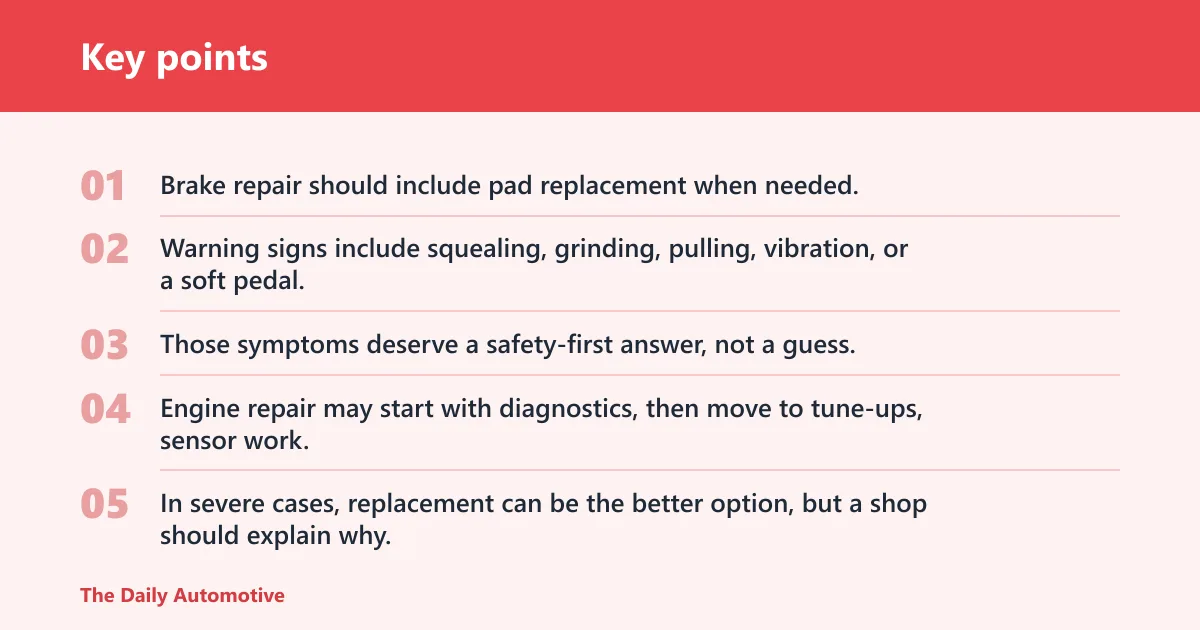
Brake repair should include pad replacement when needed, full system replacement when parts are worn beyond service limits, and inspection of rotors, calipers, lines, fluid, and pedal feel. Warning signs include squealing, grinding, pulling, vibration, or a soft pedal. Those symptoms deserve a safety-first answer, not a guess.
Engine repair, tune-ups, and replacement scenarios
Engine repair may start with diagnostics, then move to tune-ups, sensor work, ignition problems, cooling issues, or internal repairs. In severe cases, replacement can be the better option, but a shop should explain why. The best answer ties symptoms to evidence, such as misfires, leaks, or compression problems.
Electrical diagnostics for warning lights and sensor faults
Modern cars depend on sensors, modules, wiring, and control systems. Electrical diagnostics should cover warning lights, charging issues, intermittent no-start problems, and fault codes. A mechanic should explain whether the concern is a battery, alternator, wiring fault, module issue, or a sensor that needs verification.
Preventative maintenance for fluids, filters, belts, and factory services
Preventative maintenance is not a sales add-on when it matches factory-recommended service or known wear intervals. Common items include oil changes, fluid checks, tire-related care, brake inspections, filters, and belts. Auto Intensive Care’s maintenance list includes those items, which is the right category of work for planning ahead before a larger failure starts.
What should you expect from a written repair estimate?
A written repair estimate should tell you what will be repaired, which parts are included, how much labor is involved, and what decisions you still control. A good estimate helps you compare shops line by line instead of guessing from a single total. It should also show whether diagnosis is separate from repair.
| Estimate item | What you should see | Why it matters |
|---|---|---|
| Parts | Named parts and, when possible, quality level | Lets you compare material choices |
| Labor | Hours or flat-charge line items | Shows where the price comes from |
| Scope of work | Exact system or component to be repaired | Prevents surprise add-ons |
| Approval points | What needs a call before extra work | Keeps you in control of cost |
| Warranty terms | Time and mileage limits in writing | Helps you judge repeat-repair risk |
When two estimates differ, the better one is usually the one that explains more. Cheap pricing without detail can hide missing steps, lower-grade parts, or a repair plan that leaves the root problem untouched.
Which red flags should push you to keep shopping?
Keep shopping if the shop cannot explain the diagnosis, will not write down the estimate, or refuses to spell out warranty terms. A low number is not a win if the repair plan is vague. The best shops are direct about timing, limits, and what happens if new damage appears.
Pressure is another warning sign. If a shop pushes immediate approval without showing you the failed part, the test result, or the decision points, that is weak service process. The same is true for promises that sound too clean to be true, especially on difficult electrical or engine work.
Common red flags
- No written estimate before work starts.
- “We’ll figure it out later” on diagnosis.
- No clear warranty length or what it covers.
- Turnaround promises that do not mention parts delays.
- Reluctance to explain why a repair is needed now.
Use this Savannah shop comparison checklist
This checklist gives you a simple way to compare shops before the first appointment. Score each answer, then pick the shop that explains more, not the one that talks louder. Use it for brake work, engine repairs, electrical faults, and routine maintenance.
12 call-ahead questions
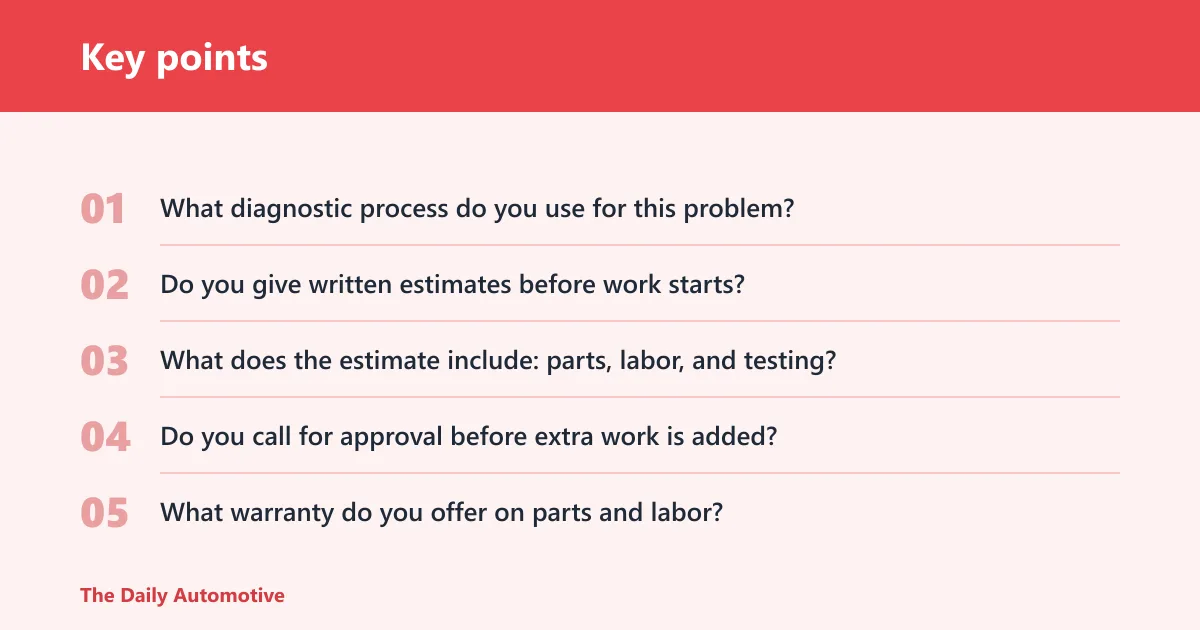
- What diagnostic process do you use for this problem?
- Do you give written estimates before work starts?
- What does the estimate include: parts, labor, and testing?
- Do you call for approval before extra work is added?
- What warranty do you offer on parts and labor?
- How long does this repair usually take?
- What could delay the repair timeline?
- Do you handle my make and model regularly?
- Do you work on brakes, engines, and electrical systems in-house?
- What maintenance items should be checked while the car is already here?
- Do you offer loaner cars, and are they appointment-based?
- What is the best way to reach the shop with questions during the repair?
Red-flag scoring system
Give 0 points for a solid answer, 1 point for a weak or partial answer, and 2 points for no answer or a vague answer. Add the points from the 12 questions.
- 0-4 points: Strong shop fit.
- 5-8 points: Proceed only if the estimate and warranty are clear in writing.
- 9+ points: Keep calling other shops.
Simple scorecard
| Category | Score 0 | Score 1 | Score 2 |
|---|---|---|---|
| Estimate detail | Written, line-by-line | Partial detail | No clear estimate |
| Diagnostics | Explains tests and findings | Some explanation | Vague or evasive |
| Warranty | Clear terms in writing | General promise only | No clear warranty |
| Turnaround time | Specific and realistic | Loose timing | No timeline |
| Loaner-car availability | Clear policy | Limited availability | Unknown |
How much does auto repair usually cost in Savannah, GA?
Auto repair costs in Savannah vary by the fault, the vehicle, and the parts required. A brake pad job, a sensor diagnosis, and an engine repair do not live in the same price range. Two estimates can differ because one includes deeper diagnostics, better parts, or a larger repair scope.
Price should matter, but it should not be the only filter. A lower quote can leave out testing, omit needed supporting parts, or cover only part of the problem. For electrical and engine repairs especially, the cheapest estimate can become the most expensive if the real fault is not fixed the first time.
What drives cost the most
- How much diagnosis is needed before repair.
- Whether the job is brake, engine, or electrical work.
- Parts quality and availability.
- Labor time and vehicle access.
- Whether the shop must handle a specialty make or system.
A common first-timer mistake is choosing a shop on the lowest quote alone. Suppose a compact car throws a check-engine light and a shop quotes only for a sensor replacement. If the wiring fault is the real issue, the light comes back and the bill grows. Good diagnosis protects the budget.
How should you choose a shop for your vehicle type?
Choose a shop that has real experience with your vehicle type, then verify it on the phone. Trucks, older cars, hybrids, and European vehicles can all need different tools, parts access, and diagnostic skill. A shop can be strong in one category and average in another.
Trucks and work vehicles
Ask about suspension wear, brake load, towing stress, and downtime. If the truck is used for work, turnaround time matters as much as price. A shop that can state when it can start and finish the job is easier to plan around.
Older cars
Older cars often need patient diagnostics, rust-aware repairs, and realistic talk about parts availability. Ask whether the shop handles aging electrical systems, cooling problems, and worn suspension components. If a shop treats every old car like a simple fix, keep looking.
Hybrids
Hybrids need proper high-voltage awareness and the right diagnostic tools. Ask whether the shop has experience with hybrid charging systems, battery-related faults, and hybrid-specific warning lights. If the answer is vague, choose a shop with clearer technical depth.
European vehicles
European vehicles can require model-specific tools, software, and parts sourcing. Ask whether the shop regularly services your brand and whether it can document the fault before replacement. For these cars, a precise explanation is better than a confident guess.
Do Savannah auto repair shops offer loaner cars?
Some Savannah shops do offer loaner cars, but the policy usually has limits. Ask whether loaners are appointment-based, what documents are required, and whether they are available for all repairs or only longer jobs. Convenience matters most when the car will be in the bay for more than a day.
Auto Intensive Care says loaner cars are available. That is useful, but the real question is how the policy works for your repair date, your vehicle, and your schedule. A loaner is helpful only if it is confirmed before drop-off.
What maintenance should I ask about before choosing a repair shop?
Ask which maintenance items should be checked now so you do not pay for a second visit later. The best shops can connect current symptoms with preventative work, then separate that from major repair needs. Oil changes, fluid checks, filters, belts, brake inspections, and tire-related care are the common starting points.
Ask whether the shop follows factory-recommended services for your mileage and model. That is especially useful for drivers who want to prevent bigger repairs instead of reacting after the warning light comes on.
What’s the difference between preventative maintenance and major repairs?
Preventative maintenance is planned service meant to keep parts and fluids within normal operating condition. Major repairs fix a failed component or a system that already causes symptoms. The line matters because maintenance is usually cheaper and easier to schedule, while repairs are often urgent and more variable in cost.
Oil changes, fluid checks, filters, belts, and scheduled inspections belong in the maintenance bucket. Brake replacement, engine troubleshooting, electrical fault repair, and replacement scenarios belong in the repair bucket. Good shops explain that difference before they recommend work.
Frequently asked questions
How do I find the best auto repair shop in Savannah, GA?
Start by calling and asking about diagnosis, estimate detail, warranty terms, repair timeline, and communication. The best shop answers those questions clearly before booking. If the answers are vague, move on. A clear phone call is often the fastest way to sort out average shops from stronger ones.
What should I look for in a trustworthy mechanic in Savannah?
Look for a mechanic who explains the symptom, the test, the failed part, and the next step in plain language. Experience with your vehicle type matters too. Brake work, engine repair, electrical troubleshooting, and maintenance all require different technical depth, so ask about each one directly.
Which shops in Savannah handle brakes, engines, and diagnostics?
Look for shops that state brake repair, engine repair, and electrical diagnostics plainly on their service list, then confirm the details by phone. Auto Intensive Care lists those services, and Motor Medics also operates in Savannah. The more useful check is how well a shop explains its process for your exact problem.
Products related to this article
Sponsored / affiliate links. As an Amazon Associate I earn from qualifying purchases. I may earn additional commission from eligible campaigns.