Best Bike Racks for Cars (2026): We Compared
For most drivers, the Young 2-Bike Hitch Rack is the better buy if your car has a 2-inch receiver and you carry two bikes; choose trunk for occasional low-cost use. Pick the wrong style and you risk paint damage, trunk slip, blocked lights, swaying bikes, or a rack that will not fit. This guide compares trunk and hitch racks by fit, failure mode, security, and daily use so you can choose well.
Quick comparison
| Product | Badge | Best for | Price | ||
|---|---|---|---|---|---|
 |
Young 200 lbs 2-Bike Rack Hitch Mount for Car SUV, 2"Young Electric | Our pick | 2-bike · 200 lbs · Hitch | $179.99
Price as of 16 Oct 2026
|
View |
 |
Universal Trunk Mount 3-Bike Rack, Rear Bicycle Stand ShelfTANAUT | Budget pick | 3-bike · 44.1 lbs · Trunk | $36.00
Price as of 16 Oct 2026
|
View |
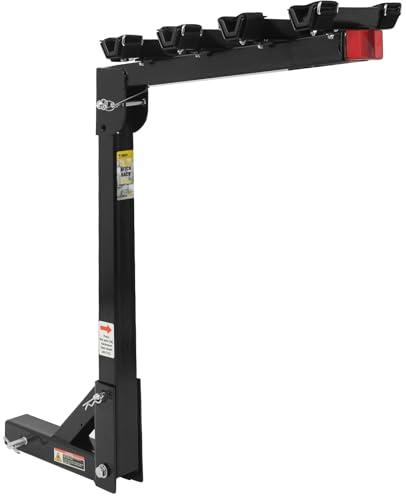 |
MaxxHaul Hitch Mount 4 Bike Rack 150 lb Capacity Heavy‑DutyMAXXHAUL | Also great | 4-bike · 150 lbs · Hitch | $79.99
Price as of 16 Oct 2026
|
View |
Use the table to sort the big tradeoffs first: receiver fit, bike weight, rear access, and storage. The right answer depends less on sticker price than on how your vehicle opens and what you carry.
How we chose
These picks and guidance are based on published product details, manufacturer specs, and buyer feedback. The comparison centers on four things that decide real ownership: fit with your vehicle, bike compatibility, access to the rear hatch or trunk, and the effort required to install, remove, and store the rack.
Hitch racks get more weight in this guide because they are usually steadier on the road and better for heavier bikes. Trunk racks stay in the discussion because they cost less, store smaller, and can make sense for occasional riders.
One more filter matters: security. A rack that folds, tilts, locks, and resists wobble is easier to live with, but none of that makes it theft-proof.
Quick picks
| Need | Best fit | Why it stands out | Main tradeoff |
|---|---|---|---|
| Most cars with a 2-inch hitch | Young 2-Bike Hitch Rack | Swings down for cargo access, has anti-sway hardware, and folds flat | Two-bike capacity only |
| Lowest entry price | TANAUT 3-Bike Trunk Rack | Low cost, detachable storage, and broad sedan/SUV fit claims | Higher contact risk on paint and spoiler areas |
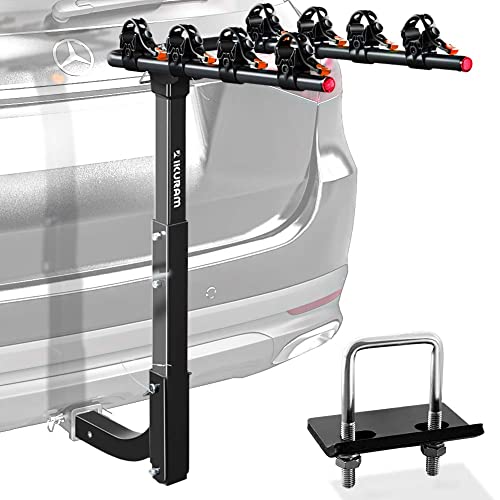
| Four bikes and a budget hitch setup | MAXXHAUL 4-Bike Hitch Rack | Swing-down access and a rigid steel frame | Heavier, bulkier, and less bike-specific than premium racks |
Young 2-bike hitch rack: best for stable everyday hauling
The Young hitch rack is the cleanest fit for drivers who already have a 2-inch receiver and want a two-bike setup that folds down for storage. Based on the published specs, it appears to support up to 5-inch fat tires, includes anti-sway hardware, and swings down so you can reach the rear cargo area without unloading the bikes first.
Its main strength is control. Hitch racks usually stay steadier than trunk racks, and this one leans into that with a tilt function, padded hooks, and compact fold-flat storage.
The drawback is obvious: it only works if your vehicle has the right receiver, and the two-bike limit is a hard stop for larger families or group rides. It also assumes the frame and tire fit are within the rack’s limits, so carbon frames, full-suspension bikes, and fender clearance still need a close check before you buy.
TANAUT trunk rack: best for lower budgets
The TANAUT trunk rack is the budget pick for occasional riders who want a cheaper way to move up to three bikes without adding a hitch. Its appeal is simple: strap-on attachment, detachable storage, and a low entry price that is far below most hitch systems once installation costs are counted.
That price advantage comes with more tradeoffs. Trunk racks depend on strap tension and contact points, which means paint wear, spoiler contact, and rear-camera or hatch interference deserve attention before every trip. Trunk racks also tend to be less stable on rough roads, especially when the load shifts or the straps loosen over time.
This is the kind of rack that makes sense for short errands, light bikes, and drivers who need the smallest storage footprint between rides. It is a poorer choice for heavy e-bikes, fat tires, or frequent highway use.
MAXXHAUL 4-bike hitch rack: best for larger groups
The MAXXHAUL rack suits drivers who need a hitch-mounted, four-bike solution and want rear access without removing the whole carrier. Its swing-down design and steel frame point to the practical use case: weekend family transport, mixed bike sizes, and vehicles that can accept the rack’s hitch format.
As with most hitch racks, the value is stability. A receiver-mounted rack spreads the load more predictably than a strap-on trunk design, and that matters more as bike count goes up. The safety reflector is useful, but it is not a substitute for checking whether the rack blocks your plate or lights on the vehicle you actually drive.
The honest drawback is bulk. Four-bike hitch racks are awkward to store, harder to move alone, and usually less forgiving when you have a small garage or limited driveway space. They can also be overkill for solo riders and anyone with a lightweight bike or a compact hatchback.
Bike rack decision matrix
This table separates trunk and hitch racks by the questions that cause most regrets after purchase. Score each row against your car, your bikes, and how often you need rear access.
| Buyer variable | Trunk rack | Hitch rack | Practical read |
|---|---|---|---|
| Vehicle type | Best for many sedans, hatchbacks, and some SUVs with compatible rear panels | Best for vehicles with a rated receiver on the right hitch size | Hitch wins if your car is already equipped; trunk wins if you need a no-hitch solution. |
| Bike weight | Better for lighter bikes and occasional use | Better for heavier bikes and multi-bike loads | Heavier bikes favor hitch racks because the load is carried at the receiver, not by straps. |
| Tire width | Limited by frame support and strap geometry | Often better for wide tires and tray-style support | Fat tires push you toward hitch racks, especially if the rack lists wide-tire compatibility. |
| Rear access needs | Often blocks trunk or hatch access when installed | Better if the rack tilts away or folds down | Tilting hitch racks are the stronger choice if you open the rear area often. |
| Install difficulty | Usually simpler at the rack itself, but fit is vehicle-specific | Usually easier once a hitch exists, but assembly can be involved | Trunk racks can be faster to hang; hitch racks can be easier to live with after setup. |
| Theft risk | Mostly deterrence through removal and strap routing | Better with integrated locks and bike-to-rack lock points | Hitch racks usually offer better lock points, but no rack is theft-proof. |
| Storage space | Smaller and easier to stash in a closet or cargo bay | Bulkier, especially tray-style models | Trunk racks win for apartment storage and small garages. |
| Budget | Lower entry price | Higher total cost, especially with hitch installation | Trunk is cheaper up front; hitch can cost less over time if used often. |
| Long-trip stability | More sensitive to strap tension and rear contact points | Generally steadier on the highway | For frequent interstate driving, hitch racks are the safer bet. |
| Common use case | One or two bikes, occasional weekend rides | Frequent transport, heavier bikes, longer trips | Choose the mount that matches frequency, not just price. |
Which rack fits your car?
The best rack depends first on the body style and rear hardware on the car, not the bike. Sedans and hatchbacks often work with trunk racks if the rear shape and spoiler allow safe strap routing, while SUVs and crossovers are more likely to suit hitch racks because they usually have more receiver options and rear clearance.
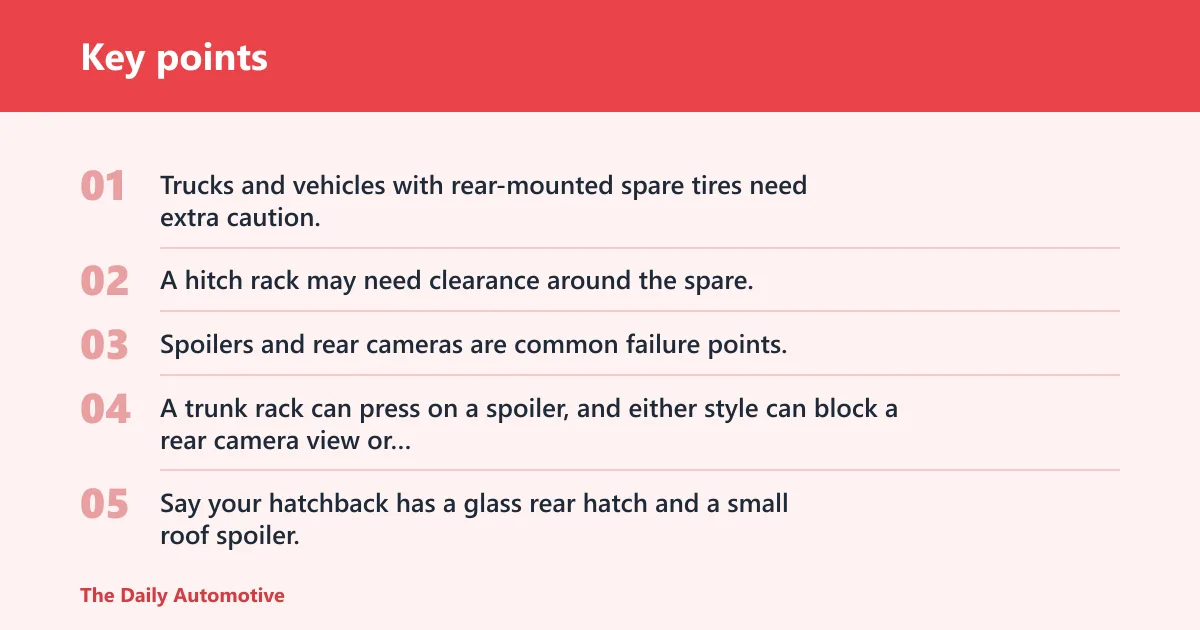
Trucks and vehicles with rear-mounted spare tires need extra caution. A hitch rack may need clearance around the spare, while a trunk rack may not seat correctly at all if the tailgate shape or spare-tire mount blocks the contact points.
Spoilers and rear cameras are common failure points. A trunk rack can press on a spoiler, and either style can block a rear camera view or obscure the license plate and taillights, which matters on the road and at night.
Say your hatchback has a glass rear hatch and a small roof spoiler. A trunk rack may sit too high and press on the spoiler edge, while a hitch rack with tilt-away access can keep the hatch usable if the receiver height and rack length give enough clearance.
Sedans and hatchbacks
Sedans often point you toward trunk racks if there is no hitch, but the fit must be exact. Hatchbacks may be better served by a hitch rack when the rear glass, wiper arm, or spoiler leaves too little safe strap contact area for a trunk design.
SUVs and crossovers
These vehicles usually give you more hitch choices and more rear door clearance, which is why hitch racks are common here. Trunk racks can still work, but the rear surface angle and spoiler design matter more than the badge on the tailgate.
Trucks and spare-tire setups
Rear-mounted spare tires, step bumpers, and tailgate accessories can make both styles harder to fit. Check whether the rack clears the spare, whether the tailgate can open, and whether the license plate or lights become hidden once the rack is loaded.
Spoilers and rear cameras
Do not assume a camera solves fit. A rack can leave the camera view intact and still contact the spoiler, or clear the spoiler and still hide the plate or lights. Fit has to be checked at the contact points, not just in the screen image.
Hitch rack: best for stability
A hitch rack is the better choice when you want steadier transport, easier rear access with a tilt function, and better support for heavier bikes. Receiver-mounted designs are also easier to live with on longer highway drives, especially when they include anti-wobble hardware and lock points.
Receiver size and weight limit
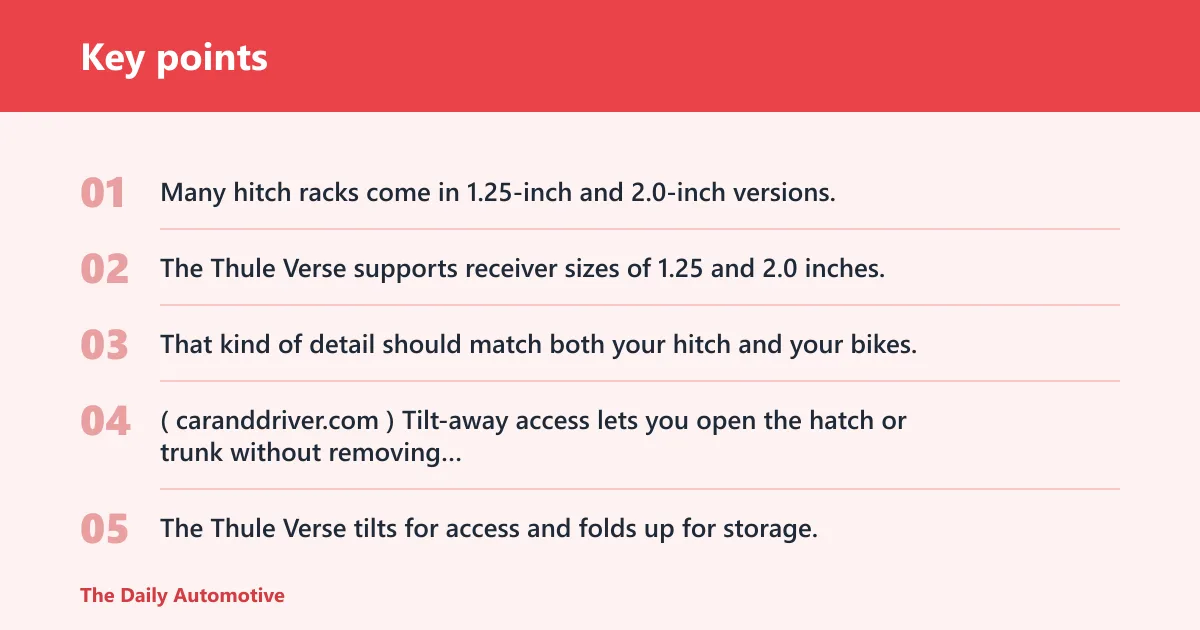
Many hitch racks come in 1.25-inch and 2.0-inch versions, and the receiver size matters because it affects compatibility and often the load ceiling. The Thule Verse supports receiver sizes of 1.25 and 2.0 inches, and its tray capacity is 60 pounds per tray. That kind of detail should match both your hitch and your bikes. (Caranddriver)
Tilt and fold access
Tilt-away access lets you open the hatch or trunk without removing the rack, while fold-up storage keeps the rack closer to the vehicle when parked. The Thule Verse tilts for access and folds up for storage, which is exactly the feature set many drivers want from a hitch system.
That said, tilt does not fix every problem. Low ground clearance, long tailgates, and large bikes can still make the rear opening awkward, so test the full motion before loading the bikes.
Locking and anti-wobble hardware
Integrated hitch locks help keep the rack attached to the car, and bike-to-rack lock points help with deterrence. Anti-wobble hardware reduces movement at the receiver, which matters because wobble can create noise, wear, and a less stable feel on rough pavement.
The Thule Verse includes integrated hitch locks, but that still only deters theft. A determined thief can defeat almost any consumer rack with tools and time, so the goal is to slow them down and make your setup a less attractive target.
Assembly and install time
Hitch racks are often simpler to use after the first setup, but the assembly can be more involved than people expect. Car and Driver says the racks were assembled, mounted, loaded, and driven on pothole-riddled streets, and that they tested folding and tilting behavior on each rack. That tells you these products are judged on living with them, not just unboxing them.
A single person can often mount a lighter hitch rack, but larger tray-style units may be easier with two people. Tools vary by model, and some racks need several assembly steps before you can carry the first bike.
Trunk rack: best for low cost
A trunk rack makes sense when you want the lower entry price, small storage footprint, and simple removal that hitch systems usually do not match. It is also the route for drivers who do not want to install a hitch just to carry a couple of bikes a few times a year.
Strap attachment and frame support
Trunk racks attach with straps and support the bikes by the frame or by cradle arms, depending on the design. That is why fit is so vehicle-specific: the strap path, hook points, and frame support style have to work with the shape of the hatch or trunk lid.
Paint and spoiler contact risk
This is the biggest downside. Trunk racks can rub paint, press on plastic spoilers, or shift if the strap tension changes, which is why they need careful setup and periodic re-checking. If your rear panel is soft, curved, or spoiler-heavy, the risk goes up.
Bike fit and rear access limits
Trunk racks are less friendly to fat tires, e-bikes, and bikes with odd frame shapes or fenders. They also tend to block rear access completely once installed, so if you need the hatch often, a hitch rack with tilt-away access is usually the better choice.
A common first-timer mistake is loading a trunk rack, then discovering the hatch cannot open even a few inches. If groceries, stroller gear, or a cooler have to come and go after installation, that inconvenience shows up fast.
Storage and carry convenience
Trunk racks usually win on storage convenience. They are easier to toss in a cargo bay or closet, which is a real advantage for apartment dwellers and drivers who only ride a few times each season.
Suppose you drive a sedan to a trailhead twice a month and keep the rack in a hallway closet the rest of the time. A trunk rack may be the better trade, even if a hitch rack would be steadier on the road, because storage and price matter more than premium access features.
How much weight can a hitch rack hold?
There is no single answer because the hitch rating, the rack’s tray or arm rating, and the bike itself all matter. In practice, you need to check the vehicle receiver rating and the rack’s per-bike or per-tray limit together, then compare that with the heaviest bike you plan to carry.
Per-bike limits
Per-bike limits are the number that keeps the rack honest. The Thule Verse has a maximum capacity of 60 pounds per tray, which is enough for many standard bikes and some heavier models, but not every e-bike.
E-bike and fat-tire limits
Fat-tire bikes need more than raw weight capacity. Tire width, wheel size range, and fender clearance all have to line up. The Thule Verse fits tires up to 4.75 inches wide, with a fender limitation, so even a “wide tire” rating may not cover every bike shape.
Tray spacing and wheelbase clearance
Long wheelbase bikes, full-suspension frames, and bikes with odd geometry can hit each other or the car if tray spacing is too tight. That is one reason premium racks often cost more: they usually handle more frame shapes and tire sizes with less improvisation.
When a 2-inch receiver matters
A 2-inch receiver often gives you access to higher-capacity racks and more stable platforms than a 1.25-inch setup. The receiver size itself does not guarantee a better rack, but it expands the range of approved products and makes heavier hauling more realistic.
How to choose the right rack
- Start with the car. Check whether you have a rated hitch receiver, a spoiler, a rear camera, a spare tire, or a hatch that needs full rear access.
- Match the bikes. Compare the rack’s wheel-size range, tire-width range, and weight limit to your heaviest bike, not your lightest one.
- Decide how often you use it. Occasional riders can justify a trunk rack more easily; frequent riders usually benefit from hitch stability and easier access.
- Check storage space. If the rack has to live in a small garage or apartment, folding and detachable parts matter more than people expect.
- Factor in ownership costs. Hitch installation, optional locks, adapters, corrosion care, and strap wear can change the total cost more than the sticker price alone.
Budget and convenience rarely point to the same answer. Trunk racks start cheaper and store smaller, but hitch racks usually age better in daily use because they are less dependent on strap tension and body-panel contact.
Security is similar. Locks, anti-wobble hardware, and bike-to-rack attachment points help deter theft, but they do not make the rack theft-proof. If you leave bikes on the car in public, remove anything easy to carry.
Which one should you buy?
If you already have a 2-inch hitch and carry two bikes regularly, buy the Young hitch rack first. If you need the lowest entry price and only move bikes occasionally, the TANAUT trunk rack is the cheaper way in. If you need four-bike capacity and already rely on a hitch, the MAXXHAUL makes the most sense of the three.
For fat tires, e-bikes, and longer trips, favor a hitch rack with a stated weight limit, wide tire compatibility, and tilt-away access. If your car has a spoiler, a delicate hatch edge, or a rear-mounted spare, verify the contact points before buying anything.
The middle ground is simple. If your vehicle can take a hitch, hitch is usually the better long-term answer. If it cannot, or if storage and price matter more than stability, trunk still has a place.
Frequently asked questions
What is the best bike rack for my car, trunk or hitch?
Choose hitch if your vehicle has a rated receiver and you ride often, haul heavier bikes, or need steadier highway behavior. Choose trunk if you need a lower-cost rack for occasional use and your hatch or trunk shape gives you safe strap contact without spoiler or paint issues.
How much weight can a hitch bike rack hold?
That depends on both the vehicle receiver and the rack itself. Check the per-bike or per-tray limit first, then confirm the hitch rating on the car. For example, the Thule Verse lists 60 pounds per tray, which is enough for many bikes but not all e-bikes.
Will a bike rack block my trunk or rear hatch?
It can, especially with trunk racks and fixed-position hitch racks. Tilt-away hitch designs are better when you need rear access often, but low rooflines, long tailgates, and loaded trays can still limit opening range. Always test access before a long trip.
Do I need a 1.25-inch or 2-inch hitch bike rack?
Buy the size that matches your receiver, then check the rack rating. Some racks fit both sizes, like the Thule Verse, which supports 1.25 and 2.0 inches. A 2-inch setup often offers more stability and broader model choice, especially for heavier loads.
What bike rack is best for fat-tire bikes?
Hitch racks are usually the better option because many list wide-tire compatibility and stronger tray support. The key is the stated tire width and fender clearance, not the word “fat tire” alone. The Thule Verse, for example, fits tires up to 4.75 inches wide, with a fender limitation.
How hard is it to install a hitch bike rack?
Once the hitch is installed, many racks are straightforward, but assembly can still take time and may be easier with two people for heavier models. Tools, anti-wobble hardware, and final alignment can add steps. The first use is often slower than later installs.
Which bike rack is easiest to use by one person?
A light trunk rack is often easiest to lift, hang, and remove alone, especially if you only use it a few times a year. For regular use, a hitch rack with fold-flat storage and a tilt-away function can be easier day to day, even if the first setup takes longer.
Products related to this article
Sponsored / affiliate links. As an Amazon Associate I earn from qualifying purchases. I may earn additional commission from eligible campaigns.