Best Car Battery Chargers for Maintenance (2026): We Compared
For maintenance, choose a smart charger/maintainer that matches your battery chemistry, outputs about 0.75–5 amps for many cars and motorcycles, and switches to float mode automatically. AGM, lithium, and flooded batteries need different profiles. Use the wrong charger or leave a parked vehicle unmaintained, and you can face a dead battery, sulfation, and avoidable replacement cost. This guide compares the best options by vehicle type, battery type, and storage pattern so you can buy the right charger.
Quick comparison
| Product | Badge | Best for | Price | ||
|---|---|---|---|---|---|
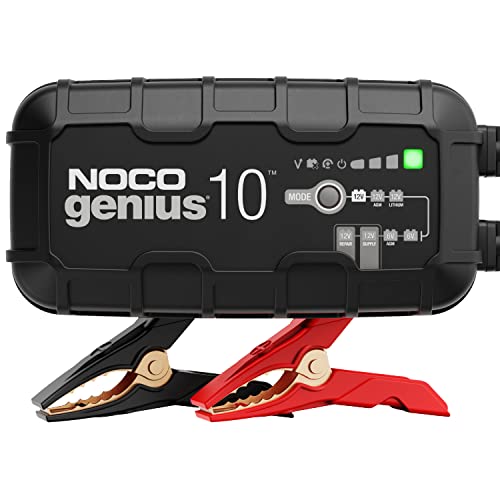 |
NOCO GENIUS10 10A 6/12V Smart Battery Charger, TrickleNOCO | Our pick | 10A · 6/12V · Smart | $99.95
Price as of 16 Oct 2026
|
View |
 |
CTEK CT5, 12V Automotive Battery Charger for Auto,CTEK | Also great | 12V · Automotive · Recond mode | $79.99
Price as of 16 Oct 2026
|
View |
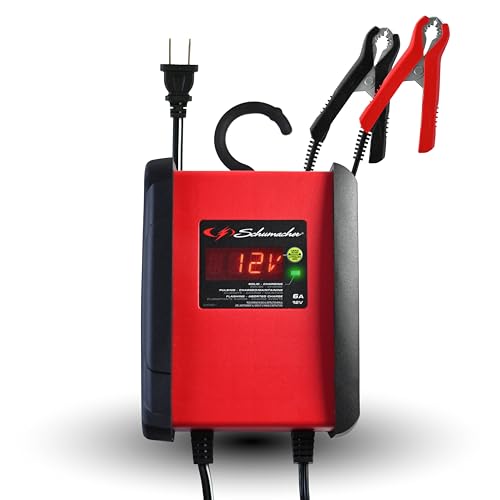 |
Schumacher SP1298 12V Automatic Battery Charger and 6ASchumacher Electric | Pair with it | 12V · 6A · Automatic | $57.99
Price as of 16 Oct 2026
|
View |
Best overall for mixed-use maintenance: NOCO Genius 1, because its 1.0-amp setting suits slow, steady charging and it works across lead-acid, AGM, and lithium batteries. (Caranddriver)
For longer storage, a low-output maintainer usually makes more sense than a faster charger. For bigger batteries or a battery that needs recovery before storage, move up to a higher-output model instead of forcing a small maintainer to do a charger’s job.
How we chose
We compared output amperage, chemistry support, maintenance behavior, and recovery use cases. We also weighed whether a model fits long-term storage, seasonal use, or faster top-off charging.
Coverage mattered too. A useful shortlist needs low-output maintainers, a true charger for larger batteries, and a faster option for batteries that need more than routine storage care.
Finally, we looked at practical ownership details: mode selection, display feedback, temperature sensing, and accessory costs such as replacement leads or hardwire harnesses.
Battery charger decision matrix
This matrix helps you match the tool to the battery, not the badge on the box. If the battery is deeply discharged or sulfated, skip maintainer-only thinking and use a true charger or replacement battery decision instead.
| Scenario | Battery chemistry | Minimum amp range | Maintenance mode needed? | Use a true charger instead when |
|---|---|---|---|---|
| Stored car in a garage | Lead-acid, AGM | 1A to 5A | Yes | The battery is deeply discharged, sulfated, or too large for low-output maintenance |
| Motorcycle or powersports battery | Lead-acid, AGM | 0.75A to 3A | Yes | The battery was left flat for an extended period or will not hold voltage after charging |
| Classic car or seasonal SUV | Lead-acid, AGM, sometimes GEL | 1A to 10A | Yes for storage; no for recovery | You need bulk charging first, or the battery has lost capacity from age or neglect |
| Lithium-equipped vehicle | LiFePO4 | 1A to 10A | Yes, but only with lithium support | The charger does not list LiFePO4 support, or the battery management system requires a different profile |
| Large battery or RV house bank | Flooded, AGM, GEL, calcium | 10A or higher | Sometimes | You need faster recovery after storage or have a larger amp-hour capacity than a small maintainer can serve |
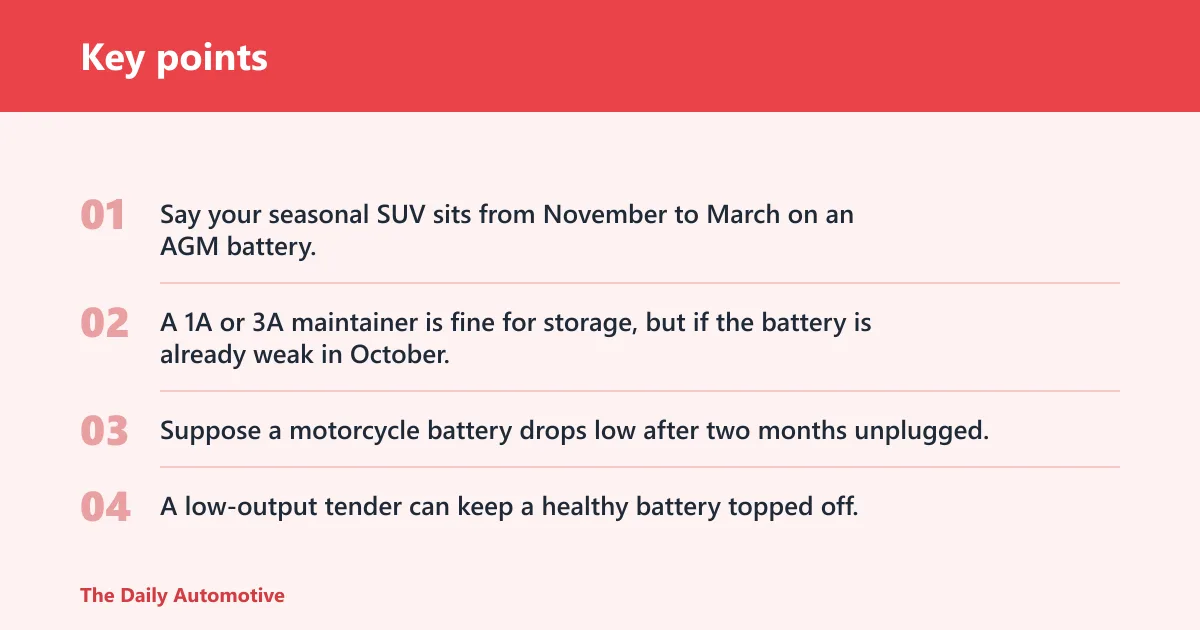
Say your seasonal SUV sits from November to March on an AGM battery. A 1A or 3A maintainer is fine for storage, but if the battery is already weak in October, a 10A charger is the better first step.
Suppose a motorcycle battery drops low after two months unplugged. A low-output tender can keep a healthy battery topped off, but it is not the right tool for a battery that needs serious recovery before winter storage begins.
What is the difference between a battery charger and a maintainer?
A charger pushes energy back into a battery after use, while a maintainer keeps a healthy battery at the proper charge level during storage. Car and Driver notes that the unit plugs into a wall outlet and the maintainer automatically supplies power as needed to keep the battery healthy.
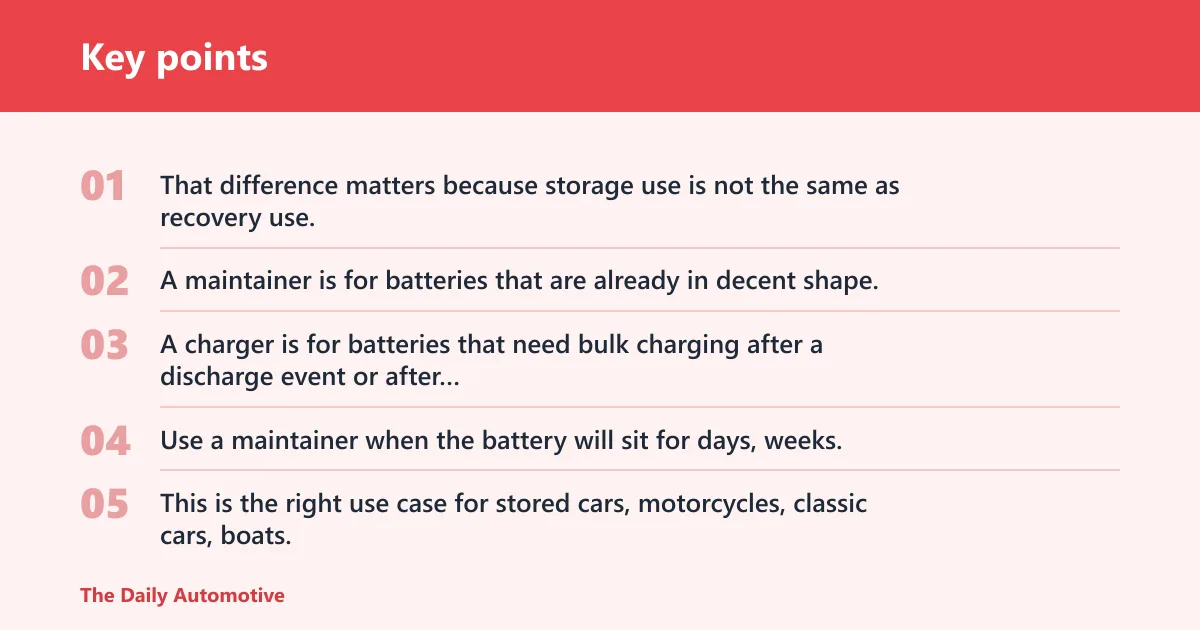
That difference matters because storage use is not the same as recovery use. A maintainer is for batteries that are already in decent shape. A charger is for batteries that need bulk charging after a discharge event or after sitting too long.
When a maintainer keeps a battery topped off
Use a maintainer when the battery will sit for days, weeks, or months and you want to prevent self-discharge from becoming a no-start problem. This is the right use case for stored cars, motorcycles, classic cars, boats, and jet skis with healthy batteries.
When a true charger is the better tool
Use a true charger when the battery is meaningfully discharged, when it has been run down by accessories, or when storage begins with a weak state of charge. Higher amperage helps restore charge faster, but only if the battery is still serviceable.
Why deeply discharged batteries need a different approach
A maintainer cannot fix a sulfated battery, and it will not revive a battery that is too far gone. If a battery has been neglected to the point that it will not accept a normal charge, recovery may require a charger with a repair or recondition mode, or simply replacement.
Do not keep forcing a maintainer onto a failing battery. That wastes time, and it can hide the real problem until the vehicle still will not start.
NOCO Genius 1: best overall for mixed-chemistry maintenance
The NOCO Genius 1 is the best overall pick for mixed-use maintenance because its 1.0-amp setting supports slow, steady charging and it works with regular lead-acid, AGM, and lithium batteries. The compact design also suits tight storage spaces where a larger unit is inconvenient.
It is a strong fit if you want one small charger for a garage-kept car, a motorcycle, and another battery type without buying a separate unit for each chemistry. Simple mode selection and the LED display keep the setup straightforward.
The drawback is speed. A 1.0-amp charger is right for maintenance and gentle top-off work, not for quick recovery on a large or heavily discharged battery.
Battery Tender picks: best for low-output storage
Battery Tender’s low-output lineup makes sense when storage care matters more than charging speed. These models suit owners who want a battery left connected for long periods without constant attention.
Battery Tender Plus 12V 1.25A: best for long-term storage maintenance
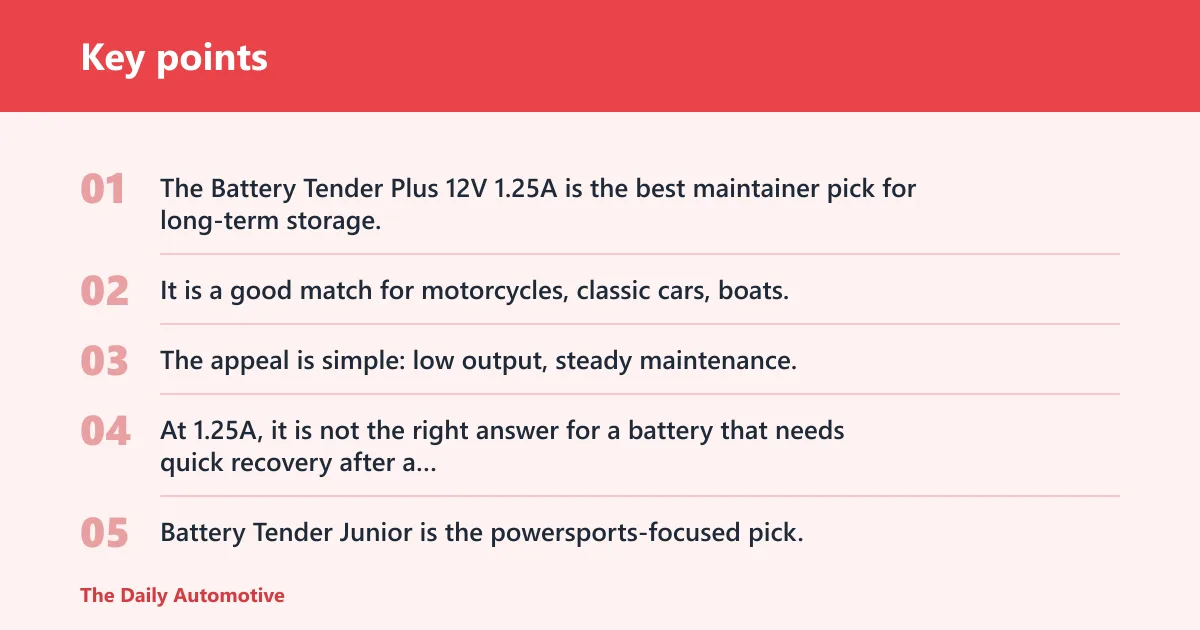
The Battery Tender Plus 12V 1.25A is the best maintainer pick for long-term storage, according to BatteryChat. It is a good match for motorcycles, classic cars, boats, and jet skis that need low-output care more than fast recovery.
The appeal is simple: low output, steady maintenance, and a form factor built for storage habits rather than hurried charging. The drawback is obvious too. At 1.25A, it is not the right answer for a battery that needs quick recovery after a deep discharge.
Battery Tender Junior: best for powersports and low-demand use
Battery Tender Junior is the powersports-focused pick. Car and Driver selected it as the best for powersports, which makes sense for motorcycles, ATVs, and similar low-capacity batteries that sit for long stretches.
It is a practical low-output tender for owners who want to keep a small battery ready without overspending on more charger than the job requires. The limitation is capacity: it is aimed at maintenance, not broader charging needs.
Battery Tender 3-Amp Battery Charger: best for easy wall-outlet charging
Car and Driver named the Battery Tender 3-Amp Battery Charger the easiest to use. Its 3-amp output and wall-outlet power make it a sensible middle ground for people who want a simple charger that is still gentle enough for routine use.
This pick is better than a tiny maintainer when a battery needs a bit more help getting back into shape. The tradeoff is that 3 amps is still not a fast-charging solution for larger batteries or hard recovery cases.
CTEK MXS 10: best for larger AGM and flooded batteries
The CTEK MXS 10 is the better choice when the battery is larger and a small maintainer would take too long. Its 10A output and 8-step automatic charging program make it more appropriate for bigger flooded, AGM, GEL, and calcium batteries.
BatteryChat says it supports flooded, AGM, GEL, and calcium batteries, and the included temperature sensor helps in cold storage where charging behavior can shift. That matters in winter garages, unheated sheds, and seasonal vehicles that live through temperature swings.
The downside is fit. If your battery only needs maintenance, 10A may be more charger than you need, and the extra capability usually costs more than a basic tender.
Schumacher picks: best for faster recovery and start assist
Schumacher’s options fit better when speed or recovery features matter more than long-term float maintenance. That makes them useful for larger batteries, weak batteries that still have a chance, and drivers who want a more versatile garage charger.
Schumacher SC1280: best for fast charging
Car and Driver named the Schumacher SC1280 the fastest-charging pick. It is the right direction when the battery needs a quicker recovery than a low-output maintainer can provide.
Fast charging is useful after a dead battery event or before you move a stored vehicle back into service. The drawback is that speed does not replace maintenance mode, and fast charging should not be the default choice for long-term storage.
Schumacher SC1281: best for versatile charging and start assist
The same source lists the Schumacher SC1281 with 3A maintain, 15A standard, and 30A fast outputs. That range gives it more flexibility than a small maintainer, especially for batteries that need both storage care and faster recovery.
Its LCD display and engine start assist add convenience when the battery is weak and you want clearer feedback during charging. The tradeoff is size and complexity; it is a more capable unit, but not the lightest-duty choice for a small powersports battery.
Can you leave a maintainer connected all winter?
Yes, if the charger is designed for maintenance and the battery is healthy, you can usually leave it connected through winter storage. The key is that the unit must automatically move into float or maintenance mode and the battery must be fit to hold a charge.
If the battery is aging, sulfated, or already failing, long-term connection is not a fix. In that case, the maintainer may keep voltage up for a while, but it will not restore lost capacity or cure the underlying battery problem.
What long-term storage requires
Long storage calls for low, controlled output and clear chemistry matching. AGM and flooded batteries need a profile made for them, while lithium batteries need a charger that explicitly supports LiFePO4 if that is the battery in the vehicle.
When to disconnect and inspect instead
If the battery gets warm, cannot hold a charge, or repeatedly drops off after full charging, disconnect it and inspect the battery and connections. A maintainer should preserve a healthy battery, not mask a battery that is ending its useful life.
Why battery condition still matters even with smart maintenance
Smart charging protects healthy batteries from overcharge, but it cannot reverse sulfation or internal damage. If a stored car still struggles after maintenance charging, the problem may be the battery itself, not the charger.
What is the best car battery charger for maintenance?
For maintenance, the best choice for most owners is a smart charger/maintainer in the 1A to 3A range with automatic float or maintenance mode. The NOCO Genius 1 is the best overall fit when you want one compact unit for lead-acid, AGM, and lithium batteries.
If the battery is larger or the vehicle sees longer storage intervals, move up to a higher-output maintainer or a true charger. Maintenance should match battery size and storage time, not just price or brand name.
Which one should you buy?
Choose the charger by the vehicle that sits the longest, not by the one that is easiest to buy. For a daily driver that only sits for a few days, the Battery Tender 3-Amp Battery Charger or NOCO Genius 1 is usually enough.
For motorcycles, jet skis, and classic cars, a low-output maintainer is often the smartest purchase. Battery Tender Plus 12V 1.25A and Battery Tender Junior fit that role well, while the NOCO Genius 1 gives you more chemistry flexibility.
For AGM-heavy garages, choose a charger with clear AGM support and enough output to matter. The CTEK MXS 10 is the stronger pick for larger batteries, and the Schumacher SC1280 is the better choice when speed matters more than gentle storage care.
For lithium owners, only buy lithium support if the vehicle actually uses LiFePO4. Victron Blue Smart IP65 12/10 supports LiFePO4 batteries, and that matters for lithium-specific charging needs; it does not add value for a lead-acid-only garage.
A common first-timer mistake is buying a high-output charger for a small powersports battery, then leaving it connected for storage. That gives you more capacity than needed and more cost than necessary. Match the tool to the battery first.
How to choose
- Identify the battery chemistry first: flooded lead-acid, AGM, GEL, calcium, or LiFePO4.
- Match output to use case: 1A to 3A for most maintenance jobs, 10A for larger batteries, and higher only when recovery speed matters.
- Decide whether you need maintenance mode, recovery mode, or both.
- Check whether your battery lives in a cold garage, because temperature sensing can help in winter storage.
- Look for practical features such as simple mode selection, display feedback, reverse polarity protection, and clearly labeled chemistry support.
- Factor in ownership cost: hardwire harnesses, replacement leads, and accessory kits can change the real total price.
Pay for the feature you will actually use. App monitoring and a multi-step program matter for some owners, but a basic low-output maintainer is the better spend when the battery simply needs to stay healthy all winter.
Frequently asked questions
Can I leave a battery maintainer connected all winter?
Usually yes, if the maintainer is designed for long-term float use and the battery is healthy. That said, a maintainer cannot fix a failing battery. If the battery is sulfated, damaged, or repeatedly loses charge, disconnect it and inspect the battery instead of assuming the charger will solve it.
Which battery charger works for AGM batteries?
Choose a charger that explicitly lists AGM support. The NOCO Genius 1 works with AGM batteries, and the CTEK MXS 10 supports flooded, AGM, GEL, and calcium batteries. AGM support matters because the charging profile should match the battery’s chemistry, not rely on a one-size-fits-all setting.
Do I need a lithium-compatible battery charger?
Only if your vehicle uses a lithium battery, especially LiFePO4. Lithium support matters because the charging profile is different from flooded or AGM lead-acid batteries. If every battery you own is lead-acid, lithium compatibility adds no useful value and can add cost.
How many amps do I need for a car battery charger?
Most maintenance jobs for cars and motorcycles fit in the 0.75-amp to 5-amp range. Use about 1A to 3A for storage maintenance, and step up to 10A or more when the battery is larger or needs faster recovery. Bigger batteries take longer with small maintainers.
What features should I look for in a smart battery charger?
Look for automatic mode selection, correct chemistry support, maintenance mode, and clear status feedback from an LED display, LCD screen, or app if you want it. Temperature sensing is useful in cold storage. Extra app control is nice, but it should not outrank proper battery chemistry matching.
Products related to this article
Sponsored / affiliate links. As an Amazon Associate I earn from qualifying purchases. I may earn additional commission from eligible campaigns.