Luggage Rack for Car: 4 Types Compared (Roof Bag vs. Hitch)
A luggage rack for a car isn’t one product — it’s four: rooftop bags, rooftop baskets, hard-shell boxes, and hitch-mount carriers, each with different weight limits and mounting needs. Pick the wrong type and a $250 hard box becomes useless without crossbars, or cargo over-tops your car’s roof rating. This guide compares all four types, covers real weight limits and MPG loss, and walks through buying and installing one.
Quick Answer
A “luggage rack for car” usually means one of four things: a soft rooftop cargo bag (no rack needed), an open rooftop basket, a hard-shell rooftop box, or a hitch-mount cargo carrier. Bags and hitch carriers work without existing crossbars; baskets and hard boxes need factory roof rails or aftermarket crossbars already installed.

The 4 Types of Car Luggage Racks, Compared
“Luggage rack” gets used loosely, but the products behind it fall into four distinct categories. The right one depends on what your car already has on its roof (or hitch) and how much you need to carry.
| Type | Needs Existing Roof Rack? | Typical Capacity | Best For | Typical Price |
|---|---|---|---|---|
| Soft rooftop bag | No — straps to door frames or bare roof | 15–21 cu ft | Occasional trips, no roof rails, tightest budget | $50–$100 |
| Open rooftop basket | Yes — needs crossbars | Up to 200 lb | Bulky or oddly shaped gear (coolers, tents, camping gear) | $100–$200 |
| Hard-shell rooftop box | Yes — needs crossbars | 110–165 lb / 13–18 cu ft | Frequent travelers wanting lockable, weatherproof storage | $250–$1,000+ |
| Hitch-mount cargo carrier | No — uses a 2″ hitch receiver | 300–500 lb | Heaviest loads, best fuel economy, no roof access needed | $80–$250 |
Do You Need Roof Rails or Crossbars First?
This is the question that determines which of the four types above will actually fit your car. Factory roof rails are the two fixed bars running front-to-back along the roofline — either raised (you can slide a hand underneath) or flush (they sit tight against the roof and need special clips). Crossbars are the separate bars that run side-to-side, clamping onto those rails or onto fixed mounting points; they’re what a basket or hard-shell box actually bolts to.
If your car has neither rails nor crossbars, a soft rooftop bag or a hitch-mount carrier are your only two options without buying a crossbar system first. If you already have crossbars, check their thickness and spread before ordering a basket or box — the WEIZE basket below, for example, only fits bars up to 1.35 inches thick and 4.6 inches wide. For a full breakdown of crossbar systems themselves, see our guide to universal roof rack crossbars, and our step-by-step crossbar installation guide if you need to add them first.

Best Rooftop Cargo Bag Pick
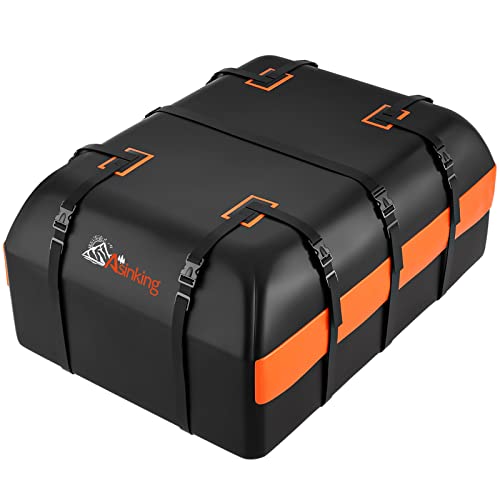
Asinking 21 Cu Ft Rooftop Cargo Carrier Bag
A soft-sided, 21-cubic-foot rooftop bag made from 840D waterproof PVC that straps to any car with or without an existing roof rack.
- Best for: Cars with no factory roof rails or crossbars
- Why we picked it: No drilling or crossbars required, and it’s the cheapest way here to add real cargo space
- Main drawback: Soft sides can’t protect rigid or extremely heavy items as well as a hard box — if you are loading actual suitcases, see our guide to padding and loading hard-shell suitcases in a soft rooftop bag without damaging it
Compare more luggage rack options
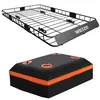 Option 1 WEIZE 54″x34″ Steel Rooftop Cargo Basket
|
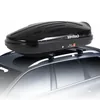 Option 2 Garvee Hard Shell Rooftop Cargo Box
|
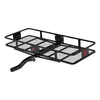 Option 3 CURT 18153 Folding Hitch Cargo Basket
|
As an Amazon Associate we earn from qualifying purchases.
How Much Weight Can a Car Luggage Rack Hold?
Every vehicle has two separate roof ratings, and mixing them up is the most common overloading mistake. Dynamic weight capacity is the limit while the car is moving — it accounts for bumps, wind, and braking, and it’s almost always the lower number, often just 100–165 lb. Static weight capacity is the limit while parked, which is why a rooftop tent can rate much higher than what’s safe to drive with. That figure is separate from the rack’s own rated capacity (200 lb for the WEIZE basket above, 500 lb for the CURT hitch carrier) and from your vehicle’s rating in the owner’s manual — the lowest of the three numbers is the one that actually applies.
“Weight includes everything sitting above the roof — crossbars, mounting towers, the platform, and the cargo itself. Always use the lower of the vehicle’s and the rack’s rating to stay safe.”
Does a Luggage Rack Hurt Your Gas Mileage?
Yes, and how much depends on the shape and where it sits. Anything mounted on the roof creates drag that a hitch-mount carrier, tucked behind the bumper, largely avoids — which is why the comparison table above lists fuel economy as one of the hitch carrier’s advantages.
📊 A large rooftop cargo box can cut fuel economy by roughly 2–8% in city driving, 6–17% on the highway, and 10–25% at 65–75 mph — while a rear hitch-mounted carrier only costs about 1–5%. Source: FuelEconomy.gov, U.S. Dept. of Energy & EPA
If you only need the rack occasionally, removing it between trips avoids paying that penalty on every fill-up in between.
How to Choose the Right Luggage Rack for Your Car
- Match the type to your cargo. Bulky or oddly shaped gear (coolers, tents, sports equipment) needs a basket or hitch carrier; soft luggage and duffel bags fit fine in a bag.
- Confirm what your roof or hitch can actually hold. Check your owner’s manual for the dynamic roof rating before shopping — not just the rack’s advertised capacity.
- Check crossbar compatibility before buying a basket or box. Measure your crossbars’ thickness and width; most baskets list a maximum, like the 1.35-inch limit on the WEIZE basket above.
- Decide how often you’ll use it. Frequent travelers benefit from a hard-shell box’s weatherproofing and lock; occasional users are usually better off with a bag that folds flat in storage.
- Budget for security and weatherproofing. Locks, reinforced straps, and sealed zippers prevent theft and shifting cargo at highway speed.
- Measure before you order. An oversized basket or box that doesn’t clear your car’s roofline, rear hatch, or garage door is the most common reason these get returned.
How to Install a Rooftop Cargo Bag or Basket
- Check compatibility: Confirm your roof rails or crossbars are rated for the combined weight of the empty rack plus your cargo.
- Position the carrier: Center it over the crossbars or roofline with the opening facing a rear door for easy loading.
- Secure the straps: Route straps through or around each mounting point and pull tight, leaving no slack.
- Load and balance cargo: Place heavier items low and centered, and distribute weight evenly from side to side.
- Re-tighten after driving: Stop after 15–20 minutes on the road and recheck strap tension, since straps stretch as items settle.
Frequently Asked Questions
What’s the difference between a roof rack and a luggage rack for a car?
“Roof rack” usually means the crossbar system clamped or bolted to a car’s roof rails — the structural mounting hardware. “Luggage rack” is a broader, less precise term that can mean that same crossbar system, the cargo container (bag, basket, or box) that attaches to it, or even a hitch-mounted carrier that skips the roof entirely.
Do I need a roof rack to use a rooftop cargo bag?
No. Soft-sided rooftop cargo bags strap directly through open car doors or around a bare roofline, so they work on cars with no factory rails or aftermarket crossbars. Rooftop baskets and hard-shell boxes do require existing crossbars.
How much weight can a car luggage rack hold?
It depends on the weakest link: your vehicle’s dynamic roof rating (often 100–165 lb), the rack’s own rated capacity (up to 200 lb for open baskets, 300–500 lb for hitch carriers), and the rack itself. Always use the lowest of these numbers.
Does a luggage rack or cargo carrier hurt gas mileage?
Yes. According to the U.S. Department of Energy, a large rooftop cargo box can cut fuel economy by roughly 2–8% in city driving and 10–25% at highway speeds, while rear hitch-mounted carriers only cost about 1–5%.
Are rooftop cargo carriers safe for long highway trips?
Yes, when installed correctly and kept within both the vehicle’s and rack’s weight limits. Re-tighten straps after the first 15–20 minutes of driving, and stay within your vehicle’s posted speed guidance for roof-mounted cargo, often 65–75 mph.
Is a hitch-mount cargo carrier better than a rooftop one?
It depends on your priority. Hitch carriers handle more weight, up to 500 lb, cost less fuel economy, and don’t require roof access, but they add length behind the vehicle and can block a rear camera or trailer hitch use. Rooftop options free up the hitch and rear view but add more wind drag.
How do I install a luggage rack on my car?
Installation depends on the type: rooftop bags strap through doors or around the roofline with no tools; baskets and hard-shell boxes clamp onto existing crossbars with U-bolts or a claw system; hitch carriers slide into a 2-inch receiver and lock with a hitch pin. Most kits include their own instructions and hardware.
The Bottom Line
Start with what your car already has, not with a specific product. No roof rails or crossbars means a soft rooftop bag or a hitch-mount carrier; existing crossbars open up baskets and hard-shell boxes. Check the dynamic weight rating in your owner’s manual before you buy anything, and expect a fuel economy hit on the highway if you go with a rooftop option instead of a hitch-mounted one.
Products related to this article
Sponsored / affiliate links. As an Amazon Associate I earn from qualifying purchases. I may earn additional commission from eligible campaigns.