Best Car Coolers for Travel (2026): Based on Specs and Reviews
The best car cooler for travel is the one that fits your cargo space and power setup first; for most road trips, a 20- to 35-quart plug-in cooler suits one to four travelers. Buy the wrong size or voltage, and you waste space, drain the battery, or end up with lukewarm drinks halfway through the drive. This guide ranks top picks by access style, cleanup burden, and cooling performance for short and long trips.
Quick comparison
| Product | Badge | Best for | Price | ||
|---|---|---|---|---|---|
 |
Stopsad 12 Volt Refrigerator, 42QT(40L) Compressor ElectricStopsad | Our pick | 42QT · 12V/24V DC · Black | $159.99
Price as of 19 Oct 2026
|
View |
 |
Rigstne Portable Electric Cooler Bag, 18L Plug in CoolerRIGSTNE | Budget pick | 18L · 12V DC · 3.5Lbs | $99.99
Price as of 19 Oct 2026
|
View |
 |
[2026 Updated] 50 Can Collapsible Soft Cooler Bag with HardUrassaoya | Also great | 50 Can · Collapsible · Olive Green | $20.99
Price as of 19 Oct 2026
|
View |
Start with your trip length, vehicle size, and available power, then pick the cooler type. A compressor fridge is the strongest all-around choice for long drives and food safety, while a soft cooler or thermoelectric unit makes more sense when you care more about carry weight, quick grab access, or low setup work.
Car cooler decision matrix
| Trip length | Vehicle size | Passengers | Power access | Noise tolerance | Cleanup effort | Food-safety needs | Best fit |
|---|---|---|---|---|---|---|---|
| Short errands, same-day drives | Small hatchback or sedan | 1-2 | 12V socket only, or no reliable plug | Low priority | Very low | Drinks, snacks, ice packs | Soft-sided insulated cooler |
| Half-day trips | Compact SUV or midsize car | 1-3 | 12V socket available | Moderate | Low | Chilled groceries, lunch boxes | Thermoelectric cooler-warmer |
| Weekend road trip | Most crossovers and SUVs | 2-4 | 12/24V DC in the vehicle, AC at home helpful | Moderate to high | Moderate | Perishable food, leftovers, medication | Compressor car fridge |
| Overnight camping or family travel | Trunk with usable cargo depth | 3-5 | 12/24V DC plus AC pre-cooling | Low | Moderate | Strong food-safety needs | Compressor car fridge with battery protection |
| Very tight trunk or solo commuting | Small car | 1 | Limited, intermittent, or none | Low | Very low | Drinks and lunch only | 6- to 19-quart soft or compact powered cooler |
The tradeoff is direct: more cooling performance means more planning for footprint, power, and airflow. A powered unit can be the wrong choice if you only need a few hours of cold storage and do not want a box taking up trunk space all day.
How we chose
This roundup uses four factors that change day-to-day use. First is cooling method, because compressor, thermoelectric, soft-sided, and hard coolers solve different problems. Second is size and footprint, since a 53QT box changes cargo layout far more than a 10QT or 19QT unit.
Third is power flexibility, especially 12/24V DC for the vehicle and AC for home pre-cooling. Fourth is the practical burden: battery protection, lid design, noise, cleanup, and how easy the unit is to move, stash, and wipe down after a trip.
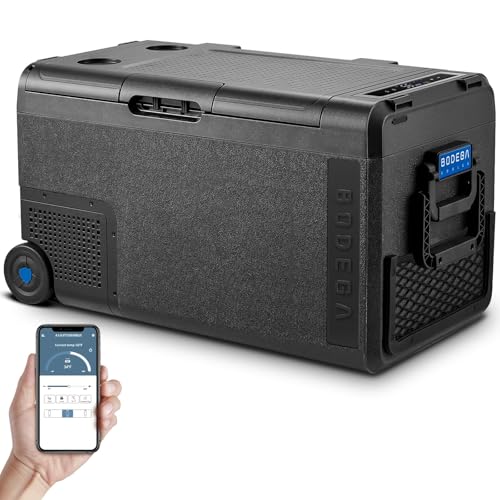
Stopsad 42QT compressor cooler: best for most road trips
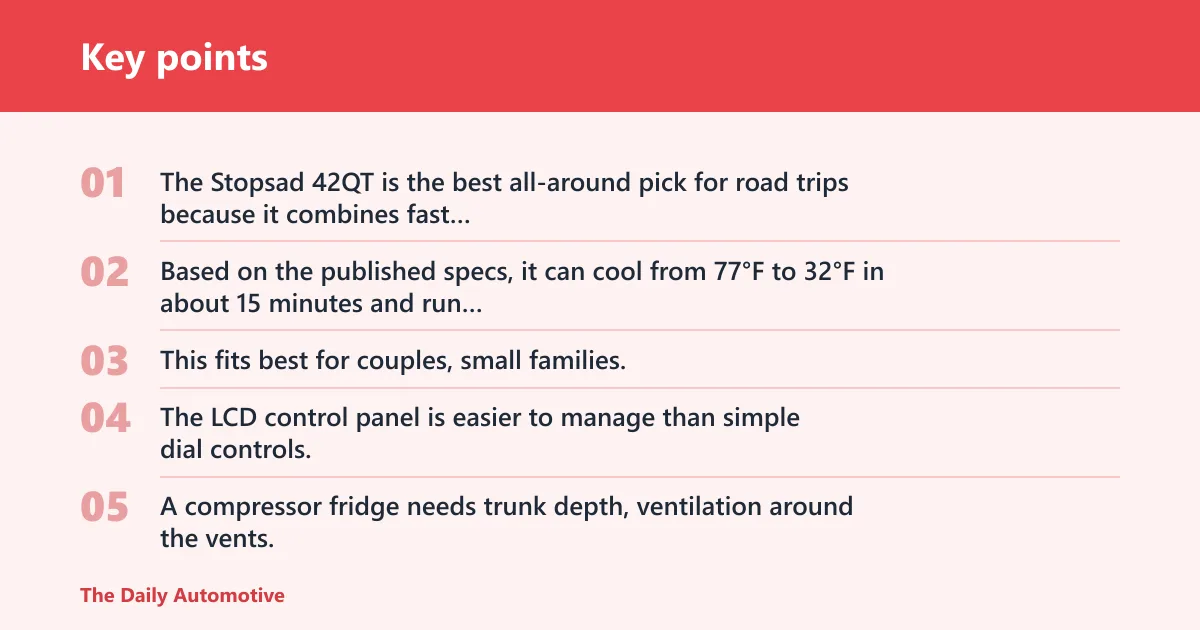
The Stopsad 42QT is the best all-around pick for road trips because it combines fast compressor cooling, dual storage zones, and both vehicle and home power support. Based on the published specs, it can cool from 77°F to 32°F in about 15 minutes and run on 12/24V DC or 110/240V AC, which makes setup easier before departure and during long drives.
This fits best for couples, small families, and travelers who want real refrigerator performance instead of cold-box compromises. The LCD control panel is easier to manage than simple dial controls, and the divider helps separate drinks from food or freezer items.
The tradeoff is size and complexity. A compressor fridge needs trunk depth, ventilation around the vents, and enough power planning to avoid battery anxiety on overnight stops.
Why it leads on convenience
For many drivers, convenience means fewer ice packs, less melting water, and less repacking. A compressor cooler handles that better than a passive cooler because it chills without relying on bagged ice, and it can be used as a fridge or a freezer depending on the trip.
That matters on drives longer than a day. It also matters when passengers want separate access to snacks and drinks without digging through a top-loaded ice chest.
Drawback to weigh
The downside is that it is not the best choice for a tiny trunk or an errand-heavy commute. It is also more setup-sensitive than a soft cooler, because compressor units work best when you leave room for airflow and keep the lid opening limited.
Quick comparison
Use this section to match a cooler to your trip, not to chase the highest cooling number. A smaller unit may be the better buy if it keeps your cargo area usable and your battery worries low.
RIGSTNE 18L thermoelectric cooler-warmer: best for short drives
The RIGSTNE 18L is best for short drives, day trips, and light loads because it plugs into 12V power, weighs only 3.5 lb, and adds a warm mode for food that should stay above room temperature. The manufacturer describes fast cooling in about 20 minutes, which can be useful for snacks, drinks, and lunches that do not need freezer-level performance.
This is the simplest powered option for drivers who want easy lift-in, lift-out use. The water-resistant nylon fabric also makes cleanup less annoying than a hard shell with awkward seams.
Its limit is capacity and cooling strength. Thermoelectric coolers are a poor fit for overnight travel, food safety, or trips where you need to hold a stable refrigerator temperature for many hours.
Where thermoelectric fits best
Choose this type when you want a light plug-in box for a workday, a picnic, or a short family outing. It is especially useful when you only need cold drinks and lunch, not deep chilling.
It is also a better match for drivers who dislike bulky equipment in the cabin. The smaller format makes loading and unloading quicker.
Drawback to weigh: it does not replace
It does not replace a true fridge. If you need ice-cream temperatures, longer hold time, or reliable chilled storage in hot weather, a compressor model is the stronger choice.
Urassaoya 50 can collapsible soft cooler: best for easy carry
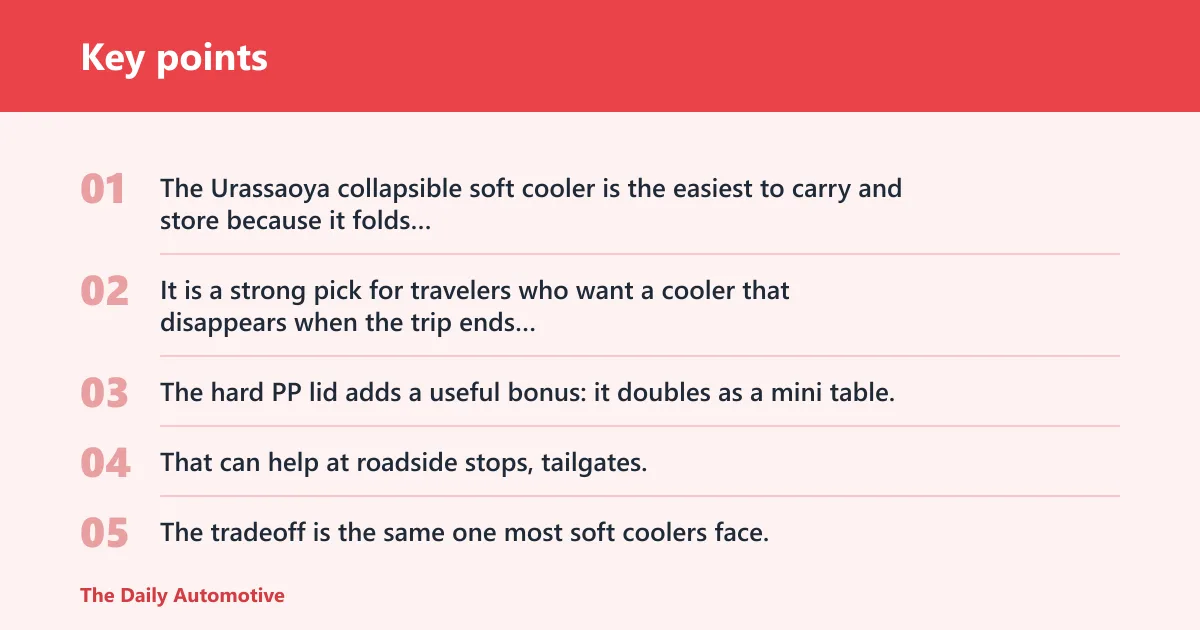
The Urassaoya collapsible soft cooler is the easiest to carry and store because it folds flat to just 6 cm, uses a leakproof insulated body, and has a quick-access top hatch. It is a strong pick for travelers who want a cooler that disappears when the trip ends and does not demand a dedicated cargo-space plan.
The hard PP lid adds a useful bonus: it doubles as a mini table. That can help at roadside stops, tailgates, or campsites where you need a flat surface for food or utensils.
The tradeoff is the same one most soft coolers face. It depends on ice or ice packs, so you give up long-run temperature control in exchange for easier handling and storage.
Why it works in small cars
Soft-sided designs are easier to squeeze into a footwell, narrow hatch area, or seat gap than a rigid powered box. That makes them a practical answer when the trunk is already full of luggage.
They are also less bothersome when you need a cooler just for one day. Fold it down, rinse it out, and stash it away.
Drawback to weigh: the cooler depends
The cooler depends on ice packs, which means you need to plan for meltwater, condensation, and repacking. For food safety on long trips, that extra management becomes the limiting factor.
Start with trip length, then space, then power. A 10QT or 11QT unit can work for a solo commuter, while a 19QT or 23 Quart box suits one or two travelers who want more than lunch storage. A 53QT or 75L model makes more sense for families or multi-day travel, but it will claim serious trunk space.
Capacity is not the whole story. Usable capacity drops once you add bottles, food containers, dividers, and ice packs. A 46-can listing sounds generous, but actual loading shape matters just as much as the number on the box.
Say your sedan trunk is narrow and you travel alone to work five days a week. A 10QT or 11QT cooler may be the most sensible buy because it avoids cargo clutter and keeps lunch within reach. A 53QT fridge would solve the cooling problem and create a storage problem.
Suppose your family takes a Friday-to-Sunday highway trip and you want milk, fruit, and leftovers to stay cold without constant ice replacement. That is a compressor-fridge use case, not a soft-cooler job. The extra power planning pays off because the food stays cold instead of merely cool.
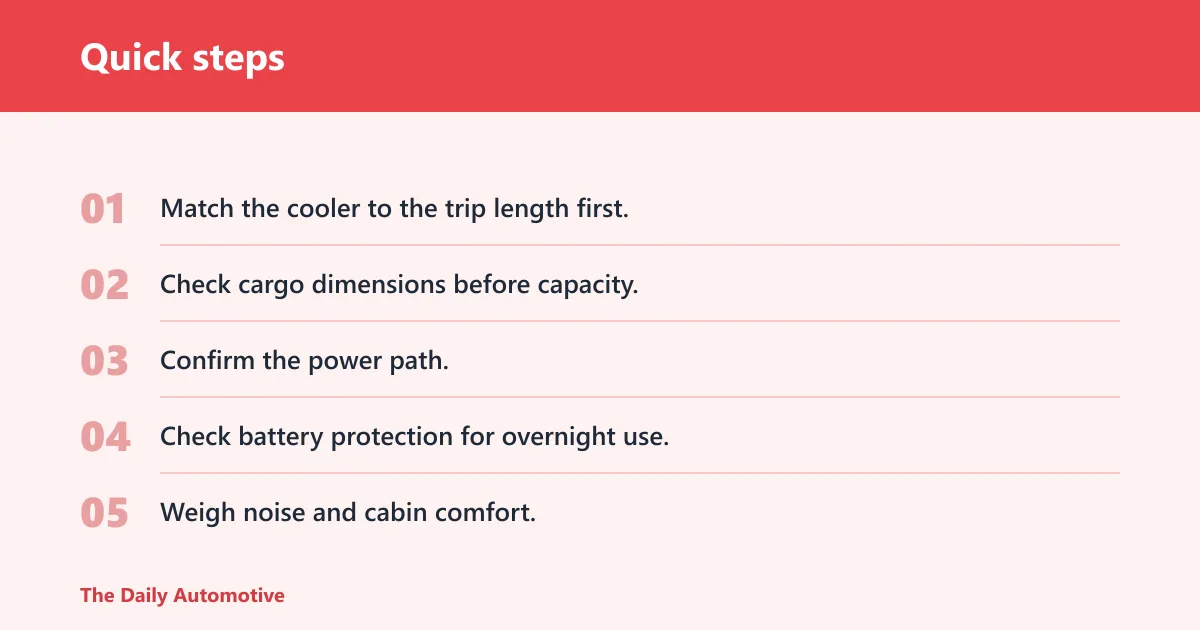
- Match the cooler to the trip length first. Short errands favor soft-sided or thermoelectric models; overnight and multi-day travel favor compressor fridges.
- Check cargo dimensions before capacity. A 53QT box can be awkward in a compact hatchback even if the volume seems right.
- Confirm the power path. Look for 12/24V DC vehicle support, and add 110V or 100-240V AC if you want pre-cooling at home.
- Check battery protection for overnight use. A 3-level battery protection system helps reduce drain risk when the engine is off.
- Weigh noise and cabin comfort. Around 31 dB to 45 dB matters if the cooler sits near sleeping passengers or the back seat.
- Consider cleanup and access. Leakproof linings, a top hatch, baskets, and divider panels change how easy the cooler is to use every day.
Capacity, access, and noise in plain terms
As capacity rises, convenience often falls. Larger boxes are heavier, harder to stow, and more likely to block rear visibility or cargo access. Smaller ones are easier to live with but less useful for family loads.
Noise matters more than many buyers think. A quiet unit around 45 dB is easier to live with in a sleeping cabin than a louder compressor box, but any powered unit still deserves placement where airflow and sound do not become a problem.
Can a car cooler run off a cigarette lighter socket? Yes, many powered coolers are built for that, but the socket must match the unit’s voltage and current needs. A 12V cable is common for vehicle use, while dual-power models add AC support for home pre-cooling and stationary use.
How long does a portable car fridge take to cool down? That depends on the model and starting temperature, but the figures supplied here show fast examples that cool from 77°F to 32°F in about 15 minutes and from 68°F to -4°F in about 15 minutes. For travel, pre-cooling before departure still reduces wait time on the road.
How much power does a portable car fridge use? That varies by compressor size, ambient heat, and duty cycle, so the useful spec is often the compressor rating and battery protection rather than one universal wattage. A 45W compressor is a relatively modest published figure, but runtime still depends on insulation, temperature setting, and whether the vehicle is running.
Compressor car fridge: best for long trips
A compressor car fridge is the best choice for long trips because it cools quickly, can chill to 32°F or below, and works as both a fridge and a freezer. It also makes the most sense when food safety matters, because you are not relying on melting ice to hold temperature.
The Stopsad 42QT is the strongest example in this roundup.
The main drawback is overkill. If you only need a few cold drinks for a two-hour drive, a compressor fridge adds weight, noise, and setup work you may not need.
Battery protection and control features
Battery protection matters most when the cooler stays plugged in after parking. A listed 3-level battery protection system helps reduce the risk of draining the vehicle battery during overnight use or at campsites with weak power habits.
App control or Bluetooth control adds convenience on the road because you can adjust temperature without reaching over luggage or unpacking the cargo area. LCD and touch-screen panels help too, especially when the cooler sits in a tight trunk.
Power, noise, and comfort
Noise levels around 31 dB to 45 dB are quiet enough for many cabins, but even a quiet compressor can feel intrusive if it sits close to sleeping passengers. Placement and ventilation matter as much as the published sound figure.
Keep the unit level, leave space for airflow, and pre-cool it before loading perishable food. That reduces strain and improves daily convenience.
Thermoelectric cooler-warmer: best for short drives
A thermoelectric cooler-warmer is best for short drives because it uses 12V power, can switch between cool and warm modes, and stays light enough to move without effort. It is a sensible choice for lunches, snacks, and drink duty when the trip ends the same day.
The RIGSTNE 18L shows the category well. At 3.5 lb, it is easier to carry than a rigid compressor box, and its water-resistant fabric is simpler to live with when you need a basic plug-in cooler for regular errands.
The drawback is performance ceiling. Small capacity and thermoelectric cooling mean it is not the right tool for long hotel-to-hotel travel or for keeping perishables cold through a hot night.
When it fits better than a fridge
Choose this style when you want lower setup friction than a compressor cooler. It is useful for one person, a couple, or a parent carrying drinks and lunch for a few hours.
It also makes sense when cabin space is scarce and you do not want a heavy box competing with luggage.
Soft-sided cooler: best for easy carry
A soft-sided insulated cooler is best for easy carry because it folds or collapses, depends on ice packs, and usually has the lightest storage burden. It works well when you care more about portability than active temperature control.
The Urassaoya 50 can model is a good example. It collapses flat to just 6 cm, which is useful if you do not want the cooler occupying trunk space after the trip ends.
The drawback is maintenance. Meltwater, refilling, and repeated opening all add friction on long drives, especially when the cabin is hot.
What to watch
Look for a leakproof lining and a lid that opens quickly. A top hatch helps when you want to grab one bottle without dumping the whole load of cold air.
Soft coolers are best when your cooling plan is simple and your timeline is short.
Hard cooler: best for ice retention
A hard cooler is best for ice retention because foam insulation and a durable shell hold up well against repeated use. It can also double as a seat, which is useful at campsites or roadside stops where every flat surface counts.
The tradeoff is bulk. Hard coolers are heavier than soft-sided bags and usually take more room in the trunk, even when empty.
That makes them a poor fit for drivers who want the coolest option with the least cargo clutter. They are better when you already have room and want passive cooling without a power setup.
Who should skip it?
If you have a small car or want one-handed carry, a hard cooler is usually the least convenient path. It makes more sense for beach trips, tailgates, and camping stops than for tight city parking and quick errands.
Which one should you buy?
Buy a compressor car fridge if your trip lasts more than a day, your food needs stay cold, or you want AC pre-cooling at home. Buy a thermoelectric unit if you want a lighter powered cooler for day trips and warm-mode support. Buy a soft cooler if you want the easiest carry and the least storage burden. Buy a hard cooler if ice retention matters more than power or compact storage.
For solo travelers and commuters, a 10QT, 11QT, or 19QT unit is usually enough. For couples and weekend road trips, a 23 Quart or 18L plug-in cooler can work if the load is light, but a 42QT compressor box gives you more flexibility. For families, RV travelers, and people carrying perishable food, the 53QT and 75L class is the better fit if the vehicle can spare the space.
Which car cooler is best for a small car or tight trunk? A compact soft cooler or a compact powered model is usually the safest choice. A 53QT or 75L box may be excellent on paper, but a cramped hatchback can make that size annoying every time you load groceries or luggage.
What is the quietest car cooler for travel? A quiet powered cooler around 45 dB is the clearest published figure in this roundup, and quieter operation matters most in a sleeping cabin or a small vehicle. If cabin noise is a priority, keep the cooler away from the front seats and avoid opening it repeatedly.
What features matter most in a travel cooler for convenience? Dual power support, battery protection, clear controls, and easy-clean materials matter most. Wheels, pull handles, shoulder straps, collapsible bodies, baskets, and divider panels all affect how often you will actually want to use the cooler instead of leaving it in the garage.
Frequently asked questions
What is the best car cooler for road trips?
The best car cooler for road trips is usually a compressor fridge because it cools fast, handles longer drives, and keeps perishables safer than ice-only options. For most travelers, the best size is still the one that fits the cargo area without blocking bags, visibility, or rear-seat access.
Do I need a powered car cooler or an insulated cooler?
Choose a powered cooler if the trip is long, the food needs refrigeration, or you want to avoid melting ice. Choose an insulated cooler if the trip is short, the load is light, and you want the easiest setup with the least battery planning.
How big should a car cooler be for a family road trip?
For a family road trip, a 53QT or 75L cooler is often the practical range because it leaves room for drinks, snacks, and a few meals. Smaller units can work, but they fill fast once you add bottles, containers, and ice packs.
Can a car cooler run off a cigarette lighter socket?
Many can, as long as the cooler is designed for 12V vehicle use and the socket can supply the needed power. Check the maker’s voltage support before you buy, and do not assume every plug-in cooler is safe for every car socket.
How long does a portable car fridge take to cool down?
It depends on the model and starting temperature, but fast examples in this roundup reach their target in about 15 minutes. Pre-cooling at home still helps, especially if you want the fridge ready the moment you leave.
Are compressor car coolers worth it for travel?
Yes, if you drive long distances, camp overnight, or need dependable cold storage without ice. They are less worth it for short errands or tiny cars, where the extra size, noise, and power planning can outweigh the benefit.
Products related to this article
Sponsored / affiliate links. As an Amazon Associate I earn from qualifying purchases. I may earn additional commission from eligible campaigns.