Best Led Headlights for Your Car (3 Real Picks Compared)
The best LED headlights for your car match the housing: choose beam control first, fit second, and price last, with three standouts for those priorities below. Bad LED swaps can throw glare, shorten useful reach, and still leave you with dim shoulders and dark cutoffs. This guide compares three real aftermarket LED bulb picks by beam safety, install ease, and value so you can choose the right one for your headlight type.
Which LED headlight bulb fits your car?
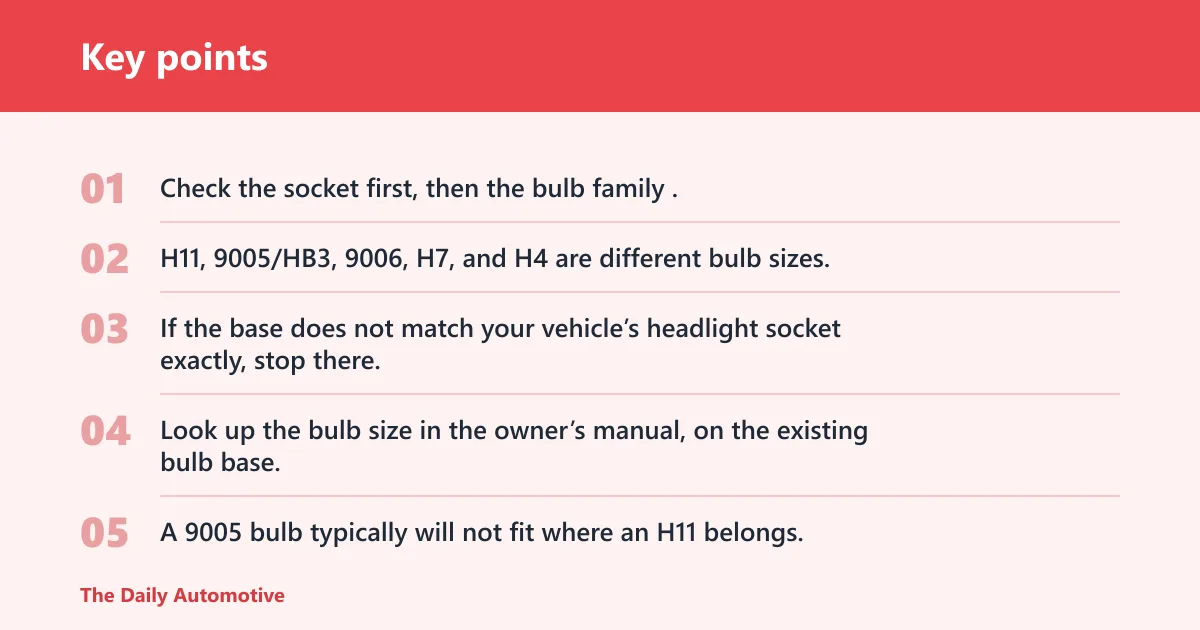


Check the socket first, then the bulb family. H11, 9005/HB3, 9006, H7, and H4 are different bulb sizes, and they are generally not interchangeable just because they look similar in photos. If the base does not match your vehicle’s headlight socket exactly, stop there.
Match the socket size first
Look up the bulb size in the owner’s manual, on the existing bulb base, or in a parts catalog tied to your exact year, make, model, and trim. A 9005 bulb typically will not fit where an H11 belongs, and H4 is a separate dual-beam design rather than a drop-in match for H7 or 9006.
Check rear depth and dust cover space
Fitment fails most often at the back of the lamp. Measure from the bulb mounting surface to the dust cover or rear cap, then compare that space with the LED’s body, fan, heat sink, and driver box. If the cover will not close, the bulb is the wrong shape for that housing even if the base fits.
Confirm CANbus and DRL behavior
Some cars monitor bulb current, check for failures, or dim daytime running lights with a reduced-voltage signal. That is where CANbus or a smart IC driver matters. Without it, you may get bulb-out warnings, flicker, radio interference, or a DRL that behaves differently from the halogen bulb it replaces.
LED headlight bulbs compared
These three picks serve different buyers. One leans toward safer beam control, one toward easier fit and broad compatibility claims, and one toward value in a common high-beam socket. The right choice depends on your housing, not on the biggest lumen number printed on a box.
| Pick | Bulb size | Housing fit risk | Glare risk | Cooling style | CANbus compatibility | Installation difficulty | Best-use scenario | Choose this if… |
|---|---|---|---|---|---|---|---|---|
| Morimoto 2Stroke 4.0 | Varies by application | Medium; check depth and cap clearance | Lowest of the three when beam control matters most | Active cooling design | Depends on vehicle; verify before buying | Moderate | Reflector or projector housings where glare control is the priority | Choose this if you want the safest beam behavior and can spend more for a better-controlled retrofit. |
| Sealight H11/H8/H9 | H11 / H8 / H9 | Lower for many applications; claims 99% housing and factory socket compatibility | Moderate; still verify pattern in your housing | Cooling design not specified here | Check your vehicle’s monitoring system and DRL dimming needs | Easy to moderate | Drivers who want broad fitment coverage in H11-family applications | Choose this if your car uses H11, H8, or H9 and you want an easier fitment path with a long claimed service life. |
| Nilight 9005 | 9005 / HB3 | Medium; 9005/HB3 fitment still needs depth and cap checks | Moderate to higher in a reflector housing if beam alignment is poor | Cooling style not specified here | Verify before install, especially in monitored or dimmed circuits | Easy if the socket and space are friendly | High-beam swaps and value-focused upgrades in 9005 applications | Choose this if your vehicle uses 9005/HB3 and you want a lower-cost high-beam upgrade with a straightforward install target. |
Morimoto 2Stroke 4.0
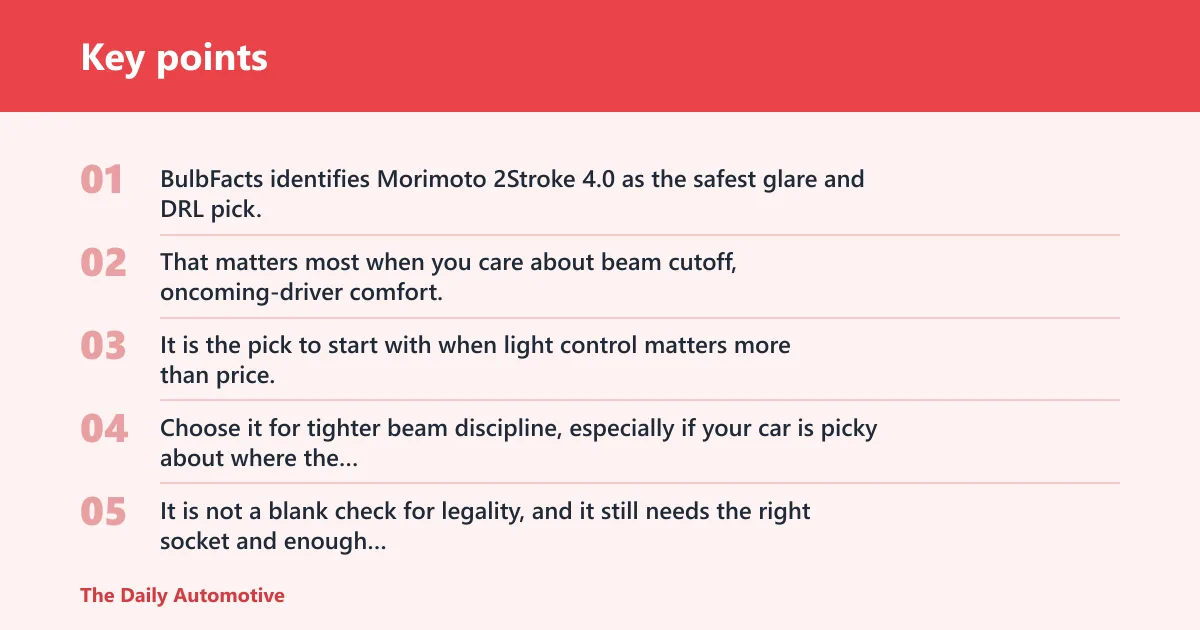
BulbFacts identifies Morimoto 2Stroke 4.0 as the safest glare and DRL pick. That matters most when you care about beam cutoff, oncoming-driver comfort, and a cleaner pattern in a housing that is sensitive to bulb position. It is the pick to start with when light control matters more than price.
Choose it for tighter beam discipline, especially if your car is picky about where the LEDs sit inside the reflector bowl or projector shield. It is not a blank check for legality, and it still needs the right socket and enough rear room.
Sealight H11/H8/H9
Sealight H11/H8/H9 bulbs claim 6 times illumination, compatibility with 99% of vehicle housings and factory sockets, and a lifespan of over 80,000 hours. Sealight also includes a DOT-related approval claim tied to FMVSS No.108. Treat that carefully: a marketing claim is not the same as a universal street-use approval for every lamp, vehicle, or jurisdiction.
This is the broad-fit option in the group. It makes sense when your car uses an H11-family socket and you want an easier purchase decision, but you should still verify depth, dust cover clearance, and whether the car uses CANbus checks or DRL dimming.
Nilight 9005
Nilight says its 9005 bulbs deliver a 400% brightness boost over standard halogen, use 6500K cool white light, and offer a 10-minute installation. That makes it the value-forward high-beam pick here, especially for drivers who want a brighter 9005/HB3 replacement without paying for a premium beam-control package.
Use it where a 9005 socket is already confirmed and the housing has enough room for the bulb body and any cooling hardware. In a reflector housing, glare control becomes the deciding factor, not the marketing number on the box.
How do projector and reflector housings change the result?
Reflector and projector housings behave differently. Reflectors are more sensitive to LED bulb shape and filament-emulation accuracy, so glare risk rises quickly if the emitter position is off. Projectors can control beam better, but only when the bulb aligns with the optics and the lamp was designed, or at least responds well, to the LED retrofit.
Why reflector housings need stricter glare control
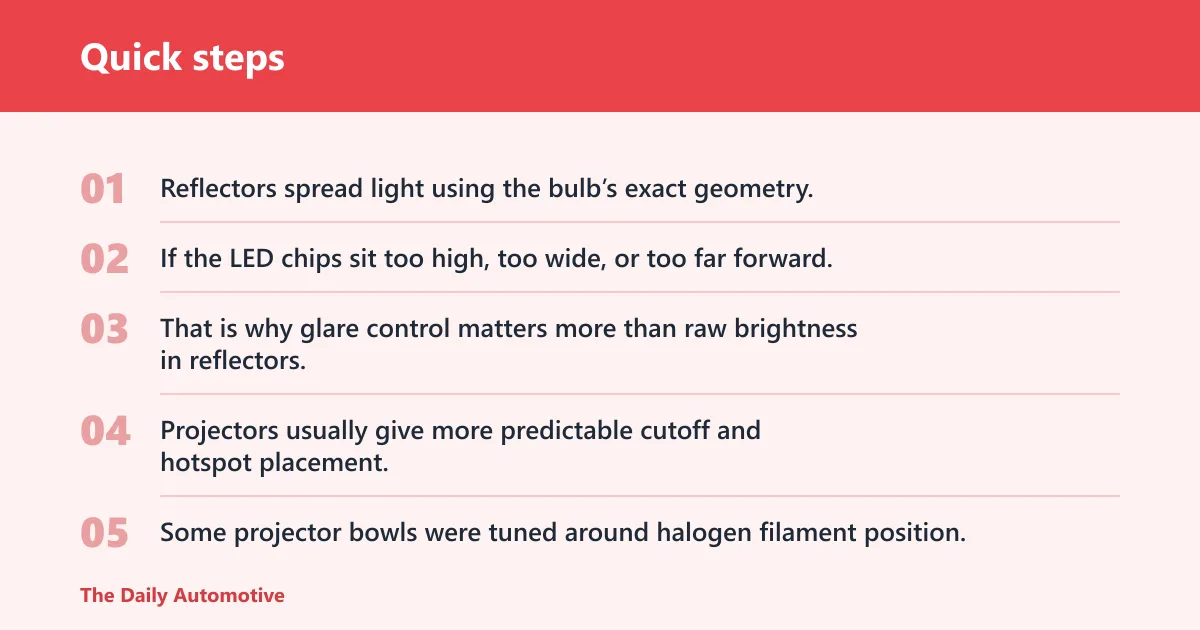
Reflectors spread light using the bulb’s exact geometry. If the LED chips sit too high, too wide, or too far forward, the beam can splash into the eyes of other drivers while still failing to put light where the road needs it. That is why glare control matters more than raw brightness in reflectors.
Why projector housings still need careful matching
Projectors usually give more predictable cutoff and hotspot placement, but they are not automatic winners. Some projector bowls were tuned around halogen filament position, and an LED that does not mimic that placement can produce uneven cutoff, foreground spill, or a weak high-beam hotspot.
Picture a 2017 sedan with H11 low beams in a reflector housing. A brighter LED may seem like an easy upgrade, but if the cutoff turns fuzzy and the right shoulder goes dim, the driver gets more glare and less useful seeing distance. The better fix is a bulb with better beam control, not a larger lumen claim.
What matters most: beam, glare, or fit?
Beam pattern comes first for night safety. You want usable reach, a clean cutoff where the lamp should have one, and enough side spread to see signs and lane edges. If the bulb is bright but throws light in the wrong places, the upgrade is poor in real use.
Glare control for other drivers
Glare risk rises in reflector housings, in poorly matched projectors, and with bulbs that place the LED chips incorrectly. If you drive in traffic, choose the bulb that keeps the cutoff calm and the hotspot in the right spot, even if it is not the brightest on paper.
Physical clearance around the bulb
Heat sinks, fans, and external drivers can make a bulb impossible to install behind a sealed cap. Dust covers, harness clips, and headlamp access openings matter as much as socket type. If the lamp has a shallow rear cavity, a compact passive design often fits better than a bulky active-cooling setup.
A common first-timer mistake is buying a high-output 9005 bulb for a sealed reflector housing and then discovering the fan hits the dust cover. The socket is right, but the lamp will not close. That is a fitment failure, not a bulb-quality problem.
Which LED headlights are easiest to install?
The easiest bulbs are the ones that match the socket, lock into place cleanly, and do not require extra harness work. Plug shape, locking tabs, driver box size, and rear clearance decide the install more than the brand name does. If your car has no bulb monitoring, the job is usually simpler.
Plug shape and locking tabs
Some bulbs twist in like the halogen bulb they replace. Others need the adapter indexed just right before the bulb locks. If the tabs do not line up or the base sits crooked, beam aim changes and the headlamp can leak glare upward.
External drivers, fans, and heat sinks
External driver boxes can be easier to place than a bulky bulb body, but they add another component to secure. Fans can make the bulb longer and can collect dust. Passive heat sinks are quieter and may suit tight spaces better, but they still need room.
CANbus and DRL dimming checks
Before you button up the lamp, turn the headlights on, the high beams on, and the DRLs on if the car has them. Watch for flicker, warning messages, radio noise, or a bulb that lights but dims oddly. If any of that happens, the vehicle may want a CANbus-compatible bulb or an additional decoder.
Street use and legality basics
Aftermarket LED replacement bulbs are often a legal gray area in the U.S. for many halogen headlamp housings. FMVSS No. 108 is the reference standard for vehicle lighting, but that does not mean every LED retrofit bulb is a straightforward DOT-approved swap. Treat blanket approval claims with caution.
What to expect from aftermarket LED claims
Some brands use DOT language or FMVSS references in marketing. That is not the same as a universal statement that the bulb is legal in every housing. If the lamp was not designed, tested, or certified around that exact LED source, do not assume road legality from the box copy alone.
When to treat a bulb as off-road only
If the beam is badly scattered, the housing has obvious glare, or the product instructions limit use to vehicles or housings that meet specific conditions, treat it as a poor street candidate. Auxiliary lights, fog lamps, and off-road use have different rules than main headlamps, and they should not be mixed up.
Choose Morimoto 2Stroke 4.0 if…
Choose Morimoto 2Stroke 4.0 if your main goal is beam control in a housing that punishes sloppy retrofits. It is also the safer starting point if you care most about glare reduction and DRL behavior. Pick it when price is secondary to a cleaner optical result.
Choose Sealight H11/H8/H9 if…
Choose Sealight H11/H8/H9 if your car uses H11, H8, or H9 and you want a broad-compatibility pick with a long claimed lifespan. It suits buyers who want an easier fit path and a lower-risk purchase in the H11 family, provided the housing, dust cover, and electronics checks all pass.
Choose Nilight 9005 if…
Choose Nilight 9005 if you need a 9005/HB3 bulb for a high-beam swap, want a value-focused upgrade, and have enough rear space for the bulb hardware. It makes the most sense when the socket is confirmed, the housing can accept the cooling design, and you are willing to verify beam aim after install.
Frequently asked questions
What are the best LED headlights for my car?
The best LED headlights for your car are the ones that match your socket, fit your housing, and keep glare under control. For this comparison, Morimoto 2Stroke 4.0 is the safest beam pick, Sealight H11/H8/H9 is the easiest broad-fit choice, and Nilight 9005 is the value option for 9005/HB3 applications.
Which LED headlight bulbs are brightest without too much glare?
The brightest safe choice is not the one with the biggest lumen claim. It is the bulb that keeps the cutoff clean and the hotspot where the housing expects it. In reflector lamps, the safer answer is usually the bulb with better beam control, not the one advertising the biggest boost.
What size LED headlight bulb does my car use?
Your car uses the bulb size listed for that exact trim and headlamp function. Verify the socket before you buy, because a close-looking base is not the same as a correct fit.
Are LED headlight bulbs legal for street use?
Sometimes, but not by default. FMVSS No. 108 is the key U.S. lighting standard, yet aftermarket LED replacement bulbs are not automatically legal in every halogen housing. Treat street-use claims carefully, and do not assume a marketing reference to DOT or FMVSS means universal approval.
Which LED bulb works best in reflector housings?
The best bulb for a reflector housing is the one with the most disciplined beam pattern and the least stray glare. BulbFacts lists DDM Tuning Saber Max 75W as the strongest reflector output recommendation and Fahren Termitor as a budget reflector option, while Morimoto 2Stroke 4.0 is positioned as the safest glare pick.
How long do LED headlight bulbs last?
Longevity depends on heat control, driver quality, and how often you drive at night. Sealight claims a lifespan of over 80,000 hours, but real-world service still depends on fit, ventilation, and electrical compatibility. A poorly cooled bulb can fail sooner than a simpler design that fits correctly.
Products related to this article
Sponsored / affiliate links. As an Amazon Associate I earn from qualifying purchases. I may earn additional commission from eligible campaigns.